
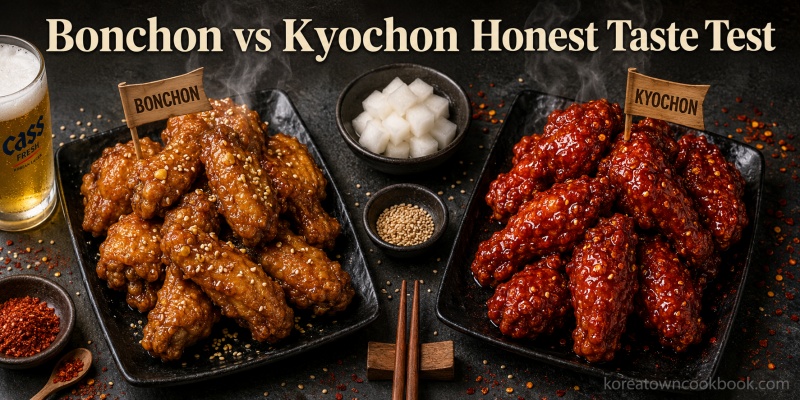
The Bonchon vs Kyochon debate comes down to this: Kyochon wins on pure chicken (crispier skin, more refined sauce), while Bonchon wins on overall meal experience (bigger menu, better sides, easier to find). After eating both in one sitting, here’s what I learned.
Here’s what I’ll cover in this honest Bonchon vs Kyochon taste test:
- The exact crunch and skin texture difference
- How the soy garlic, spicy, and honey sauces actually stack up
- Which chain has the better menu beyond chicken
- Price, portion size, and wait times compared
- My final pick (and when I’d order the loser instead)
Okay, real talk for a second. I’ve been chasing the perfect Korean fried chicken for years now. I’d eaten at both Bonchon and Kyochon plenty of times separately, but I’d never actually sat down and tasted them back to back, on the same day, with the same hunger level. That felt like cheating myself out of a real answer. So this past September, I finally did it. Same lunch. Same drive. Two takeout bags. One overstuffed kitchen table. Let me walk you through what actually happened.
Table of Contents
The Setup: How I Ran This Taste Test
I wanted this to be fair, so I gave myself a rule. Order the most similar things from both places. That meant wings, drumsticks, and one signature sauce from each. I also ordered each chain’s most famous flavor, because skipping those would’ve been pointless.
From Bonchon, I grabbed:
- 6 wings in Soy Garlic
- 6 drumsticks in Spicy
- A side of pickled radish (the freebie)
- Bulgogi Fries (because I love them)
From Kyochon, I grabbed:
- 6 Soy Garlic wings
- 6 Red (Hot) wings
- 6 Honey wings (their signature)
- Pickled radish on the side
I drove home, plated both immediately, and started eating while everything was still hot. No reheating. No favoritism. Just me, a stack of napkins, and a real appetite.
A Quick Backstory on Both Chains
Before I get into the food, you should know what you’re dealing with.
Kyochon is the OG. It started in 1991 in Gumi, South Korea, and a lot of people credit Kyochon with popularizing the double-fry technique that gives Korean fried chicken that supernaturally crispy skin. Their menu is tight and focused. It’s mostly chicken in five or six signature sauces (Soy Garlic, Red, Honey, 5-Spices, Yangnyum, and a newer Kyochon Fried option), with a few rice bowls and fries on the side. South Koreans consistently rank Kyochon as their favorite domestic chicken brand.
Bonchon launched in Busan in 2002 and rode the Korean fried chicken wave into the American market hard. It’s now everywhere. You’ll find Bonchon in malls, strip plazas, and downtown food courts across the US. Their menu is way bigger than Kyochon’s. You get wings, boneless, strips, plus bulgogi, bibimbap, japchae, dumplings, Korean tacos, sliders, bao buns, and loaded fries. The sauce lineup as of 2026 is Soy Garlic, Spicy, Korean BBQ, Yangnyeom, and Classic Crunch.
Now to the actual food.
Bonchon vs Kyochon Honest Taste Test: Round by Round Breakdown
I broke this comparison into the things that actually matter when you’re eating fried chicken: crunch, sauce, meat juiciness, menu variety, sides, price, and service. Here’s how each round shook out.
Round 1: The Crunch Factor
This is the round everybody cares about, so I’ll lead with it.
Kyochon’s skin is thinner, drier, and crackles audibly when you bite into it. There’s almost a glass-like snap. I’ve read that this is because of how they double-fry and let the wings rest between fries, and you can taste the technique. Even after the sauce sits on the skin for 10 to 15 minutes, the crunch holds. That’s wild.
Bonchon’s batter is a touch thicker. It still crunches, but it’s a heartier, more substantial crunch (closer to a really good American buttermilk fried chicken). The downside is that when sauce sits on it for too long, parts of the coating get a little soft. The honest truth? Both are crispier than literally any non-Korean fried chicken I’ve ever eaten in the States. But head to head, Kyochon’s skin felt more delicate and engineered. Bonchon’s felt more rustic.
Round 1 winner: Kyochon, by a nose.
Round 2: Soy Garlic Showdown
Soy garlic is the litmus test sauce. If a Korean fried chicken spot can’t nail soy garlic, nothing else matters.
Bonchon’s soy garlic is balanced and crowd-pleasing. It’s salty, sweet, garlicky, and clean. I’d give it to anyone, including my mom who hates anything too “ethnic-tasting.” It’s a comfort sauce. You taste the sauce first, then the chicken, then a long savory finish.
Kyochon’s soy garlic is more aggressive. It’s sharper, more pungent, and tastes like they didn’t hold back on the actual garlic. I was tasting it for hours afterward, which a lot of reviewers have flagged too. Some people will love that. Some won’t. The depth of flavor is undeniable though. It hits with more umami punch.
Round 2 winner: Tie, depending on your palate. Bonchon if you want approachable. Kyochon if you want unapologetic.
Round 3: Spicy / Red Hot Wings
Bonchon’s Spicy sauce is sweet-heat. There’s a clear gochujang base, you get some warmth at the back of the throat, but it never really crosses into “I need water” territory. It’s the kind of spicy your spice-averse cousin can handle.
Kyochon’s Red (Hot) is a different animal. It glows almost neon orange, it’s thicker, it’s stickier, and it builds. The first bite seems fine. The third bite is making me sweat. By the sixth bite, my lips are tingling. It’s not painful, but it’s real heat, and it carries actual flavor (you can taste the pepper, not just the burn).
Round 3 winner: Kyochon, if you actually like spicy food. Bonchon, if you want spicy as a flavor note, not a dare.
Round 4: The Honey Series (Kyochon’s Secret Weapon)
I have to be honest here. This isn’t a fair round, because Bonchon doesn’t really have a direct competitor to Kyochon’s Honey wings. Bonchon’s Korean BBQ and Yangnyeom skew sweet, but they’re not in the same lane.
Kyochon’s Honey wings are sticky, sweet, garlicky, and unreal. They’re basically the Korean honey-butter version of a wing, and they’re a permanent best-seller in Korea (Koreans literally call the honey combo “Honey Combo” and it has its own cult following). If you’ve never tried them, you should. I dipped one in their cream cheese sauce on the side, and I almost forgot the rest of the meal existed.
Round 4 winner: Kyochon, no contest.
Round 5: Meat Quality and Juiciness
Both chains use smaller pieces of chicken (which is normal for Korean fried chicken because the smaller size means more surface area for that crispy skin).
Bonchon’s wings were juicy, but I noticed a couple of pieces had slightly less meat than I expected. Drumsticks were great, no complaints.
Kyochon’s wings felt a touch smaller but more consistently moist. The meat had a cleaner chicken flavor that wasn’t fighting the sauce as much.
Round 5 winner: Slight edge to Kyochon.
Round 6: Menu Variety Beyond Chicken
This is where Bonchon takes a clean win.
Bonchon’s menu in 2026 is huge. You can build a full Korean-American meal there without ever ordering chicken. The Bulgogi Fries are loaded with marinated ribeye, mozzarella, scallions, and spicy mayo, and they’re one of my favorite things on any Korean menu in America. Add in the pork belly bao buns, the Japchae glass noodles, the dumplings, the bibimbap, and the chicken sandwich, and you’ve got something for the whole table. If you’re going with a group that has different tastes, Bonchon is the easy call.
Kyochon’s menu is intentionally simple. It’s wings, boneless strips (called Sal Sal Strips), chicken pop, a few rice bowls, fries, and a salad or two. That’s basically it. The focus is the chicken. Which is fine if you came for chicken. But it’s a no-go if your friend doesn’t eat chicken.
Round 6 winner: Bonchon, by a wide margin.
Round 7: Sides and Extras
Both chains hand you pickled daikon radish for free, which is the perfect palate cleanser. Bonchon also offers complimentary coleslaw, which I appreciate.
Bonchon’s seasoned fries, Korean street corn, and bulgogi fries are stronger than anything Kyochon offers on the side.
Kyochon’s truffle-shaken fries are surprisingly good though, and their honey garlic dipping sauce is something I’d buy in a bottle if they sold it. Their cream cheese dip for the boneless strips is also addictive.
Round 7 winner: Bonchon, but Kyochon’s dipping sauces are sneaky strong.
Round 8: Price and Portion Size
This one matters more than people admit.
Kyochon tends to run pricier per piece. A regular order of wings (around 8 pieces) usually lands in the $19 to $22 range depending on location, and a whole chicken is $22 to $25. The portions feel a little tighter (wings are not huge).
Bonchon is similarly priced but tends to offer more value combos, lunch specials, and group platters like the Seoul Sampler ($33.99 for wings, drumsticks, dumplings, fries, corn, and slaw). For feeding more than two people, Bonchon usually comes out cheaper per person.
Round 8 winner: Bonchon, especially for groups.
Round 9: Service, Wait Times, and Atmosphere
Honest answer here. Both chains can have brutal wait times because the chicken is fried to order. That’s not a bug. It’s the point. You should expect 20 to 30 minutes either way.
Kyochon locations vary wildly. Some are dine-in with table service. Some are food-court style. Some have call-boxes at the table. Vibe is hit or miss.
Bonchon locations are more consistent. Most are sit-down with table service, full bar, and a more lounge-y feel. They’re more “date night” friendly than Kyochon.
Round 9 winner: Bonchon, mostly because it’s more predictable.
So Who Actually Wins?
Tallying it up, here’s where I landed after eating both back to back.
Order Kyochon if:
- You’re chasing the absolute crispiest skin
- You want their Honey wings (they have no real rival)
- You want real spice, not sweet-spice
- You’re going alone or with one other person who also loves chicken
Order Bonchon if:
- You’re feeding a group with different tastes
- You want a fuller Korean meal (rice, noodles, bao, tacos, fries)
- You want easier access (Bonchon has way more US locations)
- You want sit-down vibes and a real beer list
- You’re price-conscious for a group order
If I had to pick one for a single solo dinner where I’m eating only chicken? Kyochon. Their skin and their Honey wings push them over the edge.
If I had to pick one to take my family of four to on a Friday night? Bonchon. Every time. The menu variety is just too useful to ignore.
There’s no losing pick here. This is a “great vs greater” situation, not a “good vs bad” one. Both chains do Korean fried chicken at a level that almost no American fast-casual concept can touch.
Pro Tips Before You Order
A few things I wish someone had told me earlier:
- Always go half and half on sauces. Both chains let you split the order. Don’t commit to one flavor on your first visit. Get half soy garlic and half spicy (or half honey at Kyochon).
- Eat it within 20 minutes. Korean fried chicken’s whole identity is the crispy skin. Letting it sit kills the magic. Even reheating in the oven doesn’t fully save it.
- Order pickled radish even if it’s not free. Trust me. It cuts the richness perfectly and resets your palate between bites.
- Drink something cold and slightly sweet. A light Korean beer, a Hite, a soda, or even an iced barley tea all pair better than water.
- Skip boneless on your first visit. The skin is the star, and boneless versions have a different (still good, but different) texture and skin-to-meat ratio.
- At Kyochon, get the Honey wings even if you don’t think you want sweet chicken. Just trust me on this one.
- At Bonchon, get the Bulgogi Fries as your side instead of regular fries. Worth every calorie.
Related Reading From Koreatown Cookbook
If you liked this comparison, you’ll probably want to check out:
- Best Korean fried chicken sauces ranked
- How to make Korean fried chicken at home (with the double-fry method)
- Bonchon menu ranked from worst to best
- Kyochon copycat recipe for their soy garlic wings
- The history of Korean fried chicken in America
- Bibimbap vs Japchae: which one should you order
Bookmark this page if you want to come back for the 2026 update, because Bonchon has been rolling out new sauces (the Yangnyeom return, the Korean BBQ launch) and Kyochon keeps quietly adding regional menu items I want to revisit.
Frequently Asked Questions
Is Bonchon or Kyochon more authentic Korean fried chicken?
Both are authentic Korean chains, but Kyochon has a stronger claim to authenticity because it started in South Korea in 1991 and is often credited with popularizing the double-fry technique that defines modern Korean fried chicken. Bonchon launched in 2002 and has Americanized its menu more aggressively with items like Korean tacos and bulgogi fries. If you’re judging this Bonchon vs Kyochon debate purely on Korean authenticity, Kyochon edges it out.
Which has the crispier chicken, Bonchon or Kyochon?
Kyochon’s skin is generally crispier and thinner, with that signature glass-like snap that holds up even after the sauce sits on it. Bonchon’s batter is slightly thicker, which gives a heartier crunch but can soften faster once sauced. Both are dramatically crispier than American-style fried chicken.
Is Kyochon more expensive than Bonchon?
In most US cities, Kyochon comes in slightly pricier per piece, especially on whole-chicken orders and signature combos. Bonchon offers more value-driven combos and group sampler platters, which usually makes it cheaper for parties of three or more. For a solo lunch, the price difference is usually a few dollars.
What is the most famous flavor at Kyochon?
The Honey series (Honey wings, Honey drumsticks, and the Honey Combo) is Kyochon’s most famous flavor worldwide. It’s sticky, sweet, garlicky, and has a cult following in South Korea, where Koreans call it the “Honey Combo.” Bonchon doesn’t have a direct match for it.
What is the best flavor to order at Bonchon?
Soy Garlic is the best entry-level Bonchon flavor and their most-ordered sauce. It’s balanced, salty-sweet, and not too aggressive. If you want heat, go Spicy. If you want something newer, the Korean BBQ (launched in 2024) and the returning Yangnyeom are both worth trying.
Can you order half and half sauces at both chains?
Yes, both Bonchon and Kyochon let you split your order between two sauces, which is the smartest way to try the menu without committing. I always recommend half soy garlic and half spicy (or half honey at Kyochon) on a first visit.
Why does Korean fried chicken cost more than American fried chicken?
Korean fried chicken is double-fried, hand-battered, and brushed with sauce to order, which takes more time and skill than standard fried chicken. The pieces are also smaller, which means more surface area and more handling per pound. Both Bonchon and Kyochon also use higher-end sauces with imported Korean ingredients.
Is there a vegetarian option at Bonchon or Kyochon?
Bonchon has more vegetarian-friendly options including vegetable potstickers, bibimbap (you can skip the meat), Korean street corn, and the fries. Kyochon’s menu is much more chicken-focused with fewer non-meat options, although their fries and salads are vegetarian.
Final Verdict
After running this full Bonchon vs Kyochon honest taste test, I’m calling it like I see it. Kyochon wins on pure chicken excellence (crispier skin, signature Honey wings, real heat in the Red sauce). Bonchon wins on overall experience (bigger menu, better sides, more locations, friendlier for groups). Neither one loses. They just win in different lanes.
If you have a Kyochon nearby, go at least once for the Honey Combo. It’s a Korean fried chicken experience you genuinely can’t replicate anywhere else in the US.
If your default is Bonchon (because honestly, it’s the one most of us have closer to home), you’re not missing out on much. Their Soy Garlic wings and Bulgogi Fries combo is still one of the best fast-casual meals in America in 2026.
Save this page, bookmark it, and come back when Bonchon or Kyochon launches a new sauce, because I’ll be updating this taste test every few months as both menus evolve. And if you want to recreate either of these at home, head over to the homepage for the full Korean fried chicken recipe guide. It’s the closest thing to skipping the line.