
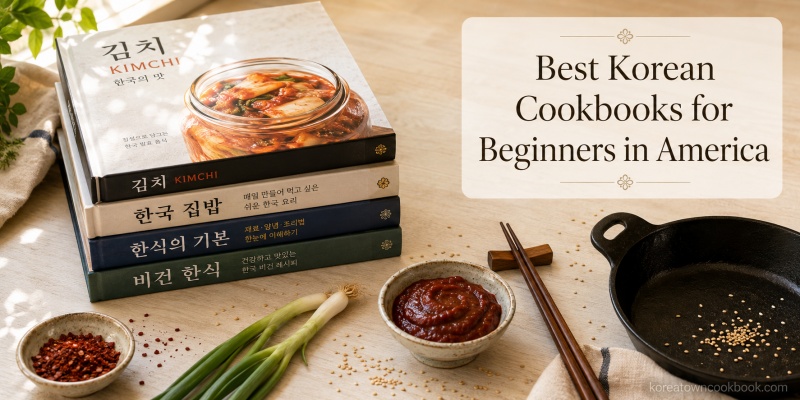
The best Korean cookbooks for beginners in America are ones that explain Korean pantry basics in plain English, use ingredients you can actually find at H Mart or Amazon, and don’t assume you grew up eating banchan. My top pick is Maangchi’s Real Korean Cooking, followed by Simply Korean by Aaron Huh and Cook Korean! by Robin Ha.
Here’s what I’ll cover in this guide:
- My 11 favorite Korean cookbooks ranked for total beginners
- Which book is best for K-drama fans, BBQ lovers, and busy weeknight cooks
- The pantry staples every Korean cookbook will ask you to buy
- Honest pros and cons for each pick (no fluff)
- Where to buy them in the U.S. and what they actually cost
Okay, real talk for a second. When I first got curious about Korean cooking, I bought three random cookbooks off Amazon, hauled home a bag of mystery sauces from H Mart, and proceeded to make the saddest, most under-seasoned bibimbap of my life. The rice was crunchy. The gochujang was the wrong kind. I cried a little. So I get it. Picking the right cookbook isn’t just about pretty pictures, it’s about finding a book that walks you through the weird stuff without making you feel dumb. That’s exactly what I’m helping you do today.
Table of Contents
Why Beginners in America Need a Different Kind of Korean Cookbook
Here’s the thing nobody tells you. A lot of Korean cookbooks are written for people who already know what doenjang smells like or how to score squid for stir-fry. If you grew up in Ohio or Texas or anywhere outside a major Koreatown, you need a book that holds your hand a bit.
The best Korean cookbooks for beginners in America do three things really well. They tell you where to buy the ingredients (or what to swap them with). They explain why a dish tastes the way it does, not just how. And they keep the technique list short enough that you don’t burn out on day two.
I bought, borrowed, and cooked from every book on this list. Some I kept on my counter for months. A few got donated to my library’s used book sale. I’m going to be honest about both.
My Top 11 Best Korean Cookbooks for Beginners in America
1. Maangchi’s Real Korean Cooking by Maangchi
If I could only own one Korean cookbook for the rest of my life, this would be it. Maangchi is a YouTube legend with millions of fans, and her first big publisher book reads like she’s standing in your kitchen showing you what to do.
What I love: Over 800 step-by-step photos. Yeah, 800. She literally shows you what the cabbage should look like at every stage of kimchi making. She also includes a full glossary with pictures of ingredients so you can match what’s on the page to what’s on the H Mart shelf.
Best recipes to start with: Spicy beef and vegetable soup, seafood scallion pancake, bulgogi, and her quick kimchi (which saved me when I didn’t want to commit to a five-day ferment).
Heads up: Some recipes do call for harder-to-find ingredients like fermented anchovy sauce, but she suggests swaps almost every time.
Price range: Around $25 to $30 hardcover on Amazon.
2. Simply Korean by Aaron Huh
This is the book I now hand to friends who say, “I want to start cooking Korean food, but I’m scared.” Aaron Huh strips everything down to the essentials. Fewer ingredients. Shorter recipe lists. Zero intimidation.
What I love: His sauce formulas. He gives you these little memorizable templates so once you know the bulgogi marinade ratio, you can flex it into other proteins without flipping back to the page.
Best recipes to start with: Fried rice, tteokbokki, easy bulgogi, and his K-BBQ chapter, which is genuinely party-ready.
Heads up: If you’re already an intermediate cook, this might feel a bit basic. But for true beginners? Chef’s kiss.
Price range: About $20 to $25.
3. Cook Korean! A Comic Book with Recipes by Robin Ha
I’ll be honest, I rolled my eyes when I first heard about a graphic novel cookbook. Then I cooked from it for a weekend and immediately apologized to the universe.
What I love: Every recipe is illustrated comic-style, panel by panel. You see exactly what each step should look like. For visual learners, this is a cheat code. Robin Ha also weaves in personal stories and ingredient notes that make Korean cooking feel approachable instead of foreign.
Best recipes to start with: Seaweed rice rolls (gimbap), soy garlic beef over rice, and her kimchi pancake.
Heads up: It’s a New York Times bestseller for a reason, but the comic format means slightly fewer recipes than a traditional cookbook. About 64 in total.
Price range: Around $20.
4. Maangchi’s Big Book of Korean Cooking by Maangchi
Okay, second Maangchi book on the list. I know. But hear me out. If Real Korean Cooking is her greatest hits album, Big Book is the deluxe boxed set. It’s bigger, broader, and covers stuff her first book didn’t touch.
What I love: A whole chapter on vegan Korean temple food, plus inventive street food and those gorgeous Korean lunchbox spreads (dosirak) that Korean moms make for their kids. The photography is stunning, and her ingredient chapter is the most thorough I’ve seen anywhere.
Best recipes to start with: Bone broth (you’ll use it everywhere), sweet and spicy baby back ribs, and her tofu stews.
Heads up: This is the next book to buy after you’ve gotten comfortable with the basics. Maangchi herself suggests this as the “more variety” pick.
Price range: Around $30 to $35.
What Makes the Best Korean Cookbooks for Beginners in America Stand Out
Before I keep going, let me share what I look for after years of buying Korean cookbooks. The best Korean cookbooks for beginners in America always include a clear pantry section, photos of every ingredient, and substitution notes for stuff that’s hard to find outside Koreatown. They also have at least 100 step-by-step photos because Korean cooking is visual, and they prioritize the 20 or so core dishes (kimchi, bulgogi, bibimbap, japchae, tteokbokki, jjigae) instead of cramming in 300 recipes you’ll never make.
5. Korean American by Eric Kim
This one tugged at my heart. Eric Kim, a New York Times food writer, wrote this as a love letter to growing up Korean American in Atlanta. It’s part cookbook, part memoir, and the recipes feel like home cooking in the best way.
What I love: Recipes like gochujang sloppy joes and his mom’s roast chicken with doenjang butter. It’s the kind of fusion that makes total sense once you taste it.
Best recipes to start with: Salt-and-pepper pork chops with gochujang glaze, his cheesy corn (the side dish heard ’round the world), and his easy weeknight kimchi pasta.
Heads up: It’s more Korean American than traditional Korean, so if you’re hunting for authentic dishes only, pair it with a Maangchi book.
Price range: Around $27 to $32.
6. Koreatown: A Cookbook by Deuki Hong and Matt Rodbard
If you’ve ever wandered through K-town in LA, New York, or Atlanta and wondered, “How do they make this taste so good?”, this book is your answer. It’s basically a road trip through American Koreatowns with recipes attached.
What I love: The photography is documentary-style and gorgeous. The recipes lean toward the bold, restaurant-style end of Korean food. Korean fried chicken, spicy pork bulgogi, gamja jorim (those addictive soy-braised potatoes my friends always ask about).
Best recipes to start with: KFC (Korean fried chicken, with the cornstarch trick), gamja jorim, and their LA-style galbi marinade.
Heads up: Less hand-holding than Maangchi. This is more “here’s the recipe, go for it.” Better as your second or third Korean cookbook.
Price range: About $25.
7. My Korea by Hooni Kim
Chef Hooni Kim was the first Korean American chef to earn a Michelin star, and this book reads like a master class with a really kind teacher. It’s denser than the others, but worth it.
What I love: His three-part approach. He breaks Korean food into core sauces, then techniques, then dishes. Once you get this framework, you can essentially improvise Korean meals.
Best recipes to start with: His basic doenjang stew, marinated short ribs, and his banchan trio.
Heads up: This is a beginner-friendly book if you’re willing to read the technique chapters. Don’t skip them.
Price range: Around $30 to $35.
8. Korean Cookbook: Quick and Easy Authentic Korean Recipes by Chu Soomin
This is the budget pick, and it punches way above its weight. It’s a small paperback that focuses on 70 of the most popular Korean dishes, with bright color photos and a 30-day meal plan in the back.
What I love: Honestly? The 30-day meal plan. When I was new to Korean cooking, I didn’t want to think, I wanted someone to tell me what to make on Tuesday. This book does that.
Best recipes to start with: Bibimbap, sundubu jjigae (soft tofu stew), Korean fried chicken, and her quick kimchi.
Heads up: The writing isn’t as warm or personal as Maangchi or Eric Kim. It’s more of a workhorse cookbook. But for around $15? Absolute steal.
Price range: Roughly $12 to $18.
9. Korean BBQ by Bill Kim
If your introduction to Korean food was K-BBQ at a restaurant in your city, this book lets you bring that experience home. Bill Kim is Korean American, married into a Puerto Rican family, and his style is fusion in the most delicious way (he calls it “Ko-Rican”).
What I love: He builds the whole book around seven essential Korean sauces. Master those, and you can grill anything. The book also has clever side dishes like kimchi potato salad and Seoul-to-Buffalo shrimp.
Best recipes to start with: His base bulgogi sauce, kimchi potato salad, and spiced chicken thighs.
Heads up: It’s BBQ-focused, so it’s a niche pick. Don’t expect a complete Korean cooking education.
Price range: Around $20 to $25.
10. The Korean Cookbook by Junghyun Park and Jungyoon Choi
This is the encyclopedia. Over 350 recipes, deep regional breakdowns, and serious cultural context. If you want one book that covers nearly everything in Korean cuisine, this is it.
What I love: The regional chapters. Jeju Island recipes, Busan-style dishes, royal court cuisine. You won’t find this range anywhere else in English.
Best recipes to start with: Their classic doenjang jjigae, jeyuk bokkeum (spicy pork stir-fry), and their japchae.
Heads up: It’s a reference book more than a hand-holdy beginner guide. I recommend it as a second or third purchase once you know your way around Korean ingredients.
Price range: Around $40 to $50.
11. The Easy Korean Cookbook for Beginners
Rounding out the list, this is another budget-friendly paperback that focuses purely on simplicity. It’s not flashy. It’s not famous. But the recipes work.
What I love: The recipes use grocery-store ingredients almost exclusively. If you don’t live near an H Mart or a Korean grocer, this is the most accessible book on the list.
Best recipes to start with: Easy bulgogi, basic kimchi (no special tools), and Korean pancake (pajeon).
Heads up: No frills, no anecdotes, no glossy photos on every page. It’s a functional cookbook, not a coffee-table piece.
Price range: Around $15.
Quick Comparison Table of My Top Picks
Here’s a snapshot if you want to skim:
| Cookbook | Best For | Difficulty | Price |
|---|---|---|---|
| Maangchi’s Real Korean Cooking | All-around beginners | Easy to medium | $25–$30 |
| Simply Korean | Total newbies | Very easy | $20–$25 |
| Cook Korean! | Visual learners | Very easy | $20 |
| Big Book of Korean Cooking | Beginners ready to level up | Medium | $30–$35 |
| Korean American | K-drama fans, fusion lovers | Easy | $27–$32 |
| Koreatown | Restaurant-style cooking | Medium | $25 |
| My Korea | Serious learners | Medium to advanced | $30–$35 |
| Quick and Easy by Chu Soomin | Budget shoppers | Very easy | $12–$18 |
| Korean BBQ | Grill enthusiasts | Easy | $20–$25 |
Pantry Staples Every Korean Cookbook Will Ask You to Buy
I figured I’d save you a trip. Before you crack open any of these books, grab these basics. You can find all of them at H Mart, Weee!, or on Amazon:
- Gochugaru (Korean red pepper flakes)
- Gochujang (red pepper paste)
- Doenjang (fermented soybean paste)
- Soy sauce (preferably Korean brand like Sempio)
- Toasted sesame oil
- Toasted sesame seeds
- Rice vinegar
- Short-grain white rice (sushi rice works)
- Garlic (a lot of it)
- Green onions
- Dried anchovies or anchovy stock packets (for broths)
- Mirin or cooking sake
If you stock these, you can make probably 80 percent of the recipes in any of the cookbooks above.
Pro Tips From My Korean Cooking Journey
A few things I wish someone had told me before I started:
- Buy gochujang in the red plastic tub, not the squeeze bottle. The tub version is usually higher quality. Look for brands like Chung Jung One or Sunchang.
- Get an electric rice cooker before you do anything else. Stovetop rice works, but a $40 Cuckoo or Zojirushi will transform your weeknight cooking. Most Korean dishes are designed to be eaten with rice, so this is non-negotiable.
- Don’t skip the banchan. Even just one or two small side dishes (a quick pickled cucumber, some seasoned spinach) elevates a simple bowl of rice and stew into a proper Korean meal.
- Start with sauces, not dishes. The pattern I noticed across every book on this list is that Korean cooking is sauce-driven. Once you nail bulgogi marinade and a basic gochujang sauce, you can pivot into dozens of dishes.
- Watch the YouTube version too. Maangchi, Aaron Huh, and many others have YouTube channels where they cook the recipes from their books. Use the video and the book together. Total game changer.
Where to Buy These Korean Cookbooks in the U.S.
Most of these are easy to find. Amazon has every single one, usually with Prime shipping. Barnes & Noble carries the big titles like Maangchi and Simply Korean. Your local library probably has at least two or three on the shelf, so try before you buy if you’re not sure. I also love hunting in used bookstores like Half Price Books, where I’ve scored gently used copies for under $10.
If you’re already a Kindle reader, most of these have ebook editions too, which is handy when you’re standing in a grocery aisle trying to remember if you need doenjang or gochujang (it’s both, by the way).
Save This Page for Updates
I refresh this guide every few months as new Korean cookbooks hit the U.S. market. So bookmark it, because September 2026 is shaping up to be a big season for new Korean food releases.
Final Thoughts on the Best Korean Cookbooks for Beginners in America
If you’re standing in a bookstore right now trying to pick just one, here’s what I’d say. Get Simply Korean by Aaron Huh if you’ve literally never made Korean food before. Get Maangchi’s Real Korean Cooking if you want one book that’ll grow with you for years. And if you want pure fun, grab Cook Korean! by Robin Ha and treat it like a graphic novel that happens to feed you.
The best Korean cookbooks for beginners in America aren’t necessarily the most expensive or the most awarded. They’re the ones that make you actually cook. The book that lives on your counter splattered with gochujang stains and bookmarked with sticky notes? That’s the one that won. For me, that book has been Maangchi. For you, it might be Aaron Huh. You’ll know within a couple of weekends.
Whatever you pick, just promise me you’ll start. Korean food at home is honestly one of the most rewarding cooking journeys I’ve ever taken. The flavors are bold but forgiving. The pantry is small but mighty. And once you’ve made your first proper pot of kimchi jjigae on a cold night, you’ll wonder why you waited this long.
FAQ
What is the best Korean cookbook for absolute beginners in America?
Honestly, Simply Korean by Aaron Huh wins this for me. It uses minimal ingredients, has streamlined techniques, and gives you sauce formulas you can memorize. Maangchi’s Real Korean Cooking is a close second and grows with you better long term, which is why most lists of the best Korean cookbooks for beginners in America put it at the top.
Do I need to live near a Korean grocery store to use these cookbooks?
Nope. Most of the books on this list either suggest ingredient swaps or stick to items you can find at Amazon, Whole Foods, or even regular supermarkets. The Easy Korean Cookbook for Beginners and Korean Cooking Made Easy by Soon Young Chung are specifically designed for grocery-store ingredients. If you do have an H Mart, Weee!, or 99 Ranch near you, even better.
How much do these Korean cookbooks usually cost?
Most fall between $15 and $35. Budget paperback options like Korean Cookbook: Quick and Easy Authentic Korean Recipes run around $12 to $18. Hardcover bestsellers like Maangchi or Eric Kim’s Korean American sit in the $25 to $35 range. Premium reference books like The Korean Cookbook by Junghyun Park can hit $40 to $50.
Is Maangchi’s Real Korean Cooking better than her Big Book of Korean Cooking?
For beginners, yes, start with Real Korean Cooking. It’s tighter, more focused, and has the essential sauces and pastes covered. Once you’ve cooked through a chunk of it and want more variety (think vegan temple food, lunchbox recipes, party dishes), upgrade to Big Book. Maangchi herself recommends this order.
Are there good Korean cookbooks for vegan or vegetarian beginners?
Yes. Maangchi’s Big Book of Korean Cooking has a strong vegan temple food chapter. The Korean Vegan Cookbook by Joanne Lee Molinaro is another phenomenal option I didn’t include in my main list because it’s a bit more advanced, but it’s beautifully written and packed with plant-based Korean recipes.
Which Korean cookbook is best for K-drama fans?
Korean American by Eric Kim and the BTS Cookbook both have a strong pop culture angle. Eric Kim’s book in particular references shows, family memories, and Korean American culture in a way that resonates if you came to Korean food through K-dramas or K-pop.
Can I learn Korean BBQ from a cookbook?
Absolutely. Korean BBQ by Bill Kim is built entirely around it, and Aaron Huh’s Simply Korean has a great K-BBQ chapter. You don’t need a fancy tabletop grill either. A cast-iron pan, a sheet pan in the oven, or a regular outdoor grill all work fine for bulgogi and galbi.
Where can I buy these Korean cookbooks in the United States?
Amazon (with Prime shipping) is the easiest. Barnes & Noble stocks the popular titles. Your local library is a free way to try before you buy. Half Price Books and Goodwill sometimes have used copies for under $10. For Kindle readers, almost all of these are also available as ebooks.