
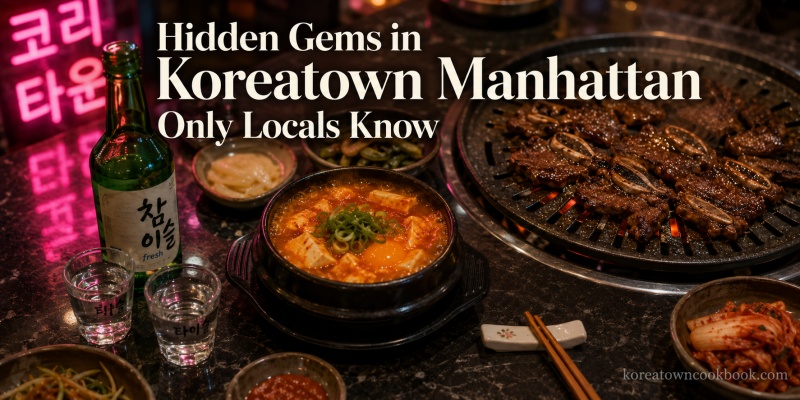
The hidden gems in Koreatown Manhattan only locals know are the tucked-away speakeasies, basement bars, second-floor BBQ joints, and dessert cafes that don’t show up on most tourist lists. These are the places where regulars sip soju past 2 a.m., grill galbi above an unmarked office lobby, and slip behind black curtains to sing karaoke five floors up.
Here’s what I’ll walk you through in this guide:
- The basement and rooftop spots most tourists never find
- Speakeasies you have to know about to enter
- Late-night eats that locals swear by after midnight
- Dessert cafes hidden above street level
- Pro tips for navigating Korea Way like you’ve been doing it for years
I’ve been crawling through Koreatown for years now, mostly because my friends keep dragging me here for birthdays, breakups, and “just one drink” that always turns into five. And I’ve realized the real magic of K-Town isn’t on the ground floor. It’s stacked above, below, and behind the places everyone Instagrams. So I’m pulling back the curtain on the spots I send people to when they ask, “Where do you actually go?”
Table of Contents
Why Koreatown Manhattan Is Built for Secret Spots
Koreatown sits along West 32nd Street between Fifth Avenue and Broadway, in a stretch officially nicknamed Korea Way. It’s tiny on a map, just a few blocks, but it’s stacked vertically. Buildings here pack three, four, sometimes seven floors of restaurants, karaoke rooms, beauty shops, and bars on top of each other. That layering is the whole reason this neighborhood holds so many secrets.
Most visitors stop at the first thing they see at street level. The locals know to take the elevator. Or the staircase tucked behind a vestibule. Or the door at the end of an unmarked hallway. That’s where the good stuff lives.
The neighborhood took shape in the late 1970s, when Korean immigrants opened the first bookstore and a few restaurants near the old Garment District. Today over 100 establishments squeeze into Korea Way, most of them open until 2 or 4 a.m. It’s one of the rare parts of Manhattan where the energy actually peaks after midnight.
Hidden Gems in Koreatown Manhattan Only Locals Know in 2026
Alright, let me get into the actual list. I’ve grouped these by vibe so you can pick what fits your night.
1. Nōksu (The Train Station Tasting Counter)
Nōksu is the one I’m most protective of. It’s a small fine-dining counter tucked into a passageway near the 34th Street-Herald Square subway station. The first time my friend told me where it was, I genuinely thought she was messing with me. Then I walked through a discreet entrance and ended up at one of the most refined Korean-leaning tasting menus in the city. It’s the kind of place where you sit at the bar, watch every plate get built in front of you, and walk out two hours later quietly recalibrated. Reservations are essential.
2. Osamil Upstairs (The Speakeasy on Top of a Restaurant)
Downstairs, Osamil looks like a stylish modern Korean restaurant. Upstairs is a whole different mood. The second-floor speakeasy is dim, plush, and full of intricate cocktails built around Korean ingredients like makgeolli, perilla, and yuzu. I always send people here for a second-drink stop, after dinner somewhere else. It’s the kind of bar you sink into and forget what time it is.
3. Bangia (The Basement Pocha)
If Osamil is the polished one, Bangia is the rowdy little cousin. It sits below street level on East 32nd Street, just south of Herald Square, and it nails that late-night Korean street-food energy. Imported soju, makgeolli, playful cocktails, fried things you’ll regret in a good way. Last call runs to 2:30 a.m. on weekends, so it’s a perfect “we’re not done yet” stop after the bars on 32nd start thinning out.
4. Turntable LP Bar & Karaoke
I love Turntable because it pulls double duty. Up front, it’s a Korean fried chicken spot with kimchi cakes and hush puppies that hit way harder than bar food has any right to. In the back, it’s an LP bar where the staff actually spin vinyl while you eat. Stick around long enough and karaoke kicks in. Most people walk past this one because the entrance doesn’t scream much from the sidewalk. That’s exactly why I’m telling you.
5. Anytime Kitchen (Third Floor, No Sign Energy)
Anytime Kitchen sits on the third floor of a building at 23 West 32nd Street. You take the elevator up, the doors open, and suddenly you’re in a warm, buzzy Korean-American spot that feels like a friend’s apartment if your friend happened to be an incredible cook. The menu mixes traditional Korean comfort food with a few playful crossovers. It’s the kind of place that locals quietly rebook every couple of weeks.
6. Itaewon Pocha (The Tent-Bar Vibe Indoors)
Itaewon Pocha recreates the feeling of a Seoul street tent, the kind you’d duck into after a long night. Plastic stools, hanging lanterns, hearty stews, soju bottles cracking open at every table. It’s loud, it’s cheerful, and the food (corn cheese, budae jjigae, fried rice) is exactly what you want at 1 a.m. when your defenses are down.
7. Grace Street Coffee & Desserts (The Sweet Finish)
Grace Street, at 17 West 32nd Street, is where I go when I’ve eaten too much BBQ and need something cold and sweet. Their bingsu (Korean shaved ice with milky toppings) is the move, but the chewy taiyaki waffles and Korean donuts hold their own. It’s open late, which is the entire point. Locals know dessert in K-Town isn’t a separate trip. It’s the closing ceremony.
8. Pocha 32 (The Watermelon Soju Spot)
You’ll hear about Pocha 32 if you talk to anyone who actually parties in Koreatown. The watermelon soju, served inside a hollowed-out half-melon, is the famous order. But the kimchi fried rice and budae jjigae (army stew) are what bring people back. The crowd is mostly locals on weekend nights, which is always a good sign.
9. Jongro BBQ (Second Floor, Best Charcoal in K-Town)
Jongro BBQ lives on the second floor of an office-style building at 22 West 32nd Street, which is exactly why it stays slightly off the casual tourist radar. Inside, it’s wood tables, classic Korean movie posters, and tabletop charcoal grills that give the meat a depth gas grills just can’t match. Pork belly and galbi are non-negotiable. Come hungry, leave smelling like a campfire in the best way.
10. 5 Bar Karaoke Lounge (Five Floors Up)
5 Bar Karaoke Lounge is exactly what it sounds like: five floors up, behind elevator doors, completely unbothered by the street below. Private suites, a full bar, a DJ booth, the works. If you walk in with a group, you don’t even need a room. The lounge floor itself is a whole vibe. This is a stop where the night either ends or restarts, no in-between.
11. Space Billiards (Late-Night Pool Hall)
Most people don’t picture a pool hall when they think of Koreatown, but Space Billiards is one of those spots that just feels like a New York secret. It’s open late, casual, and full of regulars. After a heavy dinner and a few drinks, racking up a game is honestly the perfect reset. It’s one of the few places in the area where you can sit, talk, and not shout over a soundtrack.
12. Woorijip (The Locals’ Cafeteria)
Woorijip is the spot I send people to when they tell me they want to eat real Korean food without committing to a sit-down meal. It’s cafeteria-style, you grab what looks good (japchae, savory pancakes, fried things, katsu, banchan), pay by weight, and you’re out. It’s open late, affordable, and packed with locals between karaoke sessions. There’s nothing flashy about it. That’s the point.
13. Koryo Books (The Cultural Anchor)
Koryo Books is one of the original Korean businesses in this neighborhood and it’s still going strong. Walk in and you’ll find Korean literature, magazines, stationery, K-pop merchandise, and a soundtrack of whatever’s currently topping the charts in Seoul. Even if you don’t buy anything, it’s a great quiet stop between meals.
14. The Maze (Korean-Mexican Fusion)
The Maze is a resto-bar that blends Mexican and Korean cooking in a way that sounds chaotic and ends up making total sense. Think bulgogi tacos, kimchi guacamole, mezcal-and-soju cocktails. It’s hidden enough that you actually have to know about it. I send adventurous eaters here all the time.
What Makes These Hidden Gems in Koreatown Manhattan Different
A lot of “hidden gem” lists online just recycle the same five spots. The real hidden gems in Koreatown Manhattan only locals know share a few specific traits:
- They’re rarely on the ground floor. Look up. Most of the best spots in K-Town are stacked above storefronts on floors two through seven.
- They stay open late. If a place is closing at 10 p.m., it’s not really a Koreatown insider spot. The good ones run to 2, 3, even 4 a.m.
- The signage is minimal. A small Hangul sign, an unmarked door, an elevator directory with cryptic suite numbers. That’s the look.
- The crowd skews local. Listen at the next table. If you’re hearing more Korean than English at 11 p.m. on a Saturday, you’re in the right room.
My Pro Tips for Navigating Koreatown Like a Local
A few things I wish someone had told me the first time I came here:
- Always check the building directory. That little board near the elevator is a goldmine. You’ll spot karaoke rooms, dessert cafes, and BBQ joints stacked across multiple floors of the same building.
- Go after 10 p.m. Koreatown is a late-night neighborhood. Come too early and you’re just eating dinner in midtown. Come after 10 and the whole place is electric.
- Bring a group of three to six. Most Korean food is built for sharing. BBQ, jjigae, fried chicken, all of it gets better with people around the table.
- Cash isn’t required, but it speeds you up. Most spots take cards, but smaller pocha bars and the cafeteria-style places sometimes prefer cash for splitting checks.
- Don’t fill up at the first place. I made this mistake constantly. K-Town is a crawl, not a destination. Eat a little, drink a little, move on, repeat.
- Use the bathroom whenever you find one. This sounds dumb, but multi-floor venues mean stairs and elevator waits. Plan accordingly.
How I’d Actually Plan a Night in Koreatown
If a friend was visiting from out of town and asked me to plan one perfect K-Town night, here’s what I’d do:
- 9 p.m. Start with Korean BBQ at Jongro on the second floor. Order pork belly and galbi, ask for extra banchan, drink a beer.
- 10:30 p.m. Walk over to Osamil and head upstairs for a slow cocktail. This is your decompression stop.
- 11:30 p.m. Slide into Pocha 32 for a watermelon soju with the group. Order budae jjigae if anyone is still hungry.
- 12:30 a.m. Karaoke at 5 Bar. Book a room if you can, lounge it if you can’t.
- 2:30 a.m. End at Grace Street for bingsu, because no one in this group should be drinking anymore.
That’s the rhythm of a real Koreatown night, and it hits every layer this neighborhood offers.
Common Mistakes Tourists Make in Koreatown
I see the same patterns over and over, so I’ll save you some pain:
- Sticking to the first restaurant they see on the corner. The corner spots are fine. The hidden floors are better.
- Eating dinner at 6 p.m. Show up at 10. The energy is completely different.
- Skipping the speakeasy floors. Osamil Upstairs, the lounges above BBQ joints, the karaoke rooms on the fifth floor. That’s where the neighborhood actually breathes.
- Forgetting dessert. Bingsu, hotteok, taiyaki waffles. You will regret skipping it.
- Not making reservations on weekends. Saturday night K-Town gets packed by 9. Book ahead at the popular BBQ spots or be ready to wait.
Final Thoughts on the Hidden Gems in Koreatown Manhattan Only Locals Know
The thing I love most about the hidden gems in Koreatown Manhattan only locals know is that none of them feel performative. There’s no velvet rope, no password, no list at the door. The “secret” is just paying attention. Looking up at the buildings. Checking the directories. Letting an elevator take you to a floor you didn’t expect. Following the small Hangul signs that the average tourist walks right past.
K-Town rewards curiosity in a way most Manhattan neighborhoods don’t anymore. So next time you’re anywhere near 32nd Street, don’t just eat at the first place with a line out the door. Step into a lobby. Ride an elevator. Open a door that doesn’t tell you what’s behind it. That’s how this neighborhood reveals itself, and that’s how it stays one of the best late-night corners of the entire city.
Save this guide, share it with the friends who keep asking where to go, and check back. I update it every September with new spots and seasonal moves.
Frequently Asked Questions
What are the best hidden gems in Koreatown Manhattan only locals know about?
The best hidden gems in Koreatown Manhattan only locals know include Nōksu near the subway passageway, Osamil’s upstairs speakeasy, Bangia’s basement pocha, Anytime Kitchen on the third floor, Pocha 32 for watermelon soju, Jongro BBQ on the second floor, Grace Street for bingsu, and 5 Bar Karaoke five floors up. The common thread is that almost all of them sit above or below street level.
Is Koreatown Manhattan safe to visit at night?
Yes, Koreatown Manhattan is one of the safer Midtown neighborhoods at night, largely because it’s so densely populated and active until 3 or 4 a.m. The 34th Street-Herald Square subway hub is right there, NYPD presence is steady, and the streets are well lit. Standard city awareness still applies, but plenty of locals walk the area solo late at night without issue.
What time does Koreatown NYC come alive?
Koreatown really turns on after 10 p.m. and peaks between midnight and 2 a.m. Restaurants stay full, karaoke lounges fill up, and the late-night dessert cafes get their second wind. If you’re trying to feel the neighborhood the way locals experience it, plan to arrive late and stay later.
What’s the best subway stop for Koreatown Manhattan?
The 34th Street-Herald Square station is the closest and most convenient stop, served by the B, D, F, M, N, Q, R, and W trains. You can also use the 33rd Street stop on the 6 line. From either station, Korea Way is a short walk west or east along 32nd Street.
Do I need reservations for Koreatown restaurants?
For popular BBQ spots like Jongro and Miss Korea, and for sit-down places like Nōksu and Osamil, reservations are strongly recommended on Friday and Saturday nights. For pocha bars, karaoke lounges, cafeteria spots like Woorijip, and dessert cafes, you can almost always walk in. Going earlier in the week also makes walk-ins much easier.
What food should I try first in Koreatown?
Start with Korean BBQ (pork belly and galbi are the gateway dishes), then branch into soondubu jjigae (soft tofu stew), Korean fried chicken, japchae, and bibimbap. Finish with bingsu for dessert. If you want something quick and casual, the cafeteria-style Woorijip lets you sample a lot of dishes in one shot.
Are there hidden bars in Koreatown Manhattan?
Yes, hidden bars are one of the defining features of Koreatown. Osamil Upstairs is a polished speakeasy above the restaurant of the same name, Bangia hides below street level on East 32nd, and several karaoke lounges on the third, fourth, and fifth floors of buildings along Korea Way operate as full bars with their own personalities. Checking building directories near elevators is the easiest way to find them.