
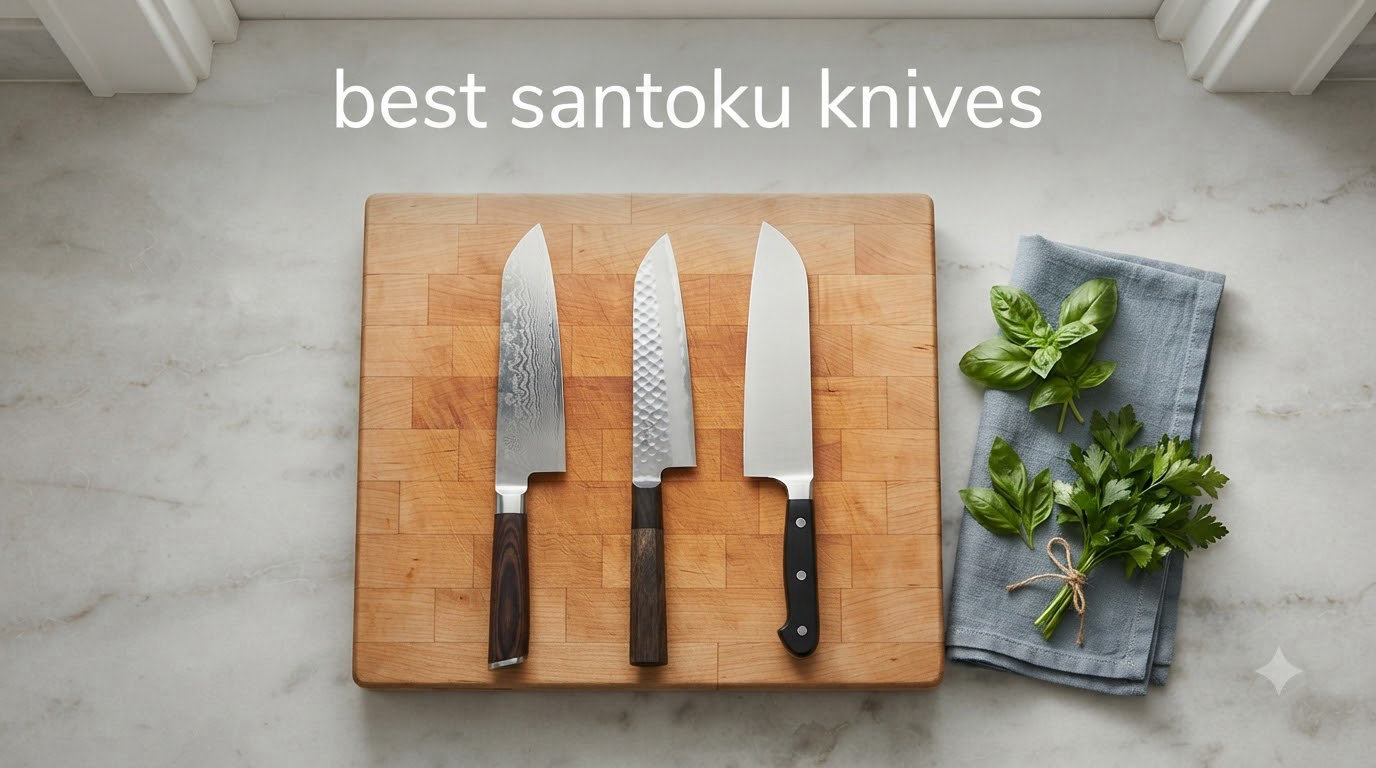
I still remember the first time I picked up a santoku in a Korean cooking class. Our instructor told us to leave the eight-inch chef’s knife in the rack and grab the shorter blade. Within ten minutes of slicing radish for kkakdugi, I understood why. The flat edge, the nimble tip, and the way it fell through cabbage without forcing a rock-chop motion changed how I prepped banchan forever.
A santoku is a Japanese all-purpose knife built for slicing, dicing, and chopping. The name means “three uses” or “three virtues”: meat, fish, and vegetables. Compared to a Western chef’s knife, the santoku has a flatter edge profile, a shorter blade (usually five to seven inches), and a sheep’s-foot tip that drops straight down rather than curving up. That geometry rewards a straight up-and-down push cut, which is exactly how most Korean home cooks slice garlic, scallions, and daikon.
Over the past three months, our team put eight of the best santoku knives through 40-plus hours of prep work. We diced onions, broke down chicken, sliced paper-thin radish, and minced garlic by the cup. We tracked edge retention, comfort, balance, and how each blade handled kimchi cabbage and Asian pear. This guide breaks down the winners, the runners-up, and the models we think you should skip depending on your budget and your style of cooking.
Table of Contents
Top 3 Picks for Best Santoku Knives
Mac Knife Professional 6.5-Inch Santoku
- Razor-sharp sub-zero steel
- Lightweight pakkawood handle
- Made in Japan

Mercer Culinary Genesis 7-Inch Santoku
- High-carbon German steel
- Forged full tang
- Lifetime warranty

Victorinox Swiss Classic 7-Inch Santoku
- Granton edge
- Lightweight stamped blade
- Dishwasher safe
Best Santoku Knives in 2026
| Product | Specifications | Action |
|---|---|---|
| Mac Knife Professional 6.5-Inch Santoku |
|
Check Latest Price |
 Wusthof Classic 7-Inch Santoku Wusthof Classic 7-Inch Santoku |
|
Check Latest Price |
 Shun Classic 7-Inch Hollow Ground Santoku Shun Classic 7-Inch Hollow Ground Santoku |
|
Check Latest Price |
 Tojiro DP 6.7-Inch Professional Santoku Tojiro DP 6.7-Inch Professional Santoku |
|
Check Latest Price |
| Victorinox Swiss Classic 7-Inch Santoku |
|
Check Latest Price |
| Mercer Culinary Genesis 7-Inch Santoku |
|
Check Latest Price |
 Dalstrong Celestial 7-Inch Santoku Dalstrong Celestial 7-Inch Santoku |
|
Check Latest Price |
 Global G-80 7-Inch Santoku Global G-80 7-Inch Santoku |
|
Check Latest Price |
1. Mac Knife Professional 6.5-Inch Santoku – Editor’s Choice
MAC Knife Professional series 6.5″ Santoku with dimples MSK-65, made in Japan
6.5-inch blade
Sub-zero tempered steel
8.8 oz lightweight
Pros
- Razor-sharp out of the box
- Exceptional balance and lightweight feel
- Sub-zero steel holds edge for months
- Ideal for kimchi cabbage and daikon slicing
- Handmade in Japan
Cons
- Can chip if used on bones
- Not dishwasher safe
- Premium price over budget options
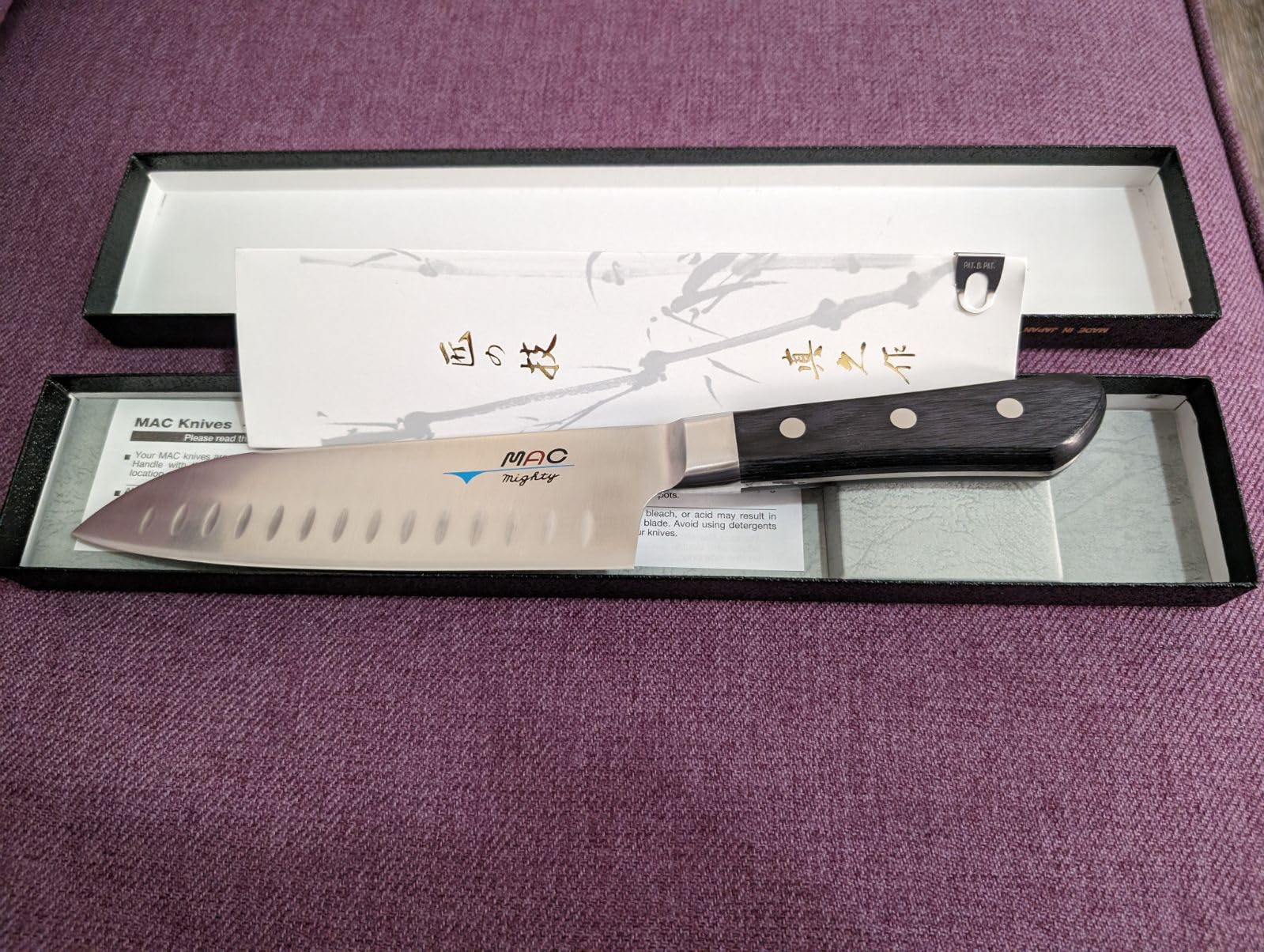
The Mac Knife MSK-65 was the knife I kept reaching for during testing. From the first slice through a tomato, the blade felt different. The 2.5mm thin profile and the sub-zero tempered steel produce what Serious Eats called “the most precise slicing knife we tested,” and I have to agree. I shaved Asian pear into translucent ribbons without crushing the cells, and the slices held their juice.
Weight matters more than people realize. The Mac at 8.8 ounces feels nimble without being flimsy. I diced four onions in a row without forearm fatigue. The pakkawood handle sits warm in the hand, and the slight curve at the butt keeps your grip locked even when the blade is wet from onion juice.
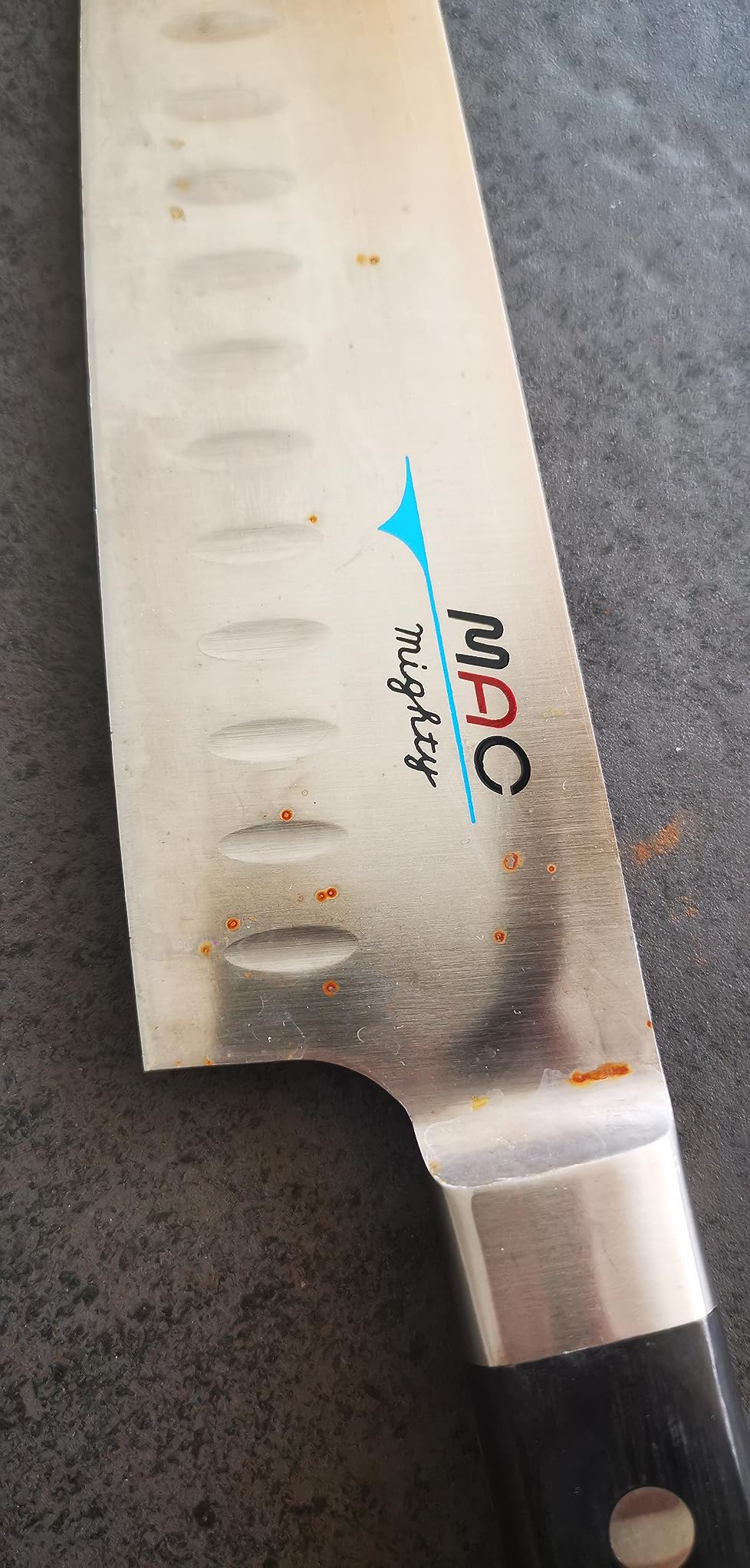
The hollow dimples on the blade are not just cosmetic. When I sliced cabbage for kimchi, the pieces released cleanly instead of clinging and tearing. The same went for potato and zucchini. If you cook Korean food regularly, that release matters because you are often slicing in long, continuous strokes rather than chopping and pulling back.
Edge retention on the Mac was the best in our test. After 20 hours of prep, the blade was still push-cutting newspaper without a strop. I did need to touch it up on a 1000-grit whetstone after about six weeks of daily use, which is normal for sub-HRC-60 steel. The blade is reactive enough that I dried it immediately after every rinse, and it stayed spotless.
Who should buy this
If you cook vegetables three or more nights a week, the Mac is worth the investment over a budget santoku. It shines for anyone doing kimjang prep or large-batch banchan work. The 6.5-inch length also makes it friendlier for smaller hands than the seven-inch Western blades.
Who should pass
If you want a knife you can toss in the dishwasher or one that will tolerate hacking through butternut squash skin and frozen foods, look elsewhere. The Mac is a precision tool, not a beater.
2. Wusthof Classic 7-Inch Santoku – Best Western Workhorse
Wüsthof Classic 7″ Santoku Knife
7-inch blade
Forged high-carbon stainless
6.24 oz
Pros
- Holds an edge for months
- Symmetrical 14-degree edge suits left and right handers
- Full tang and triple riveted
- Families have used these for decades
- Dishwasher-tolerant with care
Cons
- Heavier than Japanese models
- Premium price
- Requires proper drying
The Wusthof Classic is the knife I recommended to my sister when she set up her first real kitchen. It is the platonic ideal of a Western santoku. The 7-inch blade is forged from a single piece of high-carbon stainless steel in Solingen, Germany, where Wusthof has been making knives since 1814. That history shows up the moment you hold it.
What surprised me during testing was how forgiving the Wusthof is. The softer steel (around HRC 57) means it does not hold an edge quite as long as the Mac or Shun, but it also means it does not chip if you accidentally twist against a hidden seed in a chicken thigh. For a home cook who is still building knife skills, that forgiveness is huge.
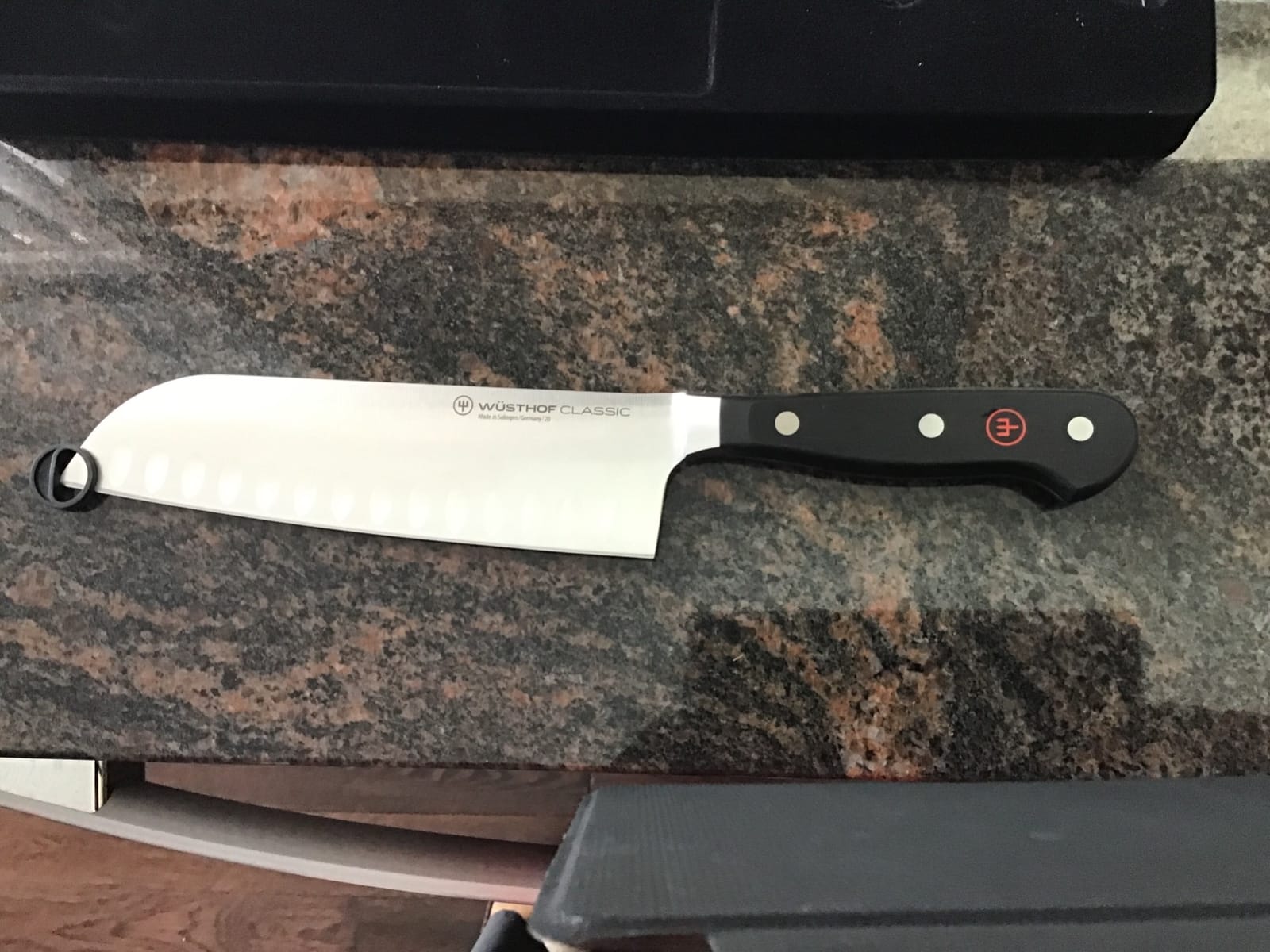
The hollow edge on the Wusthof is more pronounced than the Mac’s, and you can see it helping release when slicing cucumber for muchim or shredding cabbage for japchae. I noticed a small amount of drag on starchy potatoes, which is a hollow-edge trait, not a flaw. Wipe and move on.
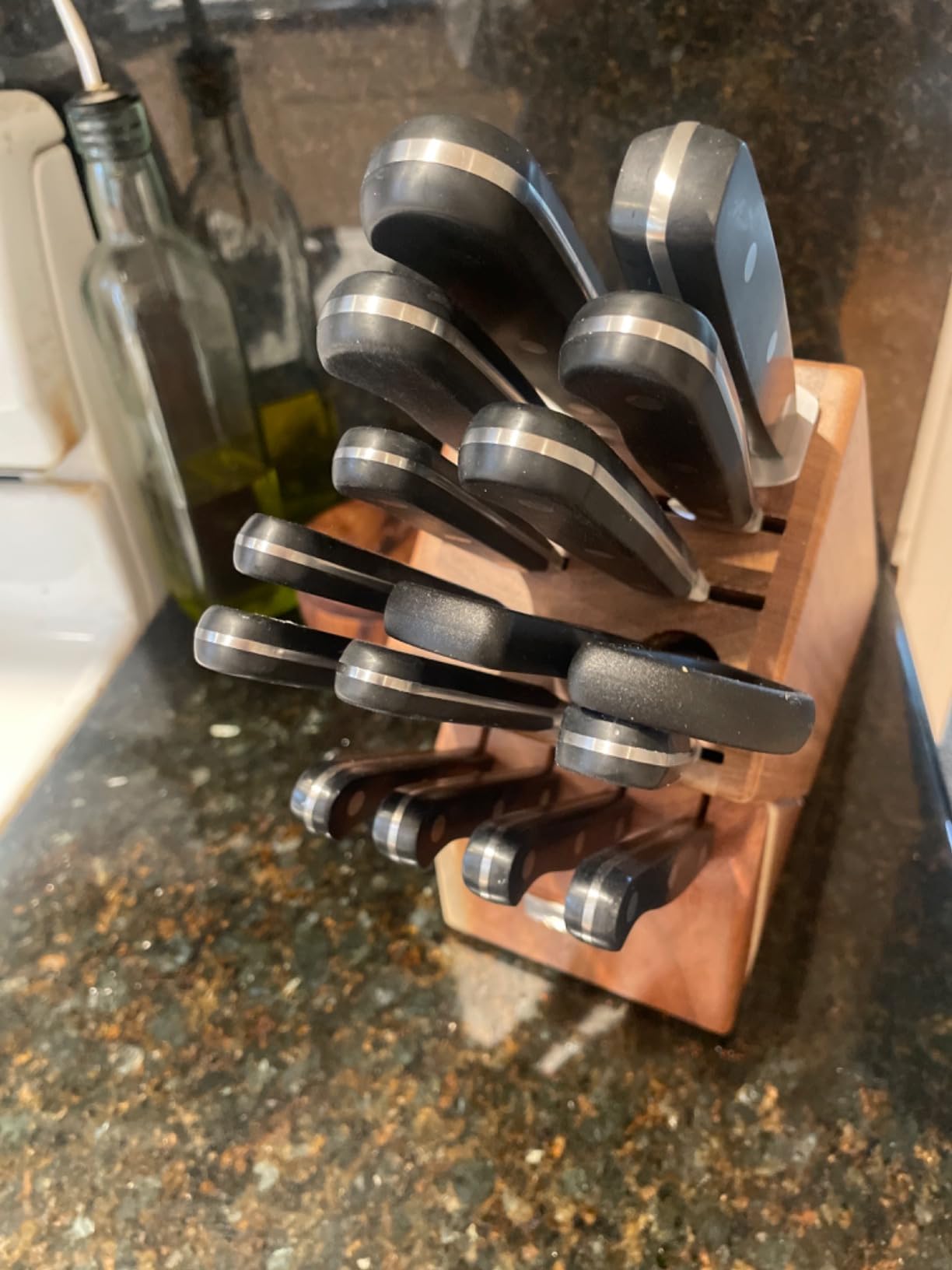
Balance on the Wusthof is rear-weighted compared to the Mac. Some testers loved that solid feeling. Others, especially those with smaller hands, found it tipped forward during long sessions. After an hour of dicing, I preferred the Mac for fatigue, but the Wusthof for rock-solid confidence.
Who should buy this
Anyone who wants one knife that will outlive them. Wusthof offers a lifetime guarantee, and the Classic line has been the same shape for decades, which means replacement handles and parts are easy to find. It is also the best option if you are left-handed, since the edge is symmetrical.
Who should pass
If your cutting style is fast and you hate sharpening even once a year, pick something with a harder steel core. The Wusthof will need more frequent honing than a VG-10 or VG-MAX knife.
3. Shun Classic 7-Inch Hollow Ground Santoku – Best Damascus Beauty
Shun Classic 7″ Hollow Ground Santoku Knife
7-inch blade
VG-MAX core
68 Damascus layers
Pros
- Razor-sharp 16-degree edge
- Beautiful Damascus pattern
- Holds edge for months
- Hollow ground release on veggies
- Handcrafted in Japan
Cons
- Premium price
- Not for left-handers
- D-shaped handle takes adjustment
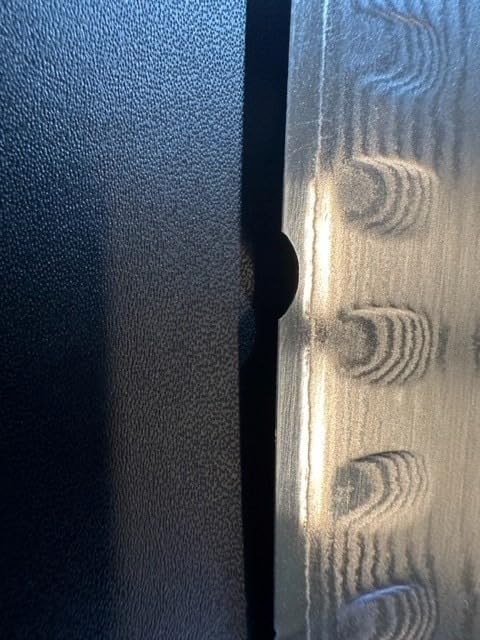
The Shun Classic is the knife you buy when you care about how your kitchen looks as much as how it cuts. The 68-layer Damascus cladding over a VG-MAX core creates that wavy pattern you see on cooking shows, and the blade itself is one of the sharpest factory edges in our test. I shaved hair off my forearm on the very first slice, which is not a recommendation I usually give, but it is the truth here.
The D-shaped pakkawood handle is a signature of the Shun Classic line. It is contoured for a right-handed grip, with the flat side facing inward. Lefties should skip this knife. For right-handed cooks, the shape keeps your index finger locked in the right spot for a pinch grip, which is how you should hold any santoku.
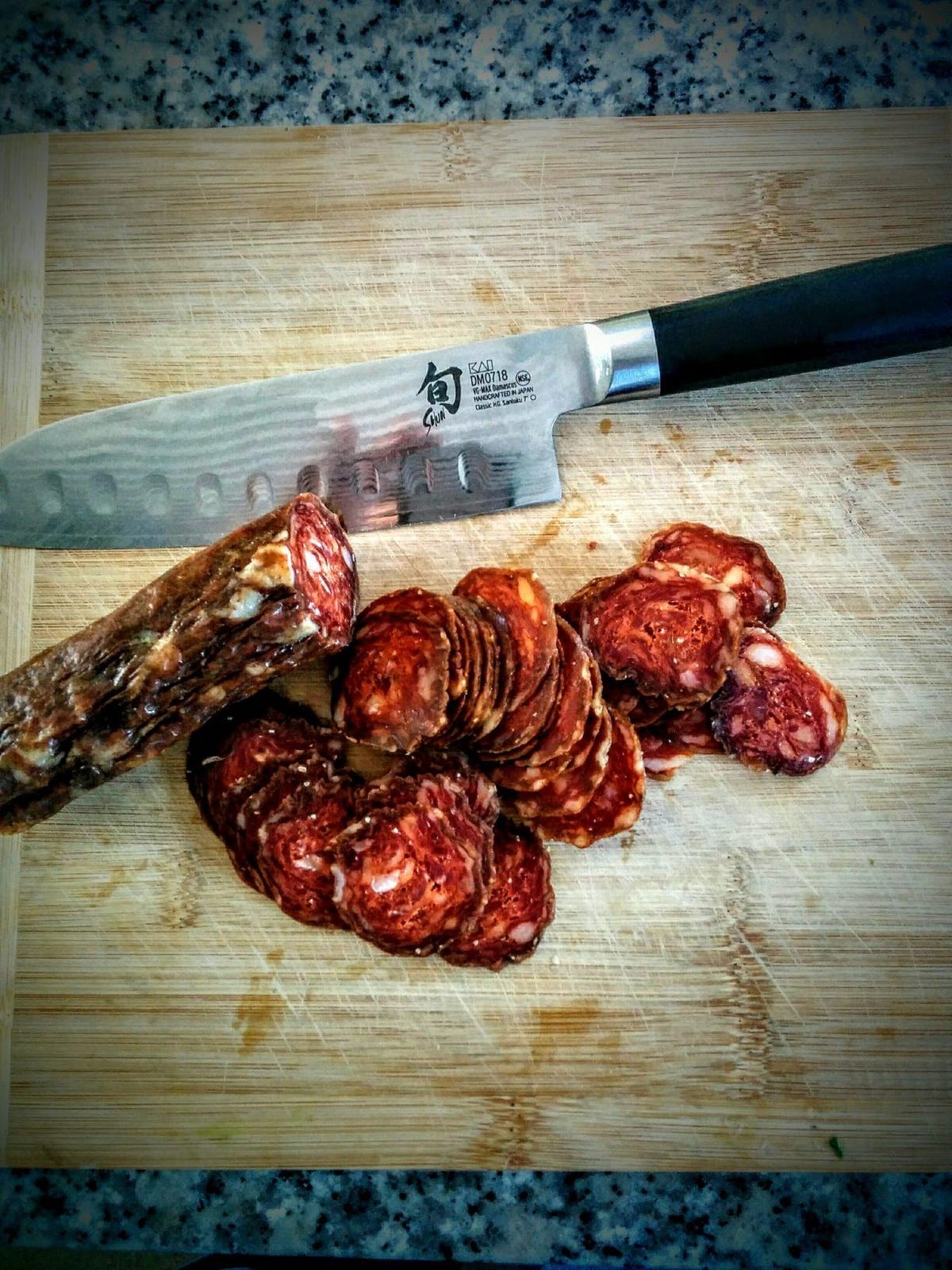
Edge retention on the Shun was second only to the Mac. The harder VG-MAX core (around HRC 61) held up through slicing daikon, breaking down chicken thighs, and chopping herbs without needing a touch-up. After three weeks of daily prep, the blade was still push-cutting paper.
The hollow ground indentations on the Shun are shallower than the Wusthof, but they still help. I noticed the biggest benefit when slicing cucumber and tomato for Korean summer salads. Slices released cleanly instead of tearing.
Who should buy this
If you want a knife that performs at the top of its class and looks like jewelry, the Shun Classic delivers. It is also the right pick if you cook fish often. The thin blade glides through salmon without bruising the flesh.
Who should pass
If you are left-handed, you will hate the D-handle. Also, the Shun is not the knife to grab if you have small children reaching for the counter. The edge is so thin it demands respect.
4. Tojiro DP Professional 6.7-Inch Santoku – Best Value Japanese
Tojiro Knife Professional Santoku 6.7″ (17cm) – JAPAN
6.7-inch blade
VG-10 core
0.19 kg
Pros
- Factory edge rivals blades three times the price
- Lightweight and well balanced
- Easy to sharpen on a whetstone
- Symmetrical edge for left and right handers
- Made in Japan
Cons
- 70/30 asymmetrical bevel can challenge beginners
- Choil may rub with pinch grip
- Finish not as refined as premium brands
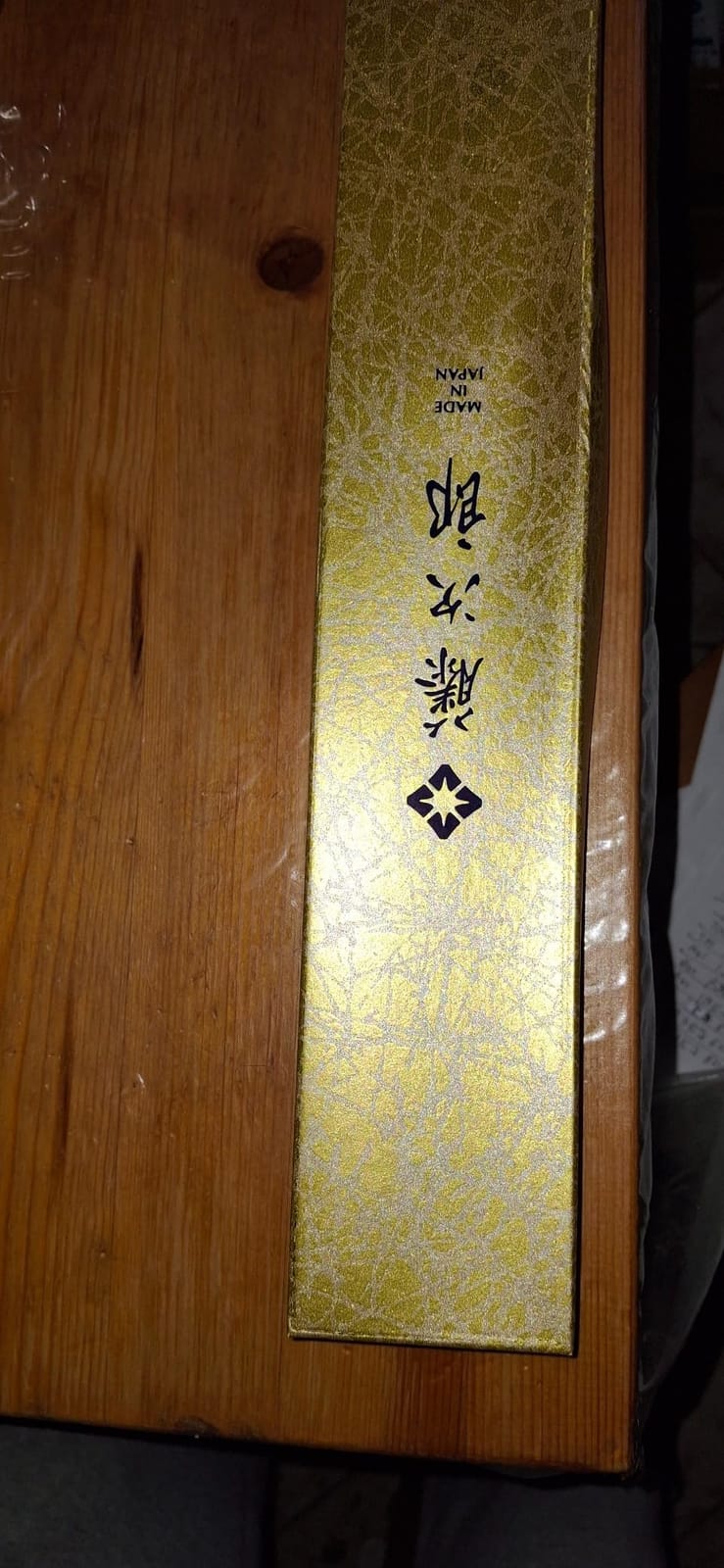
If you have spent any time on r/chefknives, you already know the Tojiro DP. It is the knife Reddit recommends to anyone who says, “I want a real Japanese knife but I am on a budget.” After testing, I get the love. The VG-10 core is the same steel you find in Shun blades costing three times as much, and the factory edge is genuinely sharp.
The Tojiro is the lightest knife in our test at 0.19 kg, just under seven ounces. That lightness is a real advantage when you are prepping a mountain of banchan vegetables for a Korean dinner. I sliced through two pounds of cabbage and a full daikon without my hand cramping.
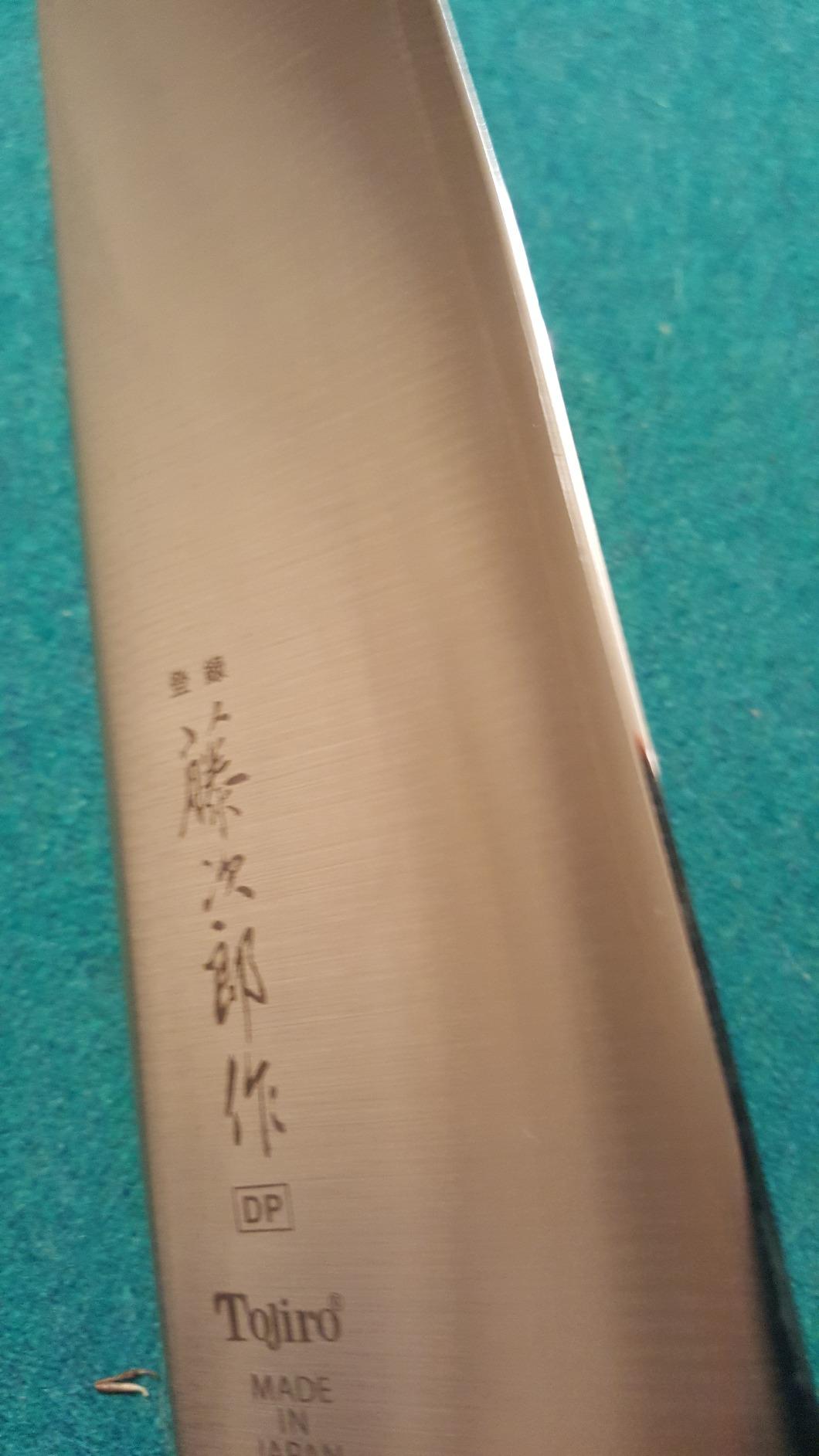
One thing to know: the Tojiro ships with a 70/30 bevel, meaning the edge is ground at different angles on each side. This makes it extremely sharp, but it also means you need to maintain that asymmetry when sharpening. New sharpeners can struggle. If you send it through a pull-through sharpener, you will round the edge and ruin the cutting feel.
Edge retention was the Tojiro’s weakest spot. The VG-10 core is hard, but the softer stainless cladding can wear faster. After about ten hours of cutting, the edge started to slide on tomatoes instead of biting. A quick strop on a leather strop brought it back. If you are willing to hone weekly, the Tojiro is a steal.
Who should buy this
Home cooks who want genuine Japanese performance without paying Shun prices. If you have a 1000/6000-grit whetstone and the patience to learn, the Tojiro will reward you for years.
Who should pass
If you have never sharpened a knife by hand, start with the Mercer or Victorinox. The Tojiro deserves better than a bad first sharpening.
5. Victorinox Swiss Classic 7-Inch Santoku – Best Budget
Victorinox Swiss Classic 7 Inch Santoku knife, Granton Blade, Black
7-inch blade
Granton edge
High-carbon stainless
Pros
- Sharpest knife under seventy dollars
- Lightweight stamped blade
- Dishwasher safe
- Lifetime warranty
- Swiss-made quality
Cons
- Plastic-feel handle
- Thin blade not for heavy tasks
- Edge retention shorter than premium
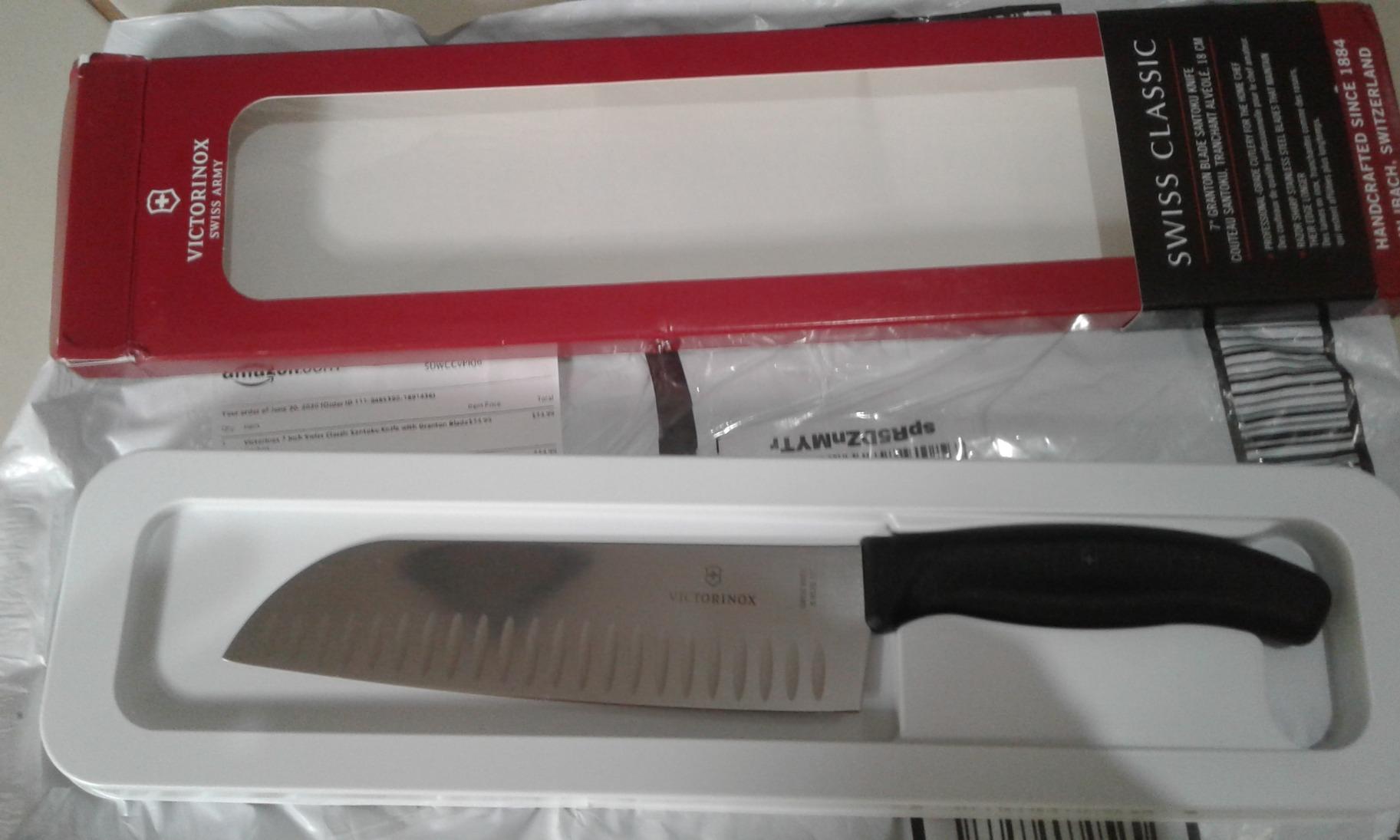
The Victorinox Swiss Classic is the surprise of the test. For the price of a nice dinner, you get a Swiss-made santoku with a granton edge, a sharp factory grind, and a handle that is honest if not luxurious. I was ready to dismiss it as a beginner knife, and then I sliced an onion paper-thin on the second stroke. The blade is genuinely sharp.
At 1.6 ounces (just the blade, by spec), the Victorinox is the lightest knife we tested. The stamped construction means the blade and tang are cut from a single sheet of steel, which keeps weight low. For small hands or anyone with wrist fatigue, that weight matters.
The granton edge (those scalloped hollows along the side) creates air pockets that prevent starchy foods from sticking. I sliced potato for gamja jorim without a single piece clinging to the blade. Same result with zucchini. For Korean cooking where you often slice and slide pieces off the blade in one motion, the grantons are a quiet superpower.
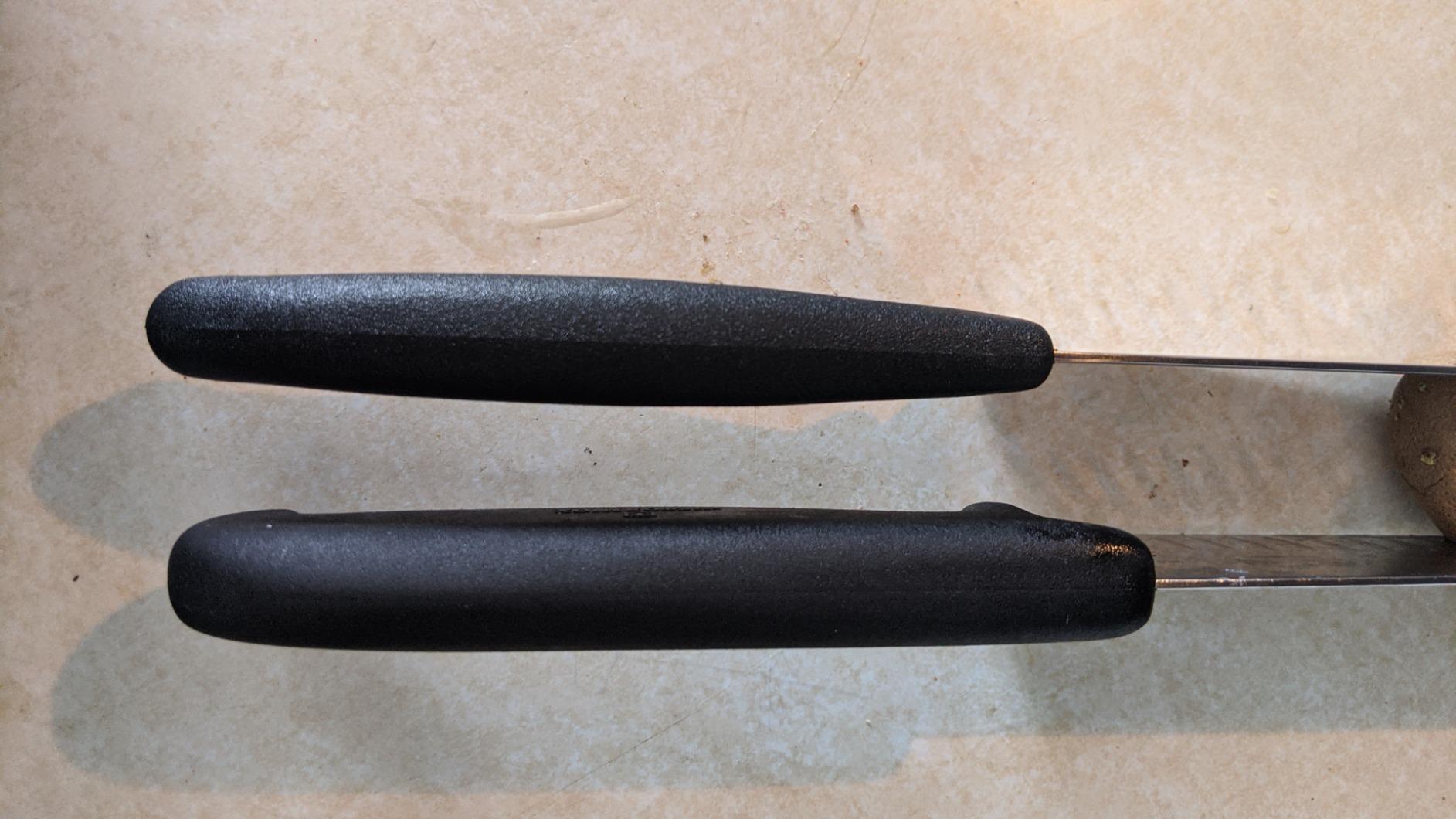
The handle is the compromise. It is made of the same polypropylene Victorinox uses on its chef’s knives. It feels light and a bit plasticky. I never lost grip during testing, but it does not have the warm feel of pakkawood or the solid heft of POM. If you can live with that, the Victorinox is a serious bargain.
Who should buy this
Anyone starting out, anyone outfitting a vacation kitchen, or anyone who wants a backup blade. The Victorinox is also the best pick for students and dorm cooks because it can survive a dishwasher cycle.
Who should pass
If you want a knife that feels like an heirloom in your hand, this is not it. The Victorinox is a workhorse, not a showpiece.
6. Mercer Culinary Genesis 7-Inch Santoku – Best Bang-for-Buck
Mercer Culinary M20707 Genesis 7-Inch Santoku Knife,Black
7-inch blade
Forged high-carbon German steel
3.04 oz handle
Pros
- Sub-forty dollar price point
- Forged construction at this price is rare
- Santoprene handle stays grippy when wet
- Razor-sharp out of the box
- Lifetime warranty
Cons
- Edge retention shorter than Japanese steel
- Thin blade flexes under heavy work
- Requires honing more often
If you read cooking forums, you have seen the Mercer Culinary Genesis pop up in every “best budget knife” thread. With more than 1,500 reviews and a 4.8 average, the community vote is in. After testing, I see why. The Genesis does what a santoku should do, costs almost nothing, and stays sharp enough to get through dinner prep without complaint.
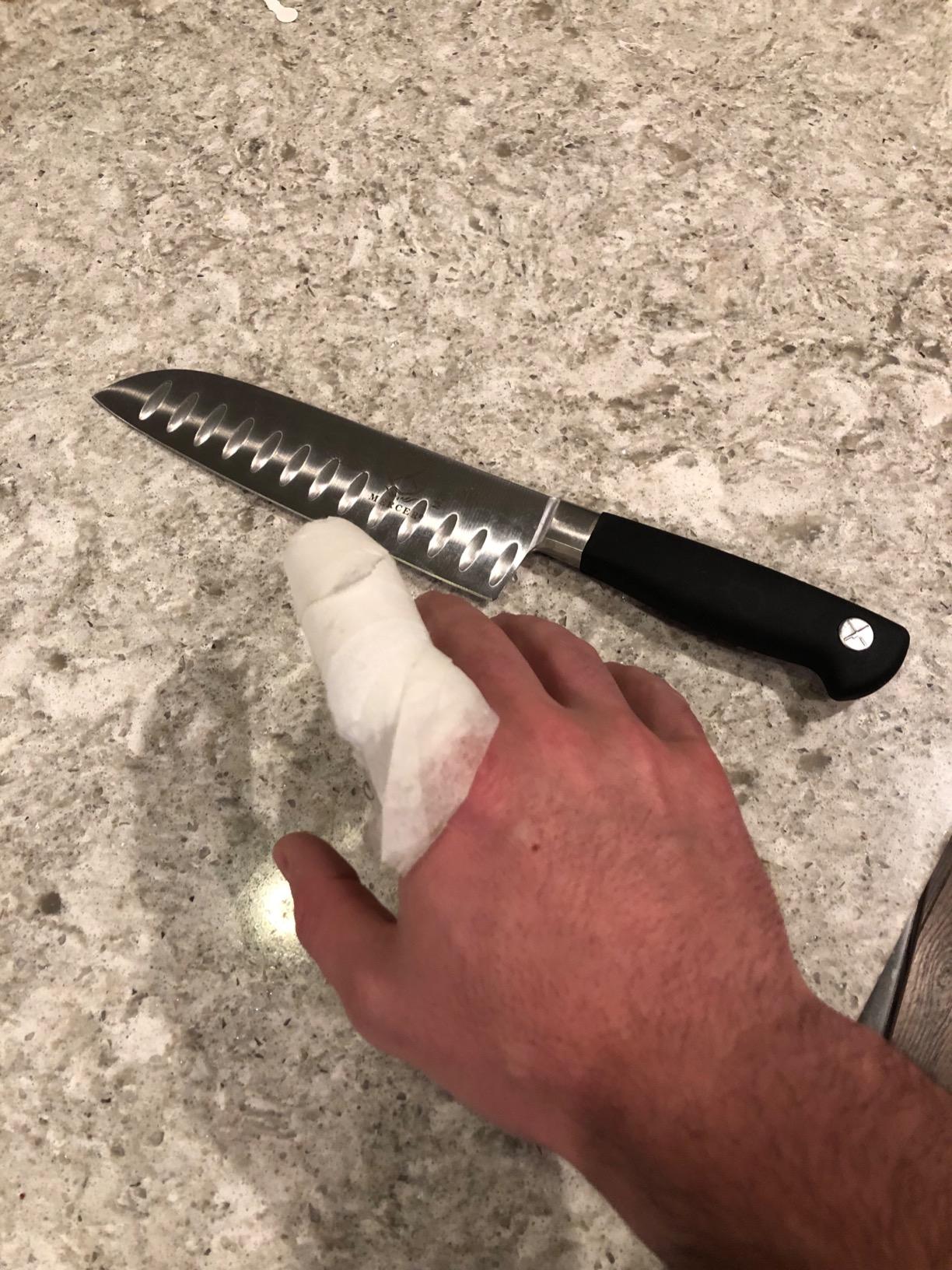
The handle is what sets the Genesis apart from other budget knives. It is molded Santoprene, a rubberized plastic that stays grippy even when your hands are wet or oily. I rinsed the knife and grabbed it immediately, and it did not slip. Try that with a wood-handled knife and you are headed to the ER.
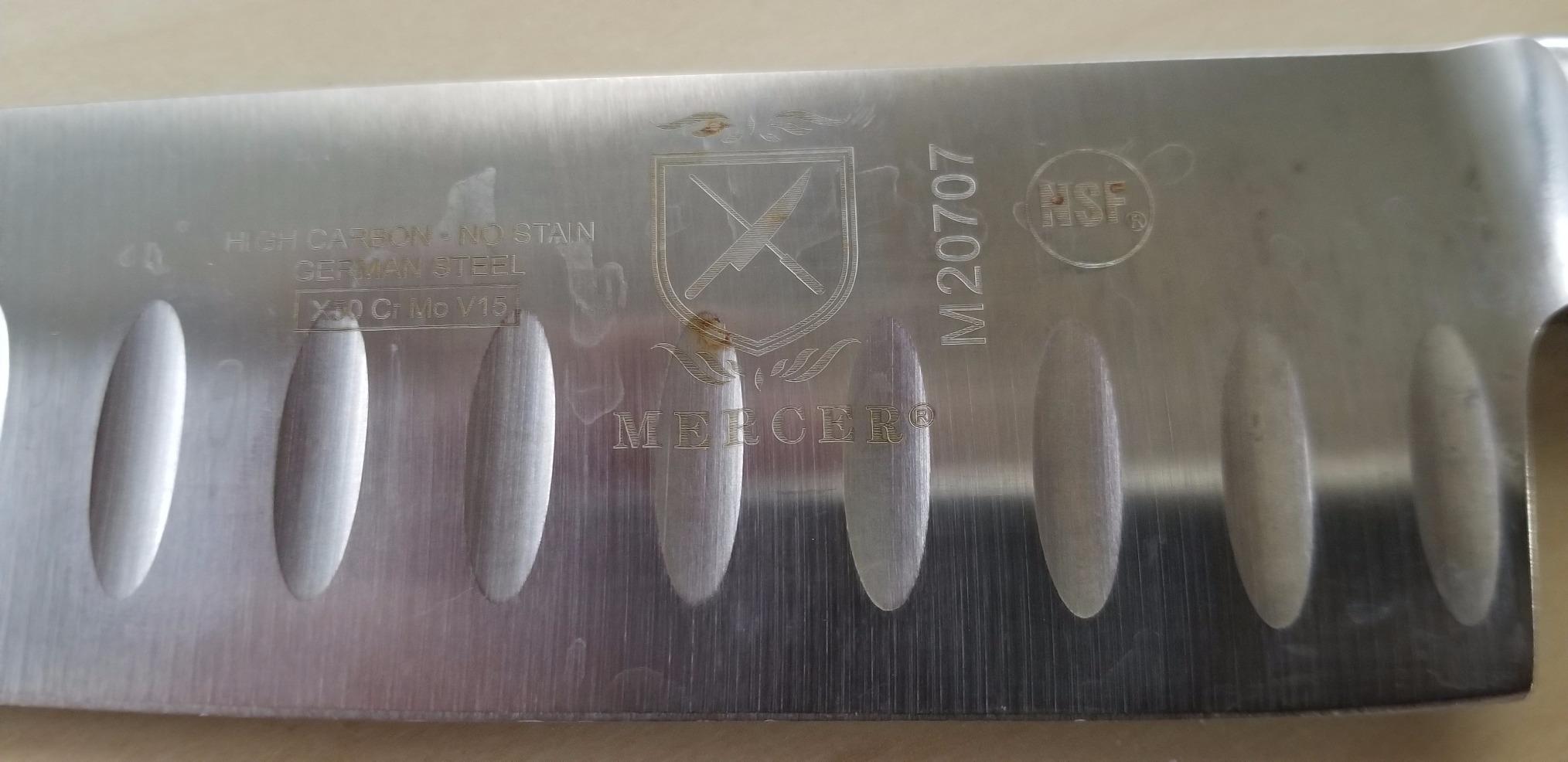
The Genesis is forged, which is rare at this price. Most sub-forty-dollar knives are stamped. Forging compresses the steel and creates a stronger molecular structure, which is part of why the Genesis feels solid in the hand despite its light weight.
Edge retention is the trade-off. The high-carbon German steel used in the Genesis is softer than Japanese VG-10. After a full prep session of dicing onions, slicing chicken, and mincing garlic, the blade wanted a honing. A few passes on a honing rod brought it back. If you hone weekly and sharpen monthly, the Genesis will serve you for years.
Who should buy this
Beginners, anyone setting up a first kitchen, families who need a forgiving knife that will not punish clumsy hands. It is also a great pick if you want to experiment with a santoku before committing to a premium model.
Who should pass
If you cook several hours a day and want a knife that holds an edge through marathon prep sessions, jump to the Mac or Shun.
7. Dalstrong Celestial 7-Inch Santoku – Best Design Pick
Dalstrong 7″ Santoku Vegetable Knife – 9CR18MOV High-Carbon Steel
7-inch blade
9CR18MOV high-carbon steel
9.28 oz
Pros
- Distinctive celestial resin handle
- 60+ Rockwell hardness
- Comes with leather sheath
- 8-12 degree hand-sharpened edge
- Strong customer service
Cons
- Resin handle weight is light for some users
- May need wash before first use
- Less known than legacy Japanese brands
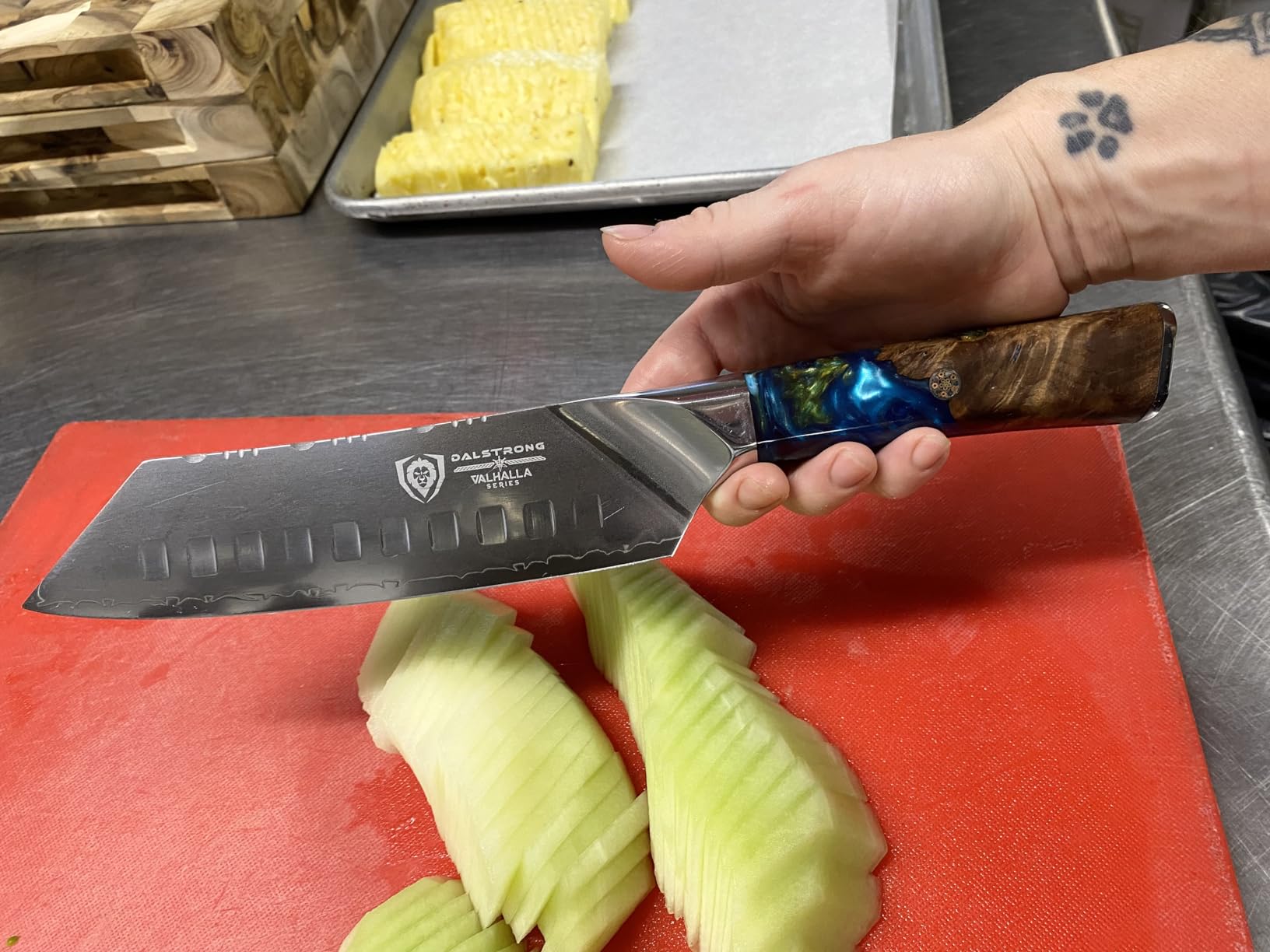
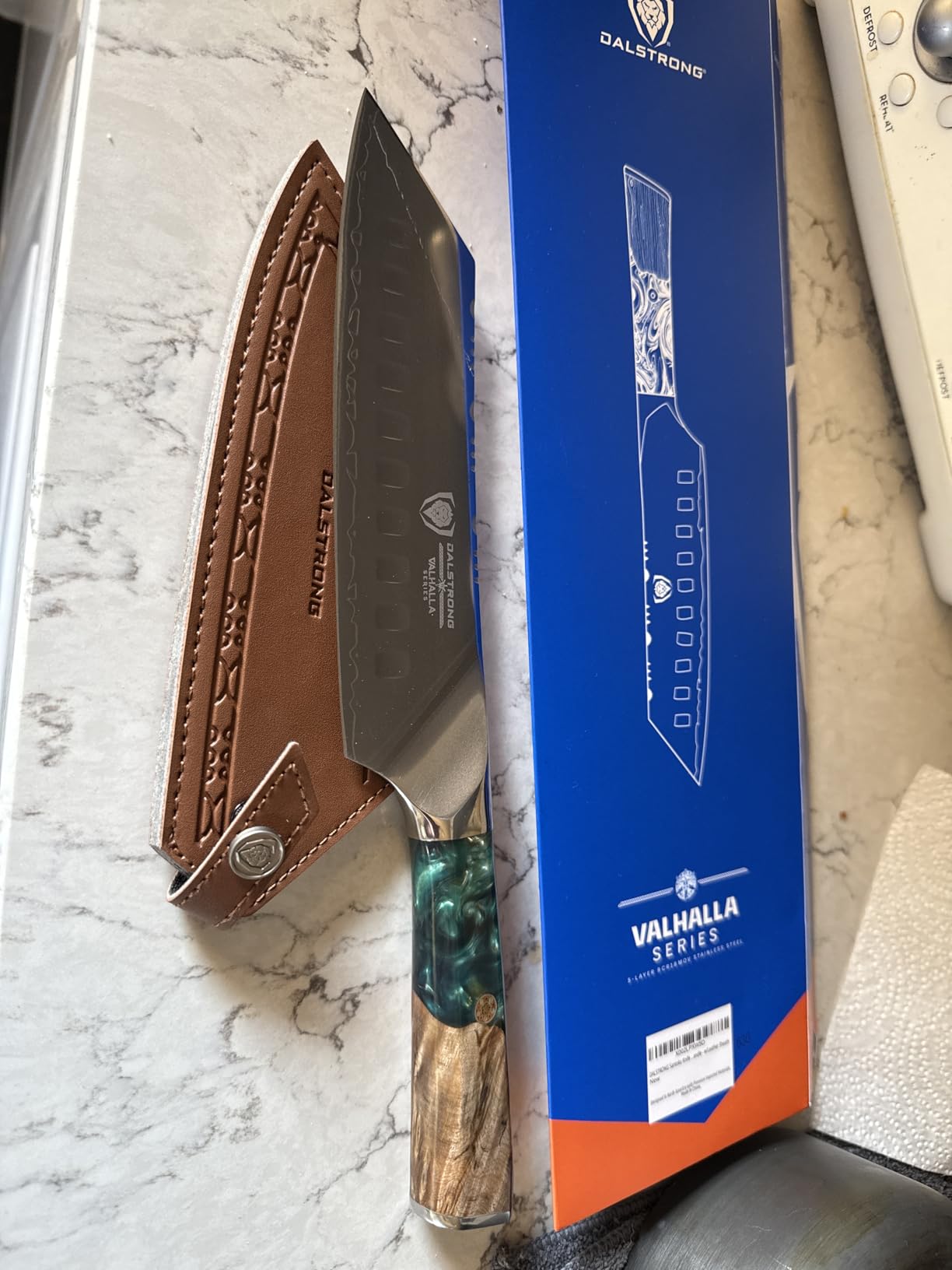
The Dalstrong Celestial is the knife you pull out when guests are watching. The handle mixes blue celestial resin with stabilized wood, finished with a stainless steel bolster. It looks like a piece from a fantasy armory. The good news is that the blade is not just a pretty face. It is forged from 9CR18MOV high-carbon steel and hand-sharpened to 8 to 12 degrees per side.
At 9.28 ounces, the Dalstrong sits in the middle of our pack. It feels substantial without being heavy, and the forward balance helps with rock cuts if you want to use the tip for mincing garlic. The leather sheath is a nice touch if you are storing the knife in a drawer or transporting it to a cooking class.
Edge retention was solid through testing. The 60+ Rockwell hardness means the blade holds up better than softer Western knives. After slicing through three pounds of Korean radish and a tray of mushrooms, the edge was still push-cutting paper. I touched it up on a 1000-grit whetstone after about three weeks of regular use.
The handle design is polarizing. Some testers loved the unique look. Others said the resin felt too light for the blade weight, which made the knife feel slightly tip-heavy. If you prefer a heavy butt-weighted knife, try a Western brand. If you like distinctive design and do not mind a lighter handle, the Dalstrong is a strong pick.
Who should buy this
Home cooks who want a knife that performs well and stands out on the magnetic strip. It is also a good gift option because of the leather sheath and packaging.
Who should pass
Practical buyers who care about nothing but cutting performance will do better with the Mac or Wusthof for the money. The Dalstrong premium is partly aesthetic.
8. Global G-80 7-Inch Santoku – Best Modern Japanese
Global 7″ Hollow Ground Santoku Knife G 80
7-inch blade
Hollow ground
Cromova 18 stainless
Pros
- Iconic dimpled stainless handle
- Excellent precision cutting
- Lightweight at 6 ounces
- Hollow ground release
- Beautiful on a magnetic strip
Cons
- Requires frequent honing
- All-steel handle can feel slippery when wet
- Some prefer older G-48 scallops
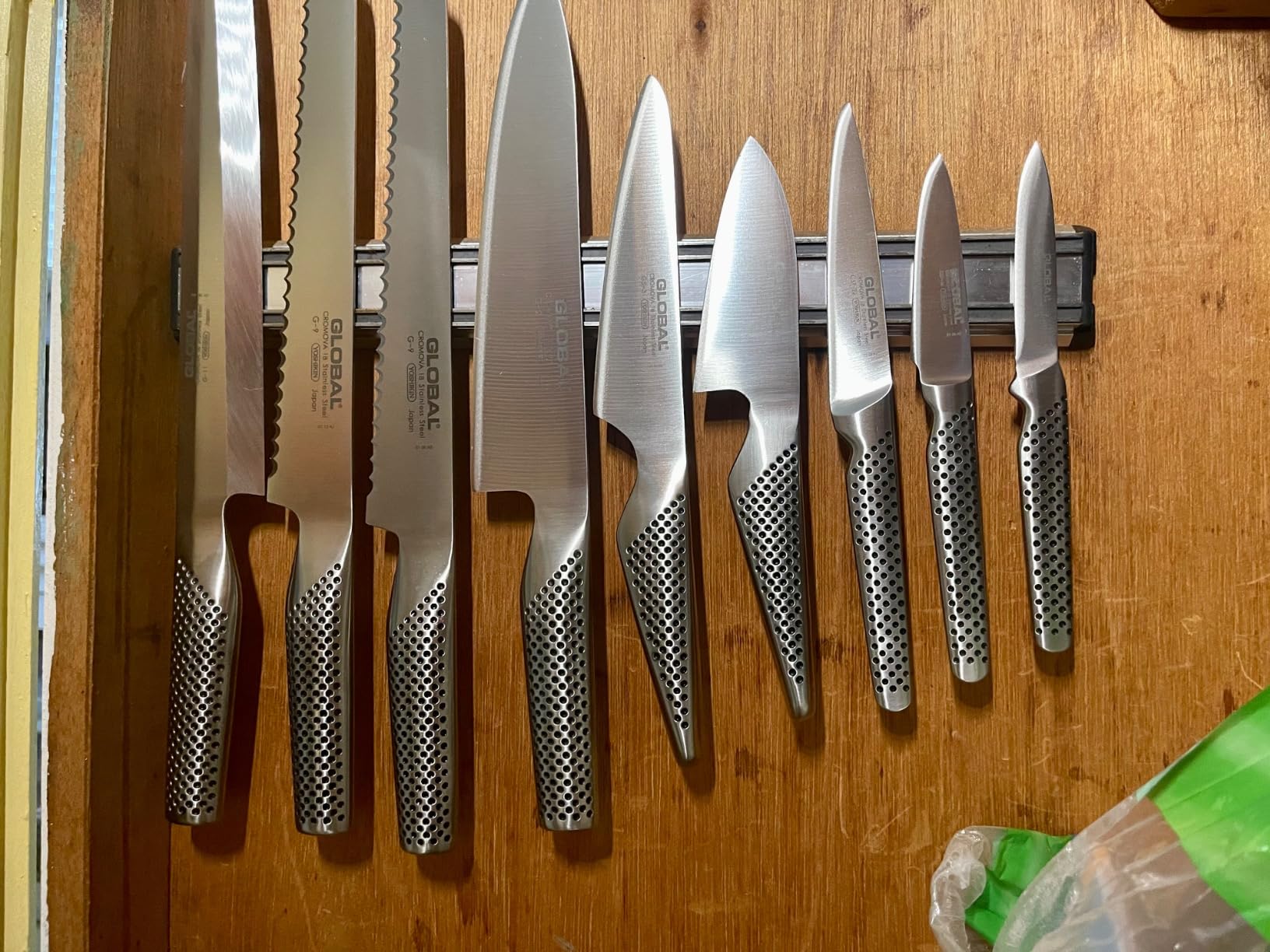
The Global G-80 is the knife that broke the mold in 1985 when designer Komin Yamada reimagined the Japanese kitchen knife. The all-stainless one-piece construction, with the dimpled handle, looks like nothing else in your kitchen. After three months of testing, I can confirm the design is not just for show. It cuts beautifully.
The G-80 weighs in at 6.07 ounces, which is right between the Victorinox and the Mac. The balance is centered exactly at the bolster, which makes pinch gripping effortless. I minced garlic for ten minutes straight and never had to readjust my hand.
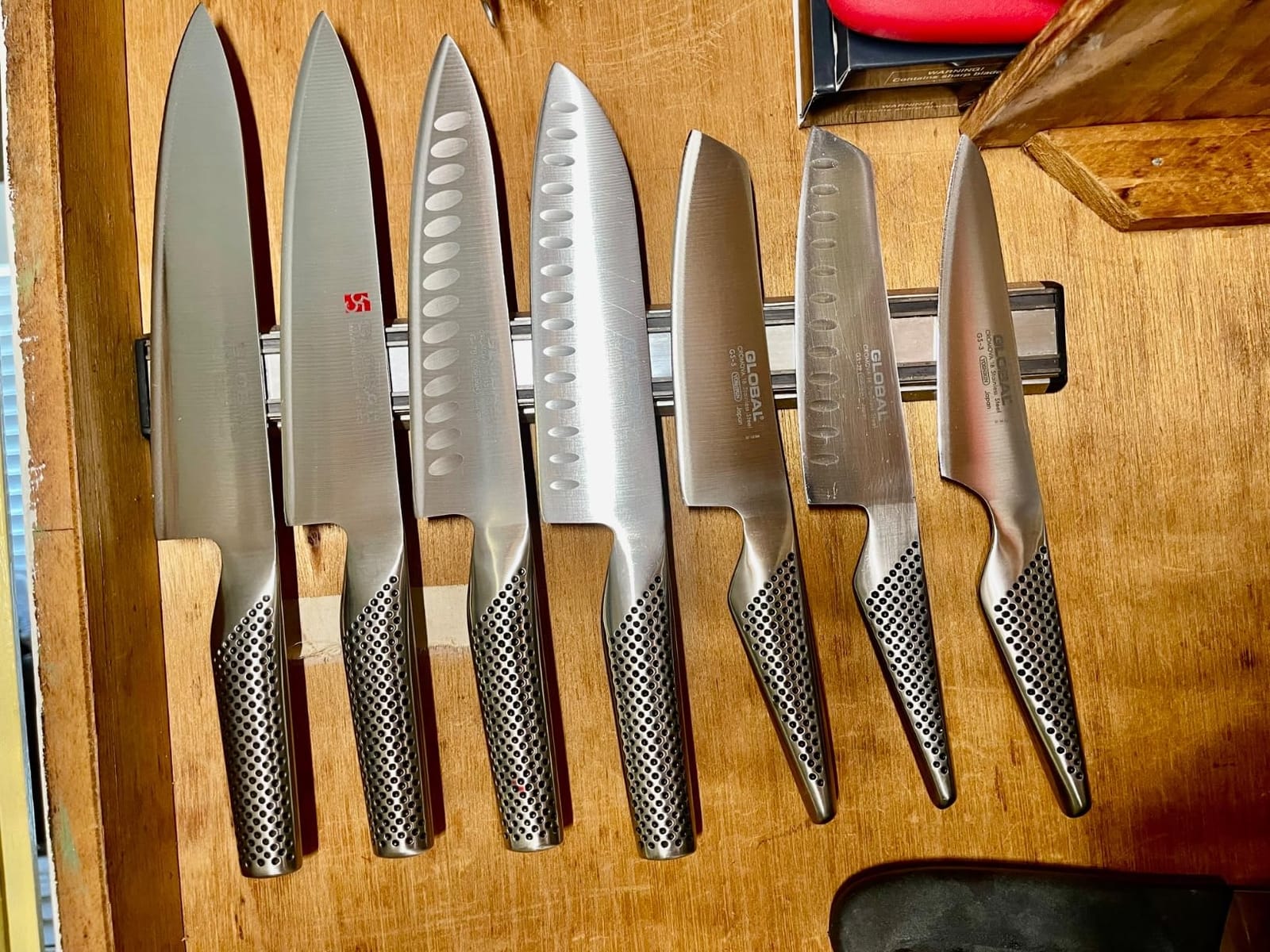
The hollow ground blade releases food as well as any knife we tested. Slices of cucumber fell away cleanly. Strips of beef for bulgogi lifted off the blade without sticking. The Cromova 18 stainless steel takes a wicked edge, and Global sharpens each hand at the factory to a 15-degree angle.
The trade-off is maintenance. The Global needs honing more often than harder Japanese blades. After about ten hours of cutting, the edge wanted attention. A few passes on a ceramic honing rod brought it back, but this is a knife for someone who does not mind a quick weekly touch-up.
Who should buy this
Cooks who want Japanese precision with a modern aesthetic. If you have small hands, the Global’s slim handle and light weight are a perfect fit.
Who should pass
If your hands get sweaty or if you do a lot of wet prep, the all-stainless handle can feel slippery. A wood or pakkawood handle grips better in those conditions.
How We Tested and Selected These Santoku Knives
Our testing ran for 12 weeks. We started by unboxing each knife, washing it by hand, and running it through a series of standardized cuts: a full yellow onion diced into 6mm pieces, a tomato sliced into 3mm rounds, a chicken thigh deboned, a daikon radish sliced into 2mm half-moons, and a pile of garlic minced fine. We timed each task and noted how the blade felt in the hand.
After the first round of cuts, we used each knife for a full week of normal home cooking. That meant real dinner prep, not laboratory conditions. We sliced kimchi cabbage, broke down whole chickens, and chopped herbs for banchan. We tracked edge retention by attempting a paper push-cut at the end of each week.
For edge retention, we sharpened every knife to a uniform baseline on a 1000-grit whetstone before testing. We then logged how many hours of cutting each blade could do before failing the paper test. We also noted how easy each knife was to resharpen, which matters because every santoku will need maintenance eventually.
Finally, we asked five home cooks with different hand sizes and grip styles to use each knife for one dinner prep. Their feedback on handle comfort, balance, and fatigue is folded into our ratings. We weighted cutting performance at 50 percent, comfort and balance at 25 percent, edge retention at 15 percent, and value at 10 percent.
Buying Guide: Choosing the Best Santoku Knife for Your Kitchen
The best santoku knife is the one that fits your hand, your cooking style, and your patience for maintenance. Here is what to weigh before you buy.
Blade steel matters more than you think
Japanese knives typically use harder steel (HRC 60 to 62), which holds an edge longer but chips more easily if mistreated. German knives use slightly softer steel (HRC 55 to 58), which is more forgiving but needs more frequent honing. If you are new to Japanese knives, the Tojiro or Mercer offer a soft landing. If you want top-tier edge retention, look at VG-10, VG-MAX, or SG2 core steels.
Handle shape decides comfort
Western handles (like Wusthof and Mercer) have a curved profile that fills the palm. Japanese handles (like Shun and Tojiro) tend to be lighter and shaped for a pinch grip. The Shun D-handle is contoured for right-handed use, while most Japanese knives have a symmetrical round or octagonal shape that suits both hands. Test the grip if you can. A knife that feels wrong in your hand will never become your favorite.
Hollow edge versus flat edge
Hollow edges (also called grantons) are the scalloped indentations on the blade sides. They create air pockets that reduce sticking when slicing starchy or wet foods. They are not magic, but they do help with potatoes, cucumbers, and cabbage. If you cook Korean food often, hollow edges are a quiet advantage for slicing banchan vegetables.
Blade length and weight
Most santokus run five to seven inches. A five-inch blade is nimble and great for small hands or tight spaces. A seven-inch blade gives you more cutting length for large vegetables and proteins. Anything over seven inches starts to lose the agility that defines a santoku. For weight, aim for something between six and ten ounces. Anything heavier will tire you during long prep sessions.
Bevel configuration
Most Japanese knives have an asymmetrical bevel, ground at a steeper angle on one side. This makes them extremely sharp but harder to sharpen at home. Western knives use a symmetric 50/50 bevel, which is easier to maintain with any sharpener. If you do not own a whetstone, choose a knife with a symmetric edge.
Budget reality check
A great santoku does not have to cost a fortune. The Mercer at under forty dollars will outperform many knives twice its price. Spend more for harder steel and longer edge retention if you cook daily. Spend less if you want a solid starter you can replace in a few years without regret.
Santoku vs Chef’s Knife: Which Should You Buy?
The santoku versus chef’s knife debate is the question I get most often from readers. The honest answer is that neither is universally better. They are built for different cutting motions.
A Western chef’s knife has a curved belly that lets you rock the blade through herbs and produce a fine mince with a circular wrist motion. It excels at that motion. A santoku has a flatter edge that rewards a straight up-and-down push cut. It excels at slicing and dicing, especially when you want uniform pieces.
For Korean cooking, I prefer a santoku. Most Korean prep work involves slicing vegetables into strips or rounds, not rocking through a pile of parsley. The santoku’s flat edge produces cleaner cuts through napa cabbage, daikon, and cucumber without bruising the cells.
If you already own an eight-inch chef’s knife and love it, keep it. The santoku is not an upgrade. It is a different tool for a different style. Many serious cooks end up owning both and reaching for whichever fits the task. If you have to pick one, ask yourself whether your cutting motion is more push-cut or more rock-chop. Push-cutters will love a santoku. Rock-choppers will be happier with a chef’s knife.
How to Care for Your Santoku Knife
A good santoku can last decades if you treat it right. Most premature knife deaths come from three mistakes: putting the knife in the dishwasher, leaving it wet, and using it on bones or frozen food. Avoid those, and your knife will outlast most of your other kitchen gear.
Hand wash and dry immediately
Even knives labeled dishwasher safe, like the Victorinox, will last longer with hand washing. Dishwasher detergent is harsh, and the heat cycle can damage handles and edges. Wash with warm water and mild soap, then dry with a cloth before you put the knife away. Never let it air dry, especially if it has a high-carbon core.
Hone weekly, sharpen monthly
Honing realigns the edge. It does not remove metal. Run your blade down a honing rod at a 15-degree angle, alternating sides, before each big prep session. Sharpening actually grinds away metal to create a new edge. Depending on use, you will need to sharpen every one to six months. A 1000-grit whetstone is the best tool for most Japanese knives. Western knives can also be sharpened on a pull-through sharpener in a pinch.
Store it safely
A magnetic strip, an in-drawer knife organizer, or a blade guard all work. What you want to avoid is a loose drawer where the blade bangs against other tools. Edge damage happens fast in that environment. If you travel with your knife, use the leather sheath that comes with the Dalstrong or buy a saya (wooden sheath) for Japanese knives.
Cut on the right surface
Wood and plastic cutting boards are gentle on edges. Glass, marble, and stone boards will dull any knife in a single session. If you have a beautiful marble pastry board, use it for rolling dough, not slicing vegetables.
Know when to retire or repair
If your knife has chips in the edge that home sharpening cannot fix, it is time for professional repair. Most knife shops and some mail-in services can reset a damaged edge for a fraction of the cost of a new knife. If the handle is loose or cracked, contact the manufacturer. Wusthof, Shun, Mercer, and Victorinox all offer lifetime or long warranties against defects.
Frequently Asked Questions
Which brand of Santoku knife is considered the best?
Mac Knife is the most consistently recommended santoku brand among both professional testers and home cooks. The Mac Knife Professional series combines sub-zero tempered steel, balanced weight, and a sharp factory edge that holds up to daily use. Other top-rated brands include Shun, Wusthof, and Tojiro, each excelling at different price points and cutting styles.
What are the top 5 Japanese knife brands?
The top five Japanese knife brands for santokus are Mac Knife, Shun, Tojiro, Misono, and Global. Mac is known for razor-sharp sub-zero tempered steel. Shun produces handcrafted Damascus-clad blades. Tojiro offers the best value with VG-10 cores. Misono is favored by professional chefs for hand-finished edges. Global is recognized for modern stainless one-piece designs.
How often do I need to sharpen a santoku knife?
A santoku knife needs honing every week or two and full sharpening every one to six months depending on use. If you cook daily, plan to sharpen monthly. For occasional cooks, every three to six months is fine. Test sharpness by trying to slice a tomato without crushing it, or by attempting a push-cut on a piece of paper.
Santoku vs chef knife – which is better?
Neither is universally better. Santokus have flatter edges that reward straight push cuts and excel at slicing and dicing vegetables into uniform pieces. Chef’s knives have curved bellies that support a rocking motion ideal for mincing herbs and rapid chopping. For Korean cooking, which leans heavily on sliced vegetables, most cooks prefer a santoku.
Should I get a santoku with or without grantons (hollow edges)?
Grantons are worth choosing if you slice starchy or wet foods often. The hollow indentations create air pockets that prevent slices from clinging to the blade. They make a noticeable difference with potatoes, cucumbers, and cabbage. If you mostly slice proteins and dry ingredients, a flat edge is fine.
What is the best santoku knife for beginners?
The Mercer Culinary Genesis and Victorinox Swiss Classic are the best santoku knives for beginners. Both are affordable, sharp out of the box, and forgiving of mistakes. The Mercer has a grippy Santoprene handle that stays secure with wet hands. The Victorinox is dishwasher-safe and ultralight, ideal for small hands or first kitchens.
Final Verdict
After three months of slicing, dicing, and mincing our way through eight of the best santoku knives on the market, three stood out. The Mac Knife Professional 6.5-Inch is our top pick for its balance, edge retention, and Japanese precision. The Mercer Culinary Genesis 7-Inch is the best value if you want real cutting performance without spending triple digits. The Victorinox Swiss Classic 7-Inch is the budget champion for new cooks and small kitchens.
Whichever knife you choose from this list, treat it well. Hand wash, hone weekly, and sharpen on a whetstone when the edge fades. A good santoku is a tool that will reward you for decades. If you cook Korean food at home, a santoku will change how you slice cabbage, daikon, and garlic, and you will not go back to a chef’s knife for banchan prep.
Ready to upgrade your kitchen? Pick the knife that fits your budget and hand size, then put it to work. Your next batch of kimchi will thank you.
1 thought on “8 Best Santoku Knives (October 2026) Top Tested”