
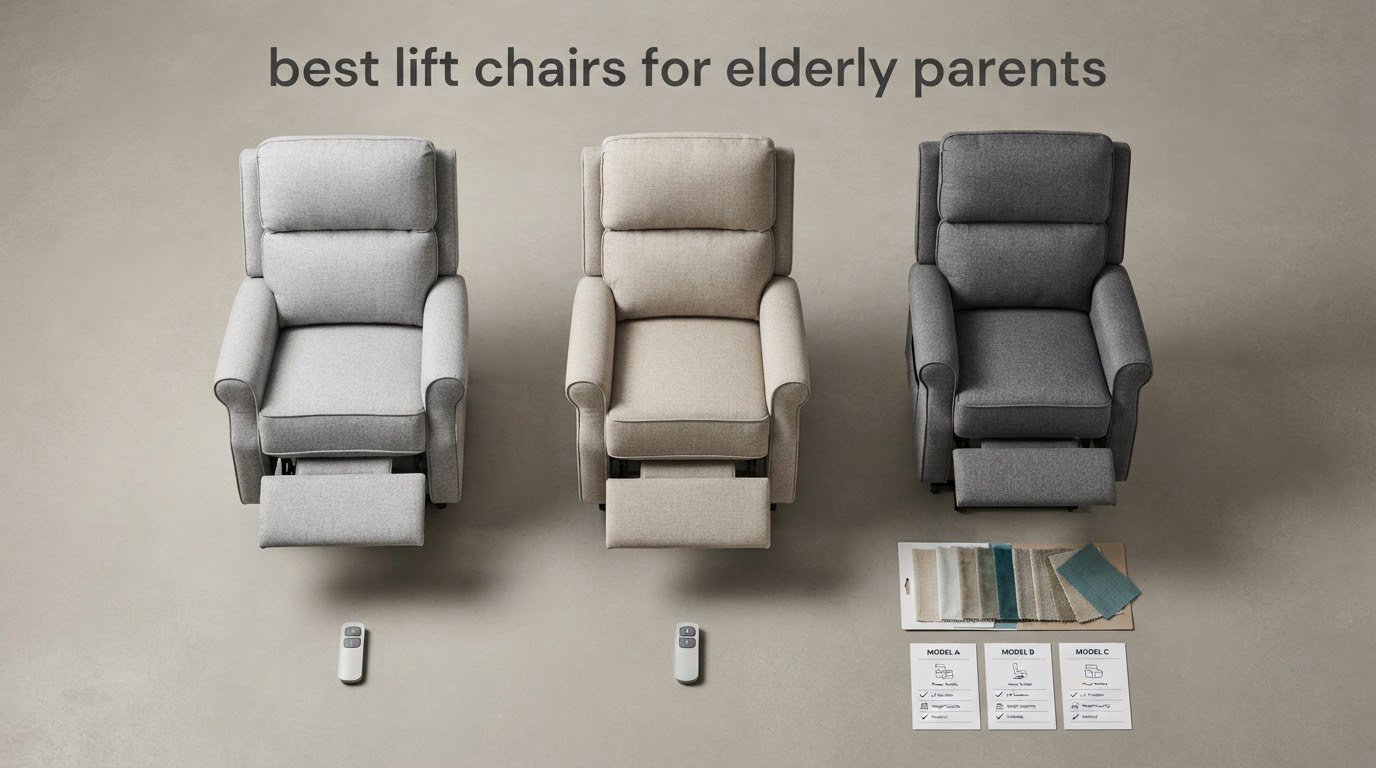
If your parent has started bracing an arm against the couch, rocking forward to get up, or asking someone to haul them out of a regular armchair, you are looking at the moment most caregivers start searching for the best lift chairs for elderly parents. Difficulty rising from a chair is one of the earliest warning signs of reduced mobility, and the sit-to-stand motion is exactly where a lot of falls happen.
A power lift chair is a motorized recliner whose seat tilts forward and upward on a powered mechanism, bringing the sitter to a near-standing position at the press of a remote button. That removes the pushing, the rocking, and the tight arm grip that most older adults rely on, and it is the single change that buys back independence for parents who still want to move around their own home.
We spent weeks comparing the specifications, seat geometry, weight limits, motor types and review histories across the chairs below, and we grouped them by the way caregivers actually shop: first by whether the parent needs one motor or two, then by body size, then by how much room you have. We also cover the parts no roundup usually mentions, including delivery, warranty, and the awkward first two weeks when the chair feels strange to your parent. For parents who also need help with personal care, our bidet guide for elderly users covers a related piece of the same conversation.
Table of Contents
Which lift chair brands are worth it?
No single brand wins every category, so the honest answer is that MCombo, CANMOV, CDCASA and MAHOMICO are the brands worth serious attention at 2026 price points, while the largest review bases and the most consistent build quality sit with MCombo. Three MCombo chairs appear in this roundup for that reason. What matters more than the logo is the motor, the weight rating, and whether the seat dimensions match the person who will sit in it.
Top 3 lift chairs for elderly parents in 2026

MCombo 7040 Power Lift Recliner
- Counter-balanced TUV actuator
- 140 degree recline
- 8-point vibration massage
- Lumbar heat
- Dual USB and two cup holders

MCombo 7287 Fabric Lift Chair
- No massage or heat
- Extended 4.7 inch footrest
- 140 degree recline
- 3.9 inch cup holder with USB and Type-C

MCombo 7890 Dual Motor Lift Chair
- Dual motors with independent movement
- 165 degree lay flat
- Zero gravity position
- 8-point massage and lumbar heat
All 8 lift chairs compared in 2026
| Product | Specifications | Action |
|---|---|---|
| MCombo 7040 Power Lift Recliner |
|
Check Latest Price |
| MCombo 7287 Fabric Lift Chair |
|
Check Latest Price |
| MCombo 7890 Dual Motor Lift Recliner |
|
Check Latest Price |
 CANMOV Large Power Lift Recliner CANMOV Large Power Lift Recliner |
|
Check Latest Price |
 MAHOMICO Power Lift Chair MAHOMICO Power Lift Chair |
|
Check Latest Price |
 CDCASA Oversized Dual Motor Recliner CDCASA Oversized Dual Motor Recliner |
|
Check Latest Price |
 RESTREAL Dual Motor Leather Lift Chair RESTREAL Dual Motor Leather Lift Chair |
|
Check Latest Price |
 Trustyue Dual Motor Lay Flat Lift Chair Trustyue Dual Motor Lay Flat Lift Chair |
|
Check Latest Price |
1. MCombo 7040 Power Lift Recliner – best overall lift chair for a parent who wants heat and massage
MCombo Power Lift Recliner Chair for Elderly, Heat and Massage 7040(Medium)
Counter-balanced TUV actuator
140 degree recline
350 lb capacity
105 lbs chair weight
Pros
- Counter-balanced lift mechanism genuinely assists standing
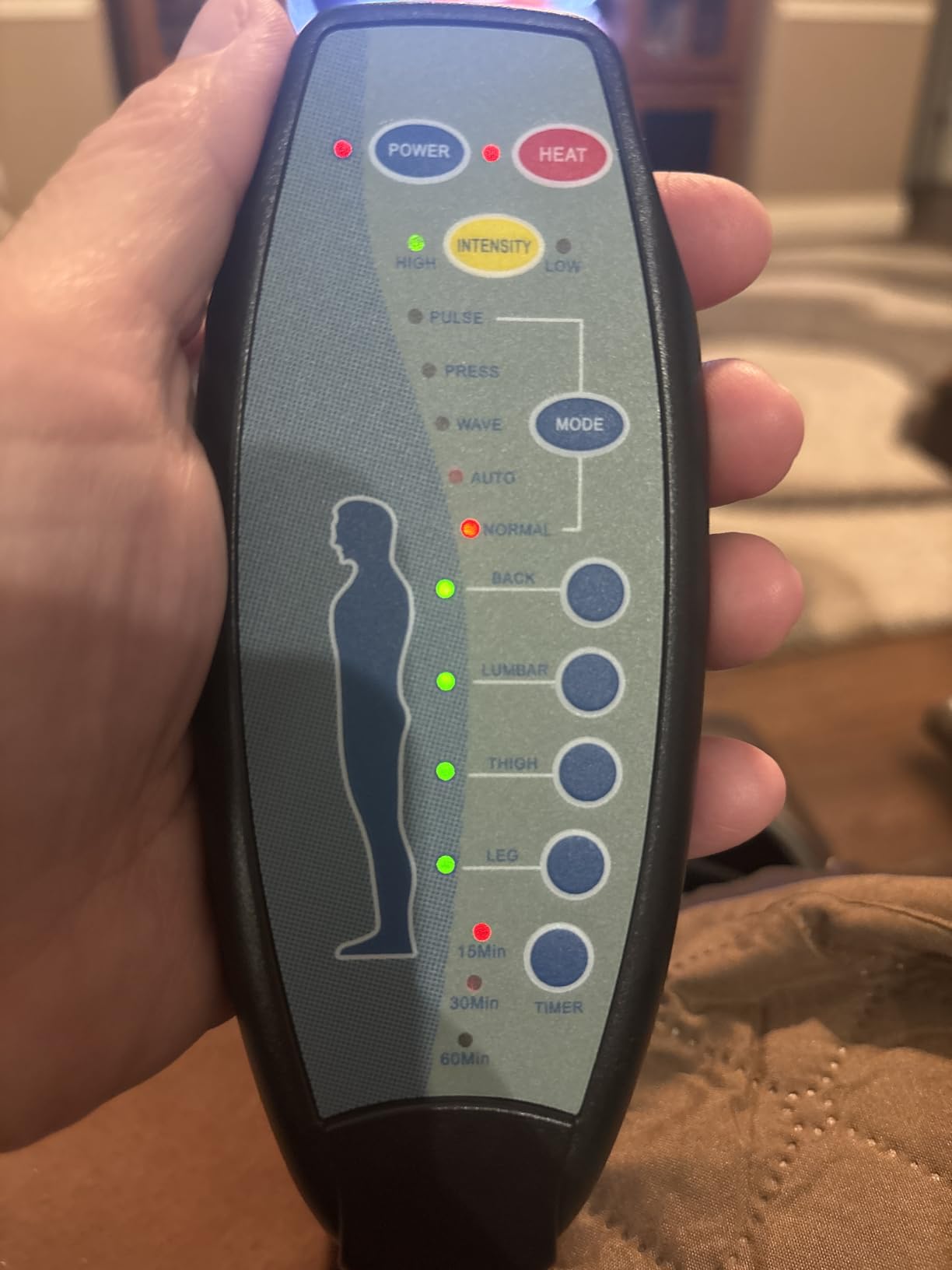
- 8-point vibration plus independent lumbar heating
- Dual USB ports and two cup holders within reach
- Tool-free assembly in about 15 minutes
- Faux leather wipes clean for caregiving
Cons
- Faux leather can feel slippery during the lift motion
- Footrest massage nodes uncomfortable on feet and ankles
- Medium and large sizes run narrower than buyers expect
- Tethered remote can be knocked to the floor
This is the chair we keep coming back to. The lift mechanism uses a counter-balanced actuator, which is the single most important spec on the whole list, because it means the seat assists the standing motion instead of just resisting it. One of the longest-running customer stories in this category sits on a listing from this brand, where a 98 year old was still using her chair after four years.
Owners credit the mechanism for helping a parent stand safely, and the massage and lumbar heat get described as a welcome addition rather than the reason for buying. Assembly is tool-free and takes about fifteen minutes, which matters more than it sounds when the person you are assembling it for cannot bend to the floor.
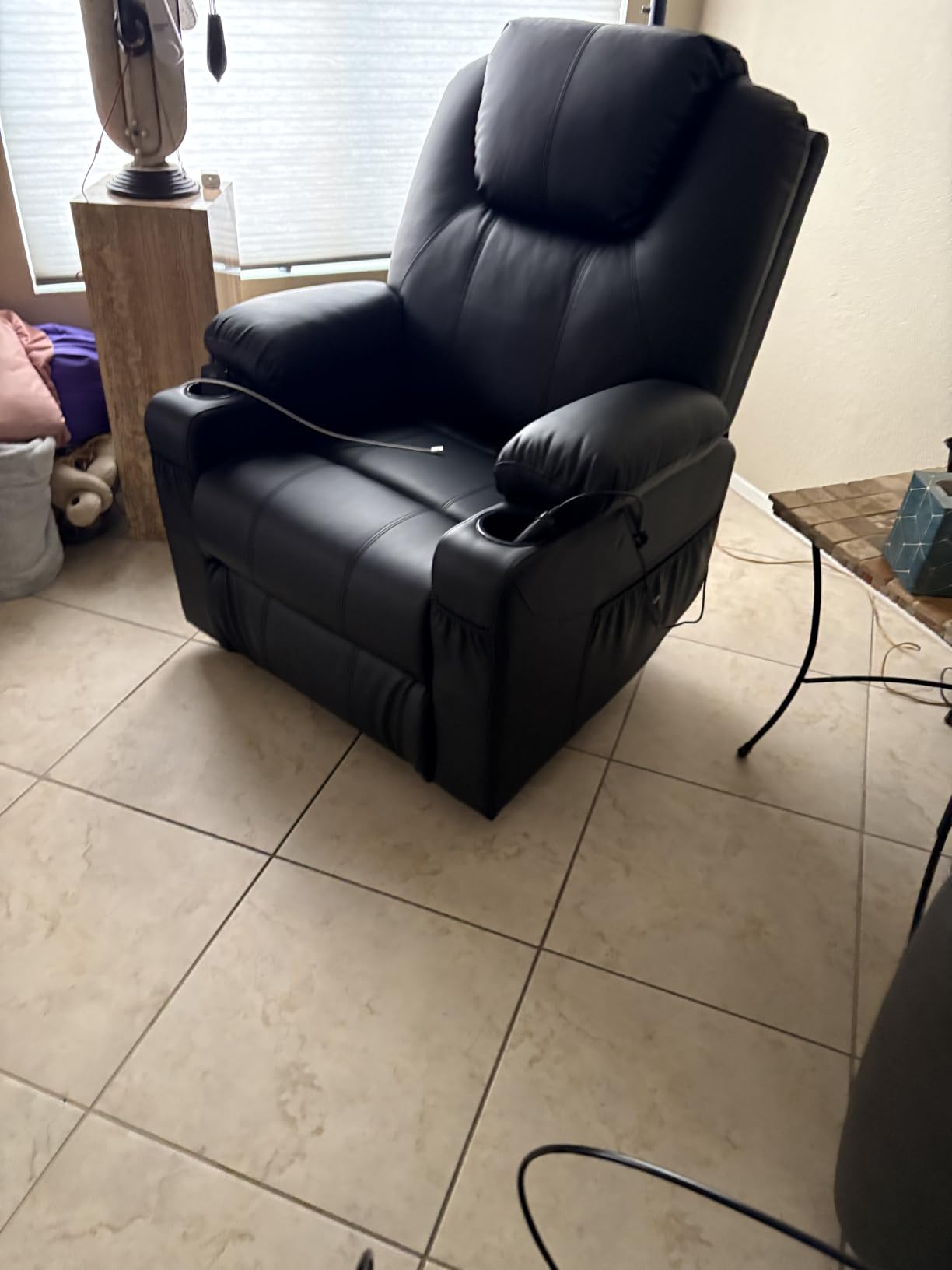
The numbers: seat height 18 inches, seat depth 20.5 inches, backrest width 31.5 inches, arm height 25.6 inches, and a 140 degree maximum recline across three positions. Recommended user height runs 5 foot 1 inch to 5 foot 9 inch, and the weight recommendation tops out at 350 pounds. The frame is FSC certified wood over alloy steel, and the warranty runs two years on mechanisms, electrical parts, upholstery and frame.
Two caveats show up repeatedly in reviews. The faux leather is smooth enough that some people slip slightly during the lift motion and recommend putting a rug under the chair, and the footrest massage nodes are not comfortable for everyone, particularly on the feet and ankles. The tethered remote is also a genuine annoyance: it can be knocked to the floor and is awkward to retrieve from under the chair.
Is the 7040 comfortable for long sitting?
For someone spending four to six hours a day in the chair, the foam fill and the 31.5 inch backrest width do most of the work. It is a medium frame, so it suits a parent in that 5 foot 1 inch to 5 foot 9 inch range, and the 18 inch seat height is on the lower side, which makes standing up easier but can be harder on the knees when getting down into it.
One MCombo listing carries a long-form review from a 98 year old who had four years of daily use on it, which is the kind of longevity evidence that matters more here than any first impression. Customer service also resolved defective units with fast replacement chairs rather than repair cycles.
Who should not buy the 7040?
Skip it if your parent needs independent leg elevation for edema, because a single-motor three-position chair moves the backrest and footrest together. It is also the wrong pick for anyone who wants a near-flat sleeping position, and the faux leather is not ideal for a parent with incontinence even though it wipes down easily.
Check the sizing carefully before ordering. Buyers regularly report that the medium and large sizes run narrower than they expected, and if the parent is near the top of the recommended height range, an oversized frame may be a better fit.
2. MCombo 7287 Fabric Lift Chair – the plain chair that just does the one job well
MCombo Power Lift Recliner for Elderly, Fabric 7287 (Dark Gray, Medium)
No massage or heat
4.7 inch extended footrest
350 lb capacity
3 recline positions
Pros
- Highest average rating in the group at 4.5
- Simplified design means fewer components that can fail
- Extended footrest supports feet without cutting off circulation
- Soft fabric is skin friendly and easy to spot clean
- Tool-free assembly in about 15 minutes
Cons
- No massage or heat function
- Medium size suits users roughly 5 foot 1 inch to 5 foot 9 inch only
- Only three recline positions
There is a real editorial argument for buying the boring chair. This one strips out every electronic extra and keeps the lift mechanism, and it carries the highest average rating in the whole group at 4.5 across nearly 3,900 reviews. The thesis behind that choice is simple: heat and massage are nice, and the motor is what actually gets your parent from sitting to standing.
Reviewers appreciate a straightforward chair that does the core job without added electronic complexity. Fewer motors and fewer heating elements also mean fewer things that can fail, and the two-year limited warranty is on par with the rest of this lineup.
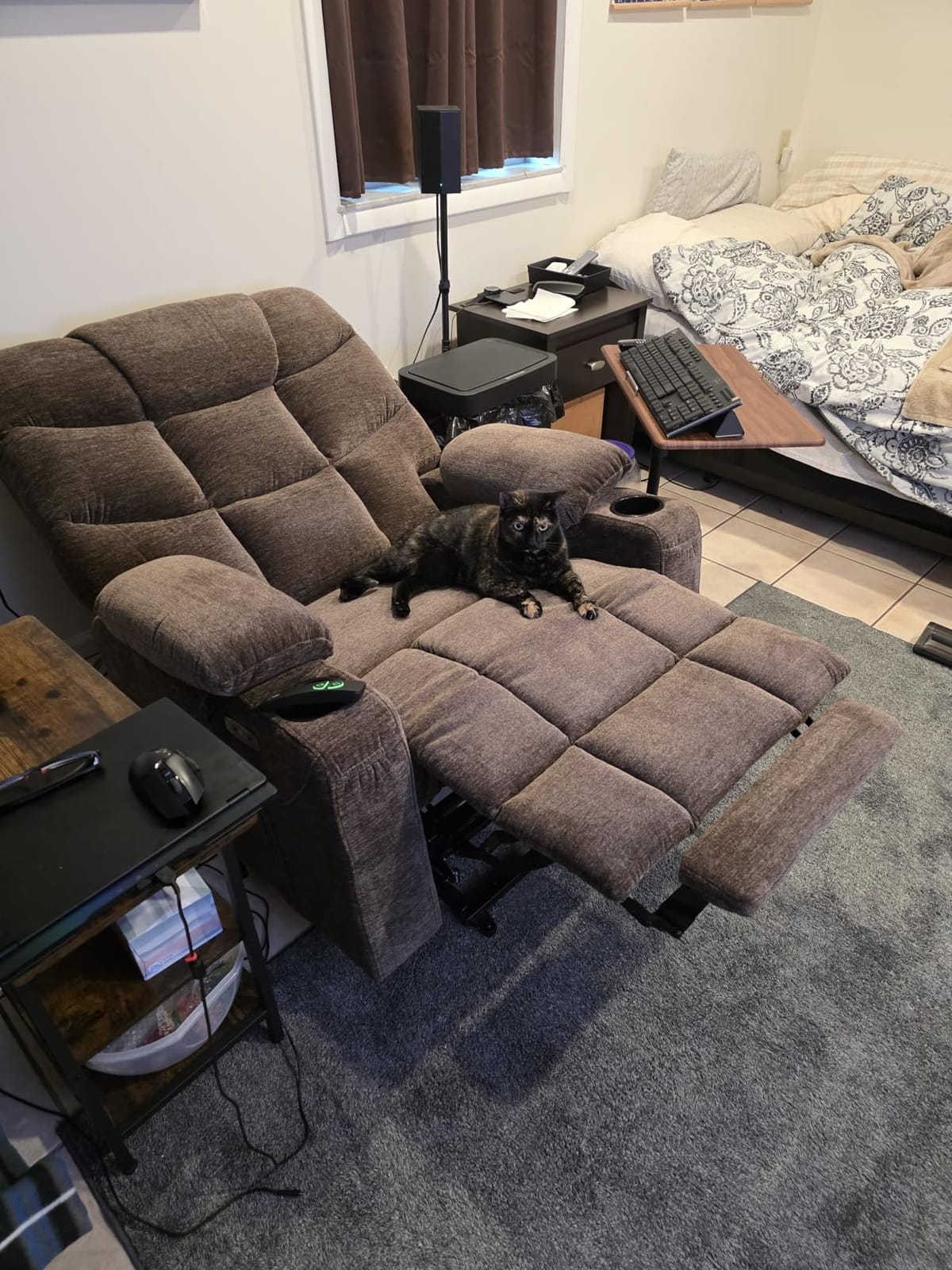
The measurements: seat height 18.9 inches, seat depth 21.3 inches, backrest width 29.9 inches, arm height 24.4 inches, 140 degree maximum recline. Recommended height is 5 foot 1 inch to 5 foot 9 inch, weight recommendation 350 pounds, and the chair itself weighs 107 pounds. Storage is generous, with a 3.9 inch deep cup holder, USB and Type-C ports, and multiple pockets. The frame is FSC certified wood.
The most common complaint is simply the absence of massage and heat, which buyers who want pain relief features will need to look elsewhere for. The dark gray textile is described as skin friendly and easy to spot clean, which is a better trade in a caregiving household than a slippery faux leather surface.
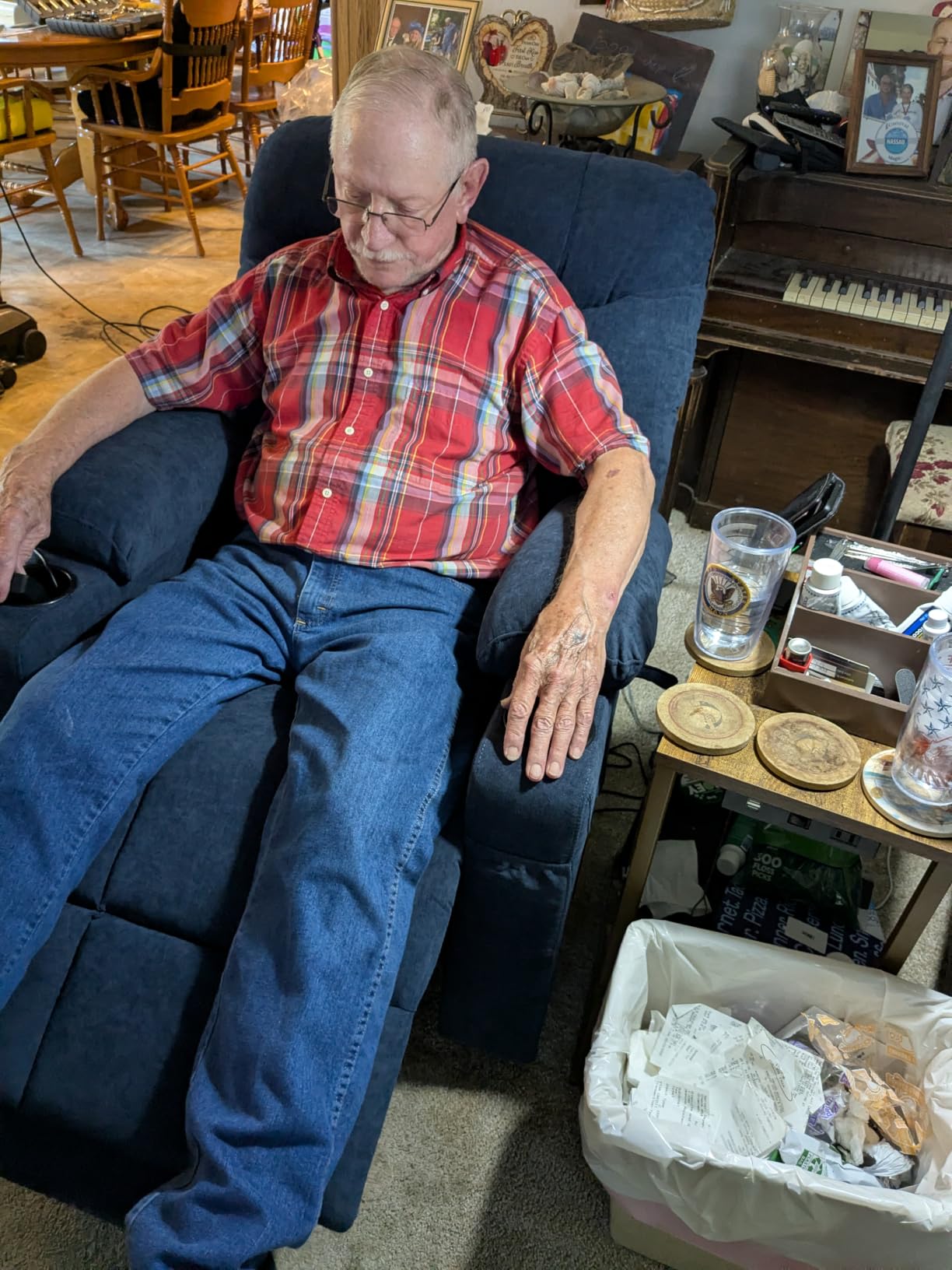
Why does the extended footrest matter?
The 4.7 inch extended footrest is the detail that separates this from a basic chair. When a parent sits for long stretches with their legs unsupported, pressure behind the knees builds up, and an extended footrest that supports the feet without cutting off circulation is the difference between a chair someone tolerates and one they settle into.
With a 140 degree recline and 18.9 inch seat height, the posture is closer to a deep recliner than a flat bed. That makes it comfortable for evening naps and for a parent who naps in their chair, but it is not a substitute for a bed for overnight sleep.
Where this chair falls short
Three recline positions is the main limit, and for a parent who wants to fine-tune the angle through the day, the lack of infinite adjustment is noticeable. The fabric also absorbs more than leather would, which is a consideration if the parent has any continence issues.
If the parent specifically wants massage and heat, this chair will not deliver it, and the alternative in the same brand is the 7890 below. Both share the same general footprint family, so switching models does not mean rethinking the room.
3. MCombo 7890 Dual Motor Lift Recliner – Premium Pick for a parent who needs real positioning
MCombo Dual Motor Power Lift Recliner Chair for Elderly, Massage Heat 7890
Dual motors, independent movement
165 degree lay flat
Zero gravity position
20.1 inch seat height
Pros
- Independent backrest and footrest adjustment plus true lay flat
- Zero gravity position is hard to find on cheaper chairs
- 20 inch seat height is easier to stand up from
- Firm supportive cushioning and stable lift
- Customer service swapped a faulty unit quickly
Cons
- Cup holder placement forces short armrests
- Fabric is softer and fluffier than the photos suggest
- Motors run slowly when fully reclined
- Heavy base box needs two people to move
This is the chair we recommend when a parent has a specific positioning need rather than a general standing problem. The dual motors drive the backrest and the footrest independently, which means the footrest can stay raised while the back comes forward, or the chair can be stopped partway through the lift. That independence is what you want for edema, for breathing trouble, or for a parent who genuinely sleeps in the chair.
Owners also value the firm, supportive seat cushioning and the ability to stop the lift at any point while standing. The fabric is OEKO-TEX certified on an FSC certified wood frame, and customer service is repeatedly described as quick to swap out a unit with a heat or massage fault.
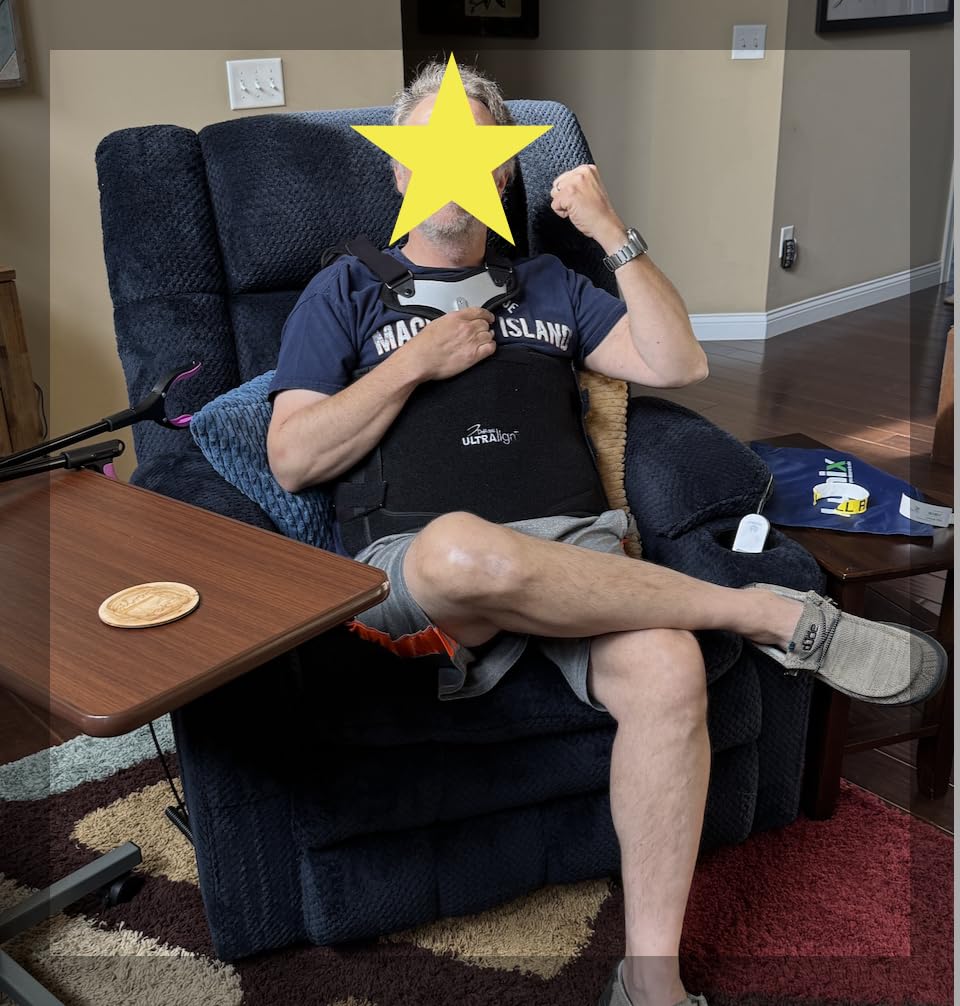
The geometry is roomier than the single-motor chairs here: seat height 20.1 inches, seat depth 23.6 inches, backrest width 32.7 inches, arm height 26.4 inches, and a 165 degree maximum recline described as lay flat. Recommended user height is 5 foot 3 inch to 5 foot 9 inch and the weight recommendation is 350 pounds. The chair weighs 121.3 pounds, and the tool-free assembly takes about 20 minutes.
Two design details frustrate some buyers. The cup holder placement forces shorter armrests, which is uncomfortable to rest your arms on, and the fabric is fluffier and softer than the listing photos suggest. Reviewers also note the motors run slowly when fully reclined, and that the heavy base needs two people to move it into place.
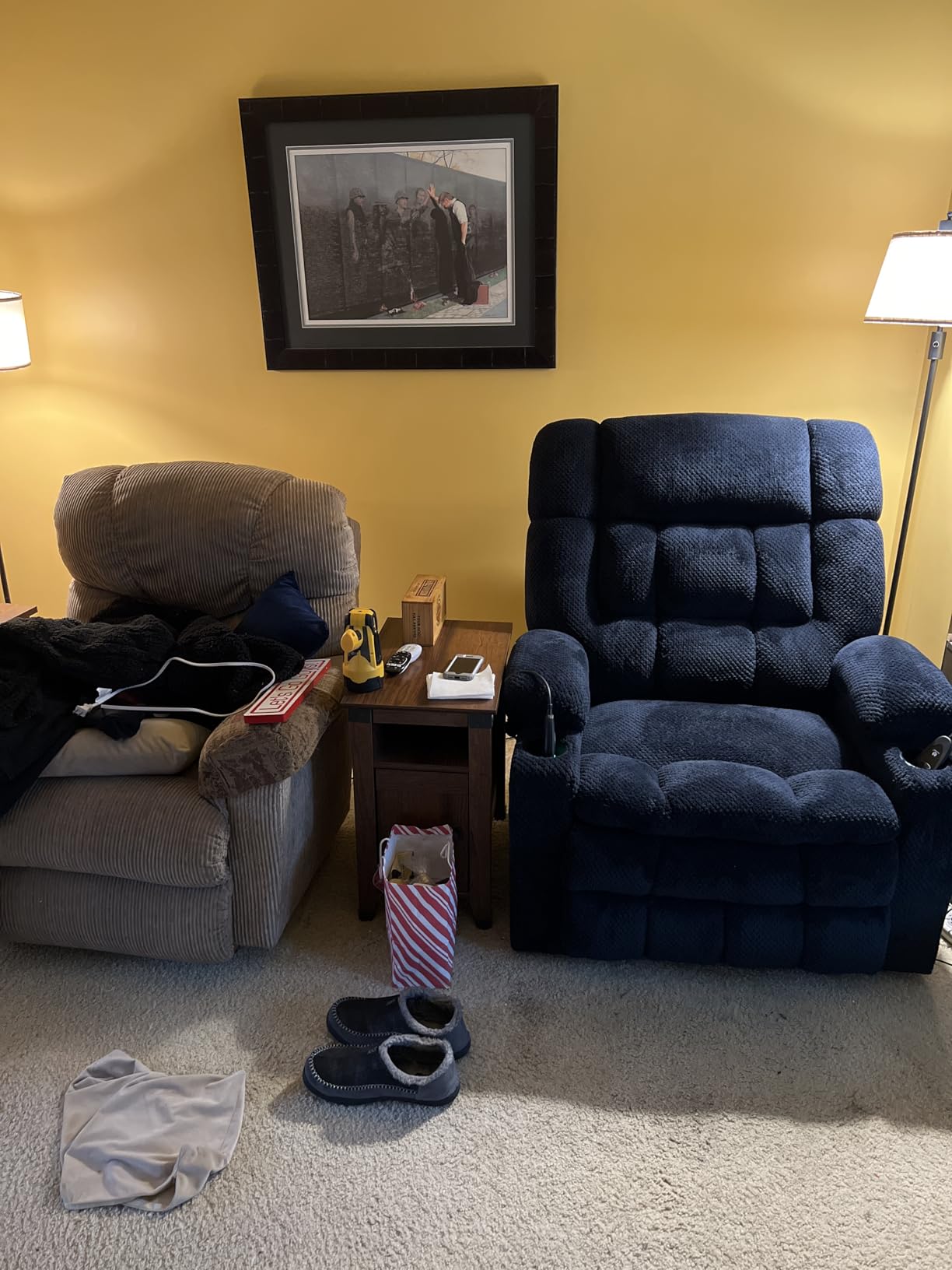
When does a parent actually need two motors?
Two motors matter when the leg position and the torso position need to move independently. For edema and leg swelling, a single-motor chair that drops the back at the same time the footrest rises is not enough, because the parent cannot get the legs above heart level without also lying back. For COPD, heart failure, or GERD, the same independence works in reverse, letting the back stay elevated while the legs stay down.
The zero gravity position is the other reason. It distributes weight across the back in a way that many people find more comfortable for an hour of napping than a standard reclined position, and it is genuinely rare on chairs at this level.
Who will not like the 7890?
If your parent is short, the 20.1 inch seat height is a real consideration. A taller seat makes standing up easier but means the feet may sit at a steeper angle, and for some shorter users that produces pressure behind the thighs. The short armrests are also a genuine drawback for anyone who uses the arms as a handhold getting up.
The 350 pound weight limit is the same as the other MCombo chairs here rather than higher. If your parent is anywhere near that number, add headroom and look at the 400 pound models further down.
4. CANMOV Large Power Lift Recliner – best for a bigger parent who needs a wider seat
CANMOV Large Power Lift Recliner Chair with Massage and Heat for Elderly Big and Tall People, Overstuffed Wide Recliners with 2 Cup Holders, Side Pocket and USB Port, Camel
21 inch wide seat
450 lb capacity
20.8 inch seat height
5 massage modes
Pros
- Genuinely wide seat and extended backrest for big and tall users
- 450 pound capacity is the highest in this group
- Five massage modes across eight points
- Iron frame with anti-tipping device
- Free replacement for installation problems or damaged parts
Cons
- Backrest is only 27 inches wide despite the wide seat
- Only three recline positions
- Single motor moves backrest and footrest together
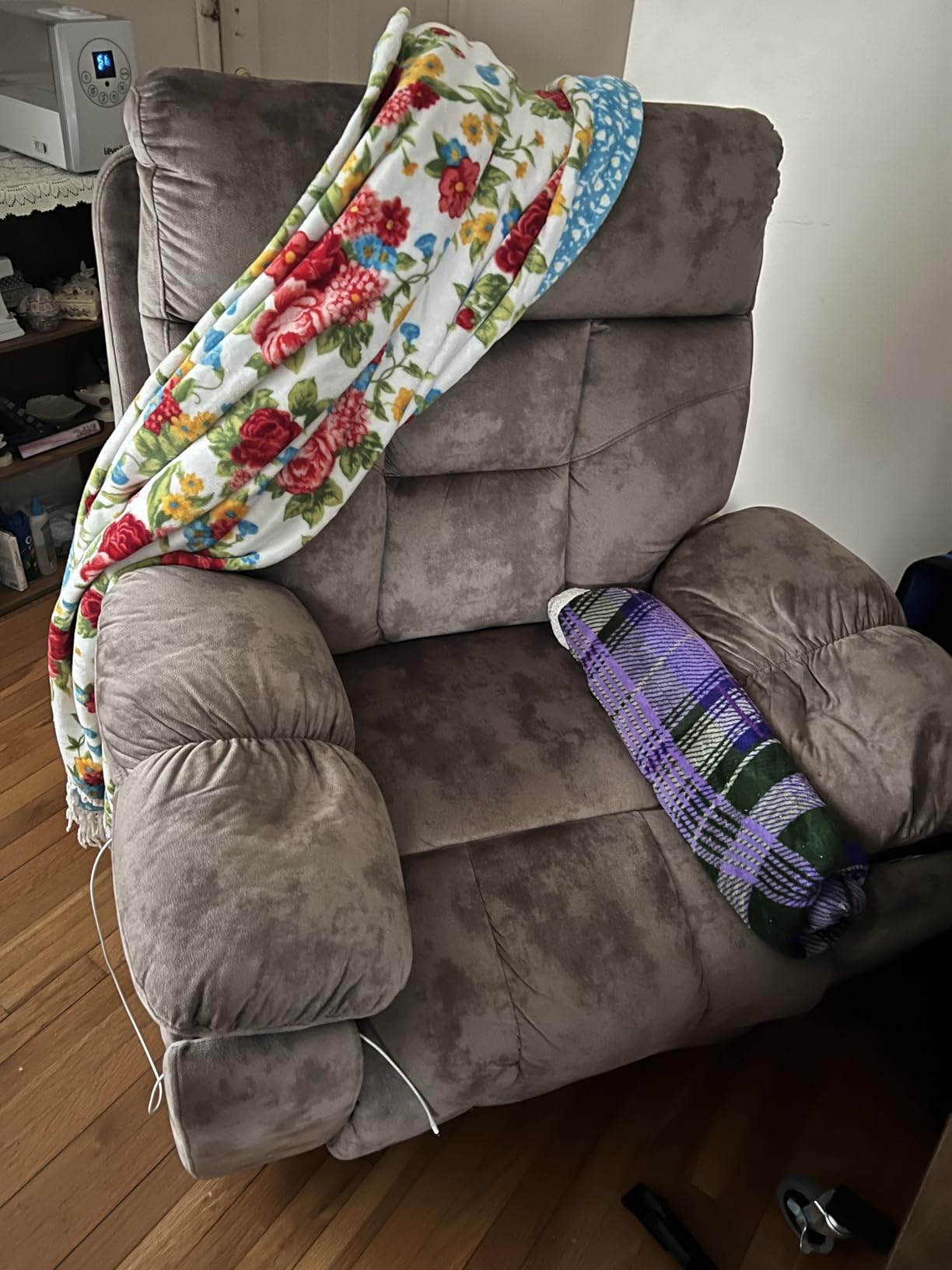
Most lift chairs are designed around a body that is smaller than the one in front of them. This one is not. The seat is 21 inches wide with a 30 inch extended backrest length, and the weight recommendation is 450 pounds, the highest in this group. For a parent who has felt cramped in a standard recliner, that extra width changes the day-to-day experience more than any feature on the remote.
The 20.8 inch seat height is also among the taller here, and combined with the anti-tipping device on the iron frame it gives a stable base for a heavier sitter. Buyers single out the roomy seat height and width as the main benefit, along with the massage and heat functions.
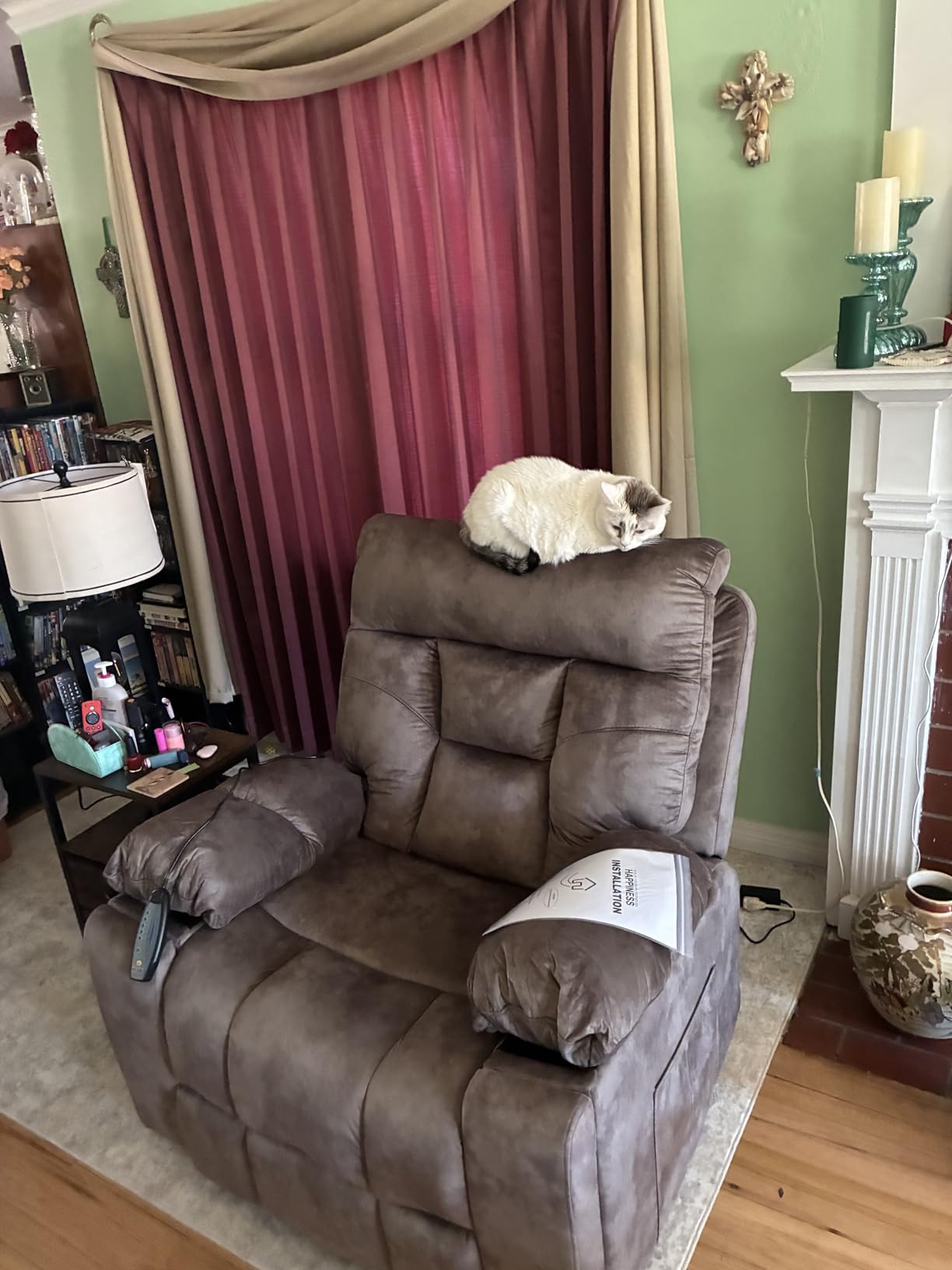
Measurements: seat height 20.8 inches, seat depth 22 inches, backrest interior height 26.8 inches, backrest width 27 inches, and three recline positions. Overall dimensions are 38 inches deep by 39 inches wide by 43 inches high, and the chair weighs 100 pounds. The frame is FSC certified wood with an iron structure, assembly is tool-free, and the warranty is one year with free parts exchange.
Here is the catch that trips people up: the backrest is only 27 inches wide even though the seat is advertised at 21 inches. Buyers find the seat roomy and the back narrow at the same time, so a parent with broad shoulders may still feel hemmed in. Recline is limited to three positions, and the single motor moves the backrest and footrest together.
Is the wide seat real?
Yes, and it is worth measuring before you order. A 21 inch seat width and 22 inch seat depth genuinely fits a larger adult where a 20 inch wide standard chair squeezes them. The frame is oversized overall at 39 inches wide, so this is not a chair for a tight corner or a narrow hallway, and it needs a plan for where the footrest extends.
The 450 pound rating gives useful headroom for a parent who weighs 380 or 390 pounds. That margin matters because a chair rated at or barely above a person’s weight gives no reserve as the mechanism ages, and heavier users generate more wear on the scissor mechanism over time.
Who is the wrong fit?
Anyone who needs independent leg elevation, since the single motor cannot raise the footrest without dropping the back. It is also the wrong pick if overnight sleep matters, because three positions and a linked back and footrest will not get anyone close to flat.
Reviewers note the overstuffed cushioning is softer than most chairs in this class, which some people love and some find insufficiently supportive for long hours. If your parent is on the lighter side, check whether the depth leaves their feet hanging short of the footrest edge.
5. MAHOMICO Power Lift Chair – budget pick with more features than the price suggests
MAHOMICO Power Lift Recliner Chair for Elderly with Vibration Massage and Lumbar Heating,Electric Lift Recliner Single Sofa with Side Pocket,Two Cup Holders and USB Charge Port for Living Room
23.62 inch extra-wide seat
135 degree recline
350 lb capacity
97.3 lb chair weight
Pros
- Lowest cost in this group while still including massage and heat
- Extra-wide 23.62 inch seat suits larger body types
- Lightest frame here at 97.3 pounds
- Infinite electric recline angles up to 135 degrees
- USB port
- cup holder and roomy side pockets
Cons
- Lowest average rating in the group at 4.0 with a 12 percent one-star share
- Only two listed recline positions despite the infinite-angle wording
- Metal frame feels less substantial than wooden frames
- 1-year warranty is shorter than the 2-year coverage elsewhere
Value is the entire argument for this chair. It includes a power lift, 8-point vibration massage, lumbar heating, an extra-wide seat and a USB port, and it is the least expensive chair in this roundup. The frame also weighs only 97.3 pounds, which makes it the easiest to reposition, and that matters in a home where the chair may need to move to clean behind it.
It is not for everyone. The average rating is 4.0, the lowest in this group, with roughly a 12 percent share of one-star reviews. Buyers who like it respond to the width, the feature count and the light weight, while skeptics point to the metal frame and the specification that does not match the marketing.
Does the infinite recline claim hold up?
Partly. The product page describes infinite electric recline angles up to 135 degrees, but only two recline positions are actually listed in the specifications. That gap between the marketing language and the documented positions is the most common reason buyers walk away.
At 23.62 inches, the seat is the widest in this group, and the 19.3 inch seat height is a good middle ground for standing up. The backrest interior height of 28.5 inches is the tallest here too, which suits a longer torso.
What are the real drawbacks?
The metal frame is the honest concern. It feels less substantial than the wooden frames on the other models here, and for a parent who uses the armrests as a handhold, that matters. The 1-year warranty is half the coverage MCombo offers, and replacement remotes on a shorter-warranty chair are worth asking about before you commit.
If your parent weighs more than 300 pounds or has significant balance issues, the lighter frame and lower rating make this a harder recommendation than the same feature set on a wooden-frame chair.
6. CDCASA Oversized Dual Motor Lay Flat Recliner – best for a parent who sleeps overnight in the chair
CDCASA Oversized Dual Motor Lay Flat Power Lift Recliner Chair, Grey
Dual OKIN motors, 180 degree lay flat
400 lb capacity
23.6 inch seat depth
Infinite position lock
Pros
- Dual motors lay genuinely flat at about 180 degrees
- 400 pound capacity with a 23.6 inch seat depth
- Very soft plush textile and padded arms suit post-surgery comfort
- Customer service repeatedly praised for fast resolutions
- 8 massage points with 4 custom areas and 5 vibration modes
Cons
- Motor transitions are slow and the back and footrest geometry can feel awkward
- Backrest is concave rather than flat
- Some units report binding or popping noises after a few days
- Oversized armrests can be too large for shorter users
- Cup holders are shallower than they look
This is the pick when a parent is genuinely going to sleep in the chair, which happens more often than most shopping guides admit. The dual OKIN motors drive the backrest from 100 to 180 degrees and the footrest from 90 to 180, with infinite position lock, so the chair reaches a true flat position rather than stopping at an angle.
At 400 pounds of capacity and a 23.6 inch seat depth, it also handles a larger sitter than most. The soft high rebound sponge and the padded arms are described as well suited to post-surgery comfort, when lying on a firm surface is not an option.
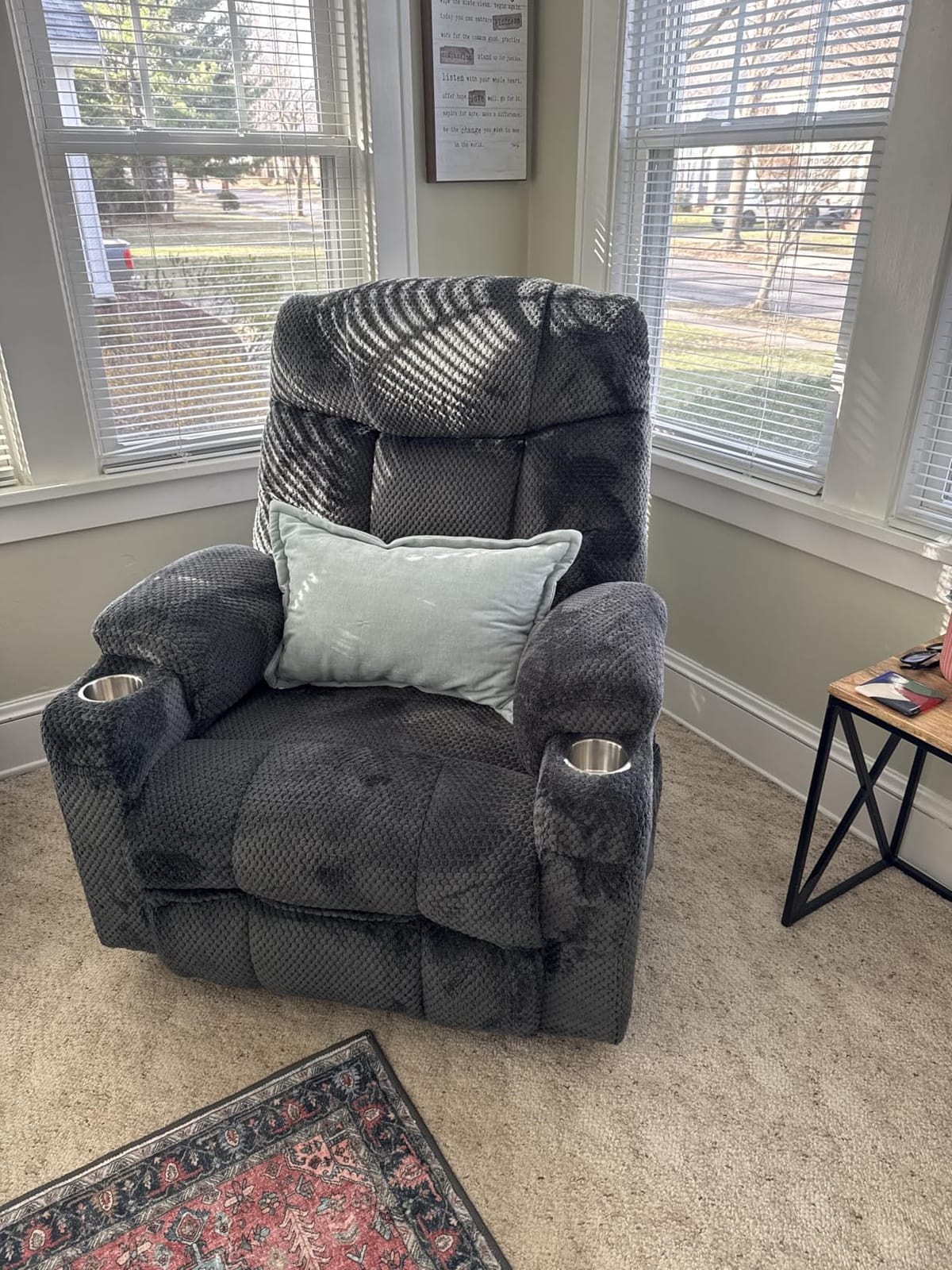
The frame is alloy steel and rubberwood with high density foam, and the backrest is described as high density foam over formaldehyde-free CARB P2 wood. The chair weighs 111.6 pounds and measures 40 inches deep by 36.2 inches wide by 44.5 inches high. It arrives in three packages with a 10 to 15 minute installation, and the warranty is one year with a 30-day replacement or refund window.
The concave backrest is the detail most worth knowing in advance. Some shorter users find they need an extra pillow because the back curves rather than lying flat, and a few units report binding or popping sounds after a few days of use. The oversized armrests, which help a larger person, can be uncomfortably large for a shorter user.
Is 180 degrees genuinely flat?
It is close, and it is the closest in this group. Reviewers describe laying genuinely flat at about 180 degrees, which is the difference between sleeping in the chair and napping in it. That is the reason this chair earns its place even though its 4.0 rating and 265 reviews are thinner evidence than the MCombo chairs carry.
The trade-off is motor speed. Transitions are described as slow, and some buyers find the sequence of back and footrest movement awkward rather than smooth. If your parent is impatient, or if the movement confuses them, that is a real factor.
Who should choose a different chair?
A shorter or lighter parent who wants firm back support, because the concave back and oversized arms work against that. Anyone who is sensitive to slow mechanism movement should test a chair with a quicker single-motor lift first.
Buyers also note the cup holders are shallower than they look, which is a small annoyance for a chair meant to be used overnight with a drink within reach.
7. RESTREAL Dual Motor Leather Lift Chair – best for small rooms and convenience features
Dual Motor Power Lift Recliner Chair for Adult & Elderly, Leather, Beige
28.7 inch width
10 recline positions, full lay flat
Foldable tray table with wireless charging
400 lb capacity
Pros
- Only chair here with a foldable tray table
- wireless charging and cup holder
- Two remotes separate lift and recline from massage controls
- Removable zippered lumbar pillow tunes firmness
- Easy-clean leather and 400 pound capacity
- Tool-free assembly in 20 to 40 minutes
Cons
- Narrowest footprint in this group at 28.7 inches wide
- 20.5 inch seat depth is shallower than most competitors
- Three separate heavy packages complicate setup and returns
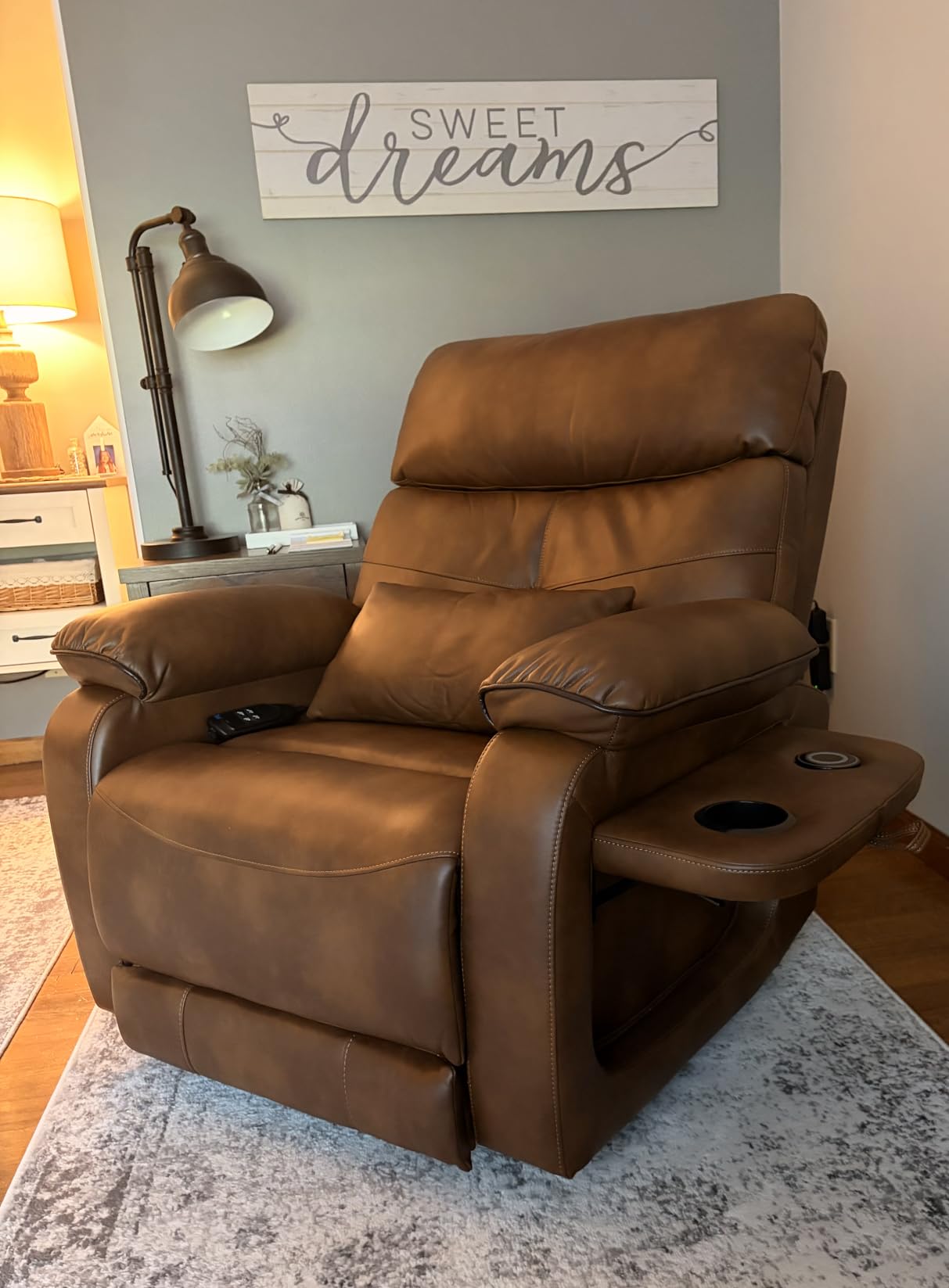
Everything about this chair is a trade. The 28.7 inch width is the narrowest footprint here, which makes it the best option for a tight living room, and the leather upholstery is genuinely easy to wipe clean, which matters in a caregiving home. In exchange, the 20.5 inch seat depth is shallow and the 20.5 inch backrest width is narrow.
What you get in return is the most considered feature set in this roundup. There are ten recline positions with full lay flat, two remotes so the massage controls are separate from the lift and recline, a removable zippered lumbar pillow for adjusting firmness, and a foldable tray table with a cup holder and wireless charging plus USB and Type-C ports.
Why do two remotes matter?
Because the common caregiver frustration is a parent pressing the wrong button. On a single-remote chair, the lift, recline, massage and heat controls all sit on one handset, and a confused or arthritic hand can trigger heat or massage when the intent was to raise the chair. Splitting lift and recline away from massage and heat removes that risk entirely, which is a safety improvement disguised as a convenience.
The removable lumbar pillow also solves a problem most upholstered chairs have. Firmness preferences change as a parent ages, and a zippered pillow lets you add or remove fill without replacing the chair.
What are the compromises?
The footprint and depth numbers above are real limits. A 20.5 inch seat depth will not suit a tall parent, and the 28.7 inch width, while a genuine advantage in a small room, gives less lateral support than the oversized models. Caregivers who asked r/eldercare about supportive sides should note the narrow frame.
The chair also arrives as three separate packages weighing 83 pounds, 36 pounds and 24 pounds, which complicates both setup and returns compared with a single-box chair.
8. Trustyue Dual Motor Lay Flat Lift Chair – best for a fast setup and an OKIN lift motor
Trustyue Dual Motor Power Lift Chair, Lay Flat Recliner Chair, Electric Recliner with Massage and Heat for Elderly, Remote Control, Infinite Position,Standing Assistance,USB Ports PU Grey
Dual motors, 180 degree lay flat
TUV certified OKIN lift motor
350 lb capacity
Under 10 minute install
Pros
- Dual motor 180 degree lay flat at a mid-range cost
- TUV certified OKIN counter-balanced lift mechanism
- Overstuffed sponge padding gives a wrapped-in feel
- Quickest stated install in this group at under 10 minutes
- Three massage modes and three intensity levels with a timer
Cons
- Heaviest chair in this group at 140 pounds
- Capacity capped at 350 pounds
- Smallest review base here at 158 reviews
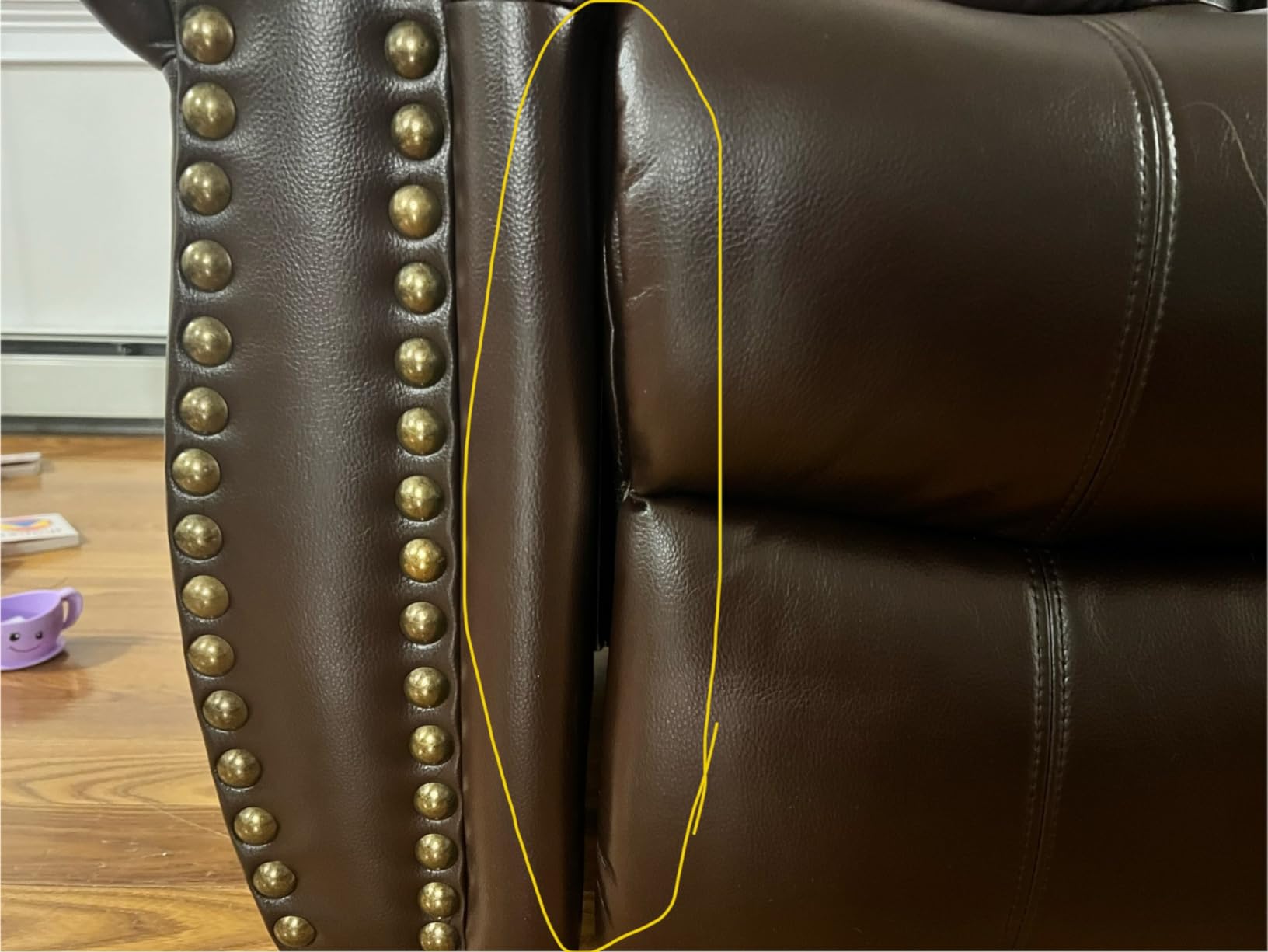
- Faux leather and PU finish is not genuine leather
The thing to notice on this chair is the motor. A TUV certified OKIN counter-balanced lift mechanism is the same class of component you would look for in a higher-priced chair, and combined with independent backrest and footrest control at 180 degrees, the specification list is strong for what it costs.
Comfort is the other selling point. The overstuffed sponge padding gives a wrapped-in feel that several buyers respond well to, and the massage has three modes and three intensity levels with a timer, which is more control than many chairs at this level offer.
Is the fast installation real?
It is the fastest stated install in this group at under ten minutes with no tools, arriving in two boxes. That matters more than it sounds if the chair is going into a room where a family member will be using it that evening, or if you do not have a second person available to help.
Be aware that the chair itself weighs 140 pounds, the heaviest in this group, and the steel base under the wooden frame is the likely reason. The two-box delivery helps, but this is not a chair you reposition on your own once it is assembled.
What should buyers keep in mind?
The review base is the smallest here at 158 reviews, so the long-term record is thinner than the MCombo models carry. The 350 pound cap is also below the 400 pound models here, and PU faux leather will not satisfy a buyer who specifically wants genuine leather.
At 22.04 inches of seat depth and a 40.15 inch overall width, the footprint is on the larger side, so measure the intended spot and the recline path before ordering.
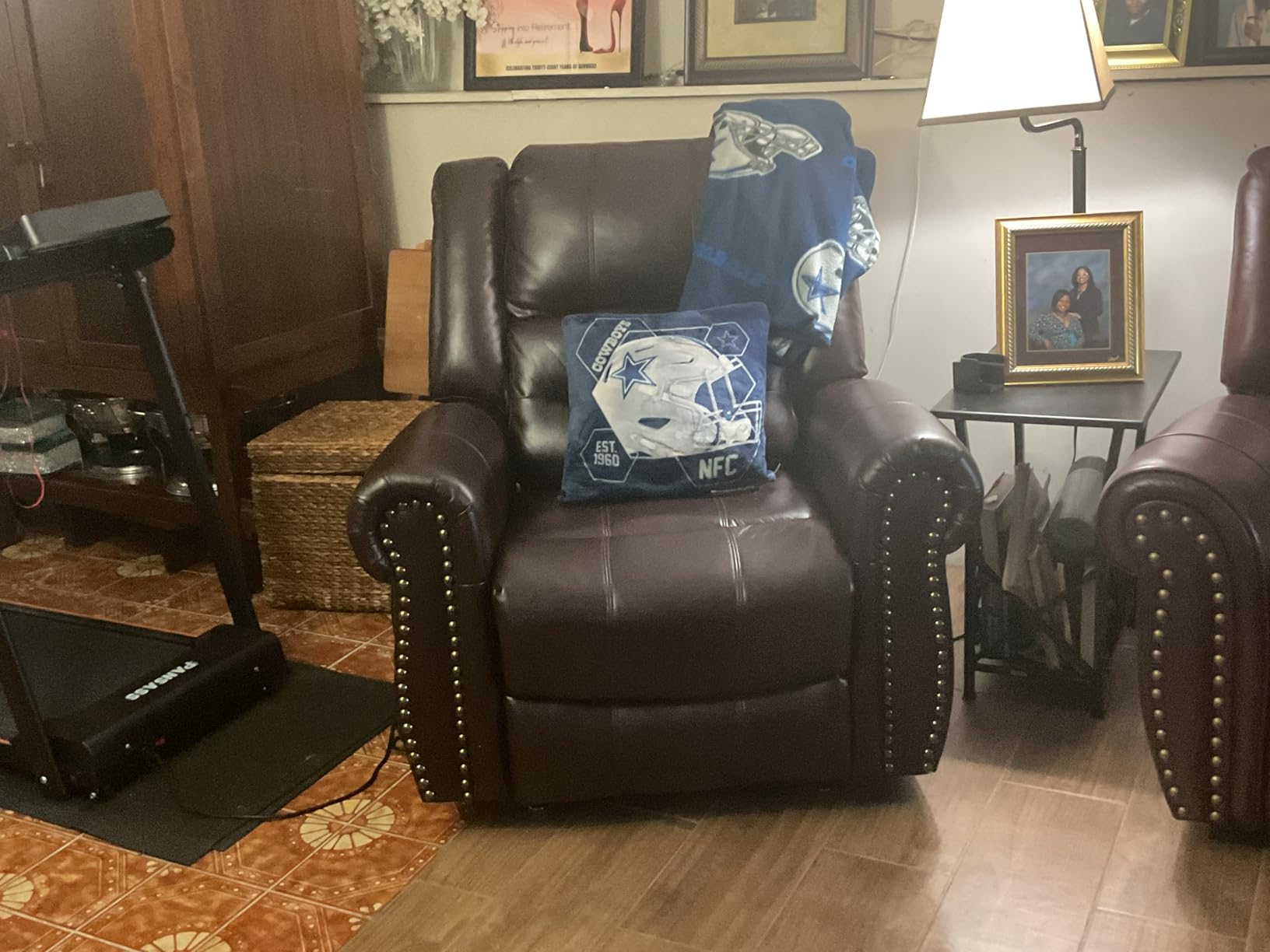
How to choose a lift chair your parent will actually use
Buying a lift chair for someone else is mostly a measurement problem. Get these five things right and the rest is preference, and get them wrong and a chair that works perfectly for a stranger will sit unused in the corner of the living room.
Step 1: Measure your parent, not the showroom
Sit height of the parent, from the floor to the top of the seat, tells you whether a 18 inch or a 20 inch seat frame is right. A parent who struggles to lower themselves into a deep seat needs a higher, shallower frame, while a taller parent needs enough seat depth to support the full thigh. For hip width, measure across the widest point and add a couple of inches of clearance.
Also measure the back-to-front room depth with the chair fully reclined and raised, not just the width of the chair itself. Any standard three-position chair needs roughly 12 to 18 inches of wall clearance behind it, while a wall-hugger model needs only 4 to 6 inches. If you are choosing between the chairs on this list, note that the CANMOV and Trustyue are the two widest at 39 and 40.15 inches, and the RESTREAL is the narrowest at 28.7.
Step 2: Decide between one motor and two
A single-motor chair moves the backrest and footrest together, which is simpler, cheaper and has fewer parts that can fail. A dual-motor chair moves them independently, which is what you need for edema, for breathing and reflux positioning, and for anyone sleeping in the chair.
Our rule of thumb: if the parent has a specific medical reason for a particular position, pay for two motors. If they mainly need help standing and sitting, one motor is enough. The reviews of the 7287 make that case well, and the 7890 makes the other side of it.
Step 3: Match the chair to the medical need
For edema and leg swelling, you need independent leg elevation, which means a dual motor. For osteoarthritis and bad knees, a higher seat height is often more valuable than any massage function, since standing up from a 20 inch seat takes less effort than from an 18 inch one. For overnight sleeping, you need a genuine lay flat position, which on this list means the CDCASA at 180 degrees, the Trustyue at 180 degrees, or the MCombo 7890 at 165 degrees.
For heart failure, COPD and GERD, the useful specification is any position between upright and elevated that a dual motor can hold. For short-term recovery after surgery, a rented or used chair from a medical equipment supplier is often the sensible call rather than buying one outright. An occupational therapist or physical therapist can also tell you, in a single visit, whether the parent needs positioning help or a strength program, and that answer will save you money either way.
Step 4: Think about upholstery and cleaning
Faux leather and PU wipe down in seconds and handle incontinence better than any fabric. Microfiber and performance textiles are warmer and less slippery during the lift motion, which is a real safety point, and they are more comfortable for a parent with sensitive skin, but they stain over time. The 7287 in dark gray textile is the balance point in this group.
Whichever you pick, keep a washable throw over the seat and back. Caregiving realities are rarely tidy, and a cover costs a fraction of a new chair.
Step 5: Check the weight rating and leave headroom
Ratings here run from 350 pounds on most models to 400 pounds on the CDCASA and RESTREAL and 450 pounds on the CANMOV. Do not buy a chair rated at or barely above your parent’s weight. Aim for at least 50 pounds of headroom, because a heavier user puts more load on the scissor mechanism and the actuator over years of daily use.
If your parent uses the armrests as a handhold to stand, test that. Shorter armrests that force a bad grip are worse than no lift at all, and the 7890 is a good example of a chair where the cup holder placement has that side effect. If you also want to plan the rest of the parent’s seating, our guide to choosing a massage chair for home covers the recovery and circulation side of that setup.
Does Medicare pay for lift chairs?
Partially, and only for the mechanism. Original Medicare Part B covers the lift mechanism itself as durable medical equipment when a doctor documents medical necessity, but it does not cover the chair or the upholstery around it. You are typically responsible for the cost of the seat. You must buy from a Medicare-enrolled durable medical equipment supplier, and a Medigap or Medicare Advantage plan may cover the chair portion. Get the doctor’s medical necessity documentation in writing before the chair is ordered.
The first 30 days: what to expect and how to keep it safe
The most common complaint in caregiving forums is not about the chair. It is about the first two weeks. One r/eldercare poster described a good experience with a Golden chair that took their mother a while to feel safe, because she felt out of control the first few times she used it. That reaction is normal, and it is the phase where most families wrongly conclude the chair was a mistake.
Sit with your parent the first five or six times. Make them hold the remote, but keep your hand near the armrest rather than the controls, and let them stop the motion whenever they want to. The single biggest cause of that feeling of loss of control is a parent who cannot stop the chair mid-motion, which is exactly the argument for a dual motor with independent control.
Keep a rug under the chair if the floor is slick, and choose a spot with clearance behind it so the footrest has somewhere to go. Do not place the chair where a parent can slide off the edge of the seat while distracted. If the parent is partial to a particular recliner for reading and naps, the ergonomic office chair comparison covers upright seating that is easier to push away from.
Call the supplier before the return window closes if something is wrong. A loose mechanism, a remote that does not respond, or a motor that bind are all fixable, and a supplier who replaces early is easier to deal with than one who argues.
Delivery, setup, warranty and service
This is the part almost no roundup covers, and it is where buyer regret is highest. These chairs weigh between 97.3 and 140 pounds, arrive in two or three separate packages, and the heaviest box is the base. Two of the chairs on this list explicitly need two people to move into position. Plan the route, the door widths, and the stairs before the boxes arrive.
Check whether the supplier offers in-home white glove delivery and setup rather than curbside drop-off. If they do not, and the room is upstairs or involves a narrow staircase, that is a reason to look at a different retailer entirely. Assembly on every chair here is tool-free and between about 10 and 40 minutes, but the unpacking is the hard part.
On warranty, read the length rather than assuming. Two chairs here carry two-year limited coverage on mechanisms, electrical parts, upholstery and frame, while several of the lower-cost models carry one year. Ask specifically what happens when the motor fails: whether a replacement actuator is serviced in home, whether the remote is covered or sold separately, and whether the parts are still available in five years. Parts availability is brand-specific, and a chair whose mechanism can be rebuilt is a very different long-term proposition from one that can only be exchanged.
For anything beyond a lift chair itself, our full body massage chair guide covers the therapy side that some families add later, and the Korean massage chair roundup goes deeper on the recovery market.
Frequently Asked Questions
Will Medicare pay for a lift chair for the elderly?
Partially. Original Medicare Part B covers the lift mechanism as durable medical equipment when a doctor documents medical necessity, but not the chair or upholstery. You must buy from a Medicare-enrolled DME supplier, and a Medigap or Medicare Advantage plan may cover the seat portion. Get documentation in writing before ordering.
What is the best lift-up chair for elderly people?
The best lift-up chair is the one whose size matches the parent and whose motor type matches the need. Our first pick is the MCombo 7040 for most parents, the MCombo 7890 if a parent needs independent leg elevation or a lay-flat position, and the CANMOV for a heavier or larger parent who needs a wide seat and a 450 pound rating.
Which brand of lift chairs is considered the best?
No single brand wins every category. MCombo has the largest verified review base and the most consistent mechanism specs in this roundup, with three models making the list. CANMOV leads on seat width and weight capacity, CDCASA on genuine lay-flat sleeping positions, and RESTREAL on convenience features in a narrow footprint.
What are the disadvantages of lift chairs?
The main drawbacks are size and cost relative to a normal recliner, a bulky footprint that needs wall clearance, and a real adjustment period where the sitter feels out of control. Many parents also find the chairs bulky, hard to reposition, and limited by a 350 or 400 pound capacity. A tethered remote on some models is an added daily annoyance.
What size lift chair does my parent need?
Measure the parent from the floor to the top of their sitting position, then measure their hip width and add a couple of inches. Match seat height to their height so their feet reach the footrest with knees supported. Then measure the room with the chair fully reclined, allowing 12 to 18 inches behind a standard chair or 4 to 6 inches for a wall-hugger model.
Can my parent sleep in a lift chair overnight?
Yes, if it has a dual motor and a true lay-flat position. In this roundup the CDCASA and Trustyue reach about 180 degrees, and the MCombo 7890 reaches 165 degrees with a zero gravity setting. A single-motor three-position chair will not get anyone close to flat and is better for naps than for overnight sleep.
Final verdict: which lift chair to buy for your parent
For most parents, start with the MCombo 7040. It has the deepest review history in this roundup, a counter-balanced TUV certified actuator that genuinely assists standing, and the right mix of comfort features, and it is a straightforward fit for a medium frame.
If the parent needs positioning rather than just help standing, the MCombo 7890 is the better fit because independent back and footrest control changes what the chair can do medically. For a heavier or larger parent, the CANMOV is hard to argue with at 21 inches of seat width and a 450 pound rating. For overnight sleeping, go dual motor and lay flat, which means the CDCASA or the Trustyue.
Measure before you order, read the warranty length, and expect a two-week adjustment period. Those three things decide more about whether the chair gets used every day than any massage function does. Use the buttons below to check the current listing details for each chair, and read the sizing notes twice before you commit.