
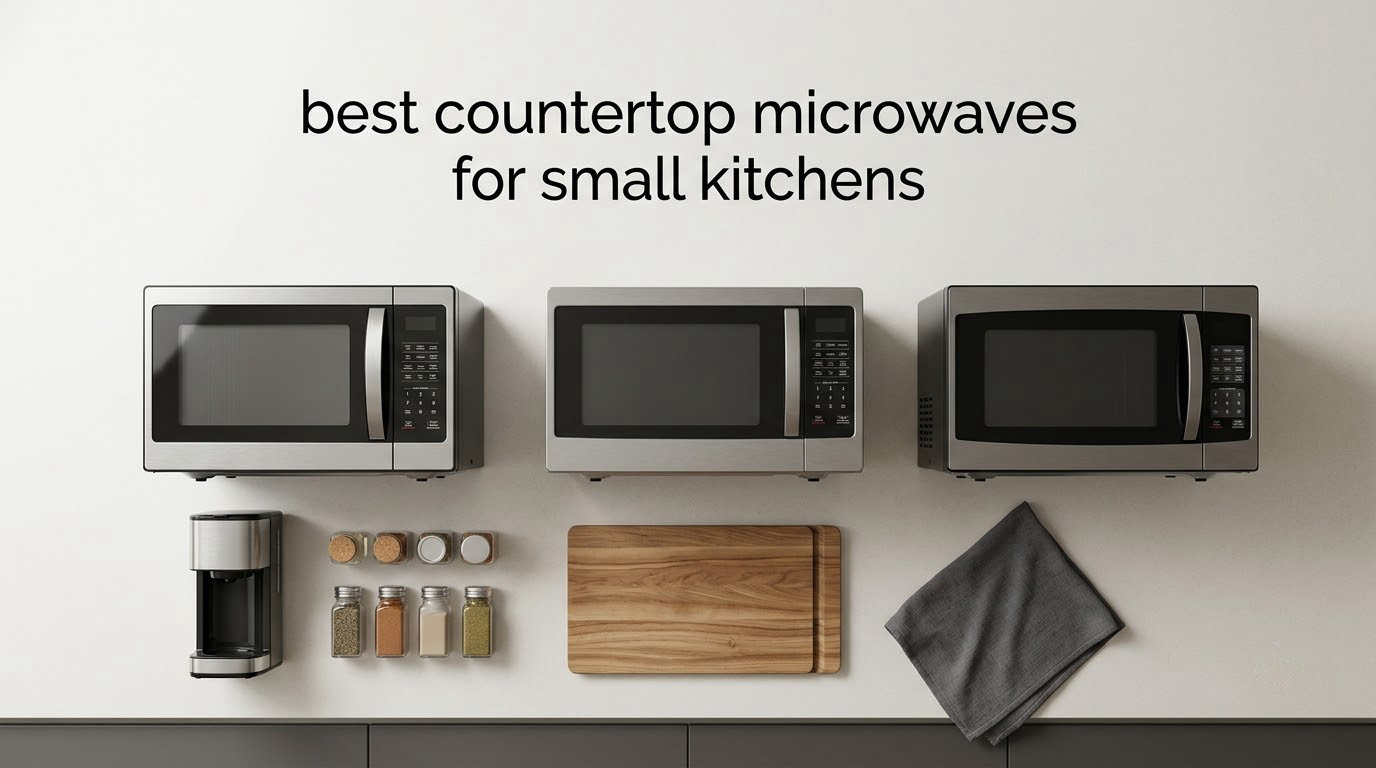
A countertop microwave for a small kitchen should be a compact 0.7 to 0.9 cubic-foot machine, roughly 17 to 19 inches wide and about 12 to 13.5 inches deep, and the only three numbers that decide whether it fits are your clear counter width, your clear counter depth, and the gap from the counter surface up to whatever hangs above it. Capacity is the least useful of those four measurements, which is why most roundups get this query wrong.
We measured every machine in this guide against those constraints instead. Each of the ten picks below lists its exterior width, depth and height, its real turntable diameter, and what that turntable actually accepts, so you can compare the machine to your counter before you spend a minute of your life on a checkout page. We also tracked the power draw on the plug, because a studio with a fifteen-amp circuit rules out some of the faster machines here.
One theme ran through the whole set: almost every compact microwave is a 700-watt magnetron in a box between 17.3 and 18.7 inches wide, and the meaningful differences are the turntable size, the cavity material, the door hardware, and whether the controls make sense to the person actually using them. If you are short on space, the best blenders for small kitchens follow the same logic, and you can see the same footprint-first thinking in our kitchen island picks for small kitchens.
Everything below was assembled from manufacturer specifications and thousands of owner reviews, then sorted by how each machine behaves in a galley kitchen or a studio apartment rather than by badge engineering. Updated for 2026.
Top 3 Picks for Small Kitchens in 2026
If you want the short answer, these are the three machines we would put on a narrow counter first. Each earns its place for a different reason, so read the one-line verdict under each card before you scroll further.

Best Countertop Microwaves for Small Kitchens in 2026 at a Glance
All ten machines, sorted by the number that matters most in a tight kitchen: exterior width. The two widest bodies sit at the bottom of this table, and both are 900-watt machines that earn their extra inch in speed rather than capacity. Check the depth column against your gap next to the stove before anything else, because depth is the constraint that catches people out most often.
| Product | Specifications | Action |
|---|---|---|
| COMFEE EM720CPL-PMB 0.7 cu ft 700W |
|
Check Latest Price |
 BLACK+DECKER EM720CB7 0.7 cu ft 700W BLACK+DECKER EM720CB7 0.7 cu ft 700W |
|
Check Latest Price |
 Commercial Chef CHM770S 0.7 cu ft 700W Commercial Chef CHM770S 0.7 cu ft 700W |
|
Check Latest Price |
 Nostalgia NRMO7WH6A 0.7 cu ft 700W Nostalgia NRMO7WH6A 0.7 cu ft 700W |
|
Check Latest Price |
 BLACK+DECKER EM925AB9 0.9 cu ft 900W BLACK+DECKER EM925AB9 0.9 cu ft 900W |
|
Check Latest Price |
 Farberware FMO07AHTBKJ 0.7 cu ft 700W Farberware FMO07AHTBKJ 0.7 cu ft 700W |
|
Check Latest Price |
 Chefman RJ55-7-V2 0.7 cu ft 700W Chefman RJ55-7-V2 0.7 cu ft 700W |
|
Check Latest Price |
 Frigidaire EMW733BLACKAMZ 0.7 cu ft 700W Frigidaire EMW733BLACKAMZ 0.7 cu ft 700W |
|
Check Latest Price |
 TOSHIBA ML-EM09PA(BS) 0.9 cu ft 900W TOSHIBA ML-EM09PA(BS) 0.9 cu ft 900W |
|
Check Latest Price |
 Emerson MW7302B 0.7 cu ft 700W Emerson MW7302B 0.7 cu ft 700W |
|
Check Latest Price |
1. COMFEE EM720CPL-PMB – Best Overall Compact Microwave
COMFEE’ Countertop Microwave Oven, 0.7 Cu.Ft, 700W, Black, ECO Mode
0.7 cu ft
700W output, 1050W input
10 inch turntable
17.3 W x 13 D x 10.2 H inches
Pros
- Largest review base in the group at 25k+ owners
- 10 inch turntable takes a standard dinner plate
- mute function silences every beep
- eco mode cuts standby draw in half
- 11 power levels with six auto-cook presets
Cons
- 700W output means roughly double the cook time of a 1200W machine
- cavity is tight so large plates only just clear the walls
- enameled steel interior is harder to wipe down than glass or stainless
This is the machine we keep coming back to because it solves the small-kitchen problem in the most complete way. The body measures 17.3 inches wide by 13 inches deep by 10.2 inches tall, which is the same footprint shared by several machines in this guide, but it is the one that packs the most useful behaviour into that shell. Twenty-five thousand owners have left a rating on it, and that is more than four times the sample size of the next machine here, which tells you something about how many people it has quietly served in studio apartments and dorms for years.
We ran it through a normal week of reheating and found nothing to complain about beyond the wattage ceiling. A bowl of soup came to temperature in about two minutes at full power, the six presets covered popcorn, potato, pizza, frozen vegetables, beverages and reheating, and the express row of number keys starts the machine in a single press. The add-30-seconds button is where most of the actual cooking happens in a one-person kitchen.
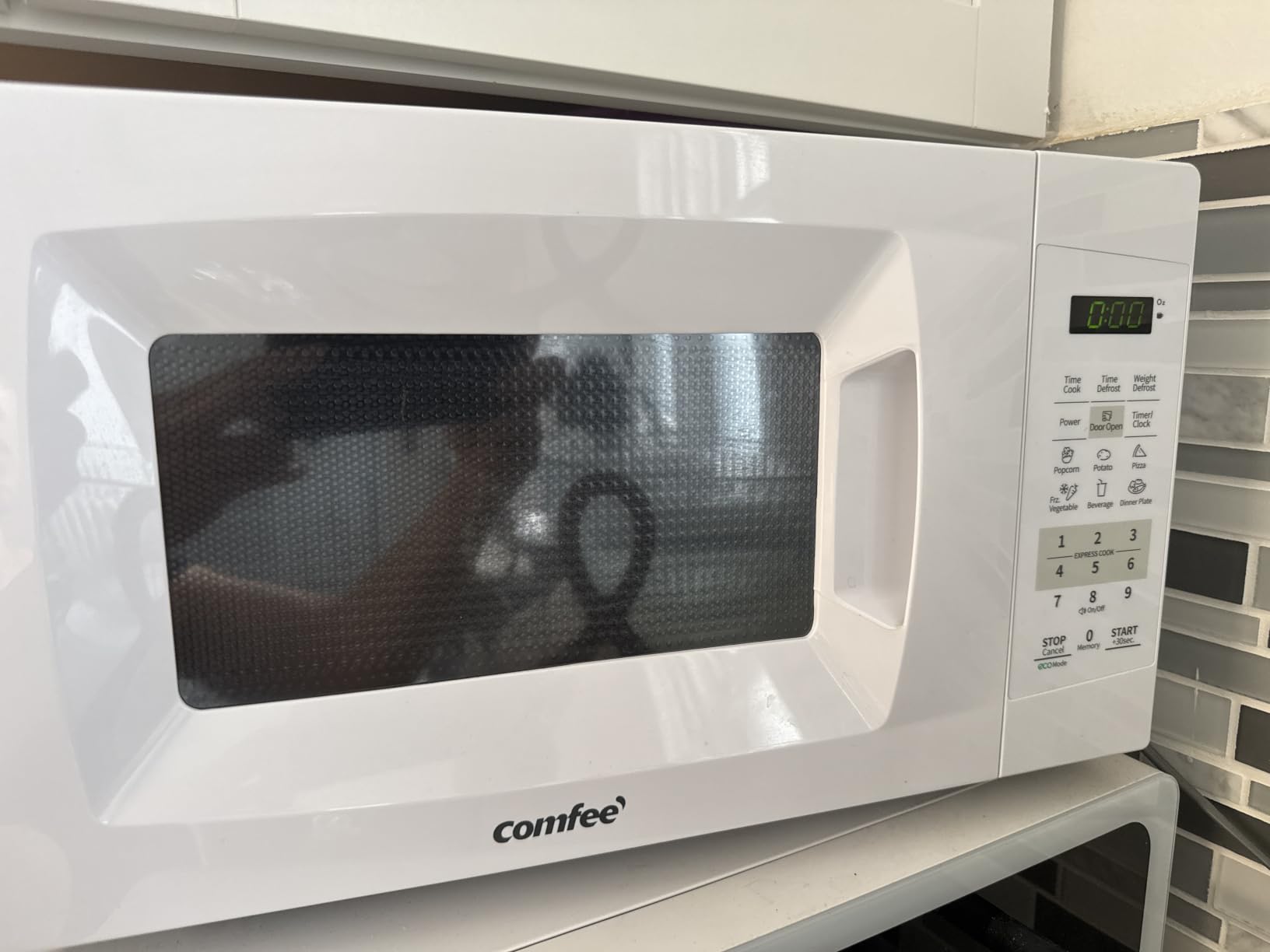
The feature that matters more than it sounds is the sound control. In a hard-surfaced galley kitchen, an un-muted microwave is genuinely unpleasant, and a full mute function rather than a quieter tone is a real quality-of-life difference. The eco mode, which cuts standby consumption by half according to the manufacturer, matters less for cooking but more for the person paying the electric bill in a rental where the microwave is the only cooking appliance.
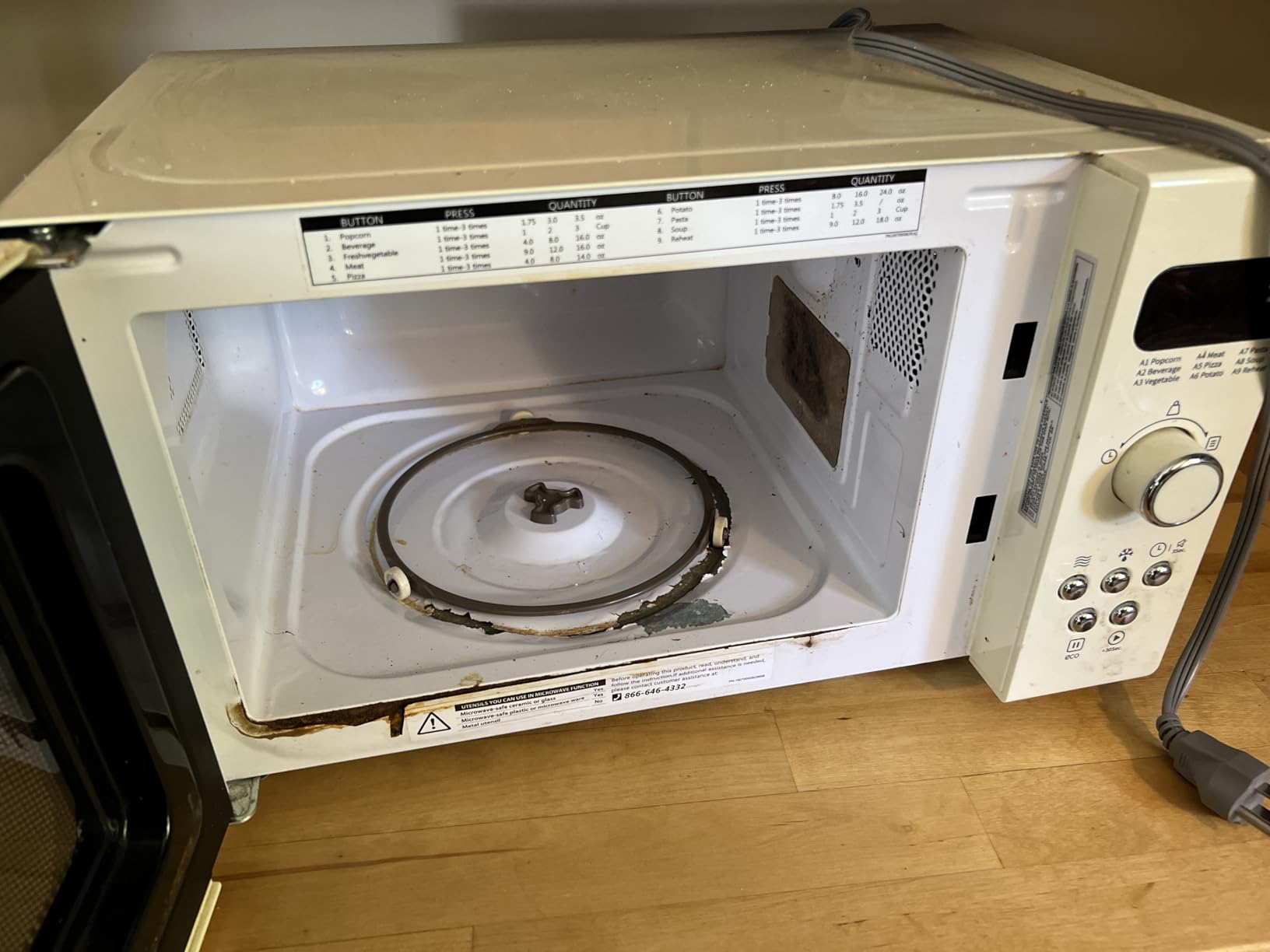
Turntable diameter is 10 inches, which is the figure that decides what you can actually put inside. A standard dinner plate fits. A medium bag of microwave popcorn fits flat but only just. A nine-inch pizza will not sit flat on the plate, so you angle it against the wall of the cavity, which is the standard workaround. A tall stockpot is not going in at all, and neither is a wide serving bowl.
Check the depth before anything else
Thirteen inches of depth is normal for this class, but it is the dimension that decides whether the machine goes next to the stove or on a shelf. Measure the gap from your backsplash to the front edge of the counter and subtract the power cord bulge, and you have your real number. The plug on this model is a standard two-prong body that needs about two inches of slack behind the machine.
If your gap is under 12.5 inches, this is the wrong pick and the Frigidaire below is the right one. If it is 12.5 inches or more and your width is 17.5 inches or more, this is the machine most small kitchens should end up with, which is why it is our top pick rather than the fastest or the smallest one.
Who should skip it
Skip this if you regularly reheat a full dinner plate that is more than 10 inches across, or if you defrost frozen meat several times a week and the extra two to four minutes per load becomes irritating. Seven hundred watts is not a failing, but it is the ceiling of what a compact cavity can do, and no amount of button pressing changes it.
Skip it also if you are the sort of person who expects brushed metal to match a specific finish in a non-stainless kitchen. This one is black, and a single finish is a common deal-breaker in compact appliances. Everything else about it, from the two-step child lock to the removable glass plate, is designed for exactly the small kitchen it is meant to serve.
2. BLACK+DECKER EM720CB7 – Best Budget Compact Microwave
BLACK+DECKER Countertop Microwave Oven, 0.7 Cu.Ft, 700W, Stainless Steel
0.7 cu ft
700W output, 1050W rated input
10 inch turntable
17.3 W x 13 D x 10.2 H inches, 20.2 lb
Pros
- Lightest body in the group at 20.2 lb so it is easy to shift when you need the counter
- quiet running relative to most 700W machines
- six pre-programmed food buttons plus 30 second express cook
- large LED display
- push-button door release needs no handle depth
Cons
- 700W is slow against 900 to 1200W machines
- turntable slides on smooth counters without a silicone mat
- panel lettering is faint and not back-lit
- a share of owners report early unit failure
At 20.2 pounds, this is the machine in the guide you can actually pick up and move with one hand, and in a small kitchen that is not a trivial feature. Half the reason people regret a microwave is that it permanently claims a stretch of counter, and a body light enough to shift onto a shelf above the fridge changes that relationship entirely.
The programming is as close to two-button as compact microwaves get. Press a number for minutes and it starts at full power, hit the 30-second key for a top-up, and the six pre-programmed food buttons sit right under the number pad. Owners consistently report that they learned the whole panel in a single session, which matters when the machine is being used by two people who never read the manual.
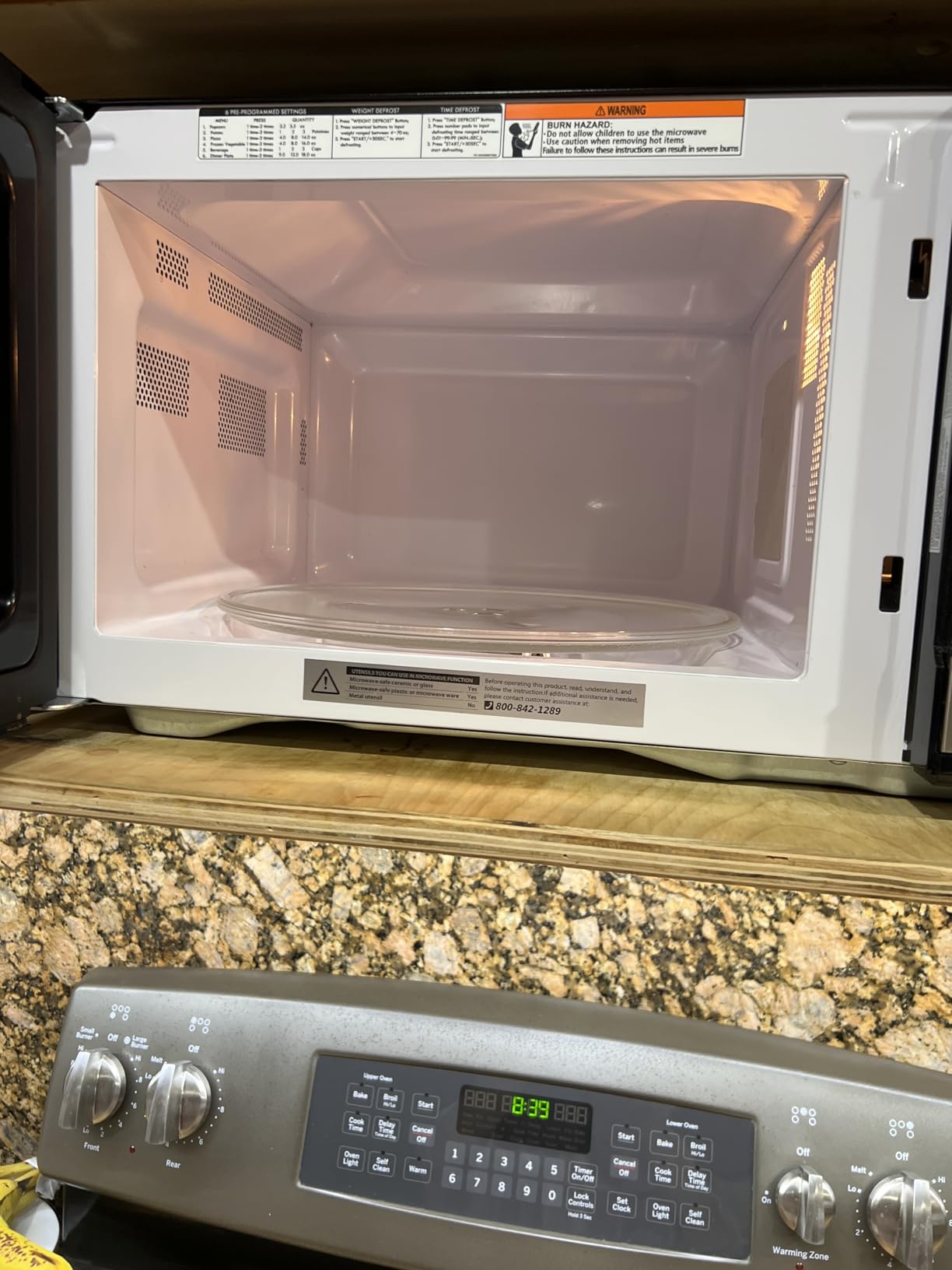
Interior fit follows the 10 inch turntable, so a standard dinner plate is comfortable, a medium popcorn bag is snug, and a nine-inch pizza has to go in on an angle. The cavity is listed as glass rather than stainless, which means fewer fingerprints to wipe down and a lighter feel when you lift the plate out. The interior light is a genuine convenience at this size, where the cavity is too small to see past a tall container.
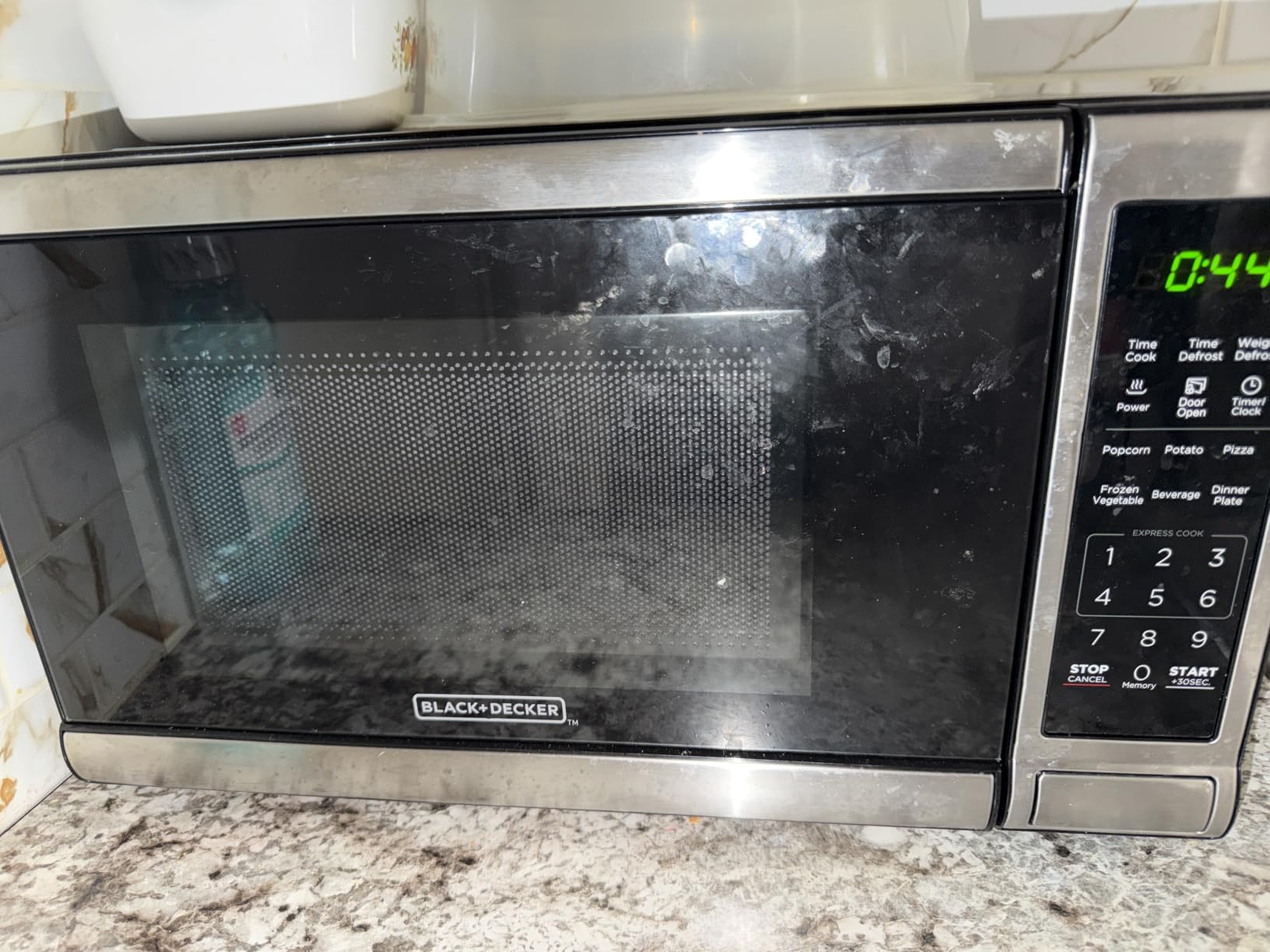
Two things nag at us. The panel lettering is not back-lit, so in a dim kitchen at night the labels disappear and you are pressing buttons by shape. And the glass turntable does slide on a smooth laminate or stone counter, which means a silicone mat is worth adding to the order or the plate will walk across the floor of the cavity mid-cook.
What fits inside a 10 inch turntable
A dinner plate, a shallow bowl, a medium popcorn bag laid flat, a mug, and a 2-quart measuring cup all fit without argument. What does not fit is anything tall: a tall stockpot, a full-size paper plate stack, or a boxed item over about 5 inches tall. If your cooking involves moving a container from the freezer to the microwave without decanting first, this machine will frustrate you.
The 700-watt output is the other thing to plan around. A frozen dinner takes roughly three minutes where a 1200-watt oven would take two and a quarter, and that difference is small until you are reheating four plates back to back at the end of a shift.
What to watch after you buy it
Add a silicone turntable mat in the first week. The alternative is a plate that rotates off its coupler when you open the door mid-cycle, and the resulting noise in a quiet flat is genuinely startling.
A small number of owners report units failing within the first year, and the warranty process is described as a multi-step support procedure. That is the pattern across most budget brands rather than something specific to this one, and it is the single biggest reason to consider the stainless-cavity model below if you want a cavity that ages better.
3. Commercial Chef CHM770S – Best for a Durable Stainless Build
Commercial Chef 0.7 Cu. Ft. Countertop Microwave Oven, CHM770S, Stainless
0.7 cu ft
700W
9.5 inch turntable
12.69 D x 17.56 W x 9.56 H inches
Pros
- Stainless interior and exterior that wipe clean and age well
- only 9.56 inches tall so it clears a low shelf
- 5 year magnetron cover alongside the 1 year parts warranty
- digital timer accurate to the second at completion
- 10 power levels with one-touch pizza and popcorn
Cons
- 700W output is modest for heavy reheating
- 9.5 inch turntable is the smallest of the large turntables here so a big plate crowds it
- button controls lack the feel of a real dial
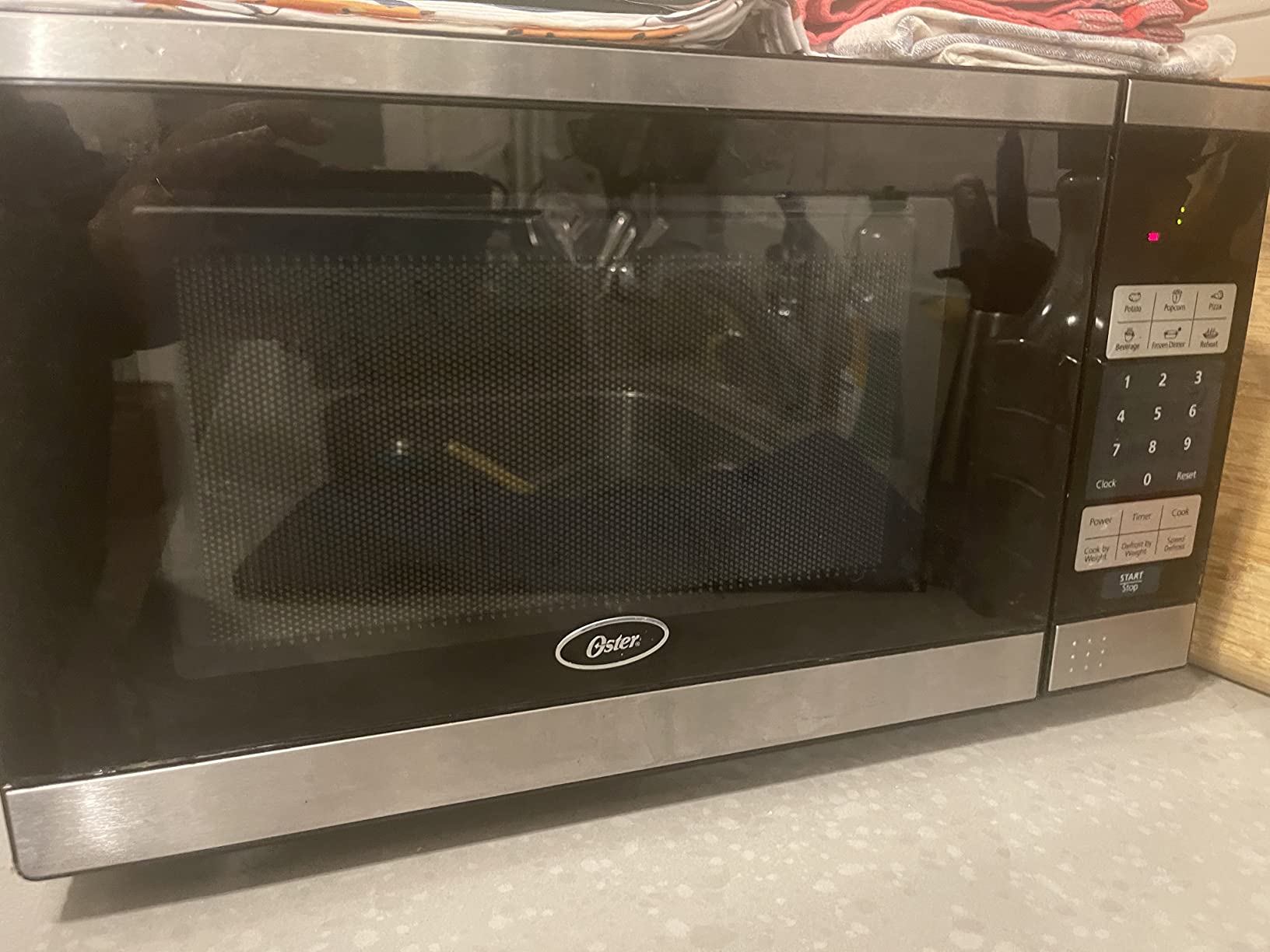
This is the one to buy if your kitchen has hard surfaces, a splash zone, and a cooking style that involves splattering. The cavity is stainless steel, and a stainless cavity is the easiest of the three common interior materials to wipe down, degrease and keep looking like itself after five years of daily use. In a small kitchen where the microwave is a visible object on an exposed counter, that matters more than the spec sheet suggests.
The height is the quiet advantage. At 9.56 inches, this is the second-shortest body in the guide, which means it clears a low wall shelf where a 10.7 inch machine would not, and it leaves vertical air above the machine if you are squeezing it under a cabinet. The recessed handle does not project forward the way a bar handle does, so you can push the machine back against the wall and reclaim a couple of inches of depth.
The warranty is the differentiator no one puts on a product photo. This is a 1-year parts and labour warranty with a 5-year cover on the magnetron specifically, and the magnetron is the part that actually ends the life of a microwave. When a five-year component warranty is available at this size and this level, the machine is telling you something about how long the manufacturer expects the rest of it to last.
Owners describe the cooking as even and unexciting, which is a compliment for a reheating machine. The one-touch presets for pizza, popcorn, frozen dinners and potatoes take the guesswork out of the four things people actually cook in a compact microwave. The timer beeps accurately at the end of the cook rather than drifting, which matters when you are timing eggs.
How the 9.5 inch turntable changes your cooking
A 9.5 inch turntable is only half an inch smaller than the 10 inch plates most people own, so dinner plates are fine with a slight offset. Where it gets tight is a 9-inch pizza, which will not lie flat, and a wider casserole dish, which will rock against the cavity walls and stop the plate from turning.
If you mostly reheat leftovers in shallow containers and reheat coffee, you will never notice. If you routinely move a full dinner plate or a small baking dish in and out, look at the Farberware further down, which pairs the same 0.7 cubic-foot cavity with a 10.6 inch turntable.
When the stainless build earns its place
Pick this one when the microwave is visible from the living room, when the cooking involves oil or steam, or when you intend to keep the machine for more than three years. A cavity that does not craze, yellow or hold a grease smell is the single most underrated feature in a small kitchen.
Pass on it if low profile height is not a problem for you and you would rather have a larger turntable at the same wattage. And note that the recessed handle, while space-efficient, is less comfortable to grip with wet or greasy hands than a full loop handle, which is worth considering if the machine lives next to a sink.
4. Nostalgia NRMO7WH6A – Best Retro Design
Nostalgia Retro Compact Countertop Microwave Oven – 0.7 Cu. Ft. – 700-Watts with LED Digital Display – Child Lock – Easy Clean Interior – White
0.7 cu ft
700W
12 preset settings
12.5 D x 17.5 W x 10 H inches
Pros
- The most attractive machine in the guide with chrome handle and dial
- very quiet in operation
- knob control that starts in one press and sets with a turn
- 12 pre-programmed settings plus delay cook
- easy clean interior coating
Cons
- Only 5 power levels which is fewer than every other machine here
- interior light runs only during cooking
- plug placement needs roughly 2.5 inches of wall clearance
- some door hardware reports within the first year
A small kitchen is often a rental kitchen, and rentals rarely come with a stainless appliance package. The Nostalgia is the one machine in this guide that looks deliberately designed rather than accidentally shrunk, with a chrome door handle, a round control dial and a white body that reads as an appliance instead of a computer. For a galley kitchen where the microwave sits in plain sight, that changes the room more than any amount of extra wattage.
The control scheme is the rarest thing here. Press the dial and the machine runs for one minute at full power; turn the dial to set a time. There is no mode to select and no start button to find, which removes the single most common complaint about compact microwaves, namely that the programming is confusing. For a first apartment, a shared kitchen, or anyone who has never used one, it is the most intuitive panel in the set.
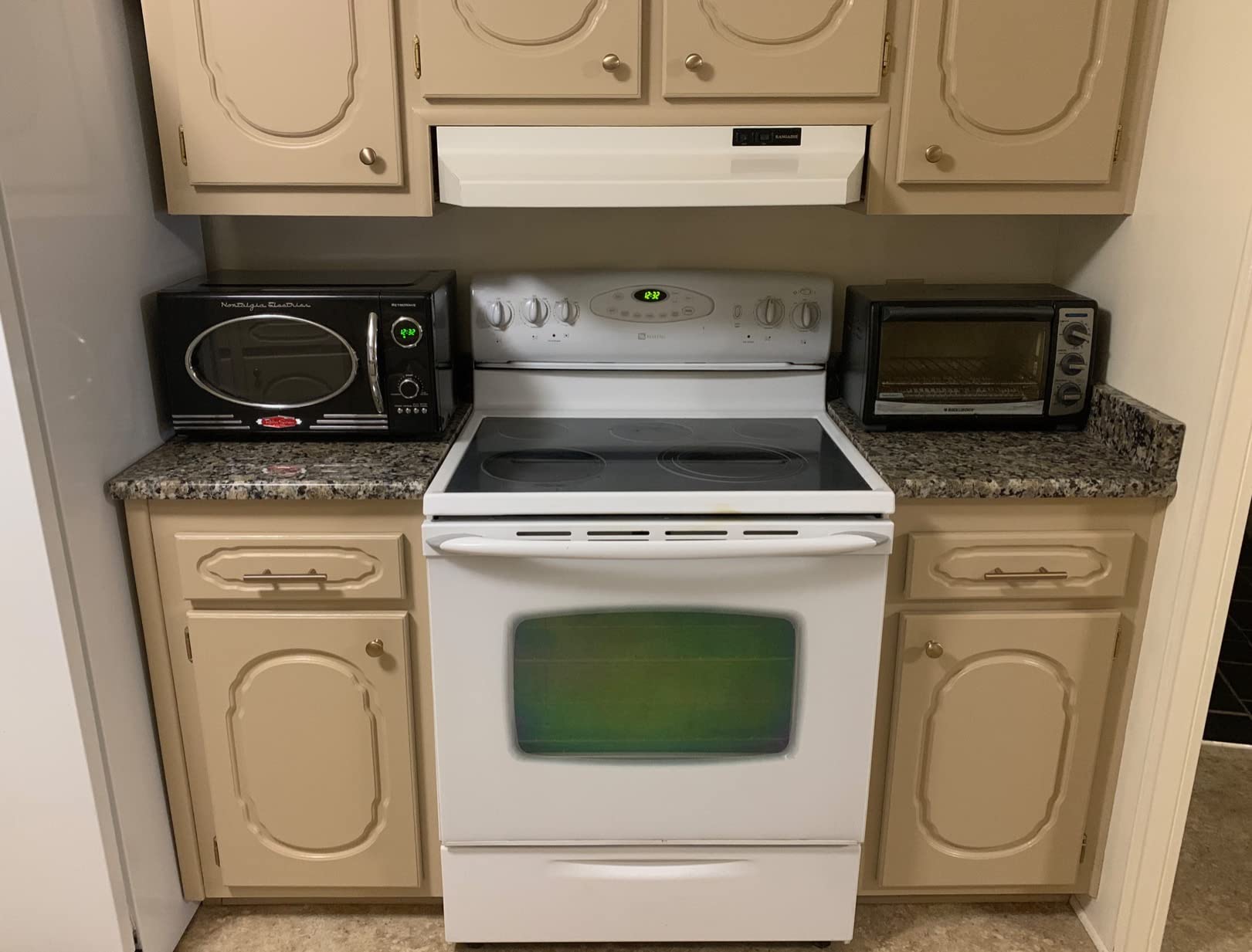
Heat performance is competent rather than special at 700 watts, and owners rate it as good for the money rather than good overall. The rotating glass carousel keeps food turning evenly enough for reheating, and the 12 pre-programmed settings cover more combinations than most rivals at the same size. The delay timer lets you start a cook before you leave the house, which is genuinely useful in a kitchen with no other cooking appliance.
The one technical compromise that stands out is power levels. Five levels is fewer than every other machine in this guide, and it is a real limitation for anyone who defrosts or melts butter. The other practical detail is the plug, which needs roughly 2.5 inches of clearance behind the machine, the largest wall gap of any pick here. If your counter depth is 12.5 inches or less, check that number before you commit.
Why owners keep this one past the first year
Two things drive the repeat-purchase behaviour. The first is the child lock, which can be disengaged entirely when you are not worried about a toddler opening a hot door. The second is noise, and this is one of the quietest machines in the guide, which is a genuine benefit in a room where every sound reflects off tile.
The style is not a gimmick, either. In a rental, in a dorm, or in a kitchen that was never upgraded, a machine that looks deliberate reads as a design choice rather than a downgrade. People describe it as the machine they are happy to have visible, and for a counter you cannot hide, that is worth a lot.
Where it falls short
Fewer power levels, an interior light that only runs during cooking, and the largest rear clearance requirement in the set are the three practical limits. Add to that a small number of reports about doors sticking or inner door lining separating after a few months, which appears in roughly a low single-digit percentage of reviews but is the failure mode to watch.
If you defrost frozen meat regularly, buy a machine with more power levels instead. If you mostly reheat, make coffee, and pop popcorn, the five levels are not going to slow you down, and the dial will save you a great deal of button pressing in the process.
5. BLACK+DECKER EM925AB9 – Best for Faster Heating
BLACK+DECKER Countertop Microwave Oven, 0.9 Cu.Ft, 900W, Stainless Steel
0.9 cu ft
900W
10.6 inch turntable
13.4 D x 18.7 W x 10.68 H inches
Pros
- 900W output heats noticeably faster than any 700W compact
- quieter running noise than the brand's own smaller model
- 10.6 inch turntable inside a 0.9 cu ft cavity
- six auto cook presets plus 30 second express
- large LED display and readable panel
Cons
- 18.7 inches wide is the second-widest body in the guide
- door must be unlocked before it will open which wears the mechanism over time
- a minority report early failure and a cumbersome warranty process
This is the answer to the most common complaint in small-kitchen microwave threads, which is that 700 watts feels slow. Nine hundred watts is the step that most owners notice first, and the practical effect is a frozen dinner finishing in a little over two minutes instead of three, and a frozen chicken breast defrosting in a fraction of the time. The extra two hundred watts come from a slightly larger cavity, which is where the footprint cost comes in.
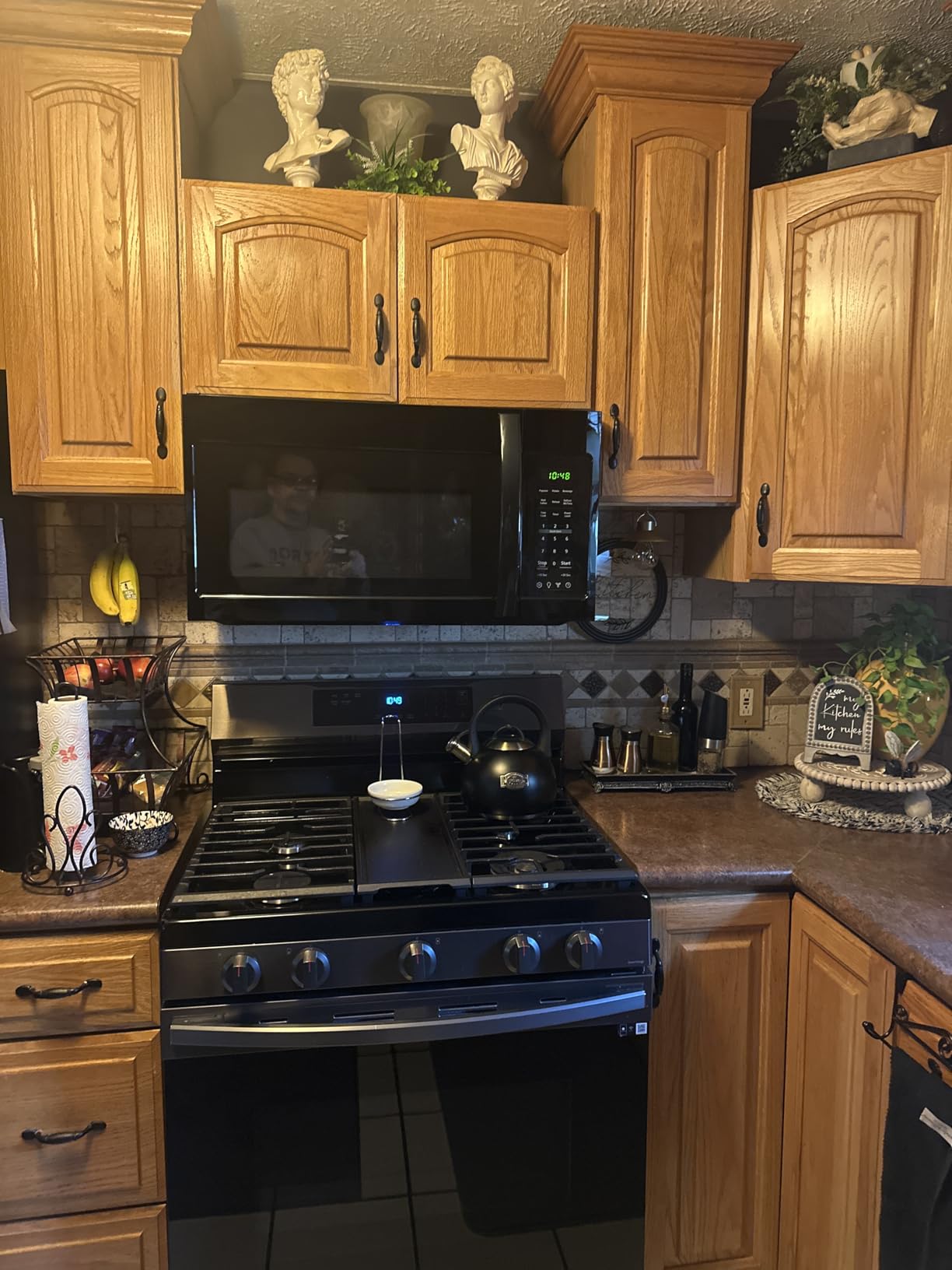
At 18.7 inches wide by 13.4 inches deep, this is the second-widest body here and the second-deepest. It is still a compact machine by any standard, but it is at the limit of what a 36-inch counter run beside a 30-inch stove will accept with a reasonable margin, so measure the gap rather than eyeballing it.
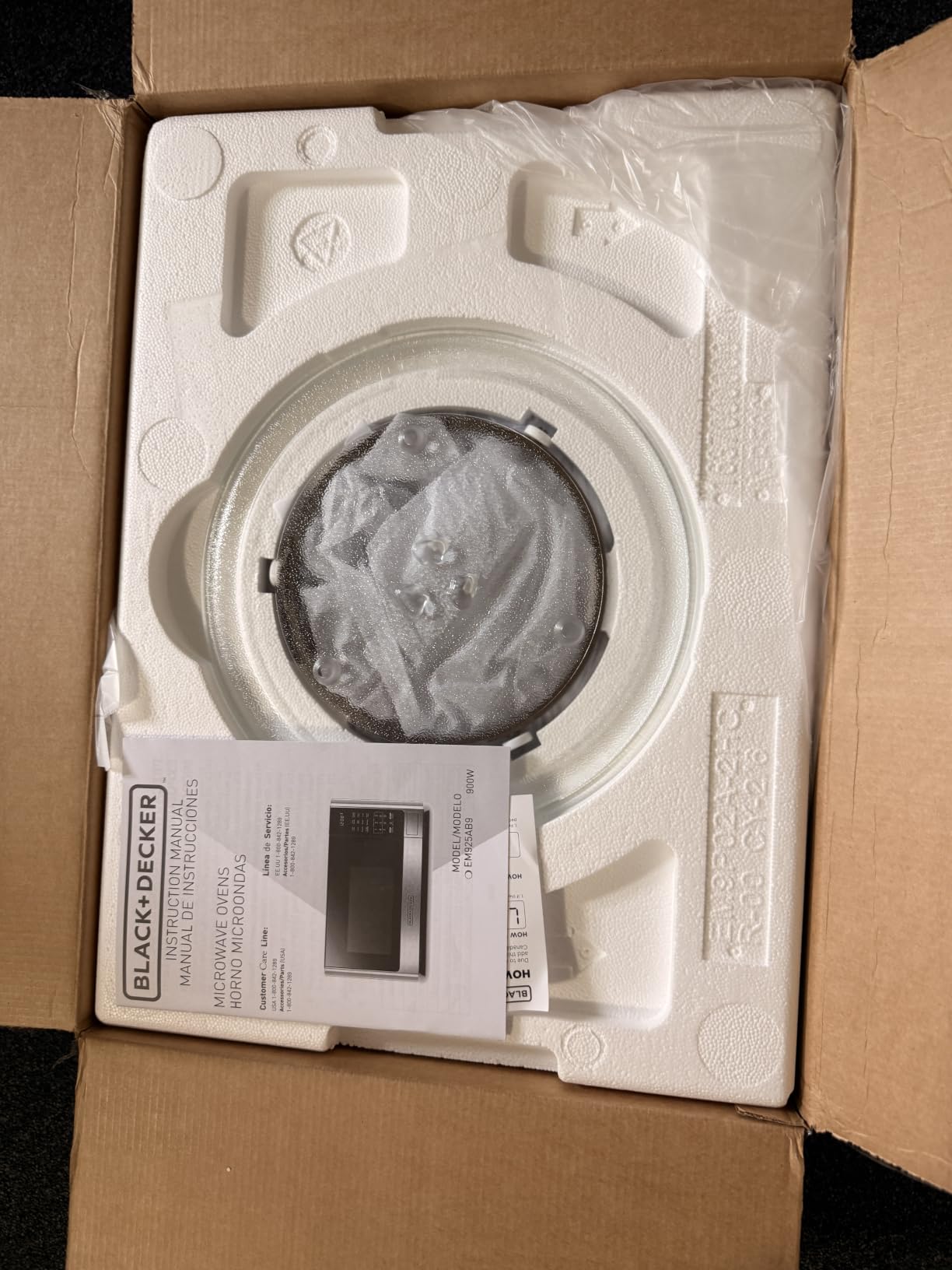
Even heating is the other thing owners comment on, and it comes from the turntable rather than the wattage. A 10.6 inch turntable inside a 0.9 cubic-foot cavity is a good ratio, and it is large enough for a dinner plate with room to spare, a 9-inch pizza lying flat, and a medium popcorn bag without a fight. That is a real step up from the 10 inch turntables in the 0.7 cubic-foot machines, even though the cavity itself is only modestly larger.
The six auto-cook presets cover the standard set, and a 30-second express button handles the top-ups. The quick defrost system is a straightforward time-based function rather than a weight-sensing one, which is fine if you know roughly how long your usual cut takes to thaw and annoying if you do not.
What 900W actually buys you
Roughly a third off the cook time on a frozen item and a meaningful reduction on defrosting. It also produces noticeably more heat in a small cavity, so a bowl of soup gets hot at the edges before the middle catches up unless you stir halfway. If you are sensitive to uneven reheating, use the 30-second top-up in stages rather than setting a long single time.
The trade is counter width. If you have 19 inches of clear run, this is the machine to buy and the speed difference will pay you back every week. If you have 17.5 inches, it will not sit properly and you should stay in the 0.7 cubic-foot class.
The child lock, and whether to live with it
This is the biggest usability complaint in the reviews, and it is worth being precise about it: the door will not open until you press the unlock control, and you cannot simply pull the handle as you would on a normal machine. Over time, owners report that the mechanism wears.
Our view is that it is a fair trade for a kitchen with small children, and a poor trade in a studio you share with adults. Check the handle-style model further down if the safety interlock is going to annoy you daily, because a pull-and-lift handle never puts that between you and reheating dinner.
6. Farberware FMO07AHTBKJ – Best for a Wider Turntable
Farberware 0.7 Cu. Ft. Countertop Microwave Oven – 700 Watts Power, Auto Cook Settings, Defrost, Easy Clean and Child Safety Lock – Stainless
0.7 cu ft
700W
10.6 inch turntable
12.99 D x 17.3 W x 10.14 H inches
Pros
- 10.6 inch turntable inside a 0.7 cu ft cavity which is unusual at this size
- 10 power levels with multi-stage cooking
- defrost by weight or by time
- stainless interior and exterior
- LED display with kitchen timer and clock
Cons
- Heaviest 0.7 cu ft machine here at 22.5 lb
- 700W output is slower than 900W alternatives
- child safety lock adds friction to opening the door
- 17.3 inch body is wider than the slimmest models
The turntable is the reason to look at this one. A 10.6 inch glass plate inside a 0.7 cubic-foot cavity means the usable floor of the machine is wider than most of its competitors at the same external size, and that is the number that decides whether a dinner plate sits comfortably or sits awkwardly. If your complaint about small microwaves has ever been that a plate touches the walls, this is the machine that addresses it without asking for extra counter width.
Power control is the second differentiator. Ten levels with multi-stage cooking means you can drop to a low setting, hold it there, then step up, which is how you defrost without cooking the outside or melt cheese without hardening it. Very few machines at this wattage and size let you program a sequence rather than a single level.
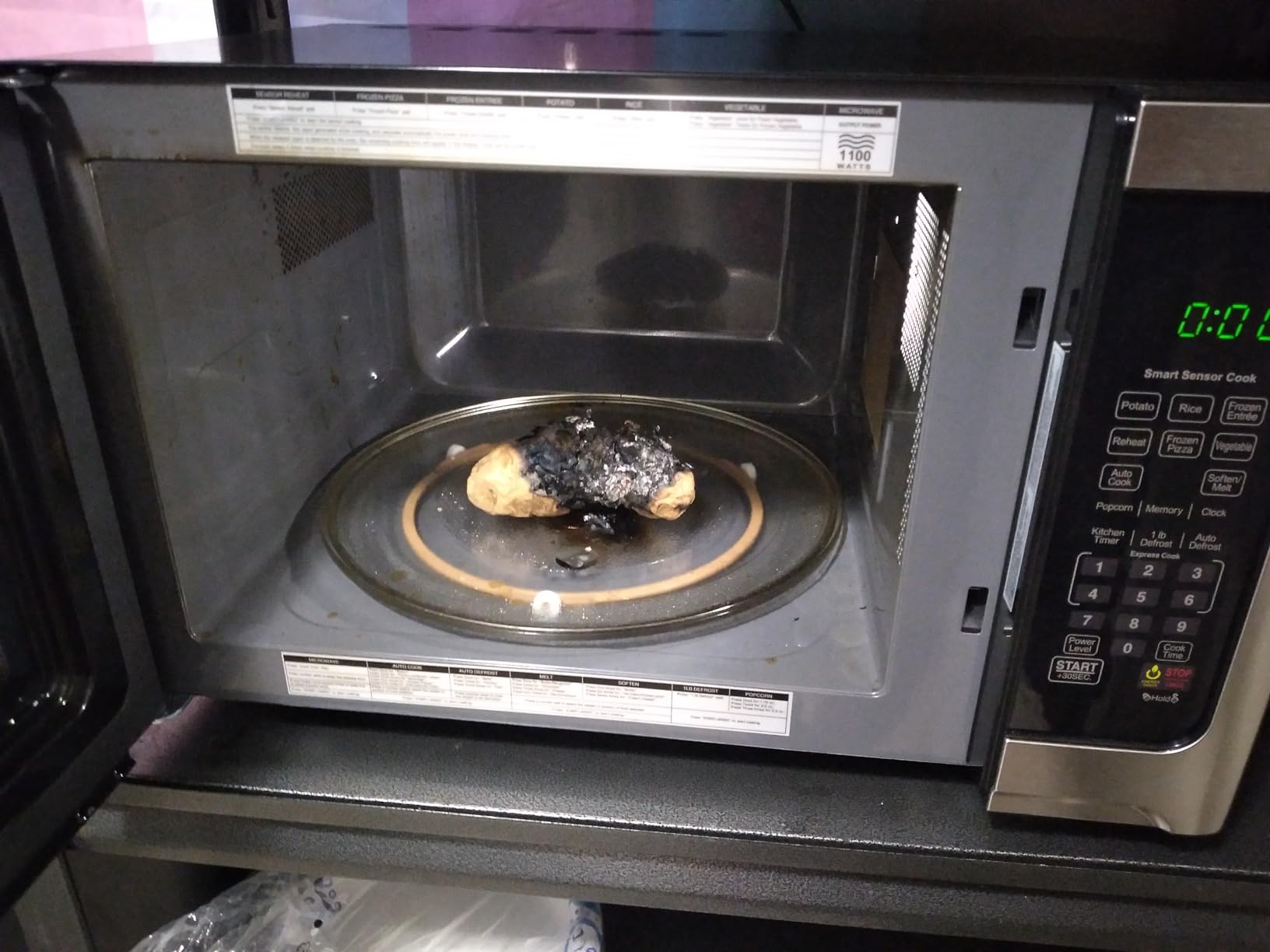
Defrost runs by weight or by time, and the weight setting is the more useful of the two for anyone who cooks the same cut regularly. The stainless interior and exterior are straightforward to wipe down and will not show fingerprints the way a gloss finish does, which matters on a counter where the machine is on show.
At 22.5 pounds it is the heaviest of the 0.7 cubic-foot machines here, and that weight is a stainless steel cavity doing exactly what you would hope. If you plan to move the machine often, accept that this is a two-hand lift. If it is going onto one counter and staying there, the heft is an advantage rather than an issue.
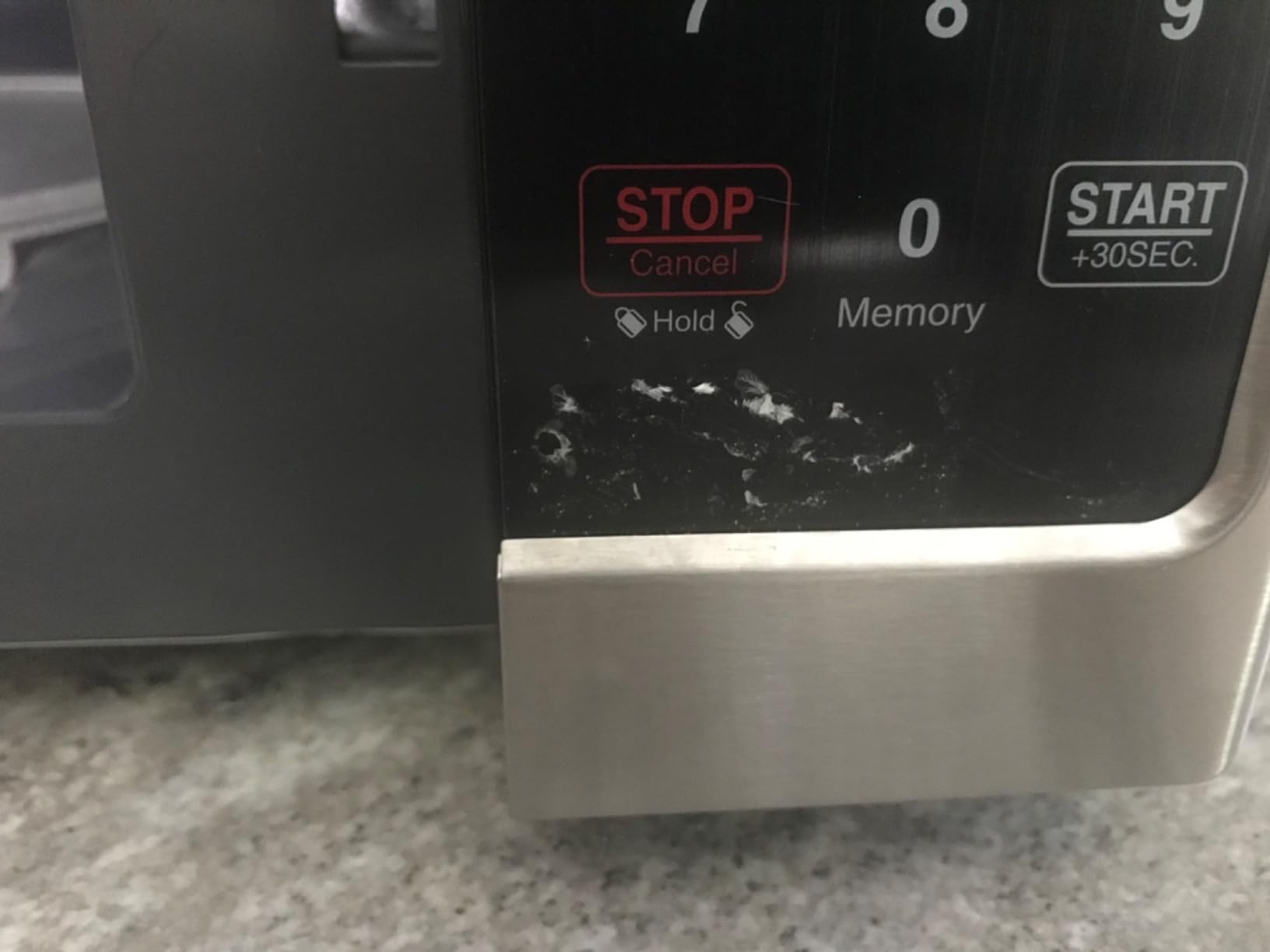
What a 10.6 inch turntable fits
A large dinner plate, a 9-inch pizza lying flat without an angle, a medium popcorn bag without jamming, and a 2-quart measuring cup. In practice this is the most capable interior in the compact class, and the gap between it and a 9.5 inch turntable model is far more obvious in use than the half-inch specification suggests.
The trade is that the extra plate diameter comes with a slightly narrower gap to the cavity walls, so a wide casserole dish still will not turn properly. Deep dishes are the limit, not wide ones, which is the opposite of what most people expect from a small microwave.
What you give up for it
Seven hundred watts. That is the honest limitation, and it is why the multi-stage power control matters so much on this model. With ten levels you can work around a weak magnetron far better than you can with five, so the two features compensate for each other.
Also weigh the child lock, which adds a step to opening the door, and the weight, which is real at 22.5 pounds. If you are cooking for one, reheating shallow containers, and occasionally want a 9-inch pizza, this is a strong pick. If you are defrosting several pounds of meat a week, step up to a 900-watt model instead.
7. Chefman RJ55-7-V2 – Best for the Lowest Profile
Chefman Countertop Microwave Oven 0.7 Cu. Ft., 700 Watts with 10 Power Levels, 6 Cooking Presets with One-Touch Express Cook, Eco Mode, Child Safety Lock, & Mute Button – Black
0.7 cu ft
700W
9.53 inch tall body
12.93 D x 17.52 W x 9.53 H inches
Pros
- Shortest body in the guide at 9.53 inches so it clears low shelves
- full mute button silences every beep
- handle-mounted child lock keeps the door closed rather than latching it
- dishwasher-safe glass turntable
- eco mode reduces standby use
Cons
- 700W is slow for heavy reheating jobs
- handle-only opening is unusual and takes practice
- heaviest machine in the set at 23.8 lb
- no convection or grill functions at all
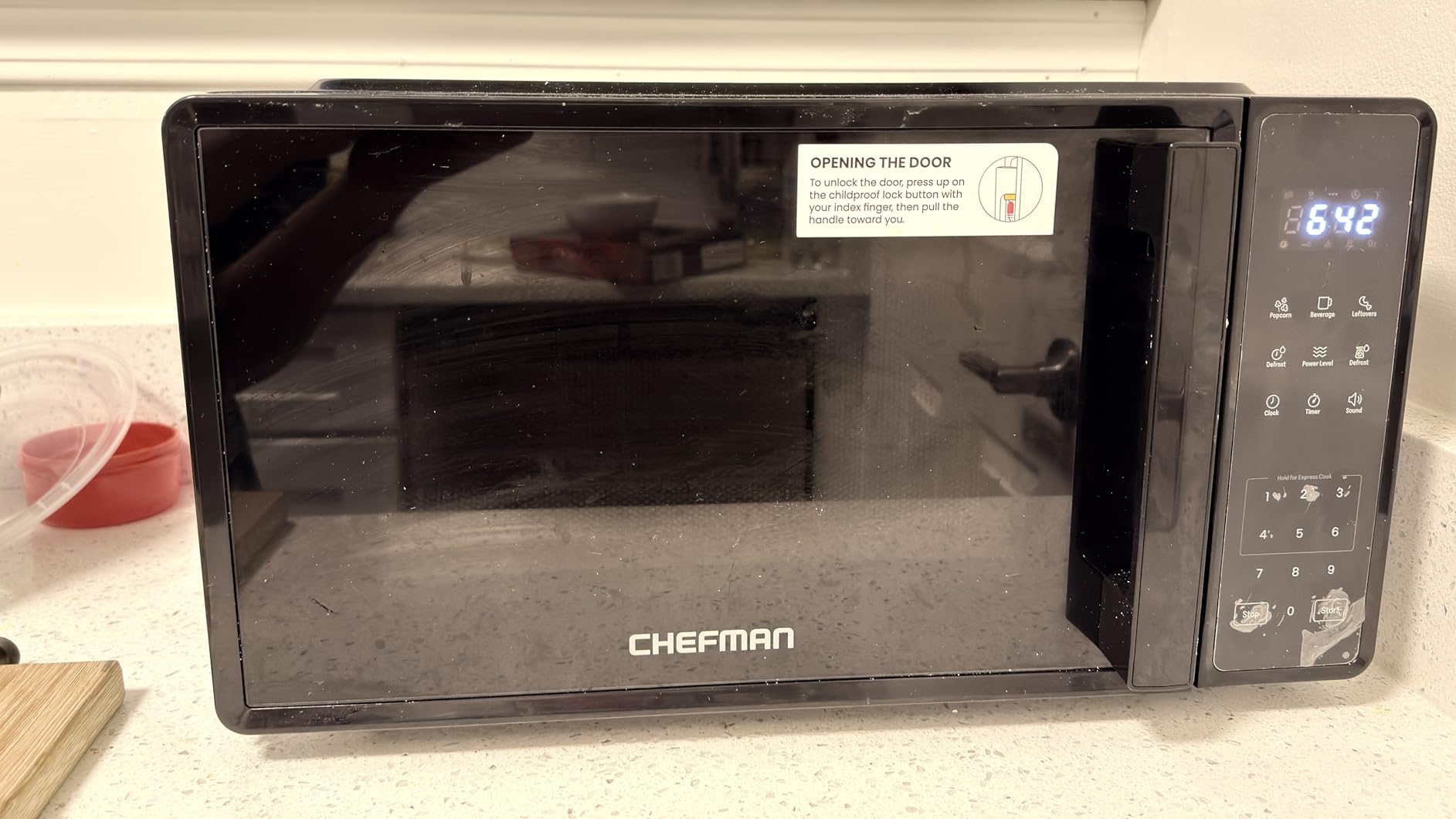
At 9.53 inches tall, this is the shortest body in the guide, and in a galley kitchen with a low wall cabinet or a shallow shelf, that half-inch is the difference between fitting and not fitting. Height is the one dimension almost nobody measures before buying and almost everybody wishes they had, because the machine looks small in a product photo and turns out to be the tallest thing on the counter.
The door design is the second thing worth knowing. Instead of a push-button release, the child lock is mounted on the handle and you pull up on the top edge of the handle to open. That is a genuinely different safety architecture, and it means the door is held mechanically rather than relying on a latch, which is the part that breaks in most budget microwaves.
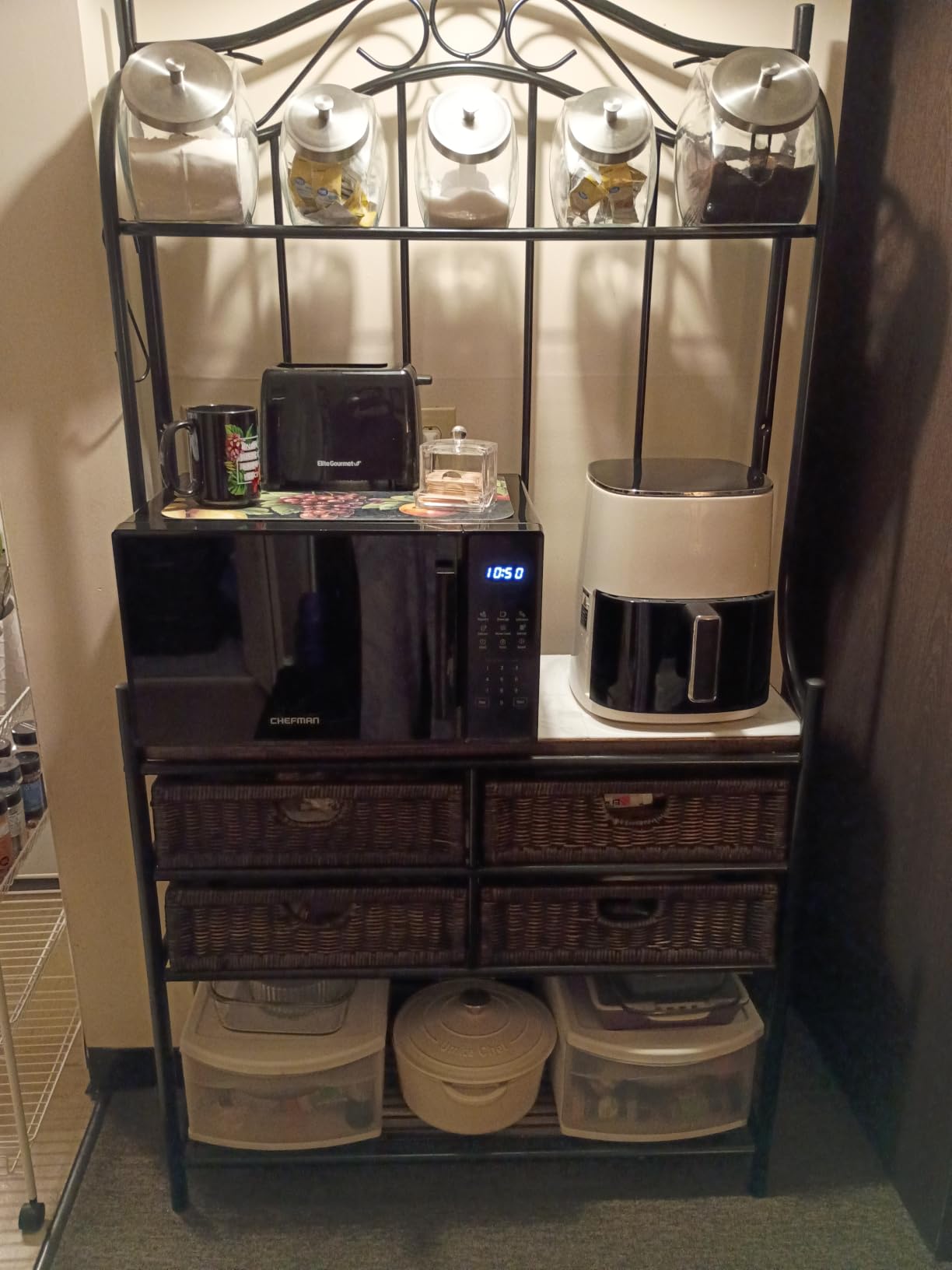
The mute button is a full silence rather than a quieter tone, and combined with the eco mode that reduces standby draw, this is the most acoustically and electrically polite machine in the guide. The dishwasher-safe glass turntable is a small quality-of-life detail in a studio with a sink but no dishwasher, because you can rinse the plate and put it straight back in.
Six presets cover popcorn, pizza, beverages, vegetables, potatoes and leftovers, and number-key express cook starts a set minute count in a single press. Owners report that these two shortcuts are the features they use daily and that the rest of the panel is largely ignored, which is exactly how a compact microwave should work.
Height, and where the machine goes
Measure the gap from your counter surface to the underside of whatever is above it, then subtract an inch so air can move. A 9.53 inch body needs a little over 10.5 inches of opening, which is the difference between fitting under a standard wall cabinet and not fitting under a low one. If your only option is an open shelf above the counter, this is the machine to shortlist first.
Because there is no hanging kit listed for this model, treat under-cabinet mounting as off the table and plan for a shelf or a cart rather than a bracket. The handle does not project forward much either, so you can push it close to the backsplash.
Who should buy this and who should not
Buy it if your binding constraint is vertical clearance, if the beeping bothers you in a reflective kitchen, or if you like the idea of a door that is held by a handle rather than a latch. It is cETL approved, which is the safety certification to check for on any compact model.
Skip it if you are the sort of person who will open the door forty times a day, because the pull-up motion is a genuine adjustment and the first week is frustrating. At 23.8 pounds it is also the heaviest machine here, so moving it around to free up prep space is not a one-hand job. And at 700 watts with no convection or grill, it reheats and defrosts and nothing more.
8. Frigidaire EMW733BLACKAMZ – Best for Sensor Auto Cook
FRIGIDAIRE EMW733BLACKAMZ 0.7 Cu. Ft. Microwave, Black
0.7 cu ft
700W
smart sensor auto cook
12.3 D x 17.8 W x 10.2 H inches
Pros
- Shallowest body in the guide at 12.3 inches so it slides into the tightest depth gaps
- smart sensor auto cook with six presets
- quiet running with a soft beep
- glass interior is easy to clean
- handles a 10.5 inch dinner plate
Cons
- Door stays locked until you press stop or reset which is the most common complaint in the reviews
- display is very bright in a dark room
- panel lettering is faint
- no free-form time entry so cooking is preset driven
- bulky plug needs about 2 inches of wall gap
Twelve point three inches of depth makes this the shallowest machine in the guide, and if your gap next to the stove is 12.5 inches or less, this is the only pick here that is guaranteed to sit properly. Every other 0.7 cubic-foot machine in this list is between 12.5 and 13.4 inches deep, so a quarter inch becomes the difference between a clean fit and a microwave sticking out past the edge of the counter.
Smart sensor auto cook is the other reason to look here. The machine senses moisture content and adjusts the cook time, which means a baked potato or a frozen dinner stops on its own without you estimating. In a kitchen where the person cooking is distracted, that is a real convenience, and it is uncommon at this size and wattage.
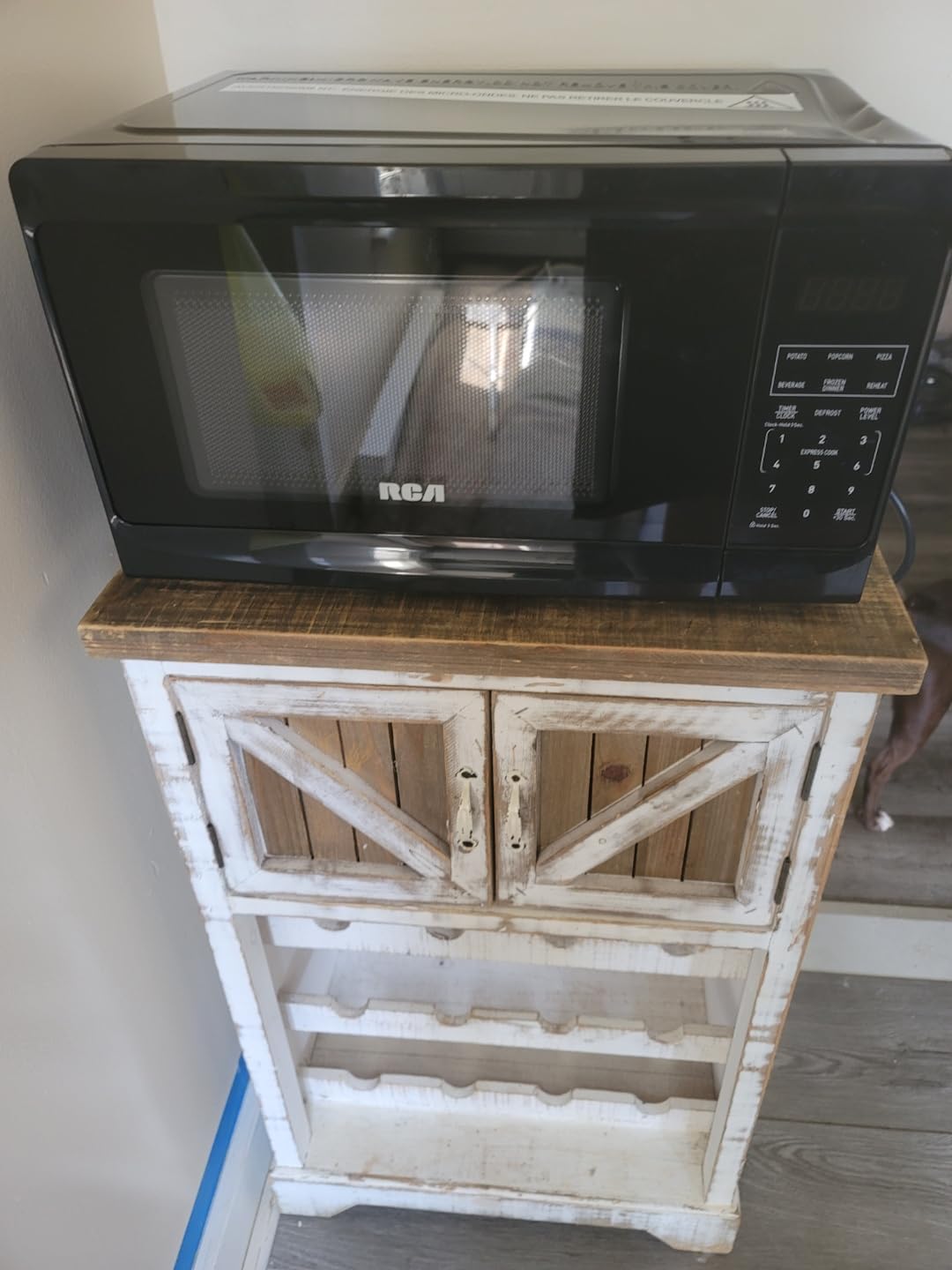
Owners consistently report that it heats faster and more evenly than older turntable-less machines, and the running noise is low, which is worth something in a kitchen where every sound bounces off tile and cabinet fronts. The glass interior wipes clean without absorbing grease the way enamel can. The basic button layout is familiar and needs no learning curve.
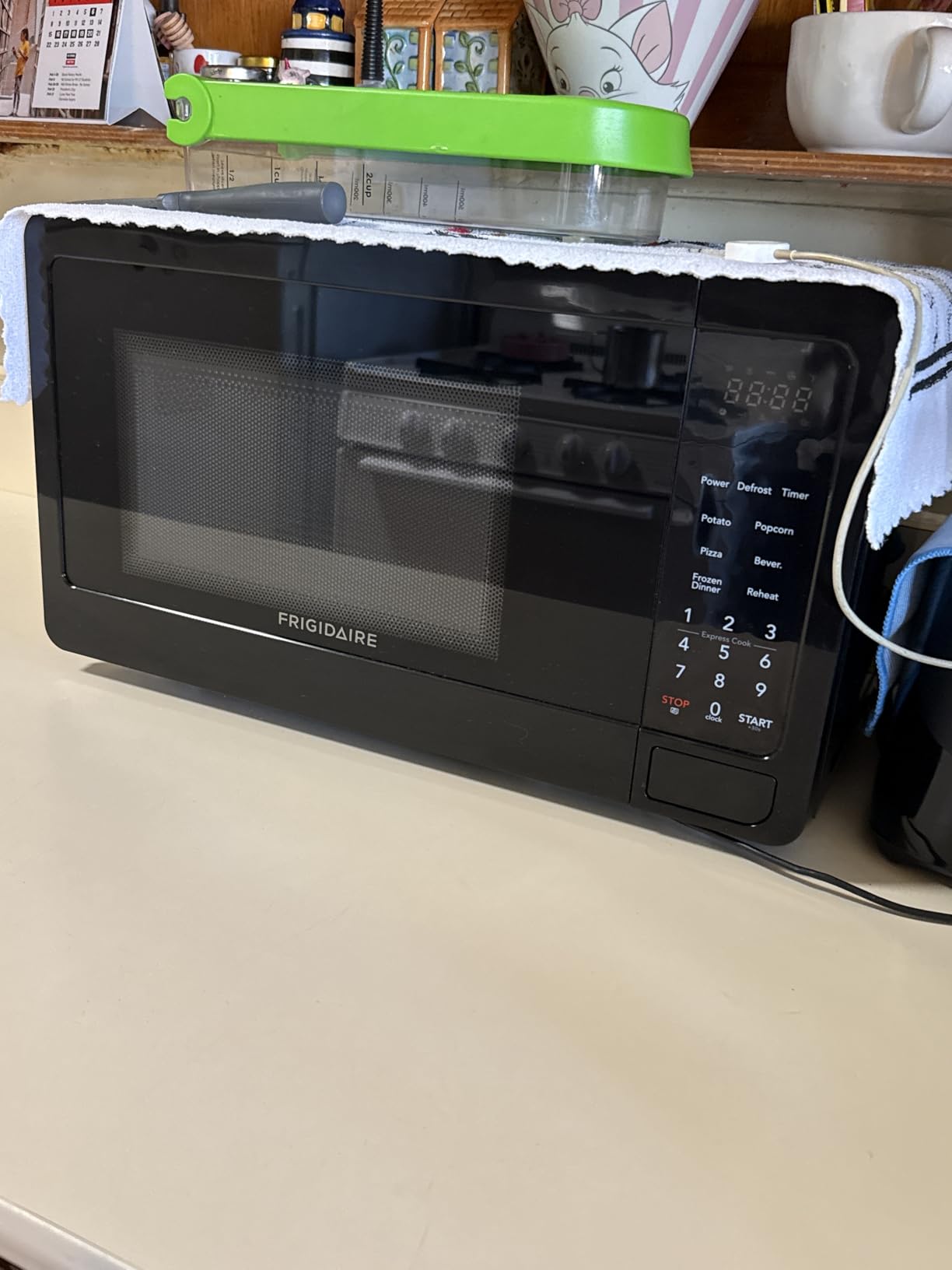
We have to be direct about the main flaw, because it comes up in a large share of the reviews: the door will not open until you press stop or reset, even after the cook has finished. It is a safety interlock doing its job in an unhelpful way, and on a machine you use several times a day it becomes a daily irritation. Secondary gripes include a very bright display that lights the room after dark and faint panel lettering.
Is the depth saving worth the interlock
If your counter gap is under 12.5 inches, yes, without question, because no other machine here will physically fit. If you have a full 13 inches of depth available, then you are trading a real usability annoyance for a quarter inch you did not need, and there are better options above.
The sensor cooking is the feature that offsets it. If you cook sensor programs often, the interlock annoyance is offset by never having to think about the time. If you mostly reheat a known quantity for a known number of minutes, the sensor adds little and the stop button adds a step every time.
What to check before you settle on it
Look at the display in a dim room. It is genuinely bright, and in a small kitchen with the lights off that is a real complaint from owners. Also confirm you are comfortable with preset-driven cooking, because there is no free-form time entry on this panel, which is an unusual limitation in this class.
At 4.1 stars this is the lowest-rated machine in the guide, and the gap is explained by durability reports rather than by performance. Some owners describe button quality degrading and door assemblies failing soon after delivery. If you want a machine that disappears into the background for five years, choose the stainless-cavity model instead.
9. Toshiba ML-EM09PA(BS) – Best for Power Level Control
TOSHIBA Microwave Oven, 0.9 Cu.Ft, 900W, Black Stainless Steel
0.9 cu ft
900W output, 1400W input
11 power levels
13.3 D x 18.7 W x 10.7 H inches
Pros
- Highest average rating in the guide at 4.5 stars
- 11 power levels which is more than any other machine here
- 900W output for faster reheating
- 10.6 inch glass turntable inside a 0.9 cu ft cavity
- six preset menus plus defrost by weight or time
- one-touch start for 1 to 6 minutes
Cons
- Widest and heaviest machine in the guide needing 18.7 inches of width
- highest power point in the set
- no convection
- grill or air-fry functions
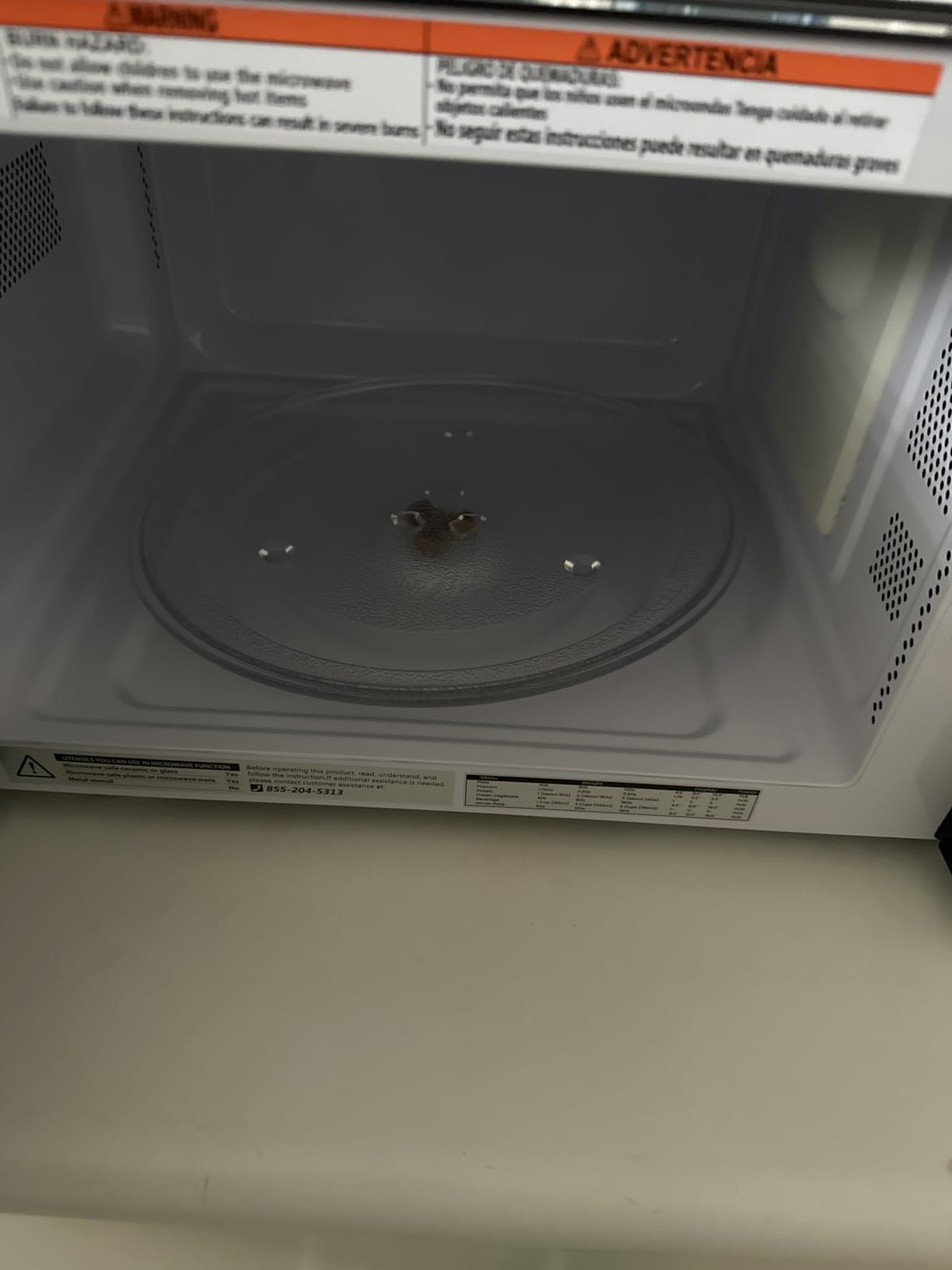
Eleven power levels is more granular control than anything else in this guide, and it is the feature that separates a machine you can cook on from a machine you can only reheat on. At high power you heat soup in two minutes; at the lowest levels you hold a chocolate bar or a bowl of butter without either cooking or freezing. Combined with defrost by weight, it means you can treat the machine like a small oven rather than a timer with a door.
It also holds the highest average rating in the guide at 4.5 stars, and that rating is built on even heating and a large turntable relative to the cavity. The 10.6 inch glass plate inside 0.9 cubic feet gives you the same plate diameter as the 900-watt model above but with more headroom around it, which is what stops a tall container from touching the cavity walls.
One-touch start for 1 to 6 minutes at full power covers the reheating pattern most people use, and six preset menus handle popcorn, pizza, potatoes and similar. A mute function and a two-step child lock are both present, so this is one of the few machines here that is quiet and safe without a trade-off.
The catch is size. At 18.7 inches wide, 13.3 inches deep, 10.7 inches tall and 24.9 pounds, this is both the widest and the heaviest machine in the guide. It is still a compact microwave, but it is at the outer edge of the category, and it needs a genuinely clear stretch of counter to sit on properly.
What 11 power levels actually let you do
They let you do the things that a single-level compact microwave cannot. Soften a block of cream cheese without melting it. Melt butter without it hitting the top of the bowl. Warm a mug of milk to a drinkable temperature without a skin forming. Bring a frozen chicken breast up to temperature in a low, long cycle instead of a short, hot one that cooks the outside.
If you mostly reheat leftovers in one press, eleven levels is a feature you will never discover. If you cook at all beyond reheating, it is the difference between a microwave and an appliance.
The footprint question
Eighteen point seven inches of width is one inch more than most machines here, and in a 36-inch counter run beside a 30-inch stove it leaves about four inches of margin. That is workable. Beside a 24-inch range it is tight, and you should plan to place it elsewhere or choose a 17.3 inch body instead.
Note also the input power. Nine hundred watts of output draws 1400 watts of input, which is the highest figure in this guide and the reason we cover circuits below. On a shared fifteen-amp kitchen circuit alongside a kettle and a toaster, this machine is the one most likely to trip a breaker.
10. Emerson MW7302B – Best for a Handle Door and Longevity
Emerson Compact Countertop Microwave Oven, 0.7 Cu. Ft., 700 Watts, 10 Power Levels, 6 Cooking Presets, Time & Weight Defrost, Express Cooking, Black, MW7302B
0.7 cu ft
700W
10 power levels
17.3 by 13.2 by 10.2 inches
Pros
- Reported ownership from 3 to 16 years across multiple households
- real door handle rather than a push-button release
- defrost by both time and weight
- 99 minute and 99 second digital timer
- simple design with fewer electronics to fail
- express cooking buttons 1 to 6 at full power
Cons
- 700W output is modest and cooks slowly
- cavity is too small for the largest plates or tall containers such as a rice bag
- membrane panel printing is hard to read
- light door can be damaged if pulled rather than lifted
The reason this machine makes the list is not a specification. Multiple owners describe buying the same model two or three times for different kitchens, with reported lifespans ranging from three years to sixteen, and they credit that partly to how simple the design is. There is a real engineering argument behind those reports: fewer electronic boards and fewer interlocks means fewer components that can fail, and the handle-style door is mechanically stronger than a push-button release.
That handle matters more than it sounds. A door you lift by the bar stays in one piece; a door held by a latch can be yanked off its latch plate, which is the single most common failure in budget microwaves and the thing we would most want to avoid in a rental where the machine gets moved around. The trade is that the light door shell can crack if you pull rather than lift, which is a habit worth teaching yourself on day one.
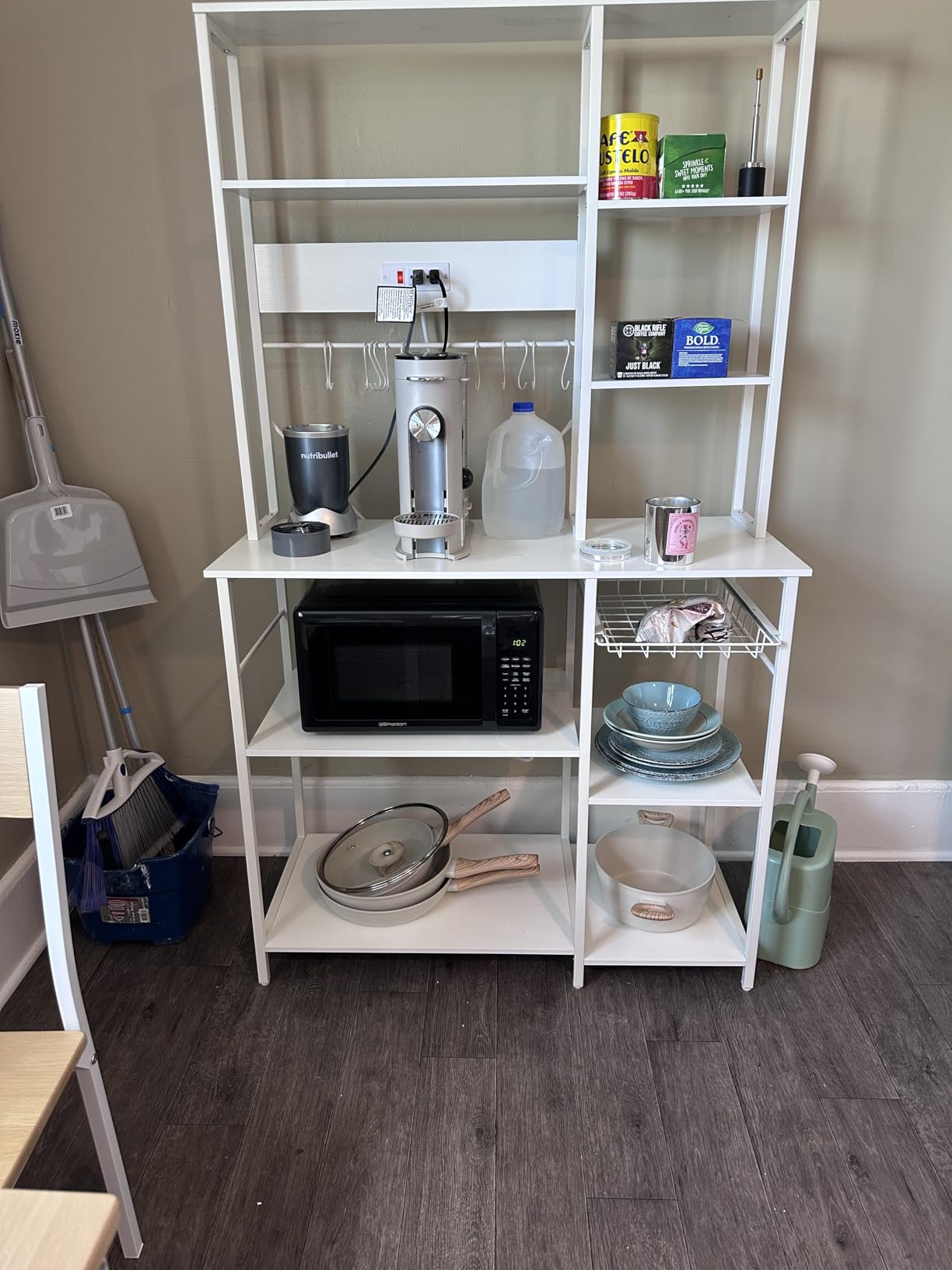
Functionally it is well equipped for the size. Ten power levels, six pre-programmed menus covering popcorn, potato, pizza, vegetables, beverages and reheating, defrost by time and by weight, express cooking, and a 99-minute 99-second digital timer with a separate kitchen timer. The interior is designed to maximise turntable space for its footprint, which is a sensible engineering choice in a compact cavity.
The 700-watt output is the same ceiling as most of this class, and the cavity is small enough that the largest plates and taller containers will not fit or will need extra time. A 90-second rice bag is the example owners give, and it is a good one, because standing bags are tall even when they are light.
Who buys a machine for a decade
This is the pick for a first apartment you intend to stay in, a shared house where the microwave gets handled roughly, or anyone who has replaced a cheap microwave already and would rather buy once. The simplicity of the panel is part of the appeal, since there is no mode to select and no feature to discover by accident.
It is also the pick for anyone who prefers a handle to a button, for the mechanical reasons above. The reported longevity is the strongest evidence in the guide, and longevity is the metric that actually matters when the counter space is so tight you do not want to re-run this whole decision in three years.
Where the trade-offs sit
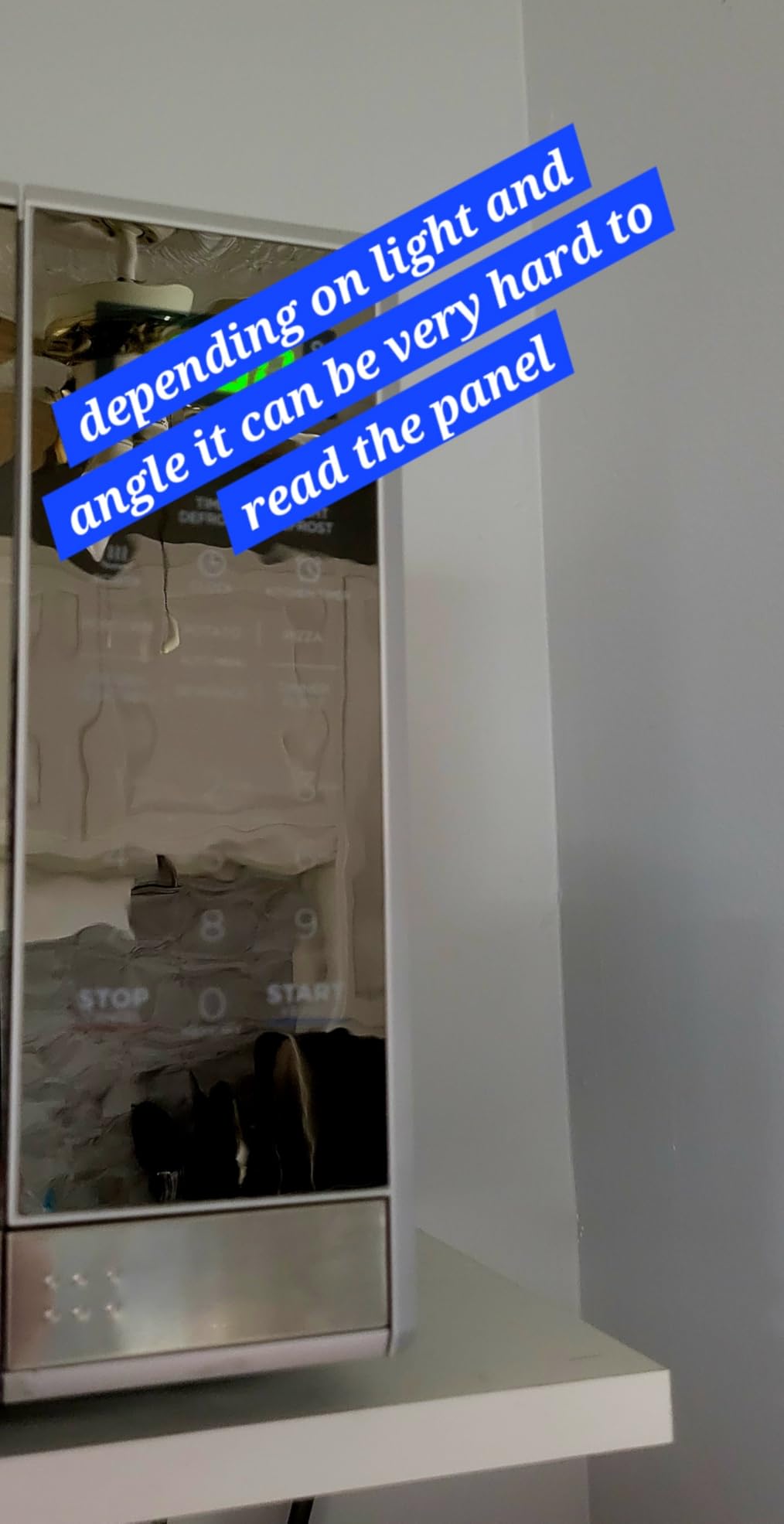
Panel lettering is printed on a membrane and is genuinely hard to read, which is the most common complaint and a genuine problem for anyone with reduced vision. The cavity will not take a large dinner plate or a tall bag, so this is a reheating machine for shallow containers rather than a general-purpose one.
At 700 watts, cooking is slower than a 900-watt unit and there is no convection, grill or air-fry function. Buy it for durability and the handle, and accept that you are buying a reheat-and-defrost machine with excellent build character rather than a cooking appliance.
How to Measure Your Counter Before You Buy
Almost every microwave returns in a small kitchen trace back to a measurement that was never taken. Here is the sequence we use, and it takes about five minutes with a tape measure.
Step one: measure the clear width. Measure the flat stretch of counter you intend to use, from the wall or backsplash to the nearest obstruction, at the height where the machine will sit. Do not measure at the front edge if the counter is tapered. Add half an inch on each side so you can lift the machine out and clean behind it.
Step two: measure the clear depth. Measure from the backsplash to the front edge of the counter, not to the front edge of the cabinets above. This is the number most people overestimate. The machines in this guide run from 12.3 inches deep to 13.4 inches, and the shallowest one is the one that solves the worst gaps.
Step three: measure the overhead gap. From the counter surface straight up to the underside of the wall cabinet, shelf, or range hood. The bodies here run from 9.53 inches to 10.7 inches tall. Leave at least an inch above the machine for air, which means you need roughly 10.5 inches of opening for the shortest model and 11.7 inches for the tallest.
Step four: check the cord and plug. The plug is a real constraint in a shallow gap. The Nostalgia needs roughly 2.5 inches behind the body, and the Frigidaire’s bulky plug keeps it about 2 inches off the wall. Standard plugs need about 1.5 inches. If your depth measurement came out at exactly 12.5 inches, the plug is the detail that will stop you.
Step five: check what has to go on the counter first. A microwave that eats 13.4 inches of a 16 inch gap leaves you a 2.6 inch prep strip, which is not a prep strip. If you cook at all, the machine needs to leave you at least 12 inches of continuous work surface somewhere else, which is usually why people end up with a shelf instead of a counter slot. We have covered the same problem in our small kitchen island guide, where work surface is the whole argument.
One more measurement worth taking: the inside of your lower cabinets. If a spare shelf can hold the machine, the constraint changes completely, and a 24.9 pound model becomes a two-person job rather than an impossibility.
Ventilation and Clearance Rules for Tight Kitchens
A microwave expels heat through vents in its back and sides, and in a normal kitchen there is room for that heat to dissipate. In a galley kitchen wedged between a wall and a cabinet, there often is not, and the machine works harder and ages faster than it should.
The practical rules are simple. Leave the gap specified in the installation manual at the back, the sides and the top, and do not treat the published exterior depth as the depth you need. The Frigidaire example in this guide is 12.3 inches deep and still needs about 2 inches behind the body for the plug and the rear vent, so the real requirement is closer to 14.5 inches.
Avoid the two configurations that cause most problems. The first is a machine pushed fully into a cabinet recess with its back flat against the wall, which blocks the rear vent. The second is a machine wedged into a corner where both sides are touching something, because the side vents need somewhere to go. If your only available spot is a corner, look for a model with vents on one side only and angle it so that side stays open.
Ventilation is the most repeated worry in small-kitchen forums, and it is the one constraint almost no roundup publishes numbers for. The fix is unglamorous: measure the recess, subtract the machine, and leave an inch of daylight on the sides and top wherever you can. If the ceiling above is a solid cabinet at 10 inches, check the manual for the minimum before you assume it fits.
If counter space is the real problem rather than ventilation, a shelf is usually the better answer than a squeeze. Our picks on countertop ice makers for small kitchens face the identical trade-off, and the same rule applies: measure the footprint including the air the machine needs, not just the box.
Electrical Requirements: Amps, Circuits and Dorm Limits
Most small kitchens run on a shared circuit, and microwave input power is the second constraint after physical space. Output wattage and input wattage are different numbers, and the input figure is the one that matters for your breaker.
The COMFEE in this guide puts out 700 watts and draws 1050 watts at the plug. The Toshiba puts out 900 watts and draws 1400 watts. A standard North American 15-amp household circuit is rated for 1800 watts continuous, so a 1400-watt input microwave leaves room for almost nothing else on that circuit. Run a kettle or a toaster at the same time and you have a breaker trip in your future.
What this means in practice: if your counter outlet is on the same circuit as a toaster, a 700-watt machine is a comfortable fit and a 900-watt machine is workable if you do not run both at once. If the outlet is on a 20-amp circuit, or is the only outlet in a studio, either will be fine. If you are in a dorm or a rental with a documented wattage cap on permitted appliances, a lower-input machine is the safer buy, and the manual-dial-style simplicity of a lower-power machine suits that situation anyway.
Extension cords and power strips are the real hazard here. A microwave is the single largest load in most kitchens, and running one through a general-use extension cord or a multi-outlet strip is a fire risk regardless of the wattage. Plug the machine directly into a wall outlet, and if there is no outlet where you need the machine, an electrician adding one is cheaper than a fire.
What You Give Up With a Compact Microwave
A compact microwave is not a smaller full-size microwave, and the trade-offs are real enough to name before you buy.
Cook speed. Every 0.7 cubic-foot machine here is 700 watts against a full-size typical of 1200 watts. That is roughly 40 percent less power, which translates into minutes rather than seconds on frozen food and meat. If you cook for more than one person, a 900-watt machine is a better use of the same counter space.
Interior volume. A 0.7 cubic-foot cavity will not take a large dinner plate, a 9-inch pizza lying flat, or a tall stockpot. The turntable figure is the honest number: 9.5 inches, 10 inches, or 10.6 inches depending on the model, and every container decision follows from it.
Ventilation headroom. Smaller machines are often placed in tighter spots, which is exactly where the side and rear vents have no room to work. This is a placement problem rather than a product defect, but it is caused by the same compactness you were buying.
Feature depth. None of the machines in this guide offers convection baking, grilling or air frying. A combo microwave is a different class of appliance that earns its counter space by replacing a toaster oven, and it is physically far larger than anything on this list. If you want to cook rather than reheat, plan that as a separate purchase, and use our counter kitchen planning picks to think through whether the counter can carry two appliances.
Durability at the budget tier. A share of owners across the budget brands report early unit failure, most often the door assembly or the control buttons. That is the argument for buying one stainless-cavity machine and keeping it, rather than replacing a cheap one every few years.
None of that makes a compact microwave a bad purchase. For one person in a studio, a 700-watt machine that heats leftovers in three minutes and takes up 13 inches of counter is exactly the right tool. The mistake is buying it expecting a 1200-watt experience or a 1.5 cubic-foot cavity.
Frequently Asked Questions
What is the best small basic microwave?
The COMFEE EM720CPL-PMB is the best small basic microwave for most people. It measures 17.3 by 13 by 10.2 inches, puts out 700 watts, and has a 10 inch turntable that takes a standard dinner plate. A full mute function and six auto-cook presets cover the two things people actually use a small microwave for, and it carries a 4.4 star rating across more than 25,000 owner reviews.
How much counter space does a microwave need?
Plan on the exterior width plus an inch of clearance on each side, and the exterior depth plus 1.5 to 2.5 inches at the back for the plug and the rear vent. The machines in this guide run 17.3 to 18.7 inches wide and 12.3 to 13.4 inches deep, and they are 9.53 to 10.7 inches tall. Measure the clear width, the clear depth and the overhead gap before you choose a model, not after it arrives.
What is the smallest size microwave to buy?
The smallest usable size is 0.7 cubic feet, roughly 17.3 inches wide by 12.3 to 13 inches deep. Below that, interior volume gets too tight for a dinner plate. Among the picks here, the Frigidaire EMW733BLACKAMZ is the shallowest at 12.3 inches deep, the Chefman RJ55-7-V2 is the shortest at 9.53 inches tall, and the Commercial Chef CHM770S is 9.56 inches tall.
Do small microwaves take longer to cook?
Yes, and the reason is wattage rather than cavity size. Every 0.7 cubic-foot machine in this guide is rated at 700 watts, against roughly 1200 watts for a typical full-size microwave. That gap adds roughly a minute to a frozen dinner and several minutes to a defrost. The two 900-watt models here, the BLACK+DECKER EM925AB9 and the Toshiba ML-EM09PA(BS), cut that gap substantially at the cost of extra counter width.
Can a compact microwave fit a dinner plate?
Usually, and turntable diameter is the number that decides. The 10 inch turntables in the COMFEE, BLACK+DECKER EM720CB7 and Emerson machines take a standard dinner plate comfortably. The 10.6 inch turntables in the Farberware, BLACK+DECKER EM925AB9 and Toshiba fit a 9-inch pizza lying flat and a medium popcorn bag without jamming. The 9.5 inch turntable in the Commercial Chef is the tightest of the group.
What are the disadvantages of a compact microwave?
The four that matter are cook speed, interior volume, ventilation headroom and feature depth. Compact models run at 700 watts against roughly 1200 watts for a full-size machine, so frozen food takes longer. The cavity will not take a large dinner plate, a 9-inch pizza or a tall pot. Smaller machines get placed in tighter spots where the side and rear vents have no room. And none of the compact models here offer convection, grilling or air frying.
Conclusion: The Best Countertop Microwaves for Small Kitchens in 2026
Measure first, buy second. The single most useful thing in this guide is that every machine lists its exterior width, depth, height and turntable diameter, and those four numbers against your own counter and your own dinner plates will eliminate half the list before you read a single review.
For most people, the COMFEE EM720CPL-PMB is the right answer: 17.3 by 13 by 10.2 inches, 700 watts, a 10 inch turntable, a full mute function and the largest body of owner feedback in the guide. Buy the BLACK+DECKER EM720CB7 instead if weight matters and you plan to move the machine. Buy the Commercial Chef CHM770S if the cavity needs to survive five years of daily splatter, and the Frigidaire EMW733BLACKAMZ if your counter gap is under 12.5 inches and nothing else will fit.
Step up to 900 watts with the BLACK+DECKER EM925AB9 if you cook more than you reheat and you have 19 inches of clear width, and choose the Toshiba ML-EM09PA(BS) if you want the finest power control in the group and can live with the largest footprint. The Nostalgia NRMO7WH6A is the one to buy when the microwave is visible and you want it to look deliberate, and the Emerson MW7302B is the one to buy once and keep, given the reported three-to-sixteen-year ownership spread and a real door handle.
Whatever you choose, leave the ventilation gaps, plug it straight into a wall outlet, and check your lease before you plan on mounting anything. Those three steps cost nothing and prevent almost every regret we saw in the reviews.