

The best bed rails for elderly adults come down to three things: what kind of bed you have, how thick the mattress is, and whether the rail is there to help with transfers or to stop falls. Our top pick is the Medline Bed Assist Bar for its grip and pouch, the Vaunn rail for certified strength on standard-height beds, and the Stander EZ Adjust when you need real fall coverage rather than just a handhold.
I have spent the last few months going through bed rail listings, spec sheets and customer feedback with a simple goal in mind. My grandmother had a bad fall trying to get to the bathroom at 2am, and the weeks after that were spent working out which kind of rail actually helps and which kind just creates a new problem. Caregivers on r/AgingParents describe almost the same thing: the fall is what triggers the purchase, and the entrapment question is the first thing they want answered.
That is why this list is not simply ten rails ranked by star rating. Capacity, mattress thickness range, whether the frame folds for caregiver access, and whether the legs clear your bed frame all matter more than the average score. Four of the ten rails here carry a stated capacity of 300 lb or less, and almost none of them fit a motorized adjustable base.
Before the picks, one framing point. A bed rail is a mobility aid, not a restraint. A practitioner posting in r/nursing described the clinical use case plainly: rails are for bed mobility, defining the bed perimeter and keeping balance while standing. If the goal is to stop someone from getting out of bed, a rail is the wrong tool and may increase injury risk. More on that in the safety section below.
Top 3 Bed Rails for Elderly Adults in 2026
These are the three we would put in a parent’s bedroom first, based on how they handle grip quality, fit across bed types, and the sheer number of people who use them without regret.

Medline Bed Assist Bar
- Foam-covered multi-grip handle
- Tool-free keyed assembly
- Folds flat with nylon pouch

Vaunn ASTM F3186 Rail
- ASTM F3186-17 certified
- 300 lb capacity
- Foam-padded slip-resistant grip

Stander EZ Adjust Rail
- Adjusts 20 to 30 inches
- Folds down with knob twist
- Multi-pocket organizer
The Medline rail wins on evidence rather than on specification. It carries more customer reviews than any other product in this roundup by a wide margin, and the recurring themes are consistent: the foam grip stays comfortable through long recoveries, and the pouch keeps glasses, medication and a phone within reach so the user does not have to cross a dark room.
The Vaunn rail is the pick when grip strength is the concern. It is one of the few in the group with a documented ASTM F3186-17 certification and a 300 lb rating, and the wide padded handle with horizontal stabilizer bars gives a user something to push against without pinching arthritic fingers.
The Stander rail is the only one here built mainly as a guard rather than an assist bar. It extends across 20 to 30 inches, folds down with a knob twist so a caregiver can make the bed, and is the option we would look at first for someone who rolls or thrashes in their sleep.
All 10 Bed Rails Compared Side by Side in 2026
Fit is the number one reason a bed rail gets returned, so the table below leads with the two compatibility numbers that decide whether a rail works at all: stated capacity and mattress thickness range.
| Product | Specifications | Action |
|---|---|---|
| Medline Bed Assist Bar |
|
Check Latest Price |
 Medical king Bed Rail Medical king Bed Rail |
|
Check Latest Price |
| Vaunn ASTM F3186 Rail |
|
Check Latest Price |
| Stander EZ Adjust Rail |
|
Check Latest Price |
 Able Life Extend-A-Rail Able Life Extend-A-Rail |
|
Check Latest Price |
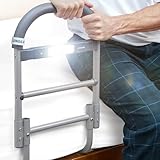 Lunderg Bed Assist Rail Lunderg Bed Assist Rail |
|
Check Latest Price |
 KingPavonini BM03-1 KingPavonini BM03-1 |
|
Check Latest Price |
 WeHwupe Bed Rail WeHwupe Bed Rail |
|
Check Latest Price |
 Panta Bed Rail Panta Bed Rail |
|
Check Latest Price |
 BigDolphin GS07 BigDolphin GS07 |
|
Check Latest Price |
A note on reading that table. Several of these rails are sold as fitting almost any bed, but the fine print matters more than the headline. Six of the ten explicitly exclude motorized adjustable beds, and two require a stated minimum floor clearance that a low platform frame will not provide.
1. Medline Bed Assist Bar – Best Overall and the Most Proven Grip
Medline Bed Assist Bar for Seniors with Nylon Bag for Storage
6.4 lb foam-grip assist bar
Fits most bed sizes
6.4 lb and folds flat
Pros
- Multiple hand positions give a firm grip
- Foam handles stay comfortable over long use
- Folds flat with an included nylon pouch
- Tool-free keyed assembly resists mis-assembly
Cons
- Can feel slightly wobbly until the strap is tightened
- Non-removable safety stickers look unsightly
- Not intended for platform beds with no box spring
This is the rail I put in my grandmother’s bedroom, and the thing that convinced me was not a spec but the grip geometry. The handle is not a single bar. It offers several gripping surfaces at different angles, which means someone with painful hands does not have to find one perfect hold before pulling themselves upright. For a person recovering from hip surgery, that difference showed up every single night.
The assembly uses a keyed hole pattern, so the pieces go together one way only. That sounds minor, and it is not. Caregivers in r/AgingParents frequently mention that a relative is the one assembling the rail, and a keyed fit removes the most common reason a build goes wrong on the first attempt. It also folds flat and comes with a nylon pouch, so it can move between the bedroom and a spare room for naps or travel to a family home.
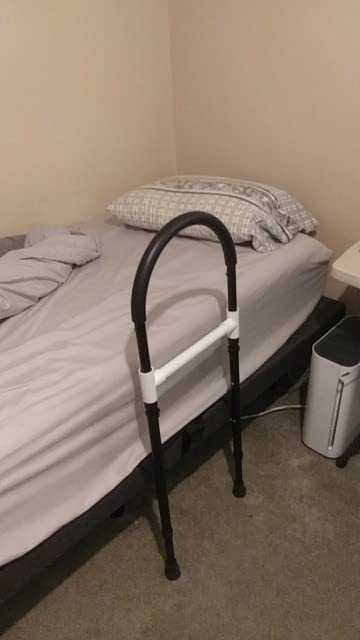
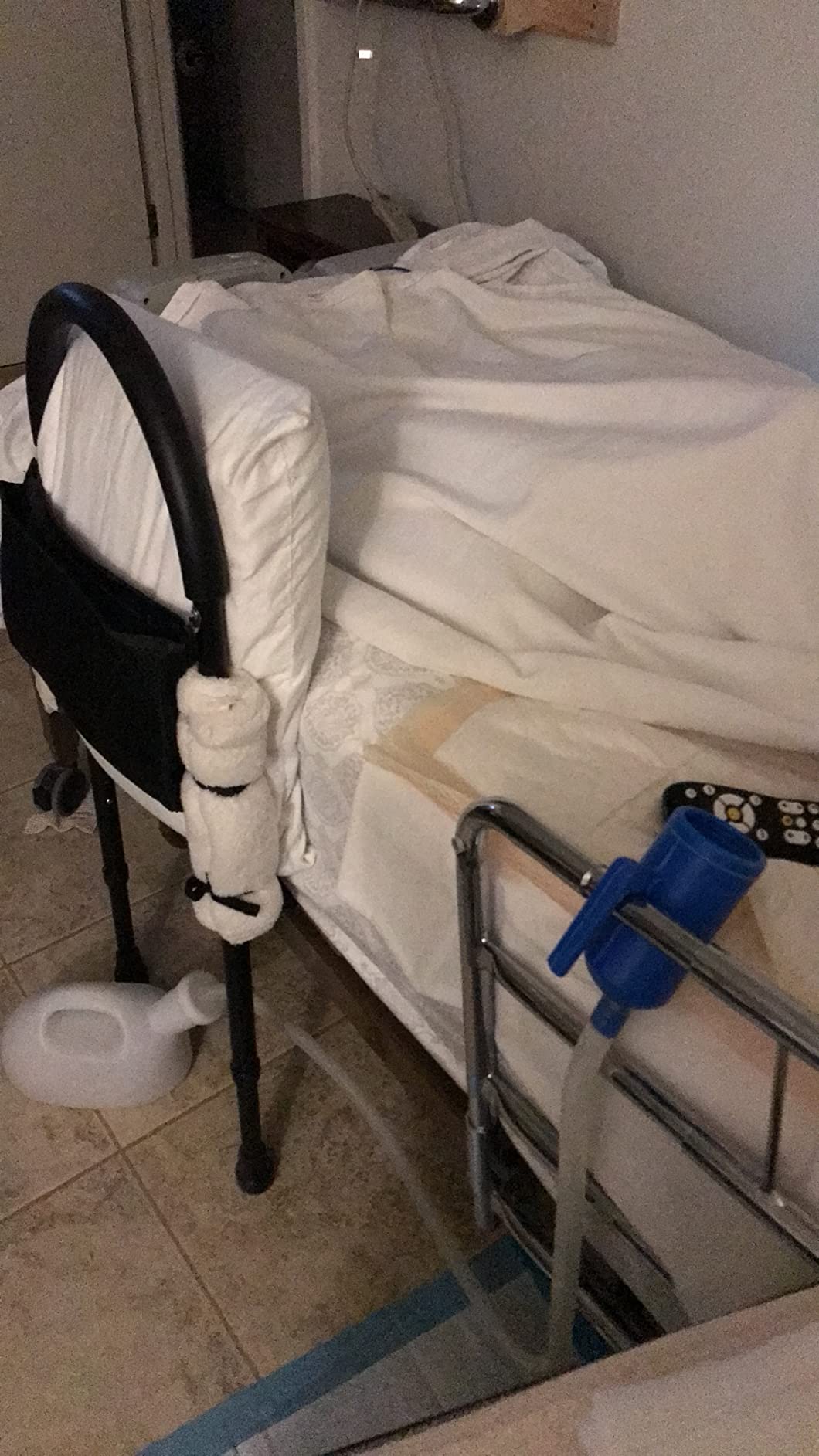
The pouch is the feature the caregiver forum consensus keeps circling back to. r/AgingParents users cited in the search results for this topic repeatedly say that integrated side pouches matter because they keep glasses, phones and medication within reach, which cuts the number of night-time trips across the room. A rail that solves a grip problem but sends someone shuffling to a dresser in the dark has only half-solved it.
Build quality is mid-list in weight terms at 6.4 pounds, with dimensions of 27.5 by 14 by 43.75 inches. Buyers report it feels solid once the included mattress safety strap is tight. The honest weakness is that a minority of reviewers describe slight wobble before the strap is tightened or the legs are anchored to the bed board, and a few dislike the non-removable safety stickers applied to the frame. There is also a fit note: it is not intended for platform beds with no box spring, so check your bed frame before ordering.
Who This Rail Suits
It suits the person who is unsteady but still cognitively steady. Someone who has had one fall getting up at night, who uses a walker, or who has painful hands and needs more than one hand position to push up. It also suits the caregiver who is the installer, because the assembly is genuinely tool-free and hard to get wrong.
It does not suit a restless sleeper who tries to climb over the edge. This is a low assist bar, not a containment rail, and if your parent is a climber it will not do the job you are hoping it does.
Where It Falls Short
The wobble-before-strap issue is the one to plan for. Have the person who is physically able to reach under the bed tighten the strap before the first night, not after. The fit limitation on frameless platform beds is the other; if that describes your setup, skip to the Stander rail, which is explicitly listed for platform beds.
It also has no built-in lighting. If night-time disorientation is the main concern, the Lunderg rail later in this list addresses that problem directly.
2. Medical king Bed Rail – Best Value Across Every Bed Size
Bed Rails For Elderly Adults Safety Bed Assist Rails For Seniors
6 lb steel rail
Slides under mattress
Fits twin to king
Pros
- Works on either side so a pair can be fitted
- Sturdy enough for heavier users to sit up
- Removable bag for glasses and remotes
- Tool-free height adjustment
Cons
- Strap can be too short for a queen box spring
- Instructions mention washers that are not included
- Some wobble if assembled incorrectly
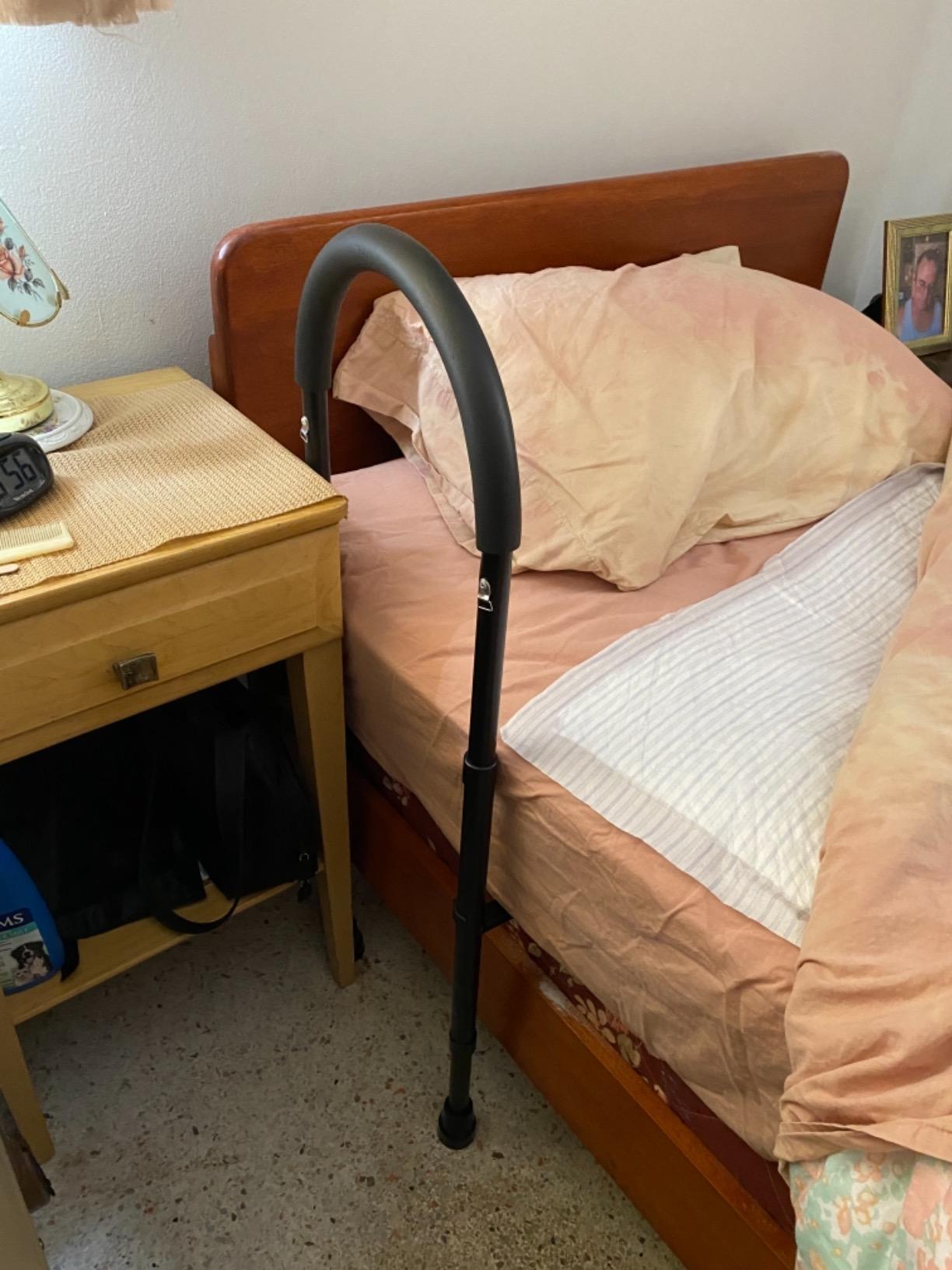
This is the one to buy when the bed itself is uncertain. The listing states it fits king, queen and twin beds at any mattress thickness, and the frame slides under the mattress with a security strap rather than clamping to a frame rail. That makes it the most forgiving option for a bed with an unusual or older frame, and it is the one I would suggest for a spare room or a rental where you cannot modify the bed.
It also installs on either side of the bed, so you can fit a pair and turn a half-length assist into a two-sided setup. Reviewers mention using it to help a heavier user pull up to a seated position, which matches the black powder-coated steel construction. The non-slip hand bar and removable storage bag cover the basics without adding much weight at 6 pounds.
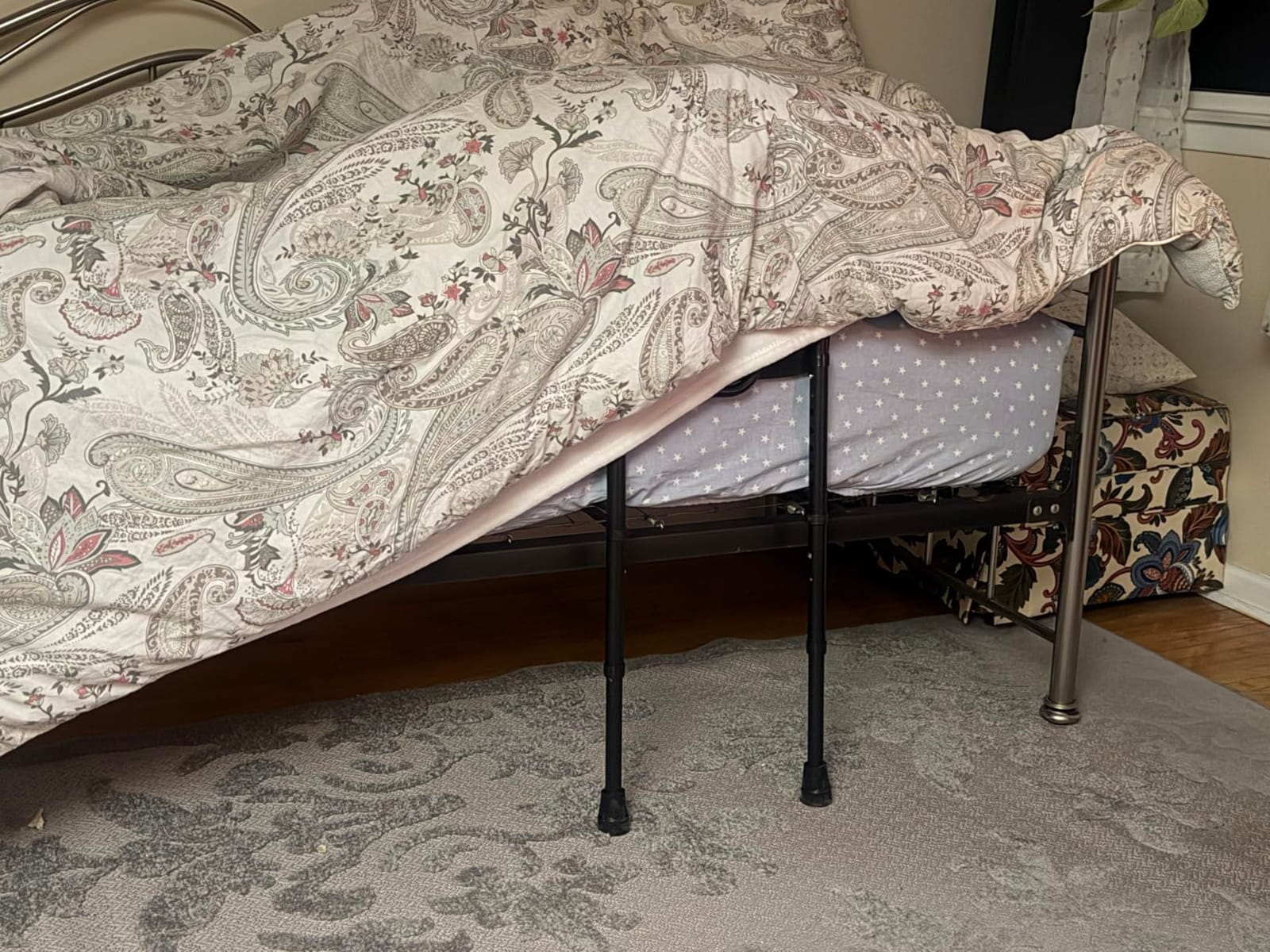
The most repeated complaint is the strap length. A number of buyers report that the included strap does not wrap far enough around a larger box spring and has to be improvised with something else from the household. That is a real installation risk, because an inadequately anchored rail is the exact scenario that creates a dangerous gap. If you have a queen or king box spring, buy a longer tie-down strap alongside it.
A second, smaller theme is instruction quality. Some reviewers note the paperwork mentions packing washers that are not actually in the box, and a few report initial wobble traced back to assembling it incorrectly rather than to the product. Budget an extra five minutes and check the assembly against the diagram before the first night.
Who This Rail Suits
It suits anyone who does not know exactly what bed they are dealing with, and anyone working within a fixed budget who still wants a proper assist bar. The wide stated compatibility with any mattress thickness is genuinely useful when the bed is a hand-me-down or a guest room.
It suits larger caregivers too, because the two-sided option means one person can make both sides safer without buying two different products.
Where It Falls Short
The strap is the problem, and it is a problem with a clear fix rather than a dealbreaker. The 4.4 average across more than 9,500 reviews also sits a notch below the rest of this list, which suggests the execution is fine but the finishing details are not.
It is marketed as meeting US safety requirements rather than carrying a named certification, so if independent testing matters to your decision, choose one of the ASTM F3186-17 models instead.
3. Vaunn ASTM F3186 Rail – Best for Arthritic Hands and Certified Strength
Vaunn Medical Bed Rail for Elderly Adults Safety, ASTM F3186-17 Certified, Adjustable Bed Assist Handle and Grab Bar for Seniors, 300 lb, Tool-Free Assembly
300 lb steel frame
20 inch rail face
7 to 11 inch mattresses
Pros
- Wide 20 inch face gives stable push-up power
- Foam-padded slip-resistant handle
- Tool-free slide-under install with strap
- Adjusts for twin through California king
Cons
- Needs 13 inch floor clearance so low frames fail
- Not compatible with motorized adjustable beds
This is the one I trust most from a documentation standpoint. It is one of only a handful of rails in this roundup that states it passed the ASTM F3186-17 safety standard for adult portable bed rails, and it rates to 300 lb on heavy-duty powder-coated steel. For a family making a decision that involves a fall injury, an independent standard is worth more than a feature list.
The handle is where the design earns its badge. A slip-resistant foam pad covers the top rail, and horizontal stabilizer bars run across a 20 inch face, which means the user is pushing against a frame rather than a single thin tube. Buyers with arthritic hands describe it as comfortable enough for long use, and the adjustability in both height and width covers twin through California king beds.
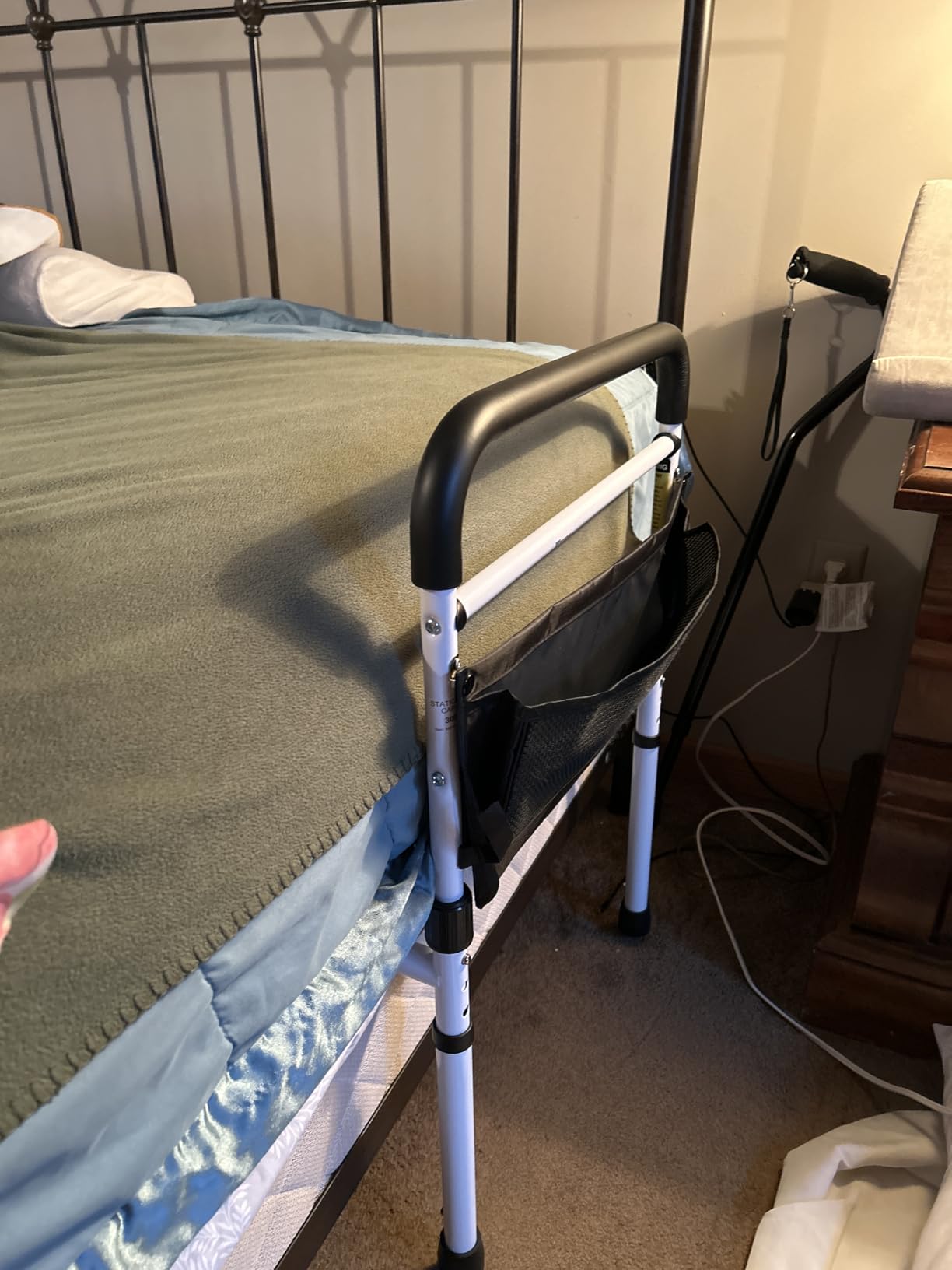
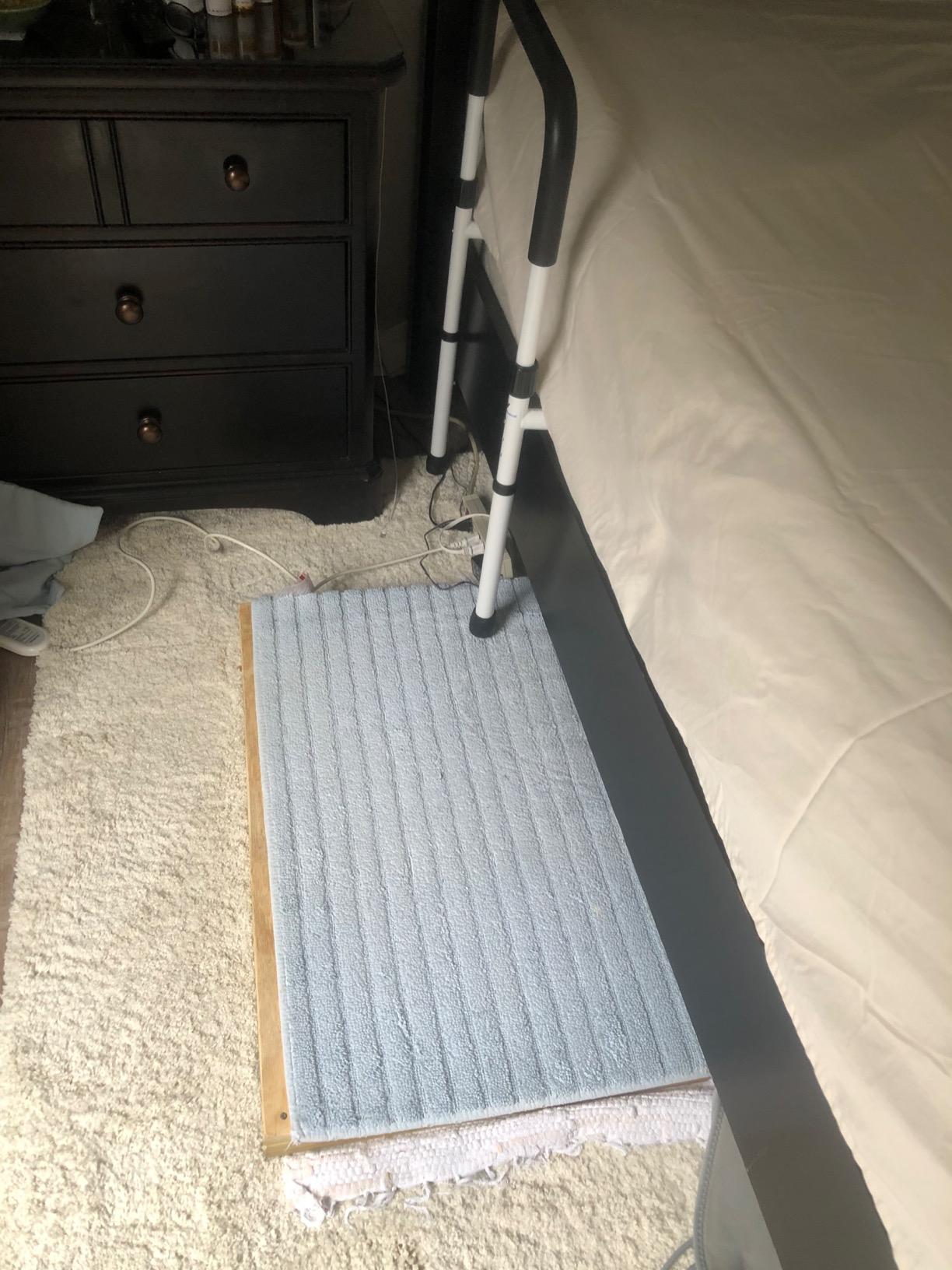
There are two fit constraints to respect. It works with mattresses between 7 and 11 inches high, which excludes a very thick pillow-top mattress, and it requires 13 inches of floor clearance. That second requirement is the dealbreaker for many modern platform beds with a low profile frame, and it is not stated as prominently as it should be. Measure from the underside of the bed frame to the floor before you order.
It is also not designed for motorized adjustable or most Sleep Number style bases. The included storage pouch and included strap handle the rest of the checklist, and the whole unit weighs 8 pounds with a one year manufacturer warranty.
Who This Rail Suits
It suits anyone whose hands hurt, and anyone who needs a firm, wide surface to push against when sitting up. The certification also makes it the pick if your family has been asked by a clinician to justify equipment purchases.
It suits standard-height beds with a mattress in the 7 to 11 inch range and enough floor clearance for the support structure.
Where It Falls Short
The 13 inch clearance requirement removes it from a large share of low platform beds, which is where most modern bedroom furniture has moved. If your frame is low, the Stander rail or the Medline bar are better fits.
At 300 lb it is not the right choice for a heavier user. For capacity above that, the KingPavonini rail is rated to 380 lb.
4. Stander EZ Adjust Rail – Best for Fall Prevention and Restless Sleepers
Stander EZ Adjust Bed Rail, Adjustable Senior Bedrail and Safety Assist Railing for Elderly Adults with Organizer Pouch, ASTM Safety Approved Guard-Rail, Black
20 to 30 inch rail
Folds with knob twist
10 to 14 inch mattresses
Pros
- Widest fall coverage at up to 30 inches
- Folds down so a caregiver can make the bed
- Large multi-pocket organizer pouch
- Substantial build at 300 lb capacity
Cons
- Strap clips are hard to unclip and secure
- Fold locks are tough for low-dexterity users
- Blocks elevation on adjustable beds
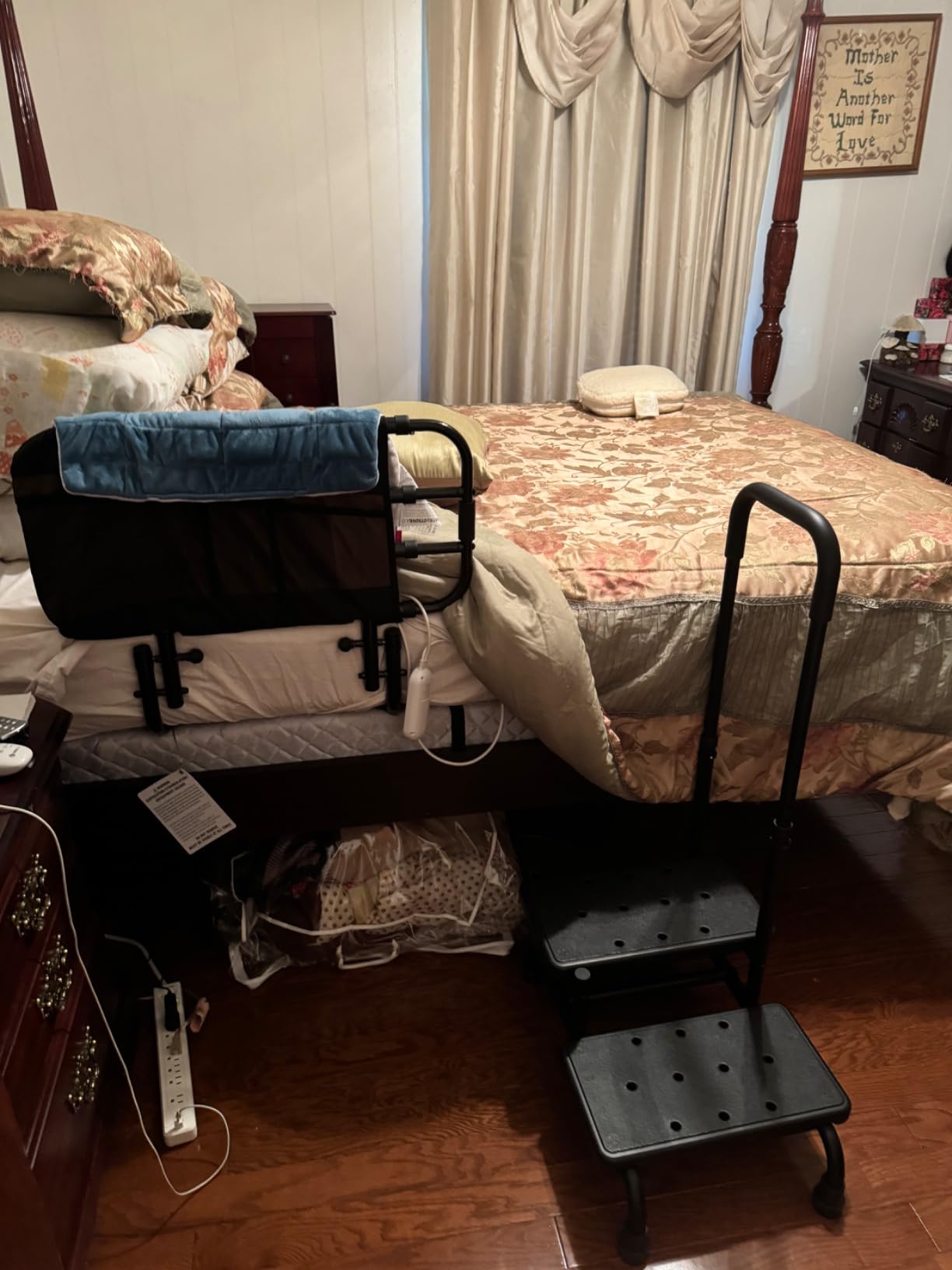
This is the only true guard rail in the group. It adjusts from 20 to 30 inches, which makes it meaningfully longer than a cane-style assist bar, and at the long setting it covers most of the side of the bed. That is the reason to choose it: a person who rolls or thrashes during sleep needs a barrier, and no amount of grip quality substitutes for coverage.
The fold-down function is what makes it practical. A knob twist releases the pivot so a caregiver can reach the bed to change sheets or help with a transfer, then push it back up. Owners of a rail used for the whole night rather than a prop left permanently open describe it as a different piece of equipment in practice. The multi-pocket organizer pouch is the more generously pocketed of the two certified rails here, holding remotes, glasses, a phone and medication.
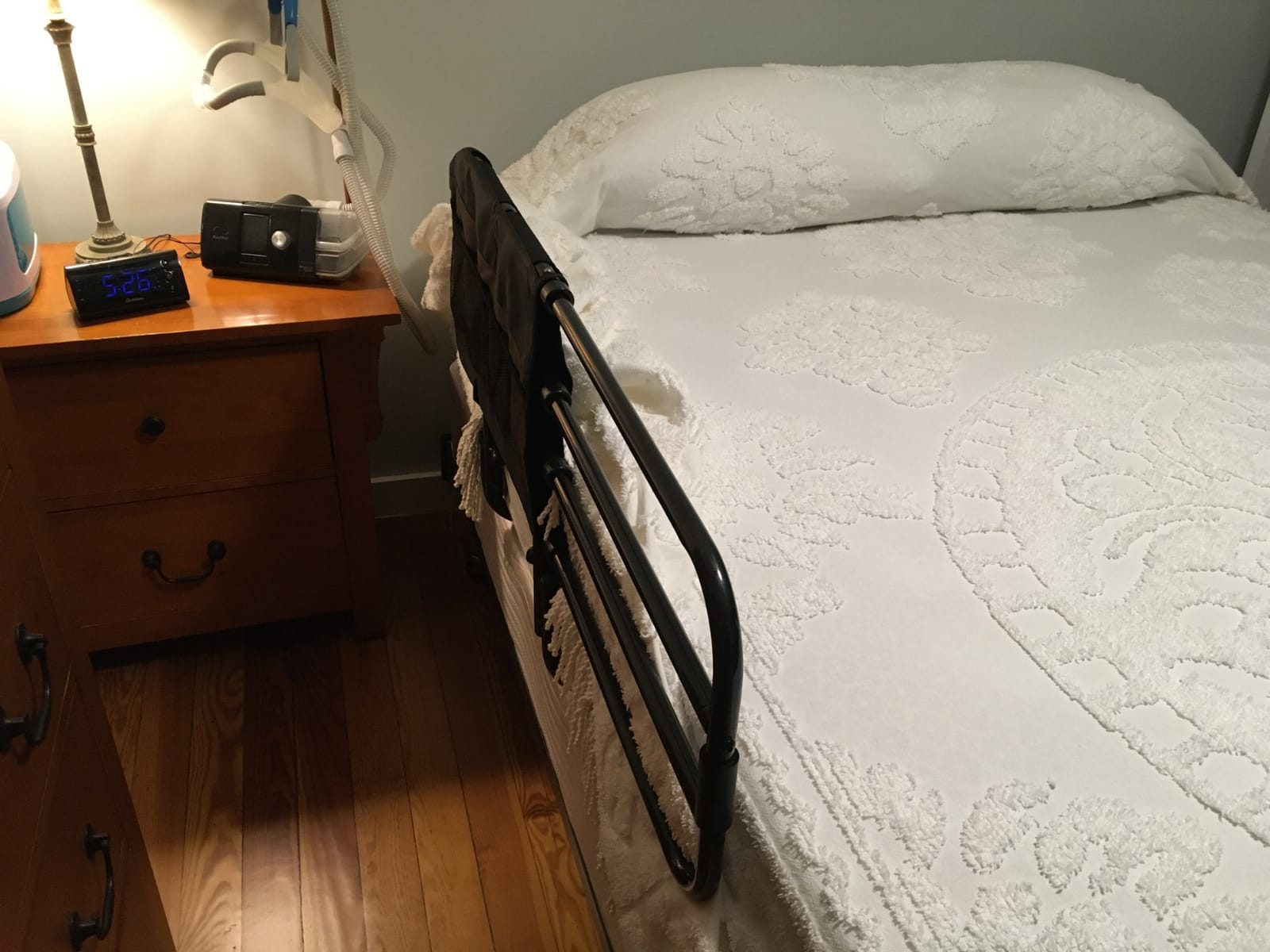
It carries ASTM F3186-17 approval and supports up to 300 lb on powder-coated steel, weighing 10 pounds at 25 by 26 by 23 inches. It fits platform beds, box springs and slat beds with mattresses between 10 and 14 inches thick, which is a wider mattress window than most certified rails in this list. A one year unlimited manufacturer warranty is included.
Reviewers flag the same two things: the strap clips are fiddly to unclip and secure properly, and the pivot or fold locks can be hard to operate for a user with limited manual dexterity. Both are installation and setup issues rather than failures, but if your parent is expected to operate the rail themselves, test the lock with them before relying on it.
Who This Rail Suits
It suits someone who has already fallen out of bed more than once, and someone whose goal is containment rather than a handhold. It suits caregivers who need to make the bed daily, because the fold-down turns a blocked transfer into a normal one.
It also suits platform bed owners, which is unusual for a rail of this length, and users of thicker mattresses in the 10 to 14 inch range.
Where It Falls Short
It is not intended for adjustable or hospital beds, and anchoring it on an adjustable base can block the elevation function. If the head of the bed needs to rise for breathing or swallowing reasons, this is the wrong rail.
It is also the heaviest frame in the group, and the fold lock is a genuine obstacle for arthritic hands. Anyone who needs to open the rail from a seated position should try it first.
5. Able Life Extend-A-Rail – Best for Thick Mattresses and Wide Bed Sizes
Able Life Bedside Extend-A-Rail, Adjustable Senior Bed Safety Railing and Stand Assist Grab Bar, Extendable Guardrail for Seniors and Elderly Adults, ASTM Safety Approved Bedrail
Push-button 20 to 30 inch rail
300 lb support
8 to 15 inch mattresses
Pros
- Push-button extension needs no tools to adjust
- Certified to ASTM F3186-17
- Fits 8 to 15 inch mattress range
- Reliable support for standing and transfers
Cons
- Not compatible with adjustable beds or extra-soft mattresses
- One of the heavier frames at 7.15 pounds
The standout here is the mattress window. At 8 to 15 inches of thickness, this rail covers a range that swallows almost every standard mattress including a thick pillow-top, and that solves the single most common fit complaint in this category. If you have a deep mattress, work down this list of specifications first.
The extension is push-button rather than a fixed-length tube, moving from 20 to 30 inches without tools. The support bar is built to hold 300 lb, and the listing states it passed the ASTM F3186-17 standard for adult portable bed rails. It fits twin, full, queen, king and California king beds, and the ASTM F3186-17 certification makes it a defensible choice for a family that has been told to document equipment.
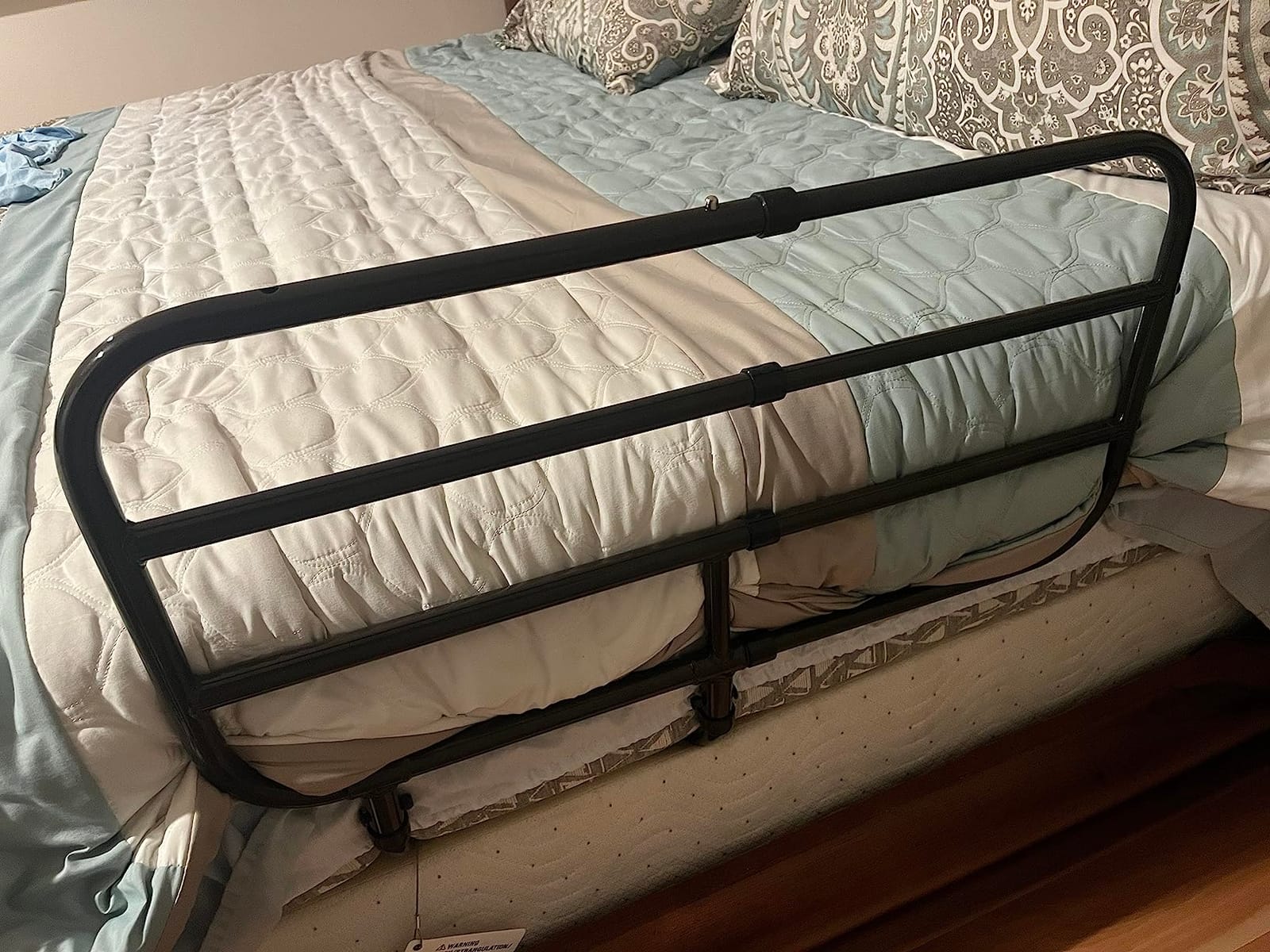
What it does well is transfers. Buyers describe it as reliable push-up support for standing and for moving into a wheelchair or walker, which is a different use case from fall containment. If your parent needs a handhold to complete a transfer rather than a barrier to keep them in bed, this is a sensible pick.
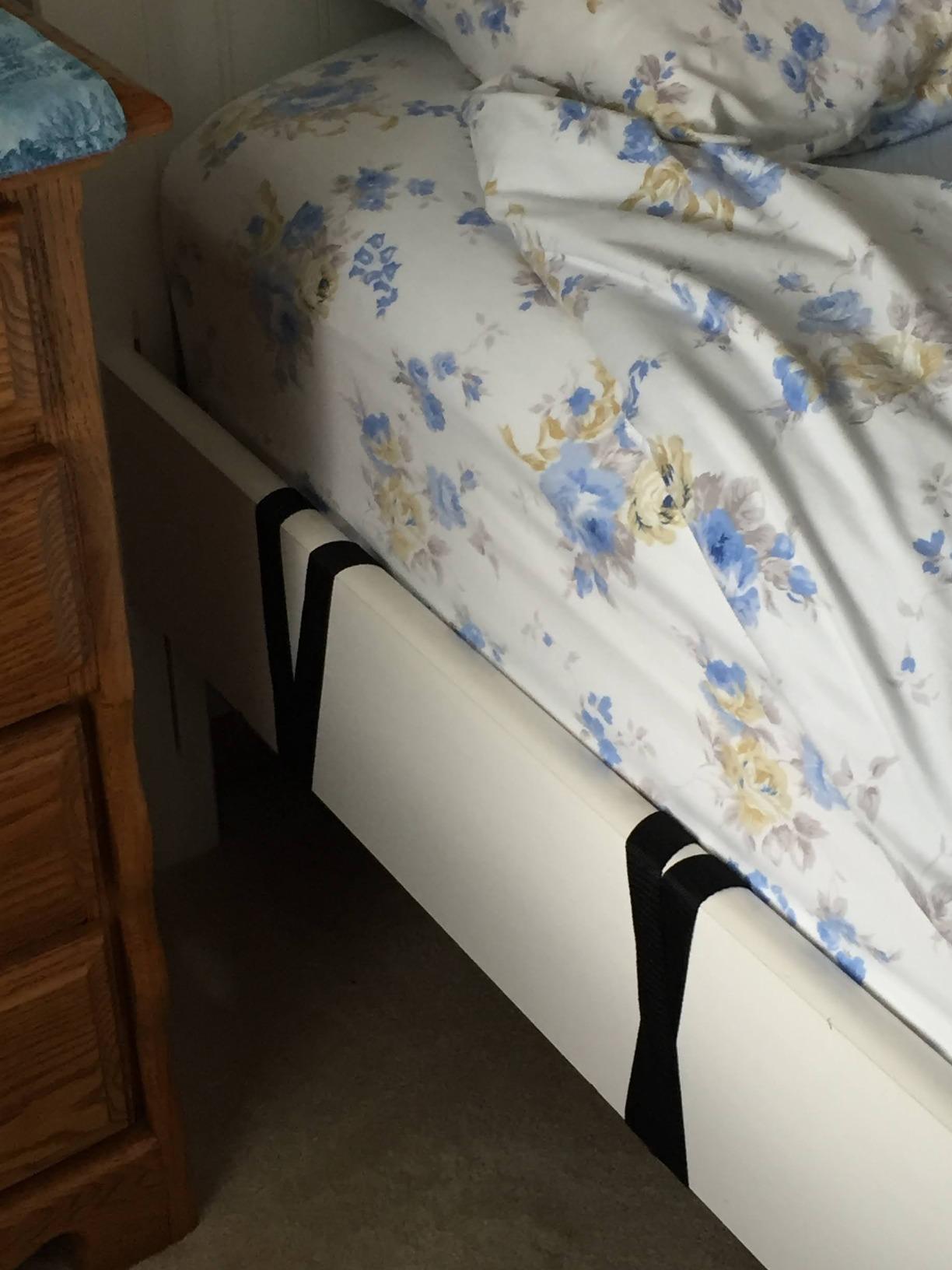
The two stated limitations are compatibility with adjustable beds and extra-soft mattresses. An extra-soft surface lets the mattress compress around the rail, which can open a gap at the top, and that is an entrapment concern rather than a comfort issue. At 7.15 pounds it is not a light unit to move between rooms, but it does not fold into a pouch the way the Medline bar does.
Who This Rail Suits
It suits anyone with a thick mattress who has repeatedly found that thinner rails sit too low. It suits transfer-focused care, where a parent stands with assistance and needs a solid bar at the right height, and it suits larger beds that need more rail length than a compact model offers.
The ASTM F3186-17 certification makes it a defensible choice for a family that has been told to document equipment.
Where It Falls Short
It will not work on an adjustable base or an extra-soft mattress, and it does not fold for caregiver access. Caregivers making the bed daily will find the Stander’s fold-down design easier to live with.
The 4.5 average is slightly below the rest of this list, and the product listing carries a warranty description that is less specific than the Stander and Vaunn entries.
6. Lunderg Bed Assist Rail with Motion Light – Best for Night Use and Post-Surgery Recovery
Lunderg Bed Assist Rail for Seniors with Motion Light & Non-Slip Grab Bar
Motion-activated light
2 lb carbon steel
7 to 13 inch mattresses
Pros
- Motion light guides night-time bathroom trips
- Short low profile does not block getting in and out
- Exceptionally light at 2 pounds
- Five-minute partly pre-assembled setup
Cons
- Light battery could run longer between charges
- Strapping to a lift bed may need two people
- Not suitable for adjustable beds
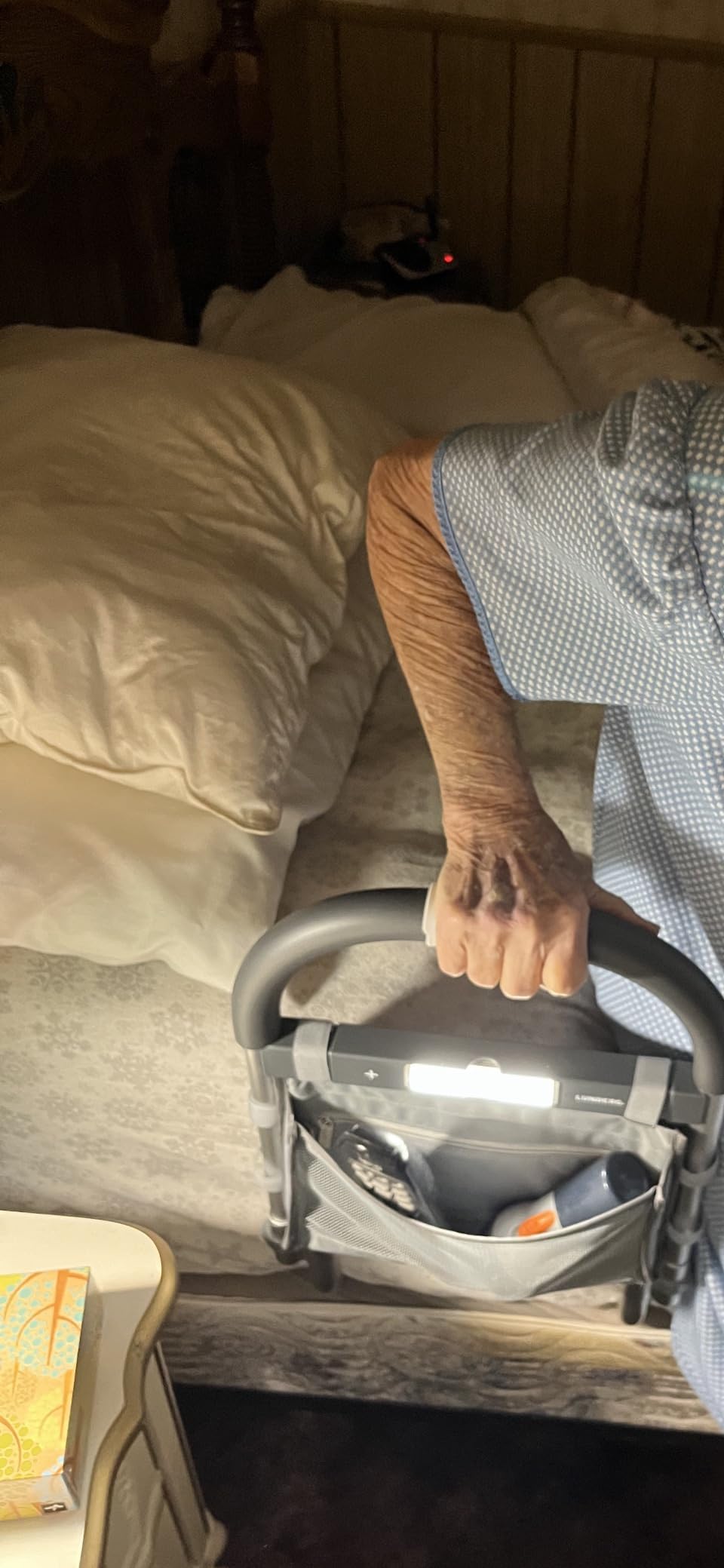
This carries the highest average rating of the ten at 4.7, and the reason is a single feature: a motion-activated rechargeable light that stays on for 60 seconds per activation. The night-time trip to the bathroom is the moment a fall is most likely, and lighting the path without turning on a room lamp is exactly the intervention most caregivers try first.
Caregivers of people with dementia are the group that mentions the light most. It functions as a wander alert, showing movement near the bed before the person has made it to the door. The rail itself is a low profile at about 13 inches, which lets the user swing their legs over without climbing, so it works as an assist rather than a cage.
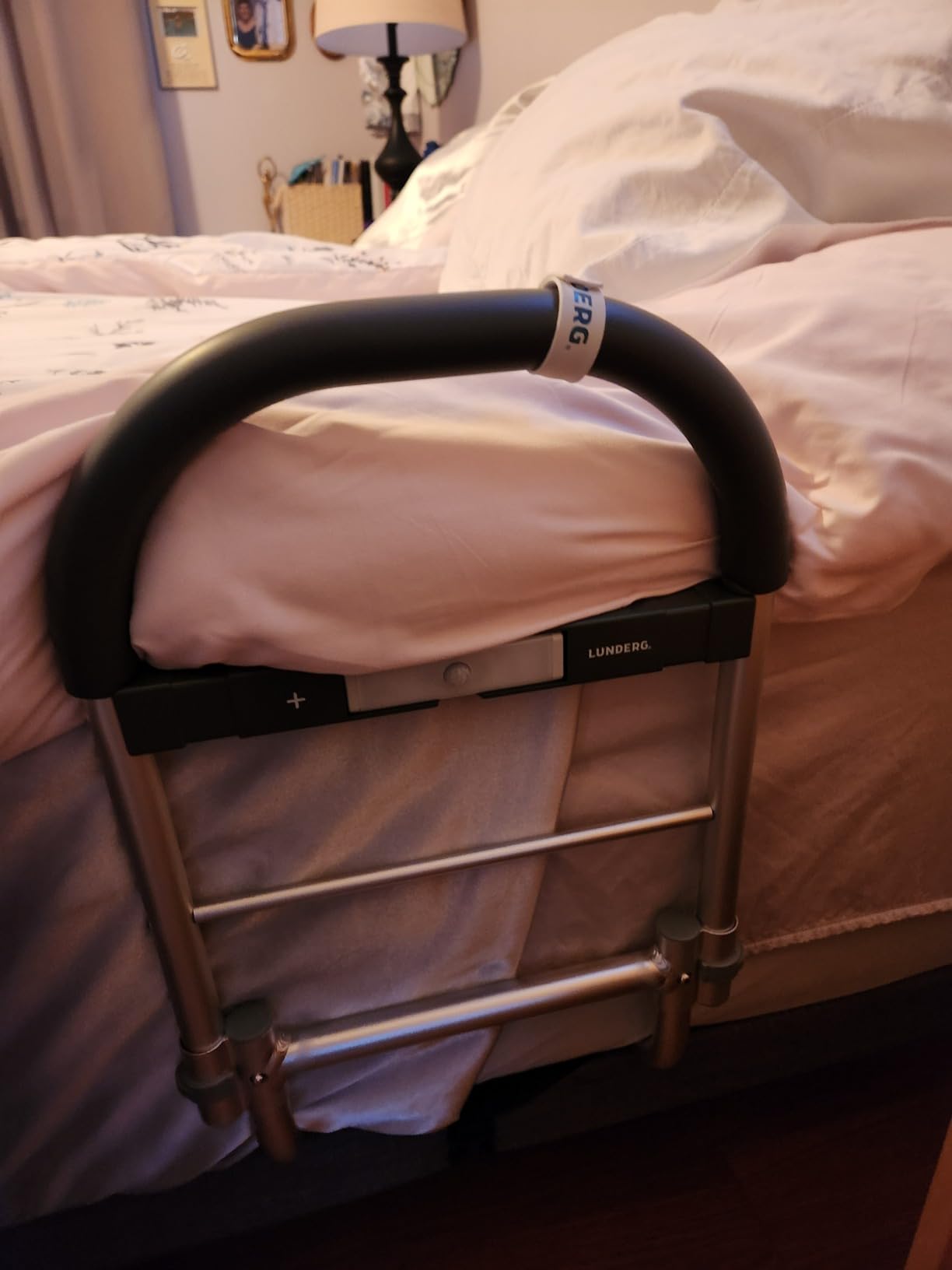
It is also the lightest rail here at 2 pounds, built from carbon steel with four horizontal stabilizing bars and load tested to 300 lb. Setup is partly pre-assembled and takes about five minutes without tools. It fits twin to king beds with 7 to 13 inch mattresses, works with box spring, slat or platform frames, and the adjustable strap anchors to the bed frame or base rather than only to the mattress.
The motion light is not perfect. Buyers report the battery could last longer between charges, and attaching the strap to a lift bed is a two-person job because you have to reach the base. It is also not suitable for adjustable beds. The light is a rechargeable cell, so treat it as a device that needs charging rather than a permanent fixture.
Who This Rail Suits
It suits anyone whose falls cluster in the dark hours, which is most people. It suits post-surgery recovery where a short, low bar lets the user sit up and move their legs without a tall frame in the way, and it suits dementia households who want a movement signal rather than a locked door.
It is also the easiest rail to install, which matters when the installer is an adult child in a hurry on a Saturday.
Where It Falls Short
It is an assist bar, not a guard. If the concern is a person rolling off the edge, the short profile will not stop that and you need the Stander rail instead.
The light needs recharging, and the low profile means there is less barrier between the user and the floor. Anyone over 300 lb, or on an adjustable base, should move on.
7. KingPavonini BM03-1 – Best for Heavy Users at 380 lb
KingPavonini Bed Rails for Elderly Adults Safety, 380 LBS, Model BM03-1
380 lb tested capacity
Adjusts 28.6 to 34.7 inches
3 to 12 inch mattresses
Pros
- Highest stated capacity in this group at 380 lb
- Long under-mattress reach holds it stable alone
- Generous height and length adjustment
- Padded non-slip curved handle
Cons
- Not compatible with adjustable beds
- Some assisted living facilities may not accept this design
- Instructions are less clear than competitors
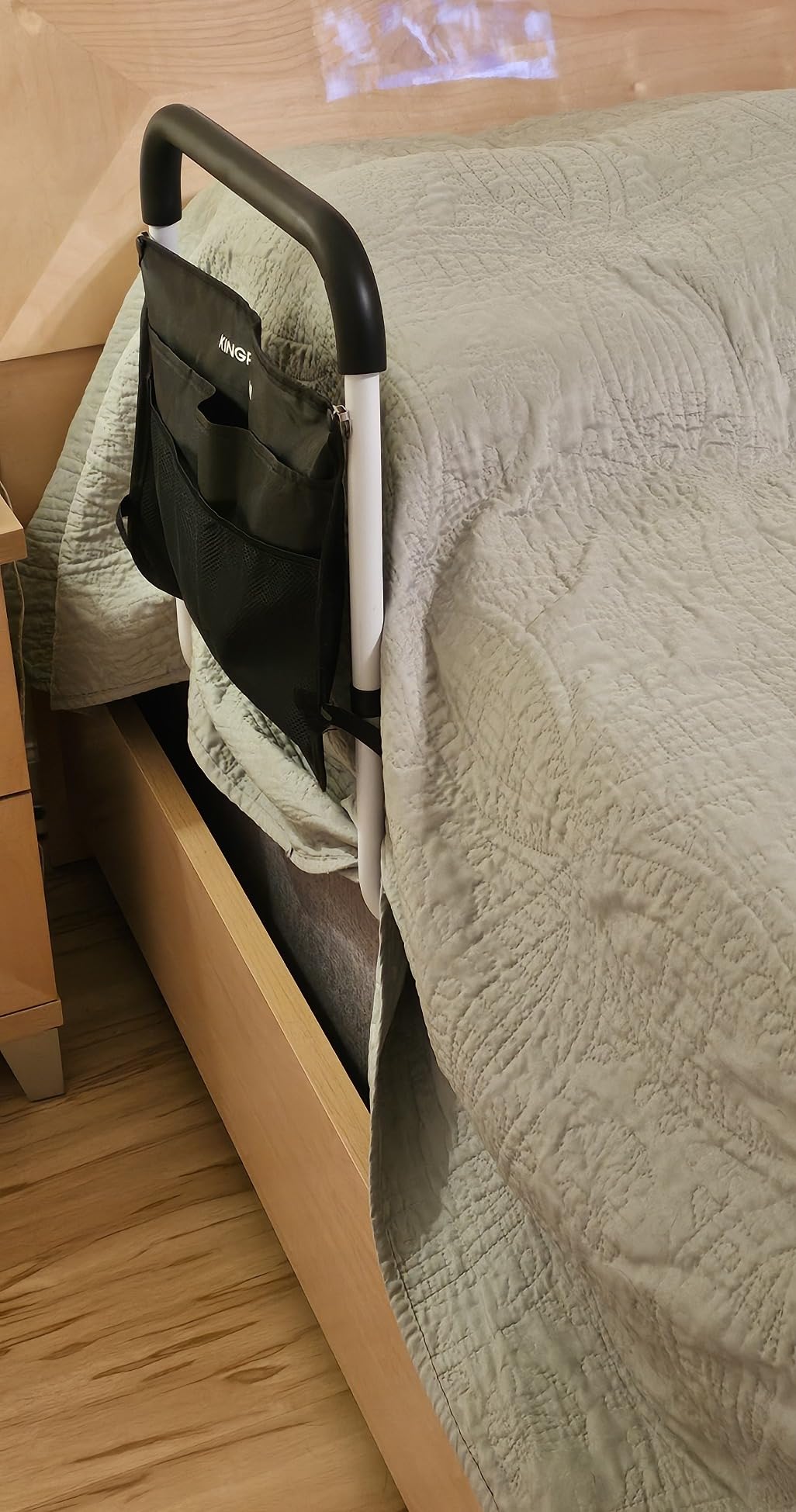
Capacity is the reason this one is on the list. It is tested to 380 lb, the highest figure in this roundup, and it is built from Q195 steel with a padded non-slip curved upper handle. For a user above 300 lb, most of the certified rails on the market simply do not apply, and this one does.
Adjustment runs from 17.6 to 20.9 inches high and extends horizontally from 28.6 to 34.7 inches, so it can cover a large share of the bed side when set long. The mattress range of 3 to 12 inches is unusually wide, and the long under-mattress reach is the detail reviewers keep praising: many report the rail is stable enough without using the strap at all, which removes the most common installation failure in this category.
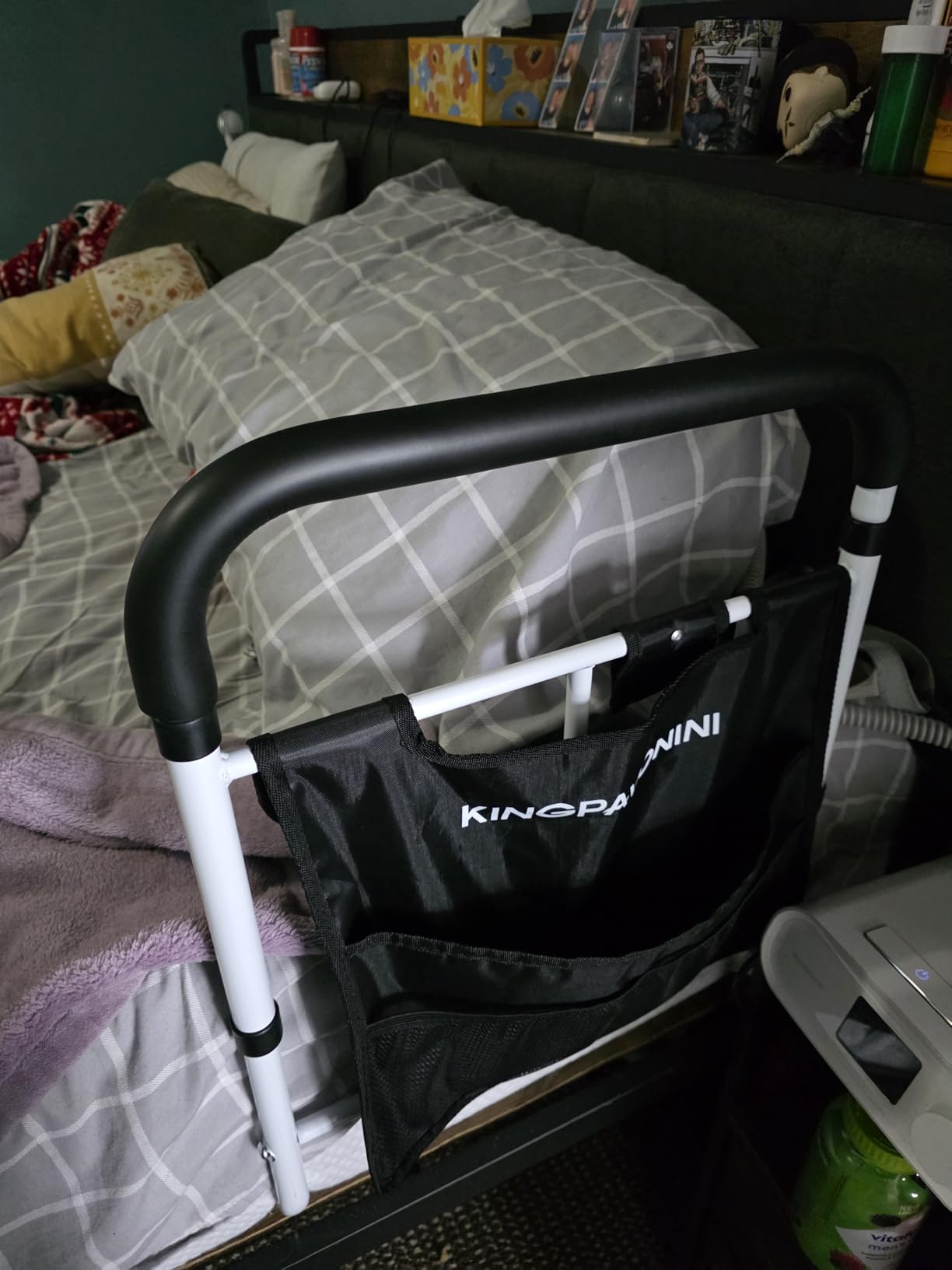
Reviewers describe stability as the standout even at around 250 lb user weight, and post-surgery, stroke recovery and caregiving use cases all come up repeatedly. It weighs 5.5 pounds and measures 34.7 by 20.9 inches, with a storage pouch included and tool-free installation.
Two cautions. It is not compatible with adjustable beds, which narrows the audience for anyone whose bed height changes. And a small but real point for institutional settings: some assisted living facilities do not accept this rail design, so check the facility’s own equipment policy before a move.
Who This Rail Suits
It suits anyone over 300 lb who has been told by the rest of this list to look elsewhere. It suits strong, rolling users who pull up hard on the rail, and households on adjustable bases that are not motorized, such as a fixed-frame platform with a manual base.
It also suits anyone with a very thin mattress, because 3 inches of clearance is about the lowest any of these rails supports.
Where It Falls Short
Not for motorized or lift beds, and the instructions are described as less clear than the competition, so allow time and check the assembly diagram carefully.
Capacity is a rating, not a promise. A 380 lb rating assumes a static, evenly distributed load, and a person hauling themselves up with one arm puts a very different force through the frame.
8. WeHwupe Bed Rail – Most Versatile with a 350 lb Frame
WeHwupe Bed Rails for Elderly Adults Safety with Bedside Storage Pocket
350 lb alloy steel
4.5 lb frame
Twin to king fit
Pros
- 350 lb capacity in a compact 4.5 pound frame
- Foam-padded non-slip handle
- Quick tool-free setup and wipe-clean finish
- Mesh pocket keeps essentials close
Cons
- Not suitable for adjustable or lift beds
- Customer review detail is thinner than the rest of this list
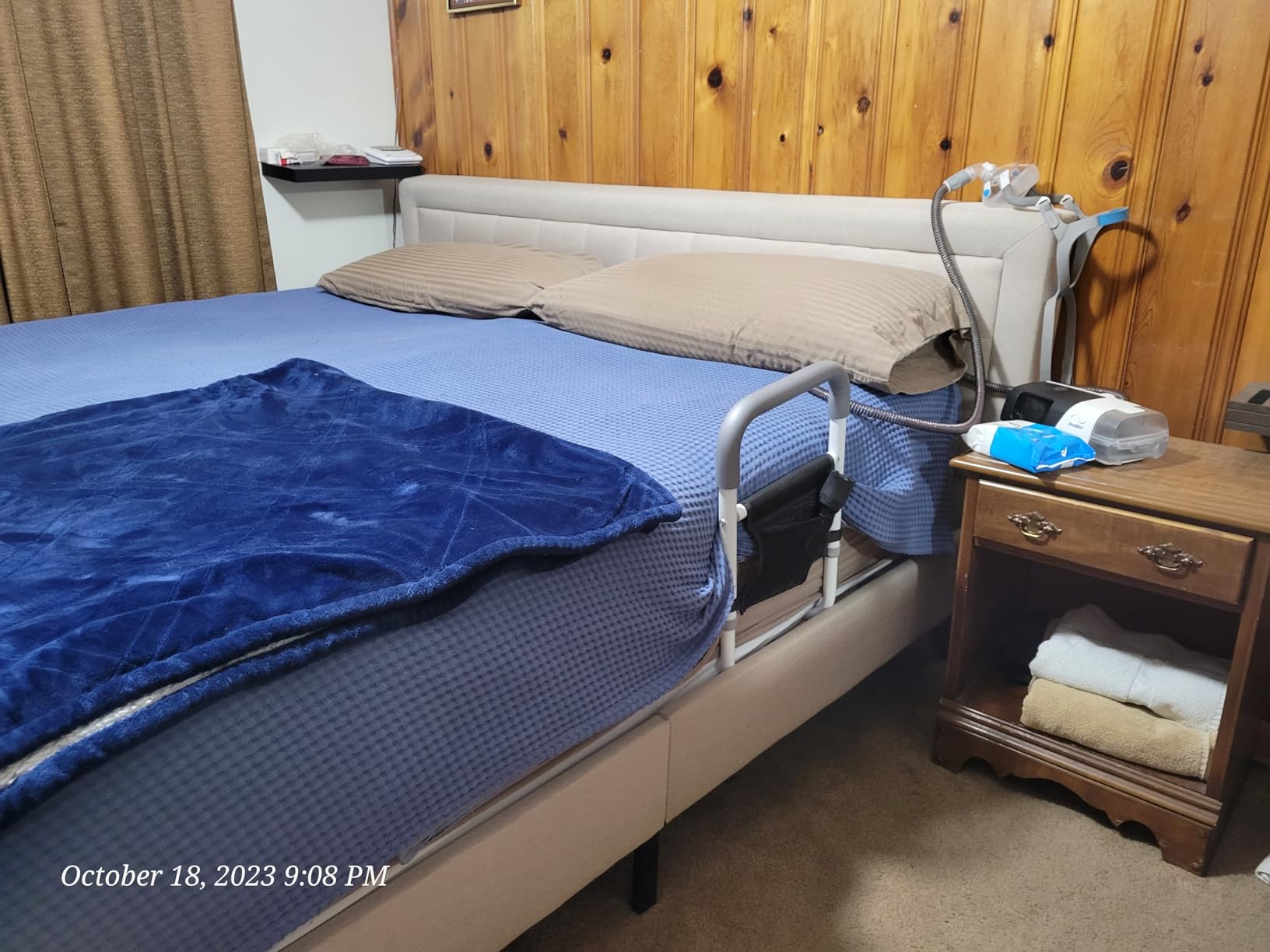
This is the value pick. It carries a 350 lb rating on alloy steel, which is unusual at this end of the market, and the whole unit weighs 4.5 pounds with dimensions of 12.3 by 21.4 inches. For a first rail in a second bedroom, or for a house where you expect to move it between rooms, that combination is hard to argue with.
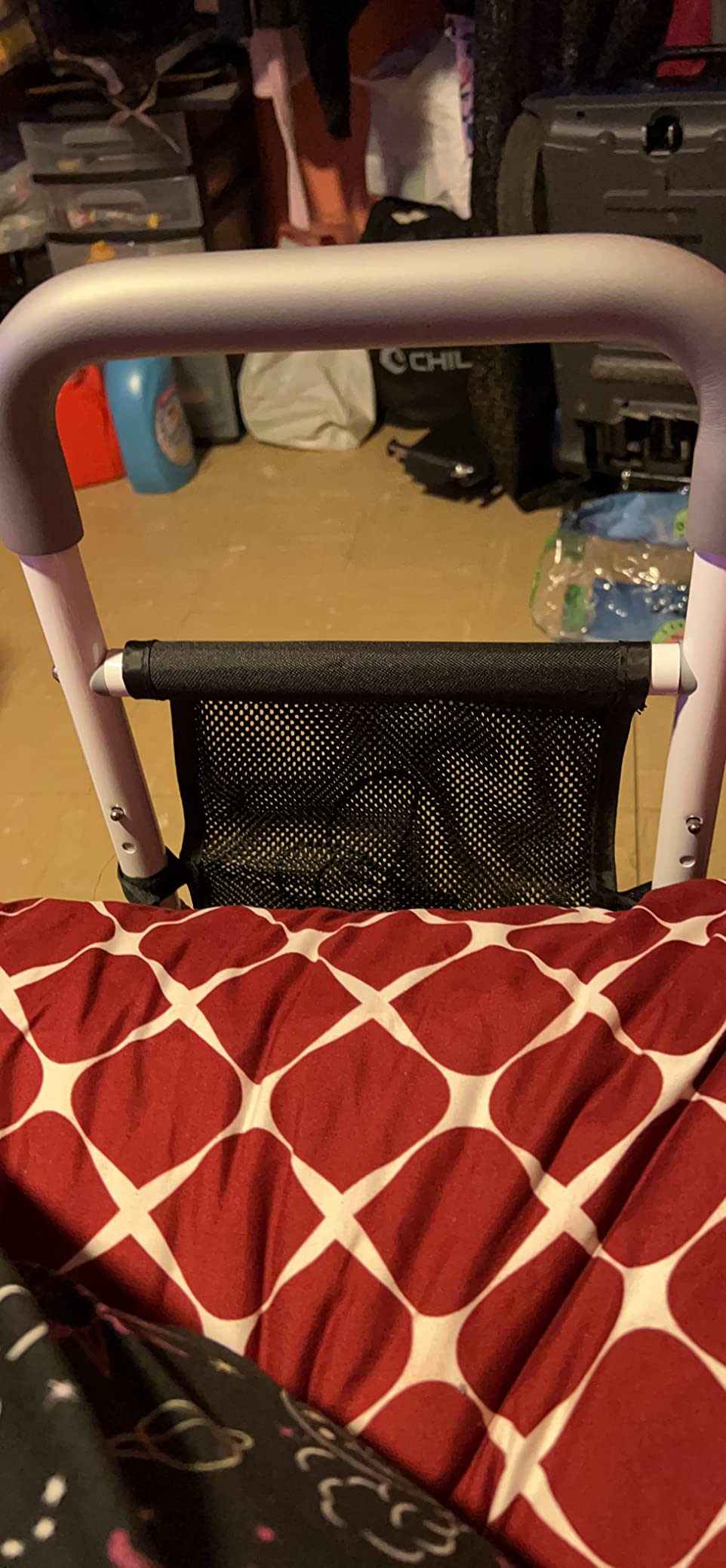
The handle carries soft non-slip foam padding, the frame wipes clean with a damp cloth, and a mesh storage pocket sits inside the rail for glasses, a phone or a book. The box includes four stands, a storage bag and a tie-down strap, and assembly is tool-free. It fits king, queen, full and twin beds, so the bed-size range is not the limitation here.
The honest limitation is that the customer review detail behind this product is thinner than the rest of this list. The 4.6 average rests on roughly 1,150 reviews, and the pattern of comments is thinner and more generic than, for example, the Medline or Lunderg entries. That is not a warning sign, it is simply less evidence.
Two practical notes. It states it has passed ASTM safety testing standards, though it does not cite the specific F3186-17 designation the Vaunn and Stander rails do, so treat the certification claim as less specific. And it is not suitable for adjustable or automatic lift beds.
Who This Rail Suits
It suits a household on a tight budget that still wants a stated capacity above 300 lb. It suits small rooms where footprint matters, since at 12.3 inches wide it takes up less mattress edge than the longer rails, and it suits anyone who wants a wipe-clean surface.
It is also a reasonable second rail for the other side of a bed, once you have the length of strap you actually need.
Where It Falls Short
It does not fold for caregiver access, so bedding changes mean working around it, and it is excluded from adjustable and lift beds. If night-time lighting is the goal, the Lunderg rail solves a problem this one does not address.
With fewer reviews behind it, there is less long-term feedback on strap durability than the market leaders offer.
9. Panta Bed Rail – Best Flat-Tube Design for Mattress Comfort
Panta Bed Rails for Elderly Adults Safety,Grey
ASTM F3186-17 certified
350 lb capacity
Flat tube frame
Pros
- Flat tube profile avoids mattress lumps and dips
- 350 lb support with adjustable height
- Non-slip pads on the support legs aid stability
- Removable storage bag and fixing strap
Cons
- Needs more than 12.6 inches of floor clearance
- Customer review detail is thinner than the leaders
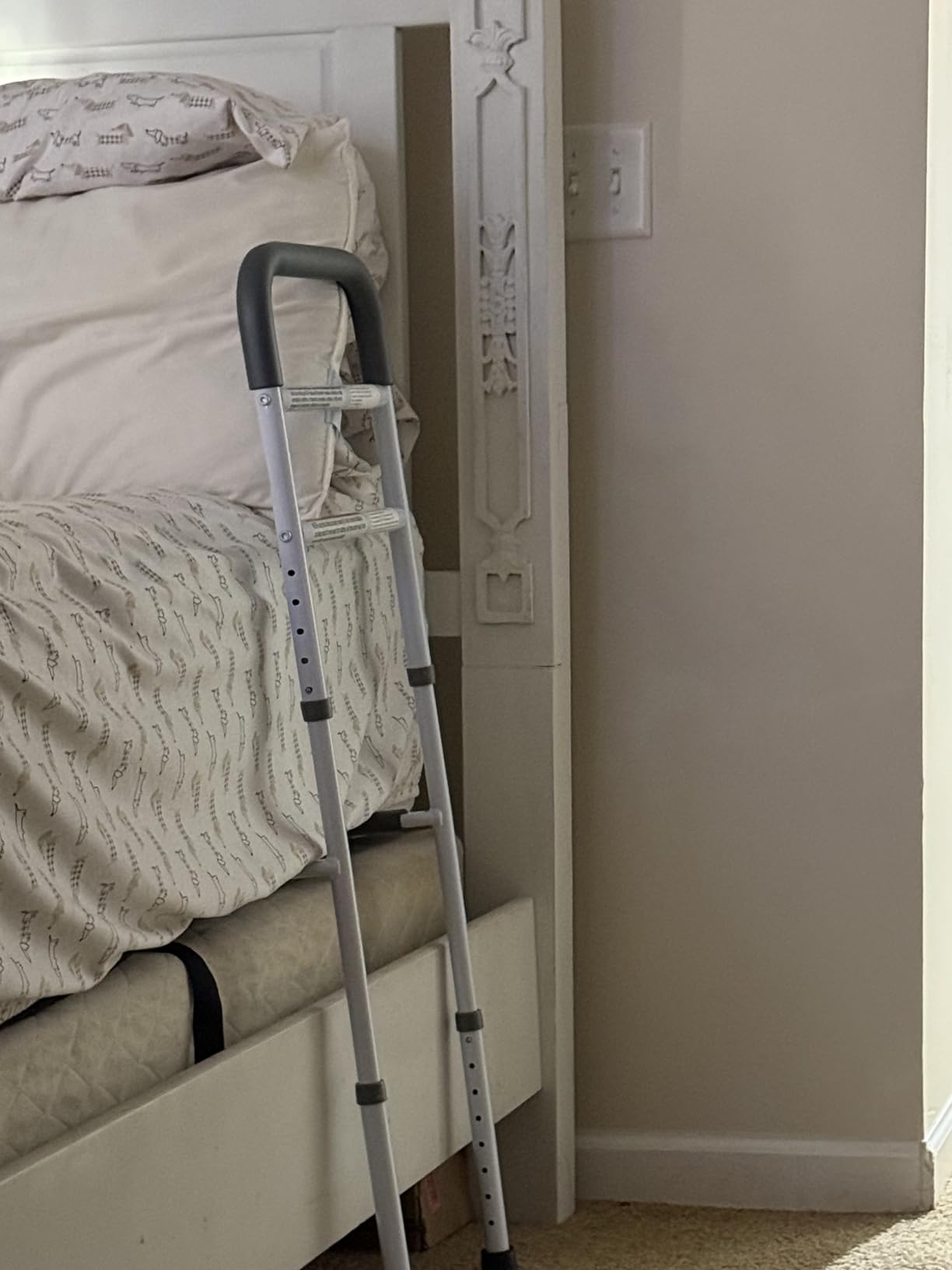
The design detail that separates this rail is the flat tube frame. Most assist bars use round tubing, and round tubing presses a visible ridge into the mattress edge. Over months of use that ridge becomes a lump the user has to sleep around. The flat tube profile here spreads the load and is the reason we would choose this model for anyone sleeping right up against the rail.
It is also one of the certified options, stating it passed ASTM F3186-17 safety standards with support up to 350 lb. Height adjusts from 17 to 21 inches, and the support legs adjust separately from 12.6 to 19.69 inches, which lets you match the rail to the height of your bed frame rather than only to the mattress.
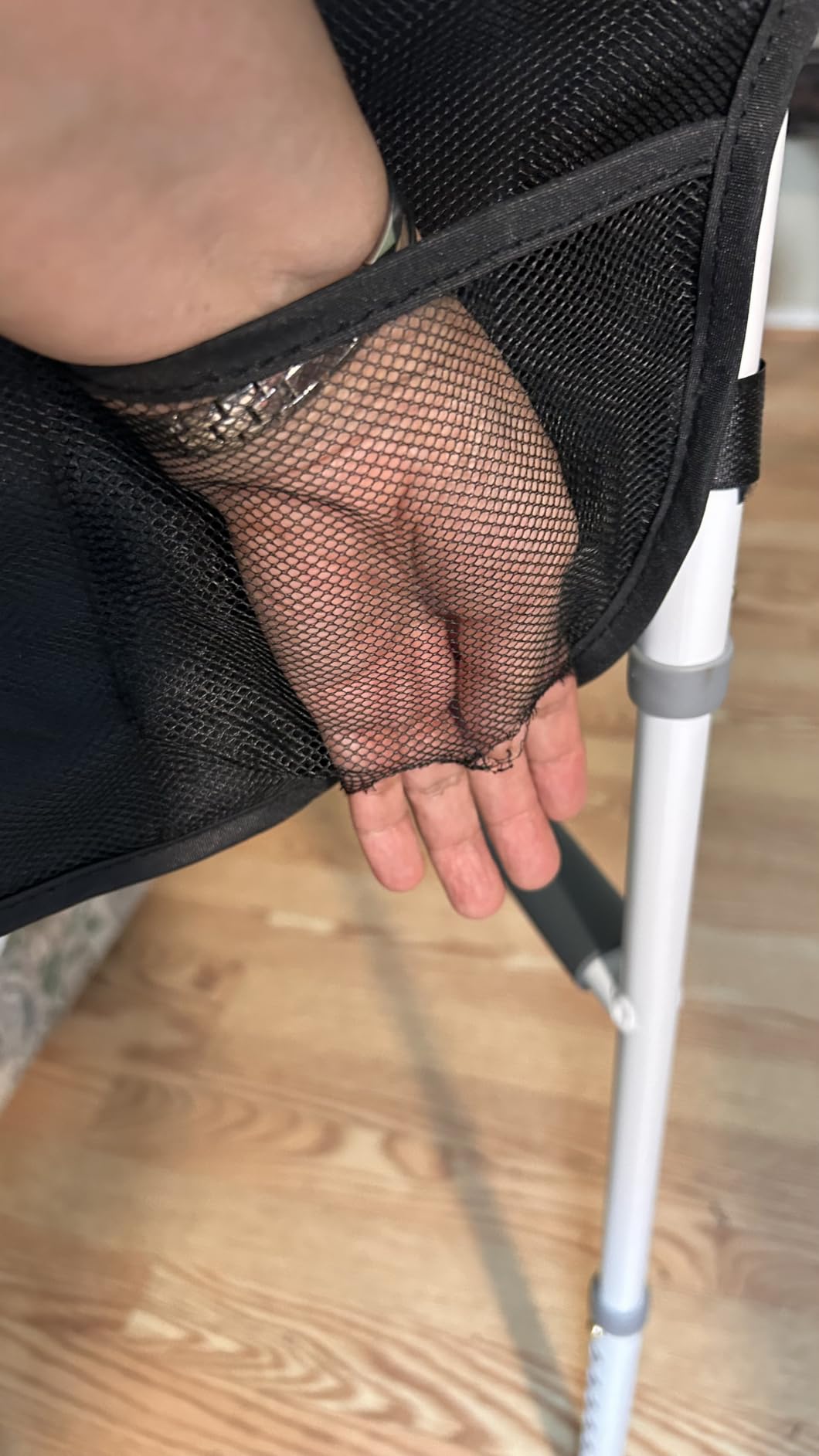
Anti-slip foam handles and non-slip leg pads are included, and the leg pads genuinely help on hard floors where a smooth foot would slide. A removable storage bag and fixing strap come in the box, with tool-free installation, and it fits king, queen, twin and medium beds.
The constraint is floor clearance: the support legs need more than 12.6 inches between the bed frame and the floor. That rules out low platform frames and many slatted bases with a shallow profile. Measure first. The unit weighs 2.75 kg and measures 12.4 by 39.57 inches.
Who This Rail Suits
It suits sleepers who lie against the rail edge and notice the mattress lump that round-tube rails leave behind. It suits anyone on a standard-height bed with more than 12.6 inches of clearance, and it suits households that want an independently adjustable leg height to match a taller frame.
The non-slip leg pads are a genuine advantage on tile, laminate or polished wood floors, where many other rails need a rubber mat underneath.
Where It Falls Short
The clearance requirement is the whole caveat. If you have a low bed, this one will not install, and the shorter adjustable legs do not solve that because the limit is the bed-to-floor gap, not the mattress.
At roughly 790 reviews, the feedback base is smaller than the leaders, so the design claims rest more on the specification sheet than on a wide pattern of long-term owner reports.
10. BigDolphin GS07 – Best Ergonomic Handle for Wrist Strain
BigDolphin Bed Rails for Elderly Adults Safety, 350 LB Capacity, Model GS07
30-degree curved handle
350 lb capacity
Adjusts 16.5 to 19.7 inches
Pros
- Curved handle is designed to reduce wrist strain
- Cushioned waterproof foam grip stays secure with damp hands
- 350 lb capacity stainless steel frame
- Generous height and length adjustment
Cons
- Not compatible with adjustable beds
- Customer review detail is the thinnest in this roundup
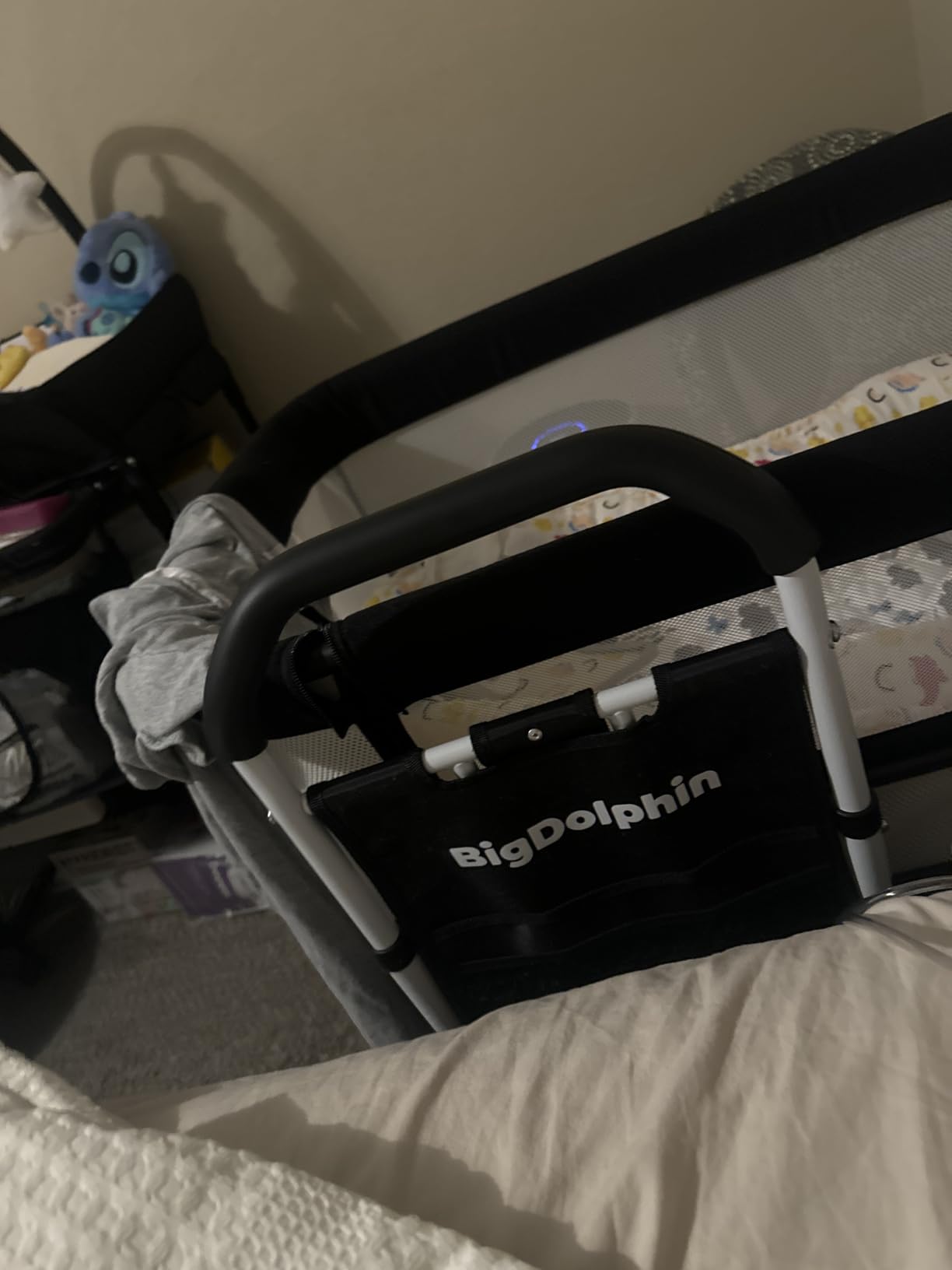
The distinguishing feature is the handle angle. A 30-degree ergonomic curve is designed so the wrist sits in a more neutral position when the user pulls up from lying down, which reduces the twisting force through the wrist joint. For a user with wrist or shoulder problems, or one recovering from a hand procedure, that geometry is worth more than another inch of rail length.
The grip is a cushioned waterproof non-slip foam, which matters more than it sounds. Hands are often damp or freshly washed at 2am, and a grip that loses traction at the exact moment of a sit-up is the failure mode most likely to cause an injury. The frame is stainless steel rated to 350 lb.

Adjustment is generous: 16.5 to 19.7 inches high and 30.3 to 35.8 inches long, fitting twin, twin XL, full, queen and king beds. Setup is tool-free with a storage pouch included, and the unit weighs 6.4 pounds at 35.8 by 40.5 inches. The long horizontal reach is what keeps it stable when leaned on.
Be aware of the evidence here. This product has the smallest review base in the roundup at roughly 630 reviews, and the customer review text available to us was limited, so the assessment leans on the 4.6 rating and the detailed feature set rather than on a wide pattern of owner reports. The claims about stability on uneven floors are manufacturer claims we could not verify independently.
Who This Rail Suits
It suits anyone with wrist, hand or shoulder pain who needs to sit up using a handhold. It suits users of damp-handed grips, and anyone who wants the longest horizontal reach in the group for stability on an uneven floor.
The 350 lb rating makes it viable for heavier users who are otherwise limited to the KingPavonini and a couple of others.
Where It Falls Short
It is not compatible with adjustable beds, and there is no independent certification cited beyond a general ASTM compliance claim. With the smallest review count here, long-term durability feedback is thinner than anything else in this roundup.
The height range starts at 16.5 inches, which is low for a very thick mattress, so check it against your mattress height before committing.
Bed Rail Safety and Entrapment Risk
Entrapment is the risk that decides whether a bed rail helps or harms. It happens when part of a body – most often a head, neck or limb – becomes wedged in a gap between the rail, the mattress and the bed frame. The hazard is not a fall. It is suffocation or strangulation, and it is why regulators, not just reviewers, care about how a rail is fitted.
The gap that matters is created by the mattress, not the rail. If your mattress is 10 inches thick and the rail was designed for a 7 inch mattress, the rail sits low relative to the mattress surface and opens a gap along the side. If the mattress compresses overnight or the user shifts toward the edge, the gap widens. This is why every rail in this list states a mattress thickness range, and why the range is more important than the capacity figure.
The mitigations are straightforward and all of them are free. Anchor the rail with the supplied strap to the bed frame or base, not just the mattress. Push the rail hard against the mattress side so the gap closes. Check the gap after a full night of use rather than on day one, because mattresses compress. And keep the rail closed during sleep hours rather than folded open.
ASTM F3186-17 is the standard worth looking for. It is the safety standard for adult portable bed rails and it covers the dimensions that create entrapment openings. Only some of the products in this roundup name it specifically: the Vaunn, Stander, Able Life and Panta rails state or imply F3186-17, while others give a general ASTM compliance claim. An unverified claim is not the same as a tested one, so when documentation matters, ask the supplier for the test report.
Federal guidance matters here because portable bed rails have a history of recalls involving entrapment. The practical takeaway is straightforward: a rail that has been through a recall may be a different design now, but the recall record is a good place to check the model number before buying anything used. Buying second-hand rails is the single easiest way to end up with a superseded design.
There is also a consent and documentation angle. In a care home or assisted living setting, rails can be treated as restraints rather than mobility aids, and residents or their representatives may need to consent. Families frequently ask whether a rail could count as restraint and cause trouble with a facility. The answer depends on the resident’s plan of care, and the correct route is to ask the facility’s clinical lead and your clinician before the rail arrives, not after.
And then there is the case for no rail at all. A person who tries to climb over a bed rail is at far greater risk of a fall from height than a person who simply rolls off the side onto a carpet. That behaviour is common in dementia and in some restless sleepers. If you have seen your parent or partner attempt to get over a rail, the rail is working against you, and you want to be reading the alternatives section further down rather than comparing handle curves.
How to Choose a Bed Rail That Fits Your Bed
Most bed rail disappointment is a compatibility problem, not a quality problem. Buy the specification you need, not the product with the nicest handle, and the decision takes about ten minutes with a tape measure.
The four rail types
Portable assist handle or bed cane: a low, narrow bar that gives a handhold for sitting up and getting out. It is a transfer aid, not a barrier. Best for a person who is steady enough to be trusted near an open edge and needs grip to stand.
Half-length rail: a middle ground, roughly 20 to 30 inches, usually adjustable, with a modest barrier component. Best for a person who rolls or has had one near-miss fall but still needs a firm handhold to sit up.
Full-length or gated guard rail: a longer barrier across a substantial part of the bed side, usually folding for caregiver access. Best for a person who actively rolls or thrashes in sleep and needs containment rather than assistance.
Floor-supported rail: a rail whose legs reach the floor for extra rigidity, requiring a stated minimum floor clearance. Best for heavier users or higher loads, and the least compatible with low profile beds.
Bed type compatibility
Platform or slatted bed: several rails explicitly exclude these, including the Medline model, which is not intended for platform beds with no box spring. The Stander rail is the one here that names platform, box spring and slat beds as supported. Check this line first, because it eliminates options fastest.
Box spring bed: the most forgiving setup and where most of these rails were designed. The one warning is strap length, since the medical king rail’s strap is reported as too short for a larger box spring. Buy a longer strap.
Adjustable base: this eliminates six of the ten rails in this roundup, including Stander, Lunderg, KingPavonini, WeHwupe and BigDolphin, none of which support adjustable beds. The Vaunn and Able Life rails also state incompatibility. If your bed elevates, you need a rail designed for it specifically rather than one of these.
Hospital or electric lift bed: none of the ten is designed for a full hospital bed, and the Stander rail states it is not intended for hospital beds. Weight capacity, controller clearance and mattress profile all differ. If the bed is a true hospital bed, the rail should come from the bed manufacturer or the DME supplier.
One further practical note for caregivers. A moving bed frame, such as an electric lift bed, usually needs two people to strap the rail to the base, as reviewers of the Lunderg rail note. If the person available to install is one older adult, avoid that combination.
Mattress thickness is the number one spec
Compare the rail’s stated range against your actual mattress before anything else. The windows here range from 3 to 12 inches on the KingPavonini rail, 7 to 11 inches on the Vaunn, 7 to 13 inches on the Lunderg, 8 to 15 inches on the Able Life and 10 to 14 inches on the Stander. A thin mattress pushes a rail low and opens a gap. A thick pillow-top can be outside the window entirely.
If your mattress falls outside every range, the fix is a rail with wider adjustment, not a lower rail.
Weight capacity needs derating
Stated capacity is a static load rating tested in a laboratory, not a promise about a 350 lb person pulling up with one arm. Treat the number as a ceiling and stay well under it. A useful rule: if the user is over 250 lb, look only at rails rated 300 lb or above, and add a second support point or a floor-supported design.
The capacity spread in this roundup runs from 300 lb on the Vaunn, Stander, Able Life and Lunderg rails up to 380 lb on the KingPavonini, with 350 lb on the WeHwupe, Panta and BigDolphin. A bariatric user above 350 lb has two realistic options here and should start with the KingPavonini.
Features that actually change daily life
A storage pouch is the feature most often praised by caregivers, because it reduces the number of trips across a dark room. The Stander includes a multi-pocket organizer, the Medline includes a nylon pouch, and the Lunderg option deliberately ships without a bag in favour of the light.
A motion-activated light matters more than its price suggests, since night-time bathroom trips are the highest-risk window. A fold-down design is what makes a long rail practical for a caregiver who changes bedding daily. A non-slip foam grip on the handle is close to mandatory for anyone with arthritic hands.
Treat the rest as optional. Cantilever versus floor-supported, glow-in-the-dark tips and cane holders are nice, and none of them fix a compatibility problem.
Certification and who does the installing
Prefer a named ASTM F3186-17 certification over a general ASTM claim when you can. And assume the installer is a family member, often an older adult, usually in a hurry. That assumption favours keyed assembly, partly pre-assembled parts and tool-free fitting, all of which are reasons the Medline and Lunderg rails sit where they do in this list.
Caregivers shopping for a parent who also uses a mobility scooter indoors or an elevated toilet seat are building a single transfer path: bed to bathroom. A rail that does not match the bed is the weak link in that path.
How to Install a Bed Rail Safely
Installation is where most of the entrapment risk is created or removed. Allow about fifteen minutes the first time, and do it before the first night rather than at 2am.
1. Measure the mattress thickness at its thickest point, typically the middle. Compare it to the rail’s stated range. If it falls outside, stop and pick a different rail.
2. Confirm the bed type. Platform, box spring, slat, adjustable or hospital. If the rail’s specifications exclude your bed type, do not force it with extra hardware.
3. Measure the floor clearance from the underside of the bed frame to the floor. Floor-supported rails commonly need 12.6 to 13 inches, and a low platform frame will fail this step.
4. Position the rail on the side where the user gets in and out, close to the head half of the bed where the mattress is least compressed. Leave enough room to enter and exit without climbing over the rail.
5. Slide the frame under the mattress and pull it firmly toward the mattress edge until there is no visible gap between rail and mattress. This single step closes most entrapment openings.
6. Fit the supplied strap and run it around the bed frame or base, not around the mattress alone. If the strap is too short, replace it with a longer tie-down before continuing. Check that the rail cannot be lifted by the handle.
7. Test load gradually. Push down and shake the rail with increasing force, then have the user lie against it and roll into it. Nothing should move, creak or flex visibly.
8. Re-check the gaps after a full week of use. Mattresses compress, straps stretch and bodies settle. A gap that did not exist on day one often appears on day seven, which is exactly the time to catch it.
Alternatives to Bed Rails for Elderly Adults
If a rail is wrong for the person or the bed, these are the options that solve the same problem without a frame beside the mattress. Several of them appear in caregiver discussions as the preferred route for parents who will not tolerate a rail.
Bed step stool with a handle: a two or three step platform with a grab handle that sits beside the bed, giving a lower climb. It addresses the height problem, which is often the real issue with a high bed, and it carries no entrapment risk at all. If the bed is the problem rather than the user’s balance, this is usually the better first purchase.
Low-height platform bed or an adjustable base: replacing a 24 inch high bed with a 12 to 15 inch one removes most of the need for a rail. This is a bigger decision than a rail purchase, but if you are replacing a bed anyway it is the cheapest safety intervention available.
Under-bed motion-activated lighting: a strip or puck that switches on when someone approaches the bed. It addresses the actual injury mechanism, which is a fall on the way to the bathroom in the dark, without adding anything beside the mattress. The light on the Lunderg rail is this idea built into the rail, but standalone units work on any bed frame.
Floor-pressure sensors and bed alarms: pressure pads or strips that alert a caregiver when a person leaves the bed. In care settings these are used precisely because they avoid the restraint question that rails raise, and they let a caregiver respond instead of preventing.
Transfer boards, transfer poles and gait belts: for a person who can bear weight with help, a sliding board or a floor-to-ceiling pole beside the bed gives a stable handhold without a rail in the bed. These are standard physical therapy tools and are usually part of a broader recovery plan.
Grab bars near the bed: a wall-mounted or clamp-on grab bar beside the bed gives a permanent handhold without occupying mattress edge space, and it cannot be climbed over.
Clear floor path and non-slip mats: the cheapest intervention of all. Remove the rug between bed and bathroom, keep the route lit, and put a non-slip mat at the bed edge. Caregivers frequently report that housekeeping changes prevent more falls than equipment does.
Frequently Asked Questions
Will Medicare pay for bed rails for seniors?
Usually not as a standalone purchase. Medicare generally treats bed rails as a convenience or comfort item rather than a covered durable medical equipment item, so a rail bought on your own will not be reimbursed. Coverage becomes possible when a doctor documents a qualifying clinical need and the rail is ordered as part of a larger prescribed equipment package, typically following a hospital stay or a documented mobility limitation. The practical route is a DME supplier rather than a general retailer, since a supplier can submit the paperwork and handle coverage rules for your specific plan. If you are unsure, ask your state SHIP counselor, who advises on Medicare and Medicaid benefits at no cost.
Are bed rails appropriate for dementia patients?
Only with care, and often not at all. For a person who tries to climb over a rail, the fall from height is more dangerous than the fall the rail was meant to prevent. For a person who is restless at night, a rail can also be removed or bent and become a hazard itself. Where dementia is present, discuss the decision with a clinician before purchasing, and ask specifically about the person’s care plan. In care homes and assisted living, rails may be treated as restraints requiring documented consent. A motion-activated light and a bed alarm address wandering without creating an entrapment risk.
What are the alternatives to bed rails for the elderly?
The most useful alternatives are a bed step stool with a grab handle, which fixes a bed that is simply too high; a low-height platform bed or adjustable base, which removes the height problem entirely; under-bed motion-activated lighting, which addresses the dark-room fall; floor-pressure sensors and bed alarms, which alert a caregiver without adding a frame beside the mattress; transfer boards, transfer poles and gait belts for a person who can bear weight with help; and wall-mounted or clamp-on grab bars beside the bed. Housekeeping matters too: clearing rugs from the route and adding a non-slip mat at the bed edge prevents more falls than equipment in many homes.
What is the best assistive bed rail for elderly people?
It depends on the goal. For transfer support and a comfortable grip on arthritic hands, the Medline Bed Assist Bar offers multiple gripping positions and a foam handle. For a certified, well-documented rail on a standard-height bed, the Vaunn model is ASTM F3186-17 certified and rated to 300 lb. For fall prevention and a restless sleeper, the Stander EZ Adjust extends to 30 inches and folds down for caregivers. For a user over 300 lb, the KingPavonini rail is tested to 380 lb. For night-time bathroom trips, the Lunderg rail’s motion-activated light is the feature that matters most.
How do you install bed rails for elderly adults?
Measure the mattress thickness first and confirm it falls inside the rail’s stated range, then confirm the bed type is not excluded by the manufacturer. Measure floor clearance if the rail has support legs, since many require 12.6 to 13 inches. Slide the frame under the mattress and push it firmly against the mattress edge to close entrapment gaps, then run the supplied strap around the bed frame or base rather than the mattress alone, replacing the strap if it is too short. Test the load gradually, and re-check the gaps after a week of use because mattresses compress.
How much weight can a senior bed rail hold?
In this roundup the stated capacities run from 300 lb on the Vaunn, Stander, Able Life and Lunderg rails up to 350 lb on the WeHwupe, Panta and BigDolphin models, and 380 lb on the KingPavonini. Treat these as laboratory static load ratings rather than working limits. A person hauling themselves up with one arm applies far more than their body weight through the frame, so stay well under the figure and choose a floor-supported design for heavier users. If the user is above 250 lb, narrow the list to rails rated 300 lb or above before comparing other features.
Do bed rails prevent falls or make them worse?
Both, depending on the user and the fit. Properly fitted, a rail supports transfers, defines the bed perimeter and gives a firm handhold where the user needs one, which is how a practitioner in r/nursing described its clinical use. Poorly fitted, with an open gap or an inadequate strap, it can contribute to entrapment. And for a person who attempts to climb over it, a rail raises the height of the resulting fall, which is worse than rolling onto a carpeted floor. Evidence for preventing falls out of bed is mixed, which is why fit and the user’s behaviour matter more than the purchase itself.
The Verdict on the Best Bed Rails for Elderly Adults in 2026
The Medline Bed Assist Bar is the pick we would install first, because its multi-position foam grip, keyed tool-free assembly and folding pouch design have held up across more customer reports than anything else here. For a bed with a standard frame and clearance to spare, the Vaunn rail adds documented ASTM F3186-17 certification and a 300 lb rating. For a parent who rolls out of bed, the Stander EZ Adjust is the only one here with real barrier coverage, folding to 30 inches and down flat for caregivers.
Match the rail to the bed before the person. Mattress thickness range, bed type and floor clearance eliminate more options than rating ever will, and a rail installed in the wrong bed is worse than no rail because it creates an entrapment gap. If your parent tries to climb over rails or has dementia-related restlessness, skip this category entirely and use one of the alternatives above instead.
Measure first, strap to the frame, and re-check the gaps after a week. That sequence matters more than the model you choose.