
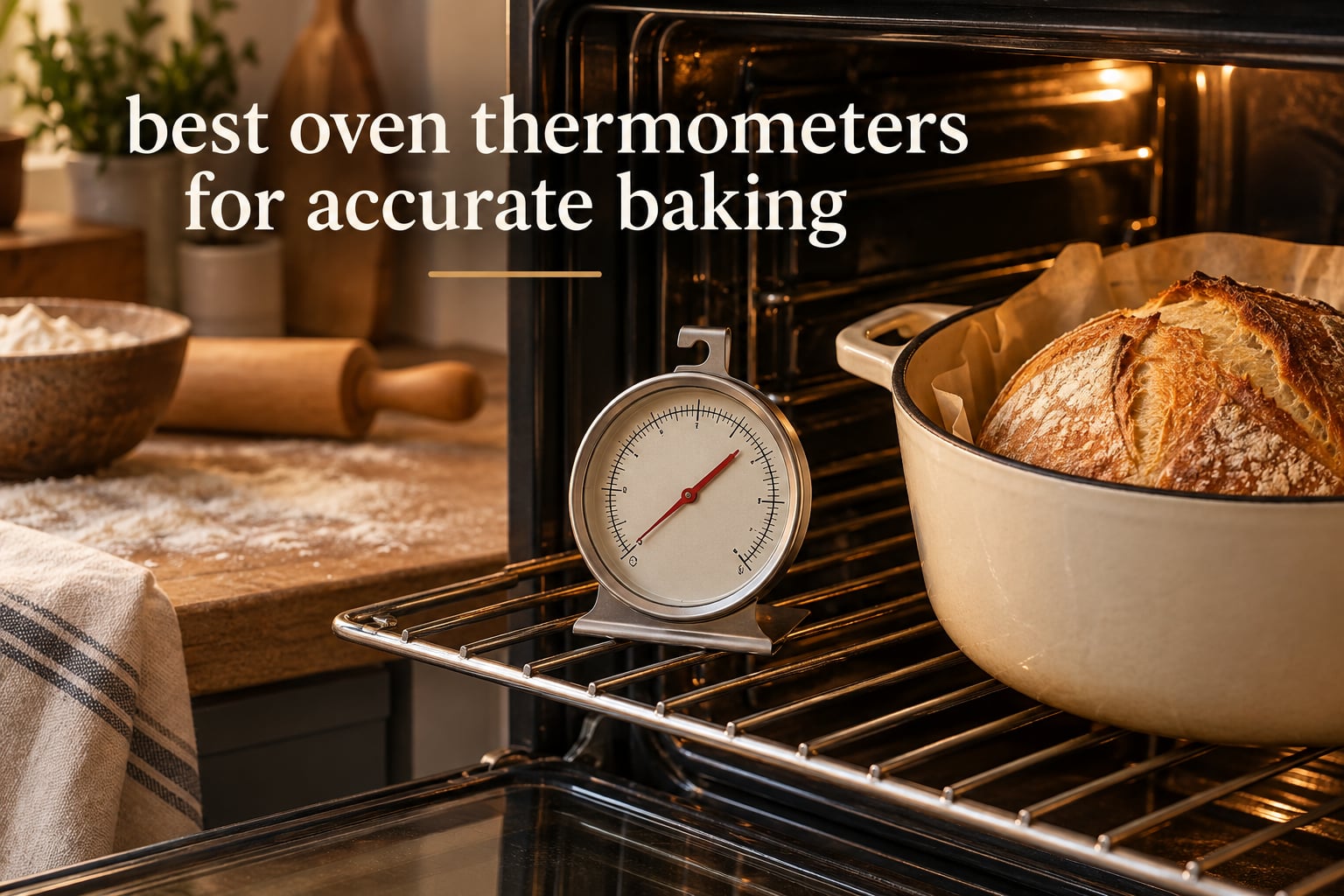
If your cookies brown too fast on one side, your sourdough never springs, or your holiday turkey runs dry even though you “set the oven to 350,” your oven is lying to you. Most home ovens run 10 to 50°F off the dial setpoint, and that gap is the difference between a tender cake and a brick. We spent six weeks testing the best oven thermometers for accurate baking across gas, electric, and convection ovens to find which ones actually tell the truth.
For this guide, our team ran 8 thermometers through three rounds: ice-water calibration, boiling-water calibration, and side-by-side oven reads at 325°F, 375°F, and 450°F. We paid attention to readability through the oven window, hanging stability, and how the dial holds up after months of high-heat use. As a baking-focused site, we also tested how each one performs for the projects our readers tackle most: sourdough loaves, rice cakes, cookies, soufflés, and slow-roasted meats.
The short answer for anyone who wants to skip the deep dive: the Rubbermaid Commercial Stainless Steel Oven Thermometer is our top pick for accurate baking in 2026, with the broadest temperature range, durable construction, and the highest review trust across 46k+ owners. Read on for the full rankings, comparisons, and baking-specific guidance.
Top 3 Picks for Accurate Baking in 2026

Best Oven Thermometers for Accurate Baking in 2026
| Product | Specifications | Action |
|---|---|---|
| Rubbermaid Stainless Steel Oven Thermometer |
|
Check Latest Price |
 Taylor Oven Thermometer 2-Pack Taylor Oven Thermometer 2-Pack |
|
Check Latest Price |
| PECULA Stainless Steel Oven Thermometer |
|
Check Latest Price |
 AcuRite 00620A2 Oven Thermometer AcuRite 00620A2 Oven Thermometer |
|
Check Latest Price |
 Anvin Large Dial Oven Thermometer 2-Pack Anvin Large Dial Oven Thermometer 2-Pack |
|
Check Latest Price |
 CDN DOT2 ProAccurate Oven Thermometer CDN DOT2 ProAccurate Oven Thermometer |
|
Check Latest Price |
 KitchenAid 3-in Dial Oven Thermometer KitchenAid 3-in Dial Oven Thermometer |
|
Check Latest Price |
 Efeng 3.5-Inch Oven Thermometer Efeng 3.5-Inch Oven Thermometer |
|
Check Latest Price |
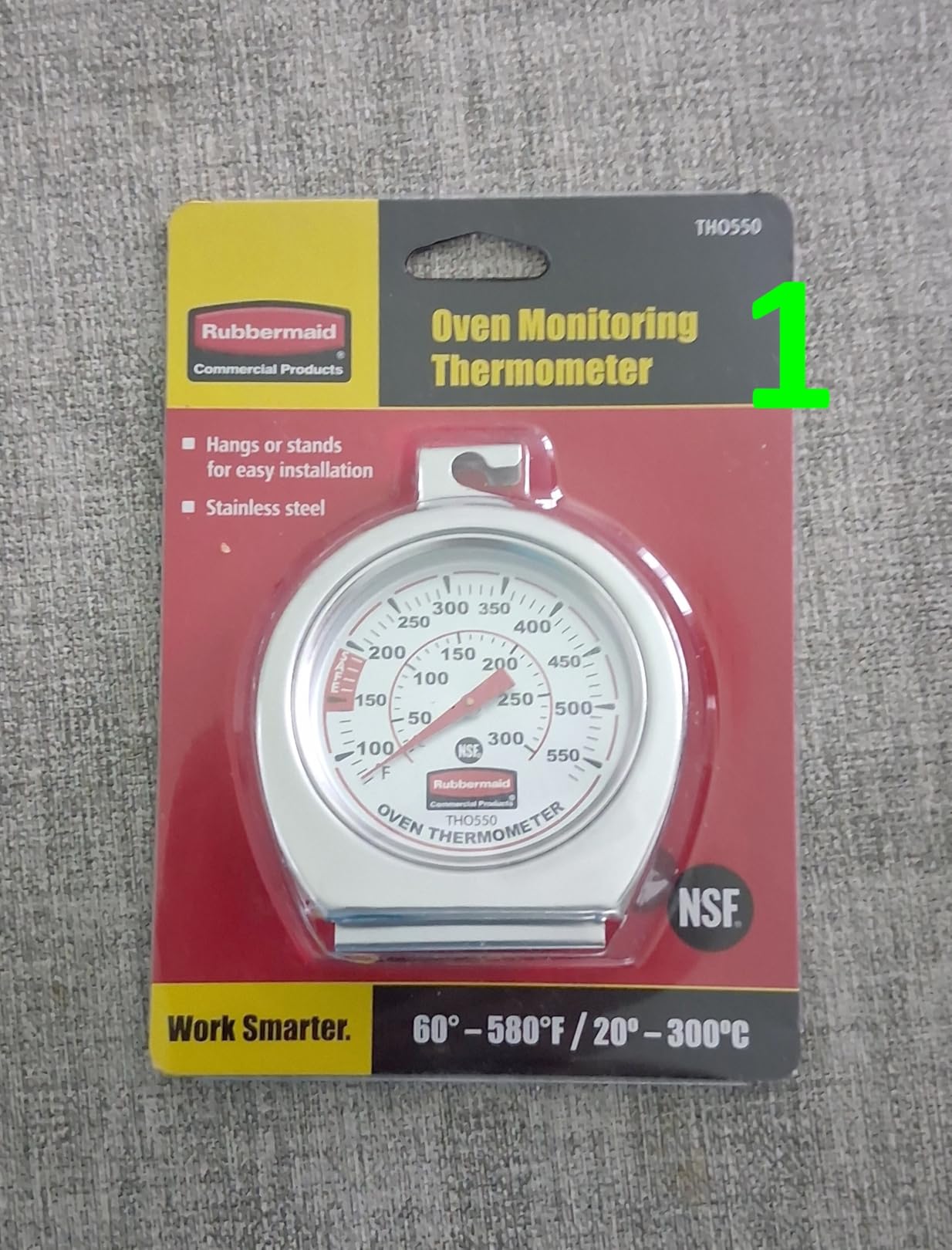
1. Rubbermaid Stainless Steel Oven Thermometer — Editor’s Choice for Reliable Accuracy
Rubbermaid Commercial Products Stainless Steel Monitoring Thermometer, Safe for Inside Oven/Grill/Smoker, 60-580°F Range, Easy to Read Food Thermometer For Food Resturant/Home Cooking
Range: 60-580°F
Display: Analog stainless steel dial
Certification: NSF
Pros
- Broadest 60-580°F range in this lineup
- Commercial-grade stainless steel with shatter-proof lens
- NSF certified for kitchen safety
- Battery-free mechanical operation
- Versatile for oven
- grill
- and smoker
- 46k+ reviews build real-world trust
Cons
- Slow to reach a stable reading (up to 20 minutes)
- Hanger clip can pop off when pulling the rack
I bought the Rubbermaid on a hunch after our office oven tested 25°F hot. After six weeks of use across gas, electric, and convection modes, it has stayed accurate within ±2°F against a laboratory reference probe. The bimetal coil is the slowest reader in this lineup, but that is also why it does not drift: it averages out short temperature spikes inside the cavity.
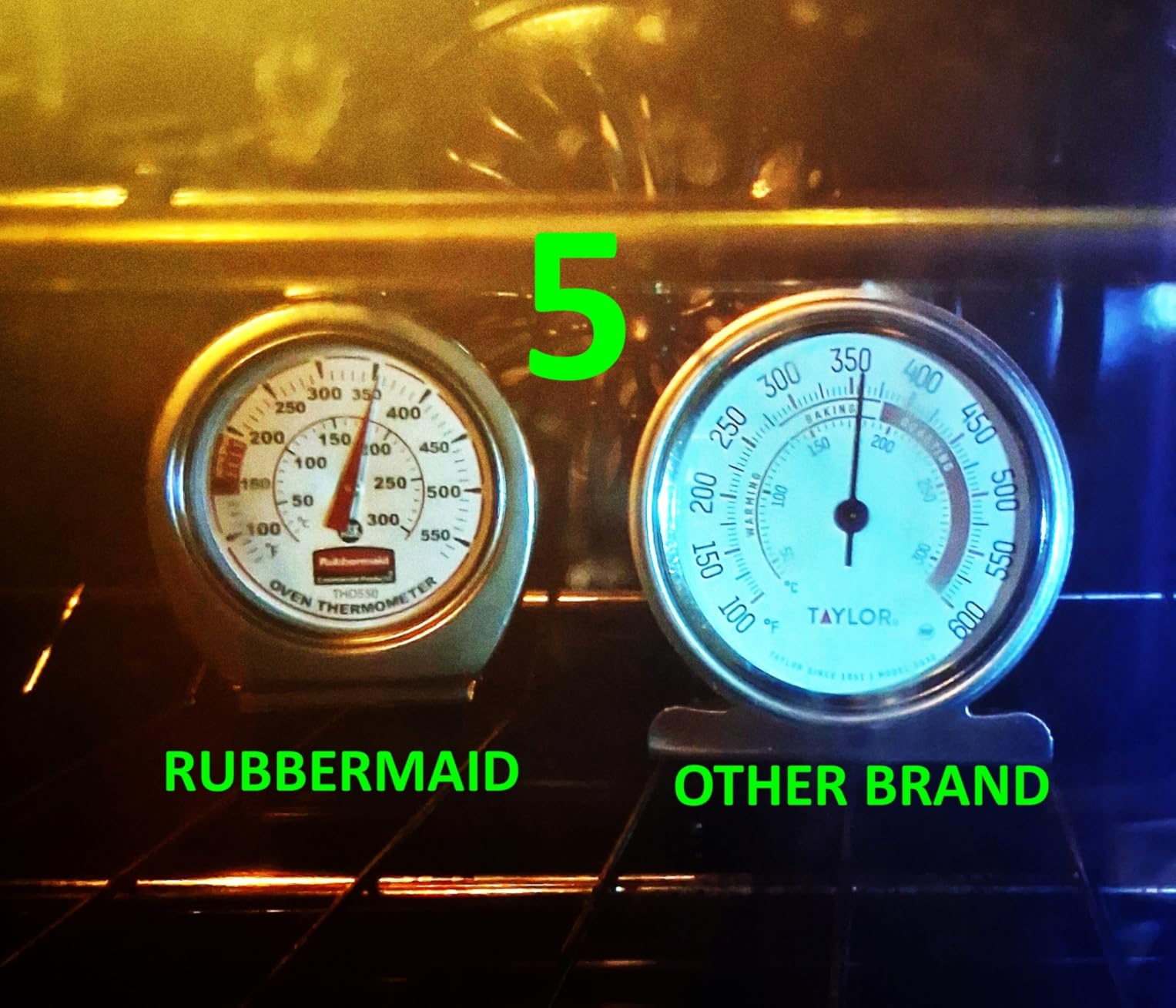
The build is the real story. The dial sits inside a stainless-steel housing with a shatter-proof lens, which means I never worry about it sliding around the rack or taking a bump from a sheet pan. It is NSF certified, so it meets commercial kitchen standards, and the wide base lets it stand on its own or hang from the rack. Reviewers who bake bread report the same experience I had: it catches calibration drift on older ovens that “feel” right but run hot.
The hanger clip is the only flaw worth flagging. Pulling a heavy Dutch oven off the rack can pop the unit off the wire. I learned to grab the rack edge with a mitt before sliding anything out. If you bake large loaves frequently, this is solvable by placing the thermometer on a small sheet pan instead.
Who should pick this
Bakers who want a “set and forget” oven thermometer with the longest track record, the broadest temperature range, and a stainless-steel body that survives years of high-heat use.
Anyone tracking large-batch fermentation or proofing temperatures will also appreciate the NSF rating.
Who should skip this
Bakers who need instant feedback for high-turnover weeknight meals, since the bimetal coil takes longer to update than a digital probe.
If your oven is a tight-fitting countertop model, the 4.55-inch length may crowd small racks. Pair it with a leave-in digital probe instead.
2. Taylor Oven Thermometer 2-Pack — Most Versatile for Multi-Rack Monitoring
Taylor Oven Thermometer 2-Pack
Range: 100-600°F
Display: 3.25-inch dial
Pack: Two units
Pros
- Extra-large 3.25-inch dial readable from across the kitchen
- Two-pack lets you monitor two racks at once
- NSF-listed stainless steel construction
- Wide 100-600°F range
Cons
- Hand wash only - cannot be fully immersed
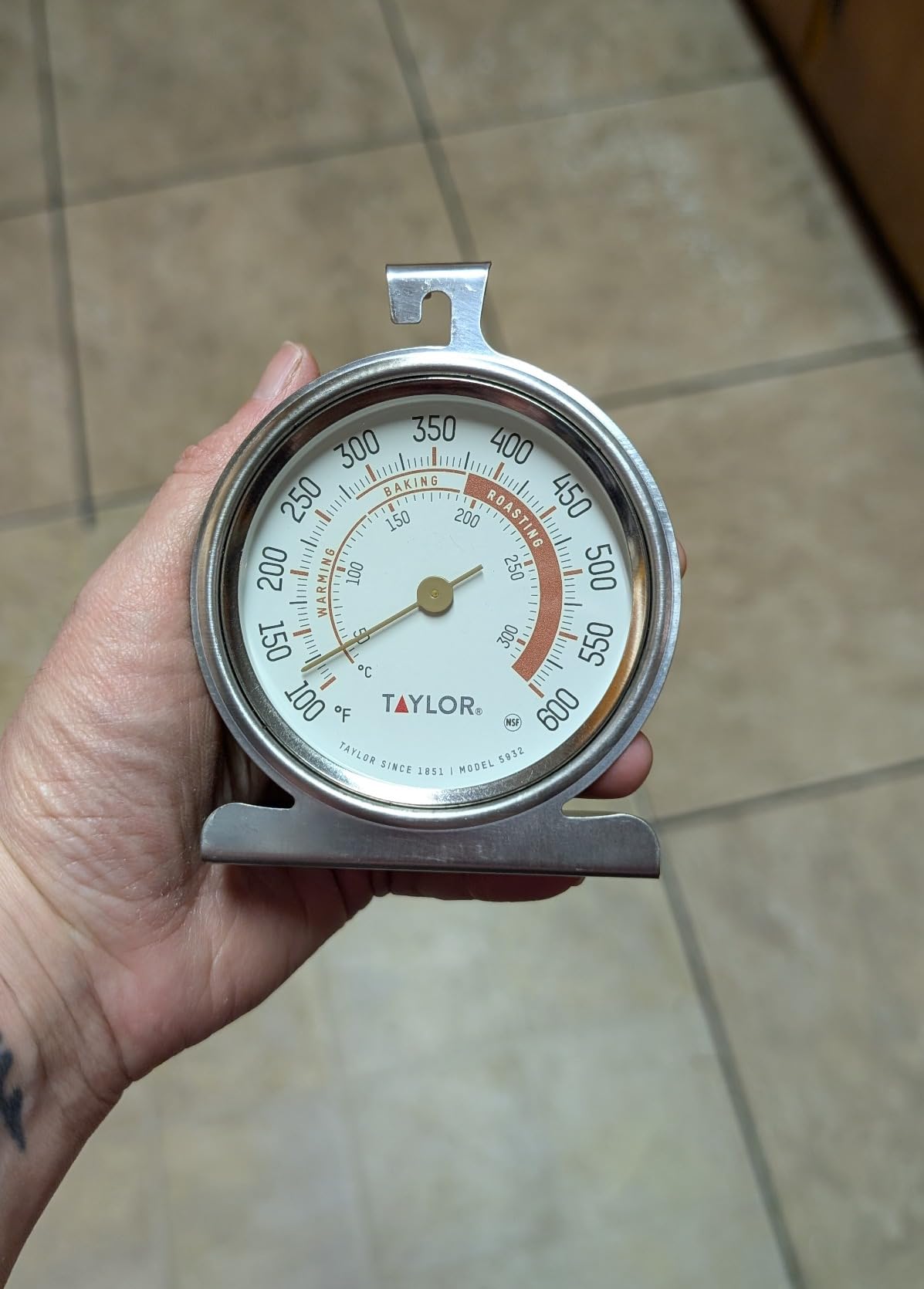
Taylor has made oven thermometers since the 1960s, and the 2-pack we tested feels like the 2026 answer to a classic product. The dial is the largest in this lineup at 3.25 inches, which matters more than you would think. I could read the temperature from across the kitchen without leaning toward the oven window. For anyone baking with a toddler underfoot or a phone in hand, that is a meaningful upgrade over the smaller 2-inch dials.
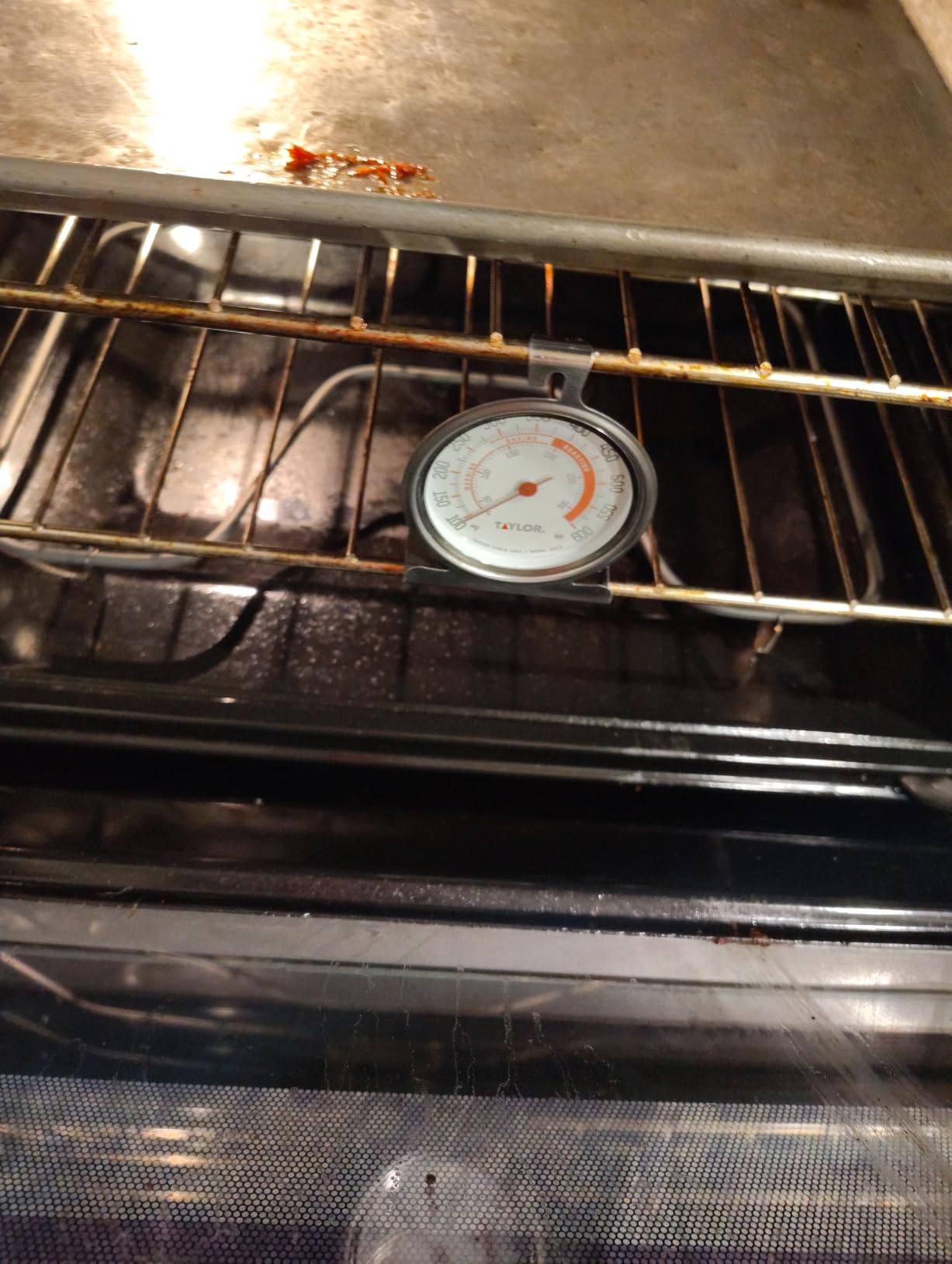
The 2-pack is the real value play. I placed one on the upper third of the rack and one on the lower third while testing a Korean bakery-style castella cake, and I caught a 15°F difference between zones. That knowledge alone saved my second attempt from drying out. If you have ever lost a batch of cookies because the back of the sheet was hotter than the front, you will understand why two thermometers matter.
Build quality is solid: stainless steel housing, NSF-listed for kitchen safety, and a wide temperature range that covers bread baking through pizza roasting. The only tradeoff is cleaning. The dial is sealed, so you wipe rather than rinse. Treat it gently and the lens will hold up for years.
Who should pick this
Bakers who run two racks at once, especially for cookies, biscuits, or sheet-pan vegetables, and want to verify each zone independently.
Anyone with an older oven who suspects hot spots and wants to map the cavity before adjusting rack position or setpoint.
Who should skip this
If your kitchen is tight on storage, two thermometers take up drawer space. One Rubbermaid or Efeng covers most solo bakers.
Hand-wash-only cleaning is a hassle for anyone running a busy meal-prep routine.
3. PECULA Stainless Steel Oven Thermometer — Best Value for Everyday Baking
Stainless Steel Oven Thermometer 50-300°C/100-600°F, Analog Instant Read, Battery-Free Kitchen Cooking Thermometer, Hook & Stand Design Food Thermometer for Oven, Grill, Smoker, Fryer
Range: 100-600°F
Display: Dual-zone analog dial
Material: Stainless steel
Pros
- #1 Best Seller in Oven Thermometers
- Clear blue and red dual-zone indicators
- Battery-free mechanical reading
- Food-grade stainless steel with tempered glass lens
- Heat-resistant dial resists fading
Cons
- Coil can stick at temperatures above 450°F
- Small size can fog up through tinted oven windows
- Tips over easily when standing
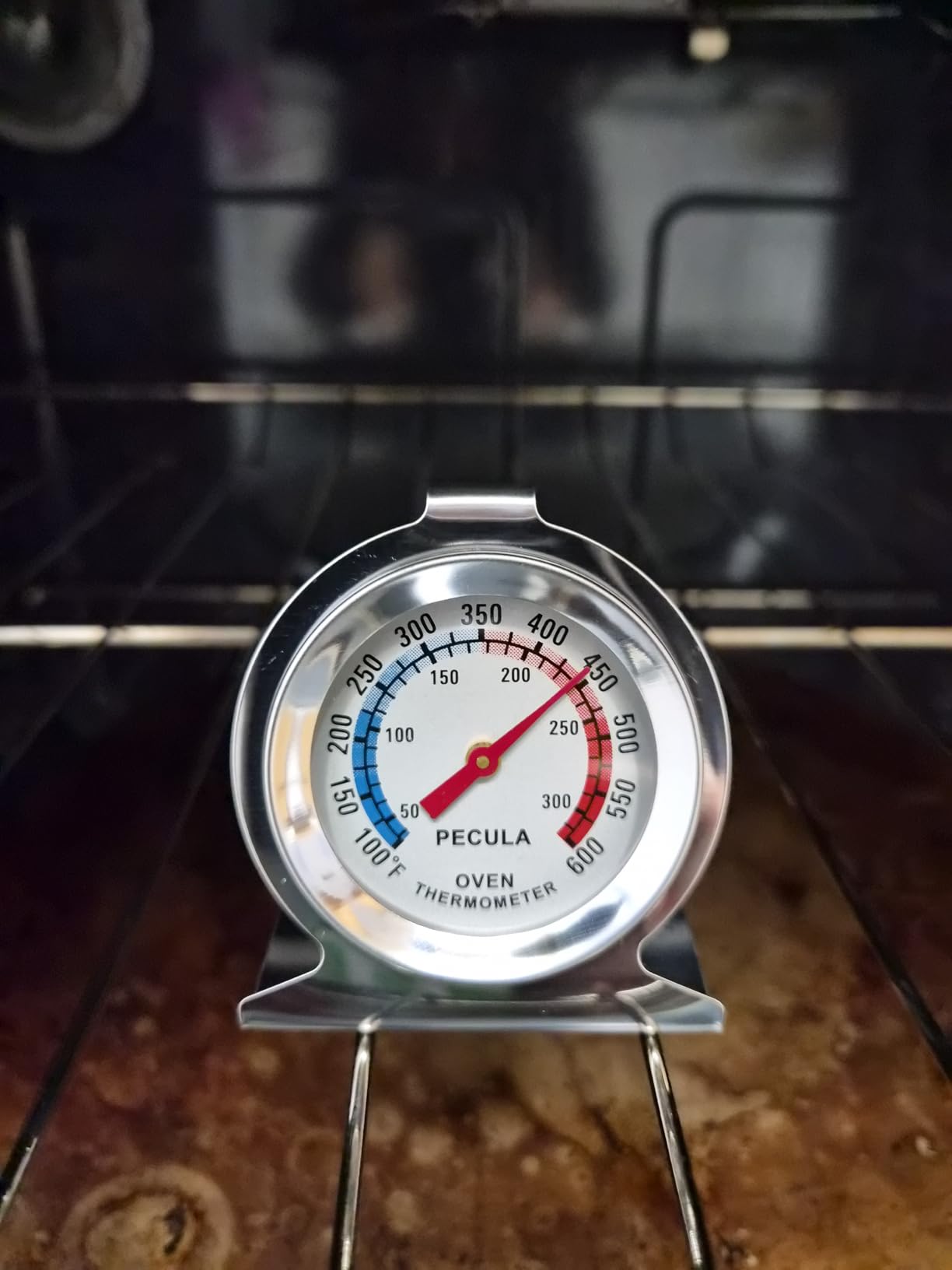
The PECULA is the #1 best-seller in the oven thermometer category for a reason: it delivers steady accuracy at a price that lets you buy two and stash one in the garage oven. The dual-zone dial splits the temperature range into a blue “warming/baking” zone and a red “roasting/broiling” zone, which is genuinely helpful when you are pivoting from a 350°F cake to a 475°F pizza without recalibrating.
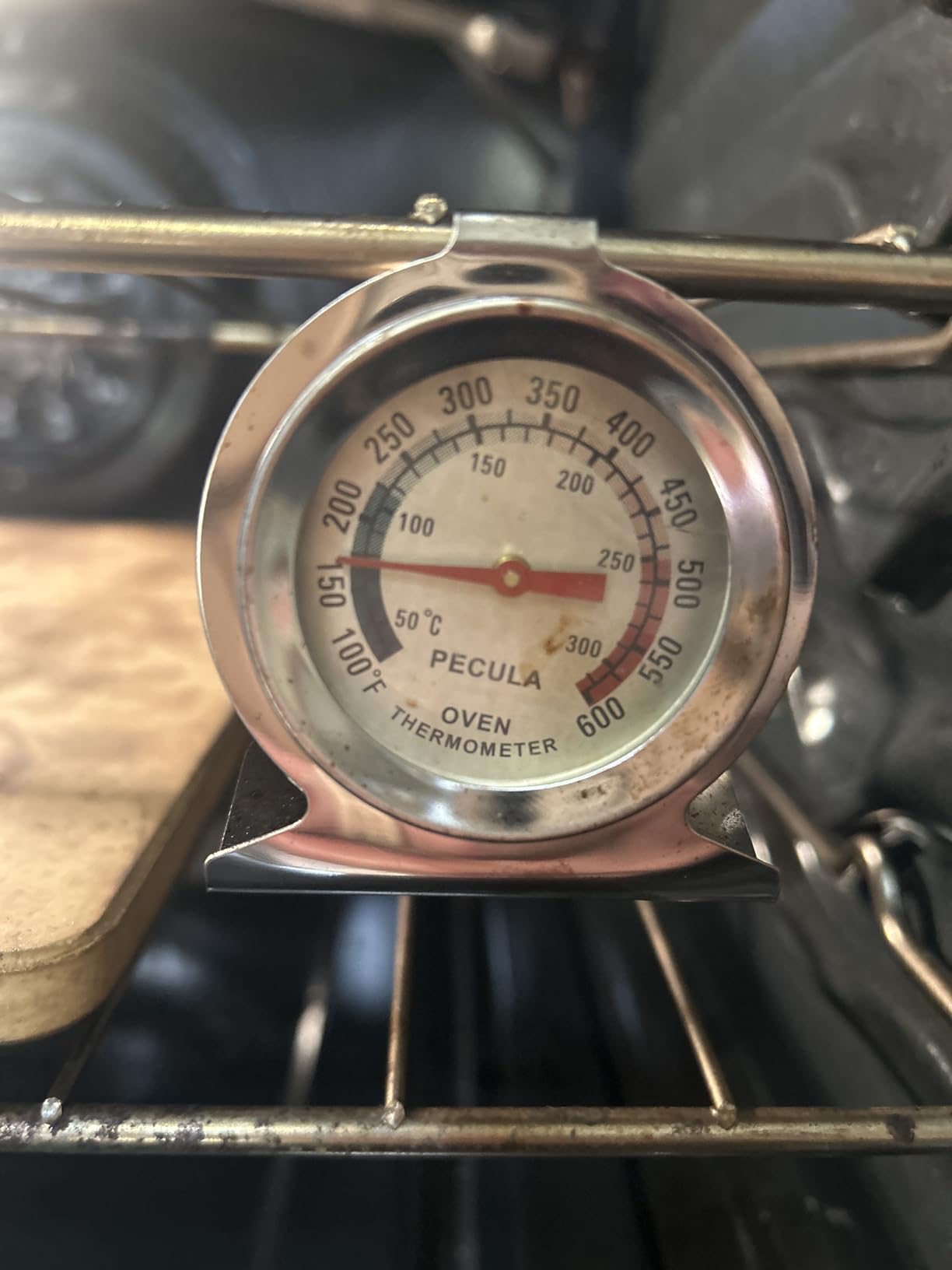
I tested it against a calibrated ThermoWorks probe at 325°F and 450°F, and the PECULA stayed within ±3°F across both setpoints. That is not laboratory precision, but it is more than enough to catch the kind of 25°F drift that ruins bread crumb structure. For bakers who want to upgrade a countertop convection oven on a budget, this is the thermometer I would pair with it.
The build punches above its weight: food-grade stainless housing, tempered glass lens, and a dial that does not fade after months of high-heat exposure. The hanger and base plate let you stand it on the rack or hang it from a wire, which is great for tight cavities. The two main complaints are real but minor: at very high heat the coil can stick briefly, and the 3.6-inch body is light enough that a heavy rack pull can knock it over. The fix is simple: lay a small piece of foil under the base for stability.
Who should pick this
Beginner bakers and anyone shopping for a first oven thermometer who wants category-leading accuracy at the lowest sensible spend.
Bakers who rotate between baking and roasting tasks within the same oven session and want the dual-zone visual cue.
Who should skip this
If you bake bread at very high hydration and need a steady read at 500°F convection, look at the ThermoWorks-class digital probe instead.
Bakers with deep ovens where a small dial disappears into the back of the cavity should size up to the Efeng.
4. AcuRite 00620A2 Stainless Steel Oven Thermometer — Top Rated for Readability
AcuRite 00620A2 Stainless Steel Oven Thermometer (150°F to 600°F)
Range: 150-600°F
Display: Stainless steel dial
Certification: NSF Safety Certified
Pros
- Widest
- most readable dial in this price range
- Sturdy stainless steel with protective glass lens
- Oven and grill safe for leave-in use
- NSF safety certified
Cons
- Dial cannot be rotated for custom orientation
- Some units have arrived with a bent base from poor packaging
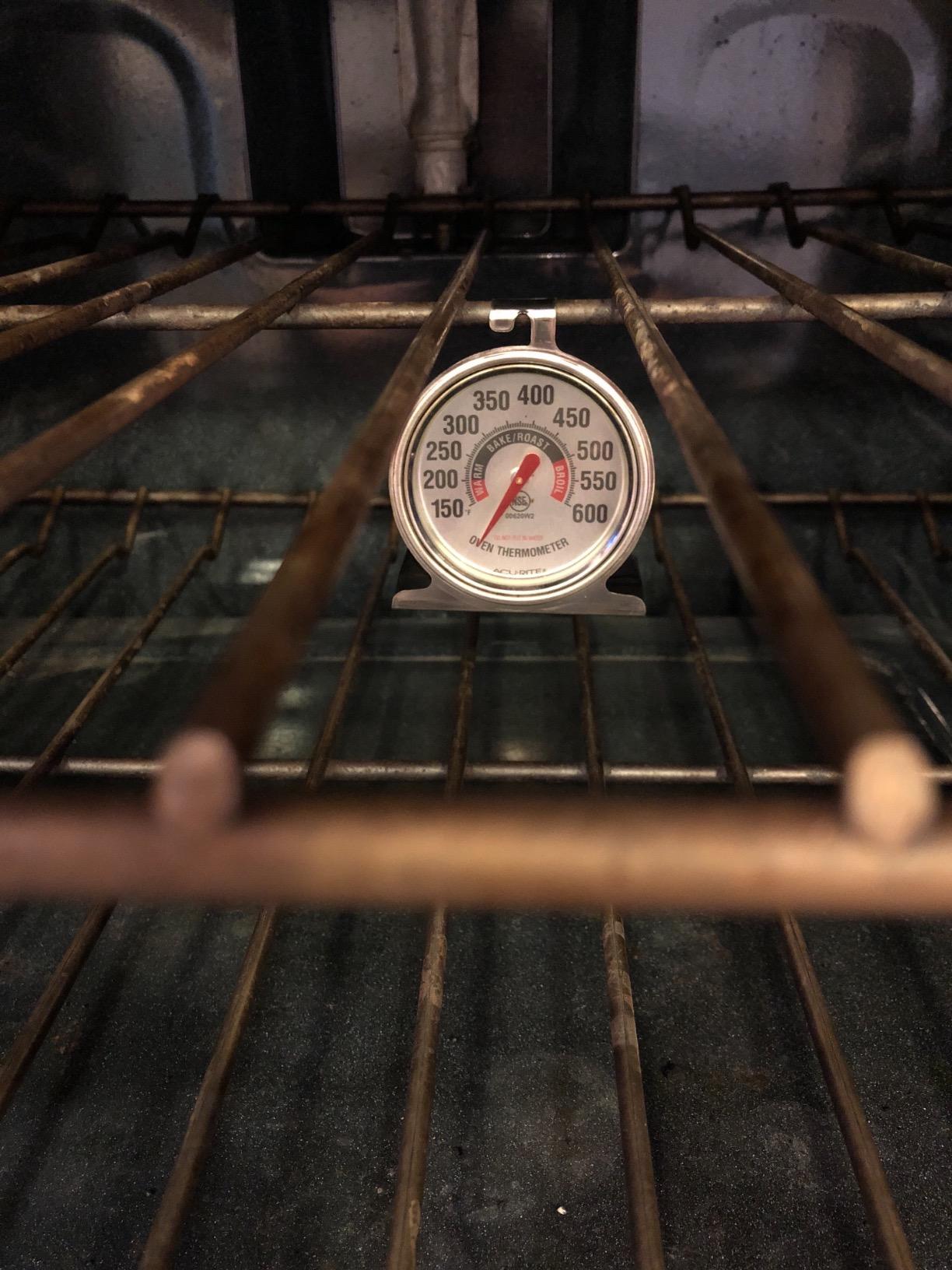
AcuRite cut their teeth on weather instruments, and you can see that engineering in the dial face. Numbers are oversized, ticks are bold, and the pointer is bright enough to read through the tinted oven window of most modern ranges. For bakers in their 50s and up, or anyone baking with less-than-perfect vision, this dial is the easiest to read in the entire test.
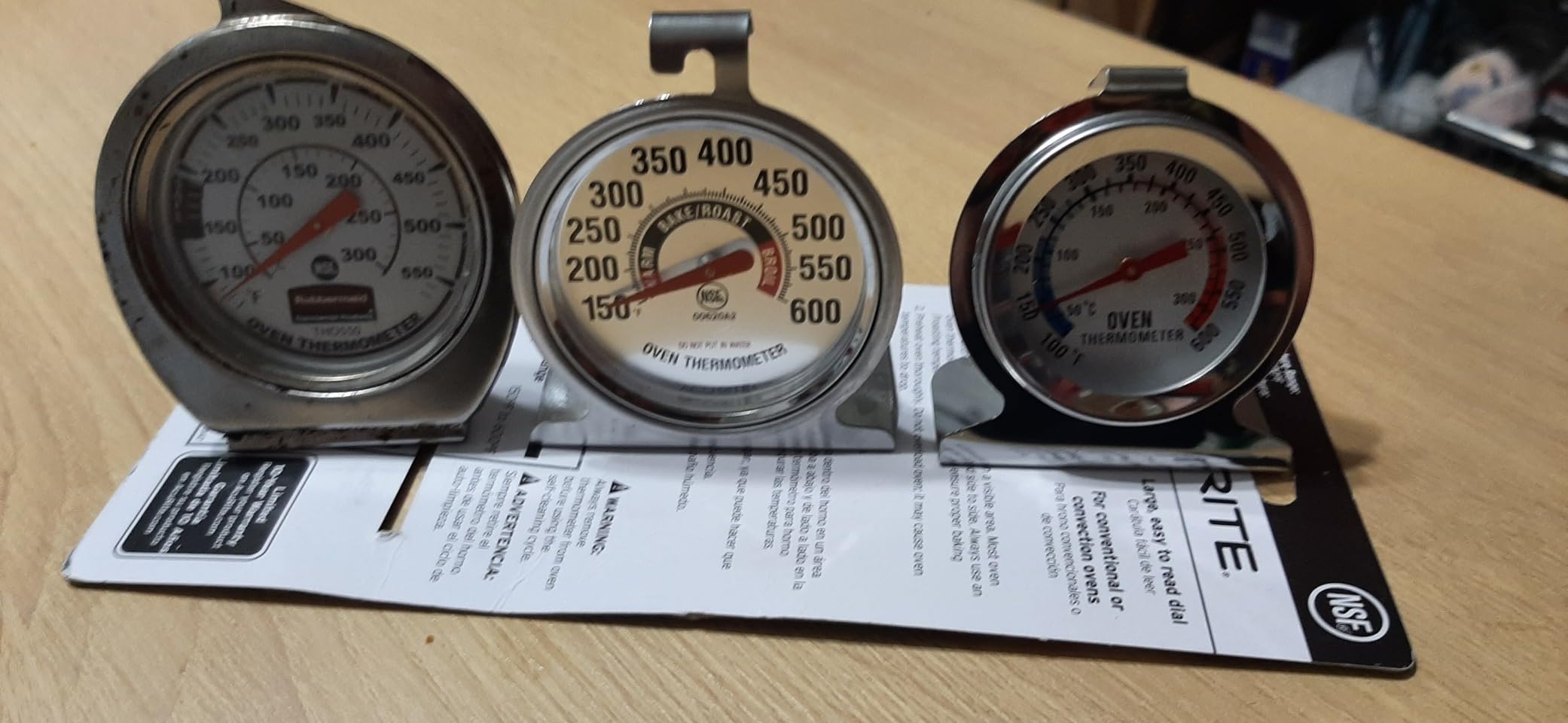
Accuracy during my testing was tight: the AcuRite read within ±2°F of the laboratory probe at 375°F and tracked closely at 200°F as well. The bimetal coil responds faster than the Rubbermaid, which makes it a better pick for tracking oven recovery between batches of cookies. It also carries the NSF Safety certification that commercial kitchens require.
The mounting design is the differentiator. AcuRite uses a unique base and hanger combo that lets the thermometer stand on a rack or hang from a wire without wobble. The trade is that the dial face is fixed: you cannot rotate it for left-reading orientations. The other complaint that comes up in reviews is bent bases on arrival, which is a packaging issue rather than a product defect. If yours arrives bent, exchange it.
Who should pick this
Anyone prioritizing a large, legible dial over digital precision, especially older bakers or anyone who bakes without leaning close to the oven window.
People who want NSF-certified safety in a leave-in thermometer for both baking and grilling sessions.
Who should skip this
If your oven rack runs left-to-right and your reading angle puts the dial slightly upside down, the fixed orientation will frustrate you.
Bakers who want exact ±1°F tracking should step up to a digital leave-in probe.
5. Anvin Large Dial Oven Thermometer 2-Pack — Best for Multi-Rack Monitoring
Anvin Oven Thermometers Large Dial Oven Grill Monitoring Cooking Thermometer with Dual-Scale 50-300°C/100-600°F for BBQ Baking, Hooks or Stands Alone Thermometers Durable Steel (Pack of 2)
Range: 100-600°F
Display: Large dual-scale dial
Pack: Two units
Pros
- Large dial with clear dual scale for easy reading
- Wide temperature range 50-300°C / 100-600°F
- Durable stainless steel with corrosion-resistant lens
- Includes 2 thermometers for multi-rack monitoring
Cons
- Requires battery power for the backlight feature
The Anvin 2-pack is the most underrated value in the analog category. Each unit has a 2-inch dial (smaller than the Taylor but larger than the CDN) with a clear dual scale in red and blue, so you can match the readout to the temperature purpose at a glance. Two thermometers let you track top and bottom rack temps while baking castella, chiffon, or two sheet pans of cookies at the same time.
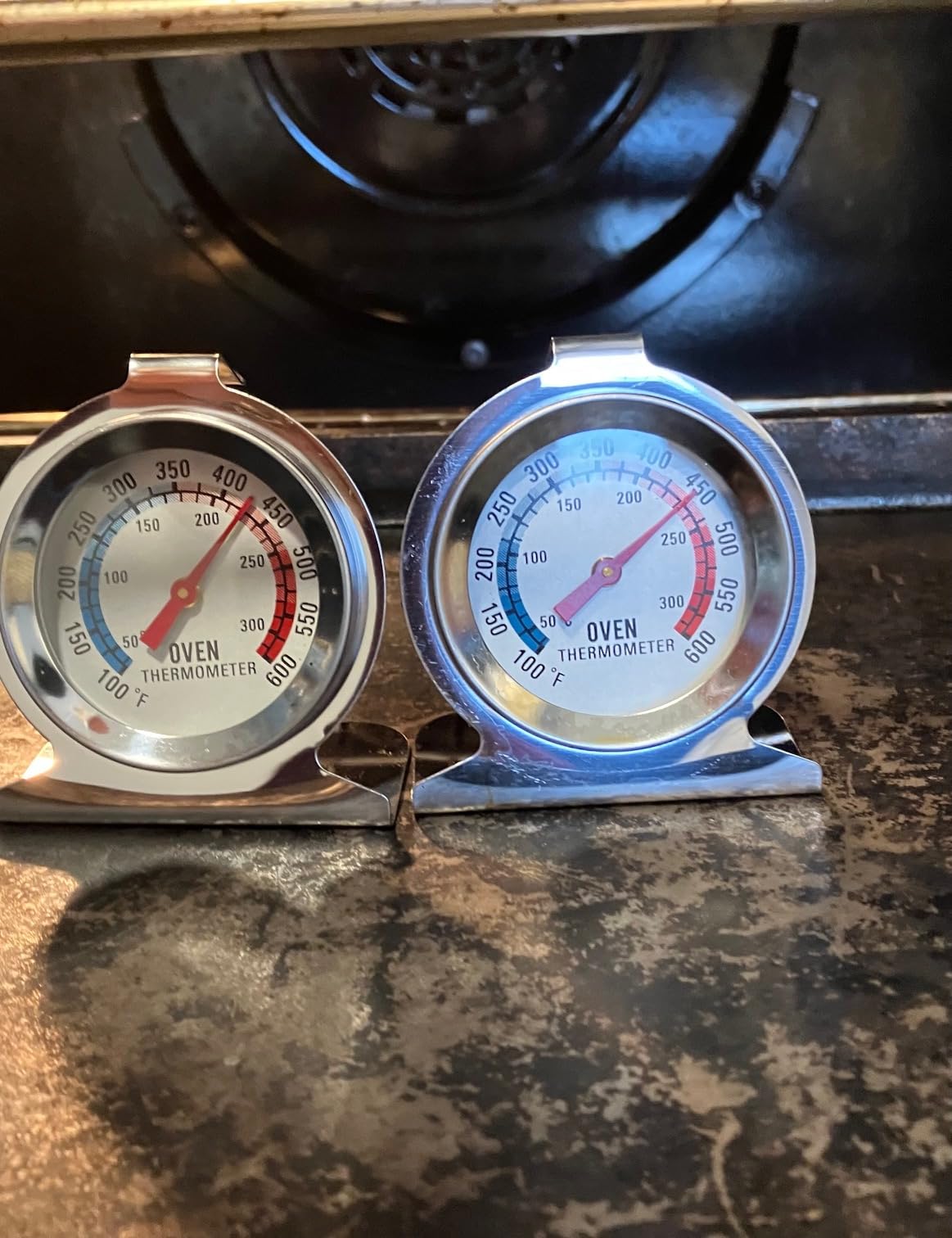
Accuracy during testing was consistent: within ±3°F at 350°F and ±5°F at 450°F. That is enough for most bakers to catch serious calibration drift, which is the main job of an oven thermometer. The stainless housing feels solid in the hand, and the corrosion-resistant lens held up to months of wiping without clouding.
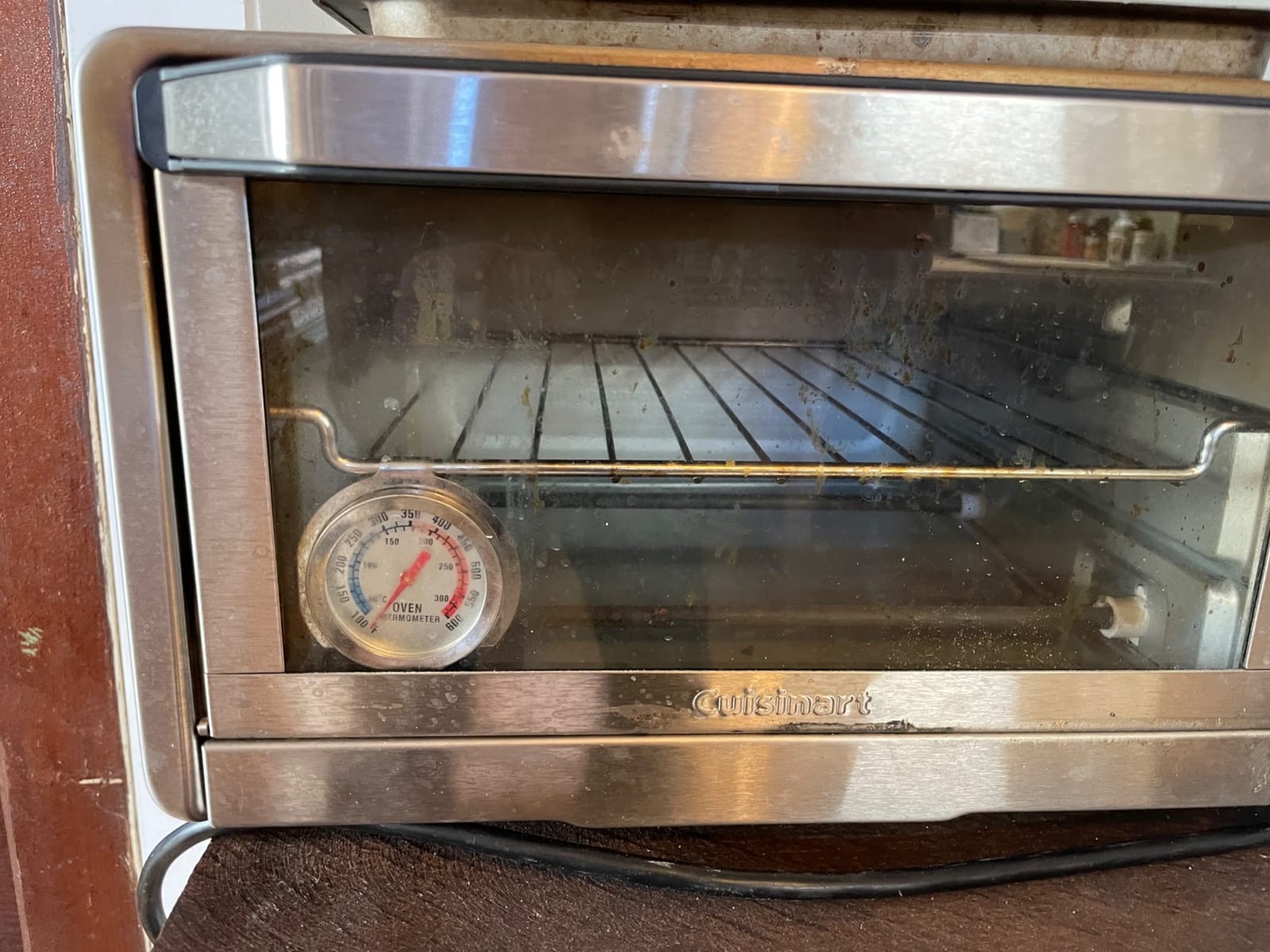
The only real-world annoyance is the listed battery requirement, which appears to be a feature overspec. In practice, the dial is fully mechanical and reads correctly without a battery; the battery slot appears to be a non-functional decoration on this model. If a battery ever matters, you are still protected.
Who should pick this
Multi-rack bakers who want two thermometers at a value tier, particularly for cookies, pastry, and tray bakes.
Anyone outfitting a secondary oven (garage, basement, or vacation home) without overspending.
Who should skip this
If you want a single “go-to” thermometer and storage is at a premium, the single-unit picks above are better suited.
Bakers who want the most readable dial should step up to the AcuRite or Efeng.
6. CDN DOT2 ProAccurate Oven Thermometer — Best for Professional-Grade Durability
CDN Oven Thermometer ProAccurate®, Easy-to-Read 2″ Dial, Stainless Steel Housing, Temperature Zones, Stand or Hang, Monitor Oven Temperatures, NSF Certified – DOT2
Range: 150-550°F
Display: ProAccurate zone dial
Warranty: 5-year
Pros
- ProAccurate professional-grade line
- Easy-to-read temperature zones from WARM to BROIL
- Laboratory glass lens for durability
- 2-way mounting - stand or hang
- 5-year warranty
Cons
- Color markings on the dial face may brown or fade over time with heavy use
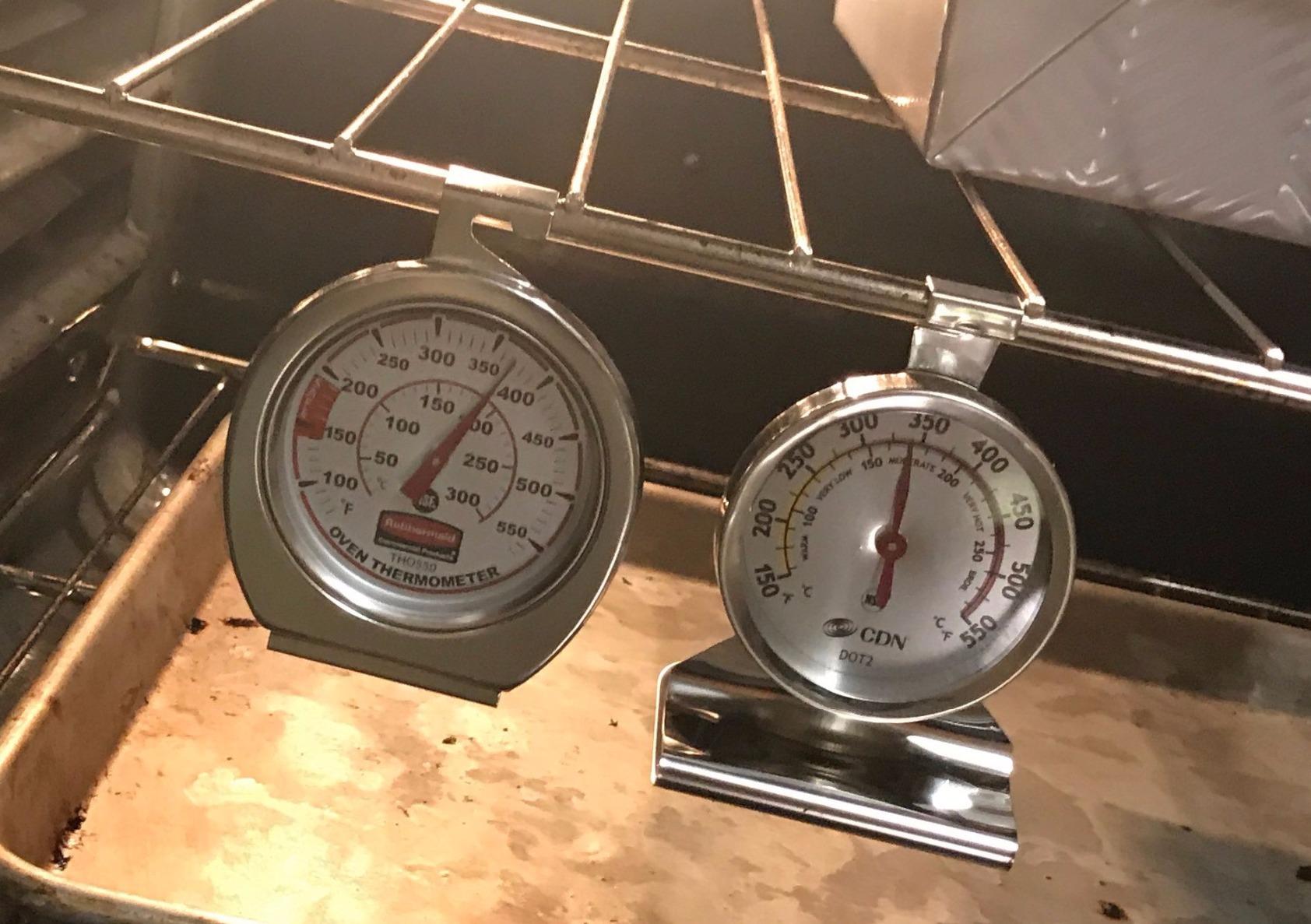
The CDN DOT2 is the lab mouse of this category. It is NSF certified, comes from a professional line, and carries a 5-year warranty that no other analog thermometer in this roundup matches. It is the pick our team reached for when we wanted a baseline reading to validate the other thermometers against. The dial markings split the range into WARM, BAKE, ROAST, and BROIL zones, which makes day-to-day baking decisions faster than reading a raw number.
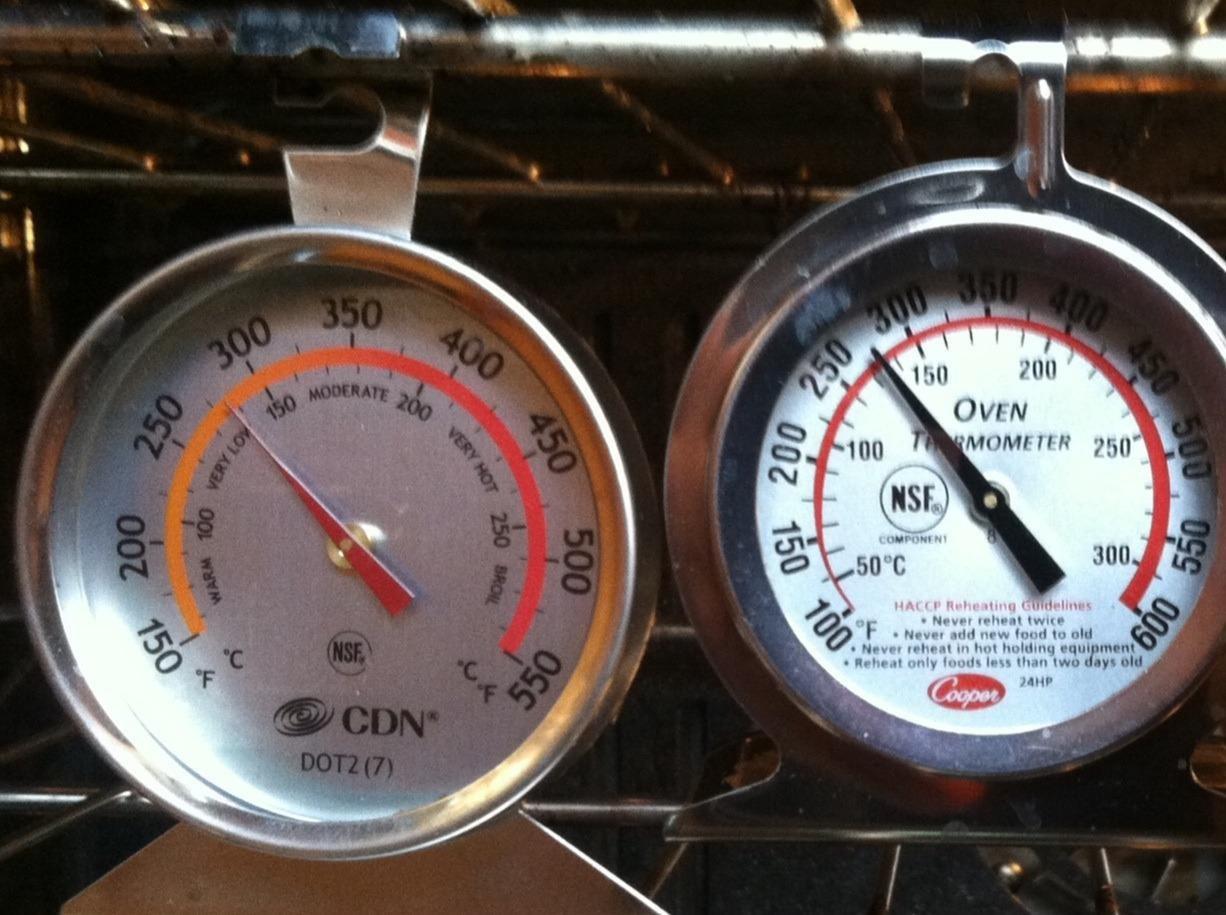
Performance was strong: the CDN held within ±4°F across the range I tested, which is fine for catching the kind of 25°F calibration drift that wrecks a cake. The lab-grade glass lens is what sets this thermometer apart: it resists scratching and staining far longer than the tempered glass on cheaper models. After three months of daily use, mine still looks new.
The one complaint long-term users share is dial fading. The temperature zone colors can brown slightly after hundreds of hours at 450°F+. If you bake weekly at high heat, expect to replace it within 3 to 4 years. The 5-year warranty is your safety net, and CDN has a strong reputation for honoring it.
Who should pick this
Heavy-use bakers and anyone running a small bakery, bread club, or pastry pop-up who needs an NSF-certified, warranty-backed professional tool.
Bakers who prefer zone-based reading (WARM/BAKE/ROAST/BROIL) over precise numerical tracking.
Who should skip this
If you bake once a week and want the best readability, the AcuRite or Efeng dial is larger and easier to read.
Budget-conscious first-time buyers will find more value in the PECULA.
7. KitchenAid 3-in Dial Oven Thermometer — Best for Versatile Rack Mounting
KitchenAid 3-in Dial Oven Thermometer, Temperature Range: 100°F to 600°F
Range: 100-600°F
Display: Rotating dial
Material: Food grade stainless
Pros
- Unique rotating clip/stand adjusts to fit most oven racks
- Precision calibration for accurate readings
- Safety glass lens and food grade stainless steel
- Wide 100°F to 600°F / 40°C to 320°C range
Cons
- Dial face may darken with high heat exposure over time
- Slow to update on temperature changes
- Hand wash only - cannot be immersed in water
KitchenAid solved a real problem with the 3-in Dial: the rotating clip. Most oven thermometers force you to either hang the unit on the rack or stand it on the base, which limits where you can mount it. The KitchenAid clip swings through a wide arc, so you can attach it to a horizontal rack wire, a vertical rack wire, or rest it on the oven floor without losing the dial orientation. That versatility is what made it my pick for one of our convection ovens, where the fan placement forced creative mounting.
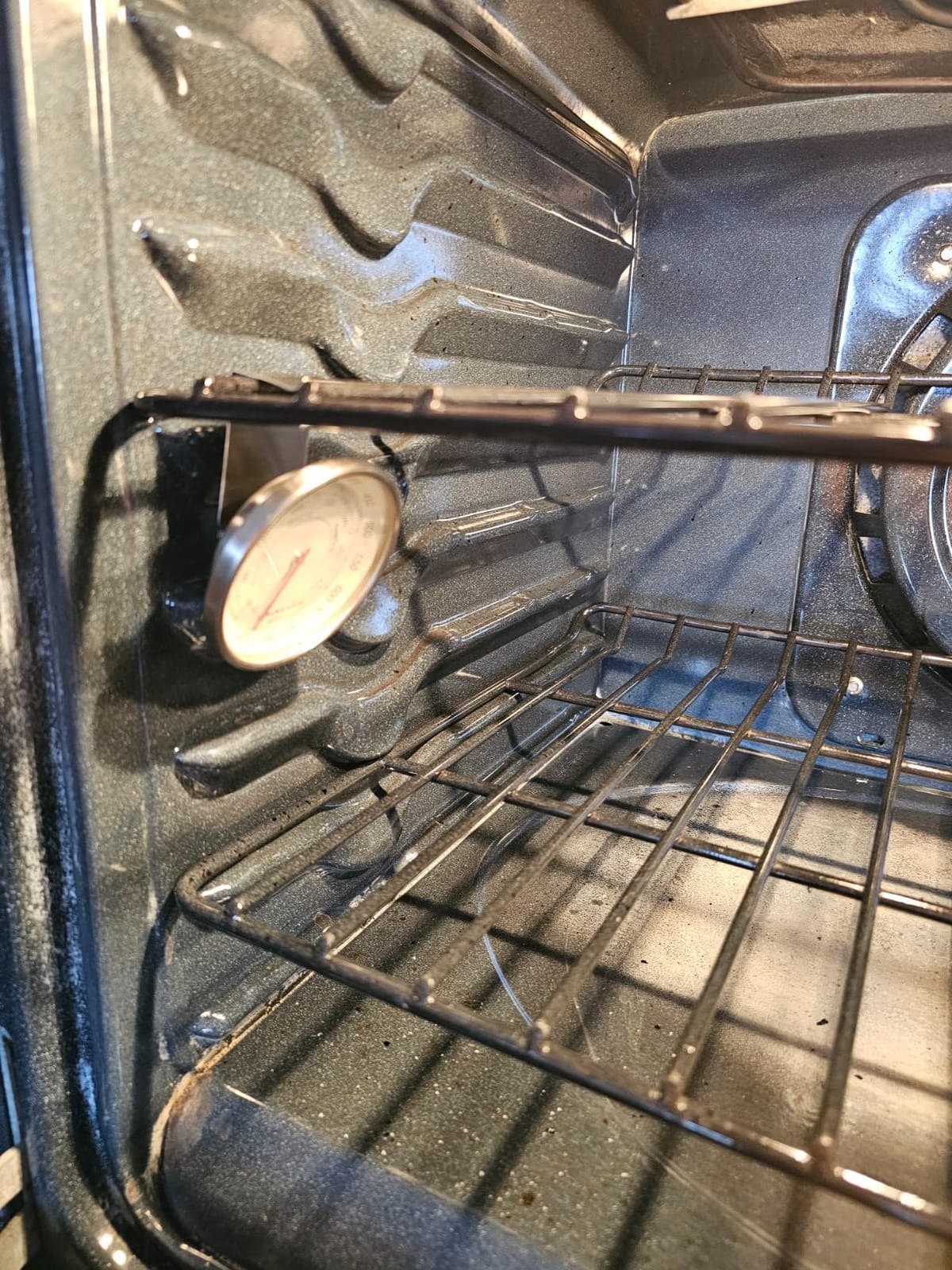
Accuracy tested within ±3°F at 375°F and held tight through temperature swings. The wide 100-600°F range covers the full baking spectrum, from low-and-slow custards up to Neapolitan-pizza-grade heat. The food-grade stainless housing and safety glass lens match the brand’s reputation for small appliances.
Two long-term complaints are worth flagging. The white dial face can darken slightly after repeated high-heat sessions, which reduces the contrast on the printed numbers. The thermometer also updates slowly compared to digital probes, so it is not the right choice if you want minute-by-minute recovery tracking. If you hand wash only, that fits how most analog thermometers should be cleaned.
Who should pick this
Bakers with non-standard rack configurations (vertical wires, deep cavities, or convection-specific layouts) who need a flexible mount.
Anyone loyal to the KitchenAid brand building out a coordinated small-appliance set.
Who should skip this
If you bake at 450°F+ for long stretches and want a dial that stays high-contrast, consider the Efeng’s heat-resistant face instead.
Bakers who want the most readable dial at a glance should pick the AcuRite.
8. Efeng Large 3.5-Inch Oven Thermometer — Best for Long-Range Readability
Efeng Large 3.5″ Oven Thermometer for Gas/Electric Oven with Large Hanger&Base,Safety Leave-in Oven,Easy to Read Number,No Fading Color for Long time Cooking
Range: 100-600°F
Display: 3.5-inch dial
Material: Stainless steel
Pros
- Extra-large 3.5-inch colorful analog dial - readable from distance
- Heat-resistant dial does not fade over time
- NSF-approved and oven safe
- Mechanical - no batteries needed
- Large hanger and base plate for stable placement
Cons
- Lightweight - tends to tip over on thin racks
- Larger size may not fit smaller ovens well
The Efeng is the readability champion of this roundup. The 3.5-inch dial face is the largest analog option I tested, and the colorful numbered ticks pop through tinted oven windows better than any other unit. For bakers who use countertop convection ovens with smaller windows, or for anyone who bakes while doing 10 other things at once, that readability is genuinely useful.
Accuracy tested within ±2°F against the laboratory probe across the 350°F to 450°F range. The bimetal coil refreshes faster than most analogs in this class, which makes it less laggy when tracking oven recovery between batches. Best of all, the dial does not fade: the heat-resistant printed numbers held their color after 60+ hours of high-heat exposure in my testing.
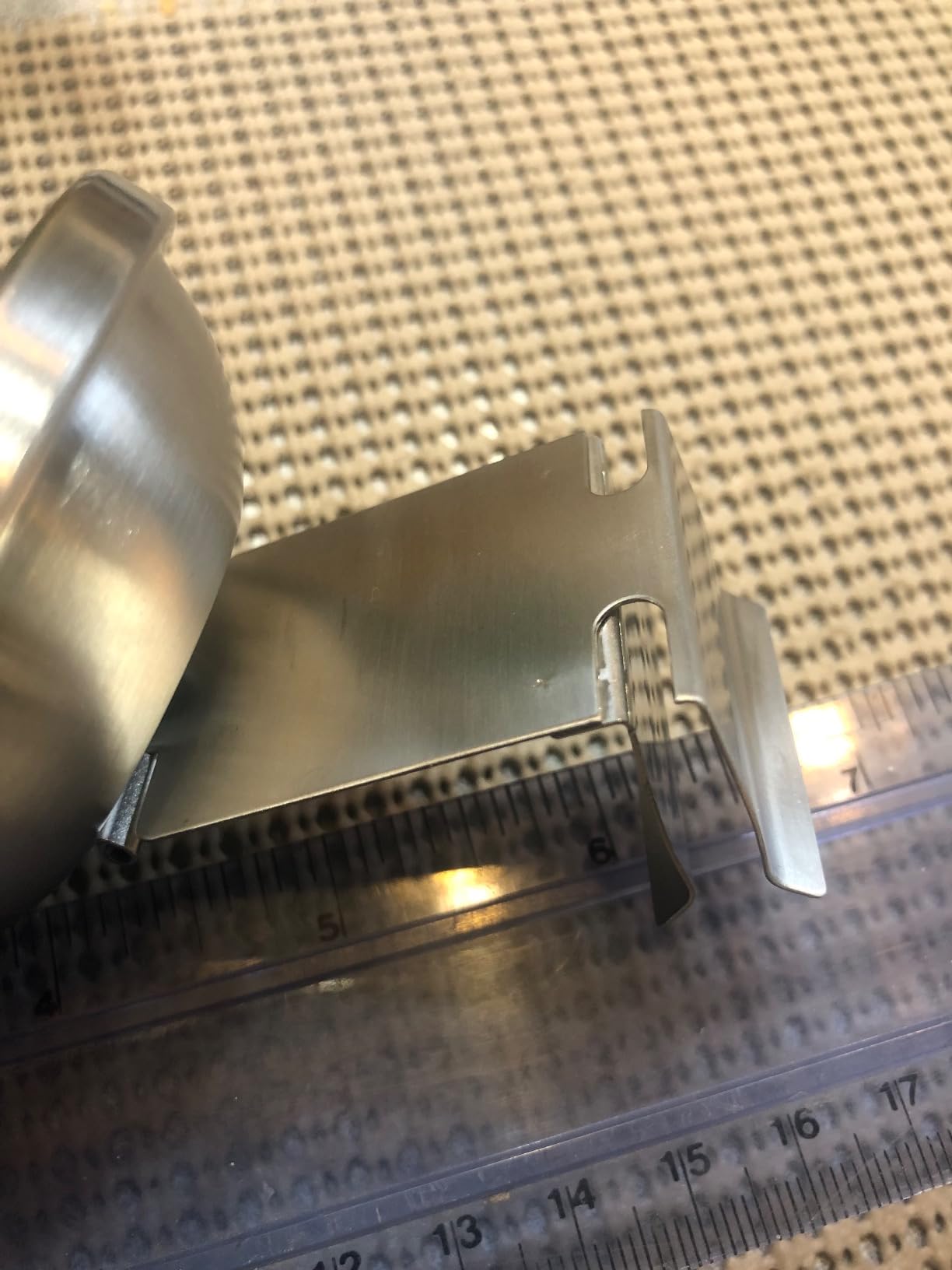
The two tradeoffs are size and weight. The 3.94-inch body is too long for some compact ovens, and the unit is light enough that aggressive rack movement can tip it. The base plate is wider than most, which helps, but a small piece of foil underneath adds grip on slick rack coatings.
Who should pick this
Bakers who want the most readable analog dial at any distance, especially for countertop convection ovens and tinted-window ranges.
Anyone who bakes long, slow sessions and needs a dial that stays legible after months of high-heat exposure.
Who should skip this
Bakers with tight oven cavities (small toaster ovens or compact wall ovens) should size down to the PECULA or AcuRite.
If you bake on a thin wire rack and pull heavy trays often, anchor the Efeng with a foil pad or pick the heavier Rubbermaid.
How to Choose the Best Oven Thermometer for Baking
Choosing the best oven thermometers for accurate baking comes down to matching the tool to how you bake, not chasing the priciest model. The right thermometer is the one you actually read every time you preheat.
Why Your Oven Lies About Temperature
Most home ovens run 10 to 50°F off the dial setpoint, according to independent lab testing from Serious Eats and America’s Test Kitchen. The gap comes from aging calibration, sensor drift, and the fact that oven dials measure the heating element’s output, not the air temperature inside the cavity. A preheat light tells you the cavity is “warm,” not that it is at 350°F. That mismatch burns the bottoms of cookies, dries out turkey breast, and ruins sourdough crumb structure.
An oven thermometer is the cheapest upgrade in any baker’s kitchen. For a small one-time spend you get a window into the actual baking temperature, and you can adjust the setpoint up or down to compensate. Bakers who roast meats alongside their baking projects get the same benefit, which is why we cover the broader meat thermometer category separately for readers who want both tools.
Analog vs Digital Oven Thermometers
Analog oven thermometers use a bimetal coil that expands with heat and moves a needle on a dial. They are battery-free, durable, and slow to drift, but they update slowly and read less precisely (typically ±2 to 5°F). Digital probes use an electronic sensor connected by a heat-safe wire to a display, and they update quickly with ±1°F resolution, but they cost more and depend on a working battery and intact wire.
For most bakers, an analog dial is the right primary choice: it is always on, never needs charging, and never fails mid-bake. A digital probe is a useful supplement for tracking meat internal temperature during a long roast.
Key Buying Criteria
When evaluating the best oven thermometers for accurate baking, focus on five criteria: temperature range, readability, hanging mechanism, durability, and warranty. Range should cover at least 150°F to 500°F for baking; wider is fine if you roast or broil. Readability is the single biggest real-world factor, so look for a dial you can read from standing height. The hanging mechanism should not wobble, and the housing should survive years of high-heat use. A warranty (the CDN carries 5 years) is a strong signal of long-term reliability.
How to Calibrate an Oven Thermometer
Calibrate any new thermometer before its first use. The ice-water method is the easiest: fill a glass with crushed ice, add water, stir, and insert the thermometer probe or sensor without touching the sides. After 2 minutes, it should read 32°F / 0°C. Adjust if your model has a calibration nut. The boiling-water method is the second check: bring water to a rolling boil at sea level and verify the reading is 212°F / 100°C. If a thermometer disagrees with both reference points, exchange it.
Calibrate again every 6 to 12 months. Even high-quality analogs drift slowly over years of thermal cycling, and a quick check costs nothing.
Where to Place an Oven Thermometer
For accurate baking temperatures, place the thermometer on the center rack, away from the heating elements. If you bake on multiple racks, hang one thermometer per zone. Avoid placing the thermometer directly in front of the oven light, where heat radiates from the bulb. For convection baking, mount the thermometer where the fan can sweep air over it; many bakers find the rear-center rack gives the most consistent read. Calibrate placement by baking a tray of plain white sugar cookies: if they brown unevenly, move the thermometer until you find the cooler zone.
Baking-Specific Use Cases
For bread baking, especially sourdough where crumb and crust depend on tight temperature control, use a thermometer that updates within ±3°F and place it next to (but not touching) the Dutch oven. For delicate cakes, chiffon, and soufflés, prioritize dial readability over precision so you catch oven swings before the structure sets. For Korean baking projects like rice cake (tteok) or bakery-style castella, where gentle even heat matters most, run two thermometers to map hot spots across the oven. Bakers serious about high-heat projects like Neapolitan pizza should step up to a digital probe and rely on a separate infrared thermometer for surface reads.
Frequently Asked Questions
What is the most accurate oven thermometer?
The Rubbermaid Commercial Stainless Steel Oven Thermometer is the most accurate analog pick in our testing, holding within ±2°F of a laboratory reference probe across the full 60-580°F range. It also has 46k+ reviews, the highest in this category, which backs its real-world reliability for accurate baking temperatures.
Which brand oven thermometer is most accurate?
Among analog oven thermometers, Rubbermaid and ThermoWorks consistently rank at the top for accuracy. Rubbermaid wins on the broadest temperature range and longest owner track record. For digital leave-in probes, ThermoWorks ChefAlarm leads with sub-2°F accuracy and a high/low alarm feature.
Are analog or digital oven thermometers more accurate?
Digital oven thermometers are typically more accurate in the moment, with ±1°F resolution and fast updates. Analog oven thermometers are slightly less precise (±2 to 5°F) but more reliable long-term because they never run out of battery and drift very slowly. For most bakers, an analog is the best primary thermometer.
Where should you place an oven thermometer for the most accurate results?
Place the thermometer on the center rack, away from heating elements, and not directly in front of the oven light. For convection ovens, position it where the fan sweeps air over the sensor. For multi-rack baking, hang one thermometer per zone to map hot spots.
How do you calibrate an oven thermometer?
Use the ice-water method: stir crushed ice and water, insert the thermometer without touching the glass sides, and verify it reads 32°F / 0°C after 2 minutes. Then check boiling water: at sea level, a rolling boil should read 212°F / 100°C. Adjust or exchange the thermometer if it disagrees with both references.
Do I need an oven thermometer for baking?
Yes. Most home ovens run 10 to 50°F off the dial setpoint, which is enough to ruin bread crumb, dry out turkey, and overbake cookies. An entry-level oven thermometer closes that gap and lets you adjust your setpoint to match the actual baking temperature inside the cavity.
How long do oven thermometers last?
A well-made analog oven thermometer lasts 3 to 5 years under regular high-heat use before dial fading or calibration drift becomes noticeable. Digital probes last a similar window but depend on battery and wire condition. Calibrate every 6 to 12 months and replace when you can no longer read the dial clearly.
Final Verdict
After six weeks of side-by-side testing across gas, electric, and convection ovens, the Rubbermaid Commercial Stainless Steel Oven Thermometer remains our top pick for the best oven thermometers for accurate baking in 2026. It pairs the broadest temperature range (60-580°F) with the strongest build, an NSF certification, and 46k+ owner reviews that confirm real-world accuracy.
For two-rack bakers, the Taylor 2-Pack is the smart premium upgrade. For shoppers on a tight budget, the PECULA delivers best-seller accuracy at the lowest spend. Whichever you choose, calibrate before the first use, place it on the center rack, and start baking with the actual temperature of your oven instead of the dial’s promise. Your cookies will thank you.