
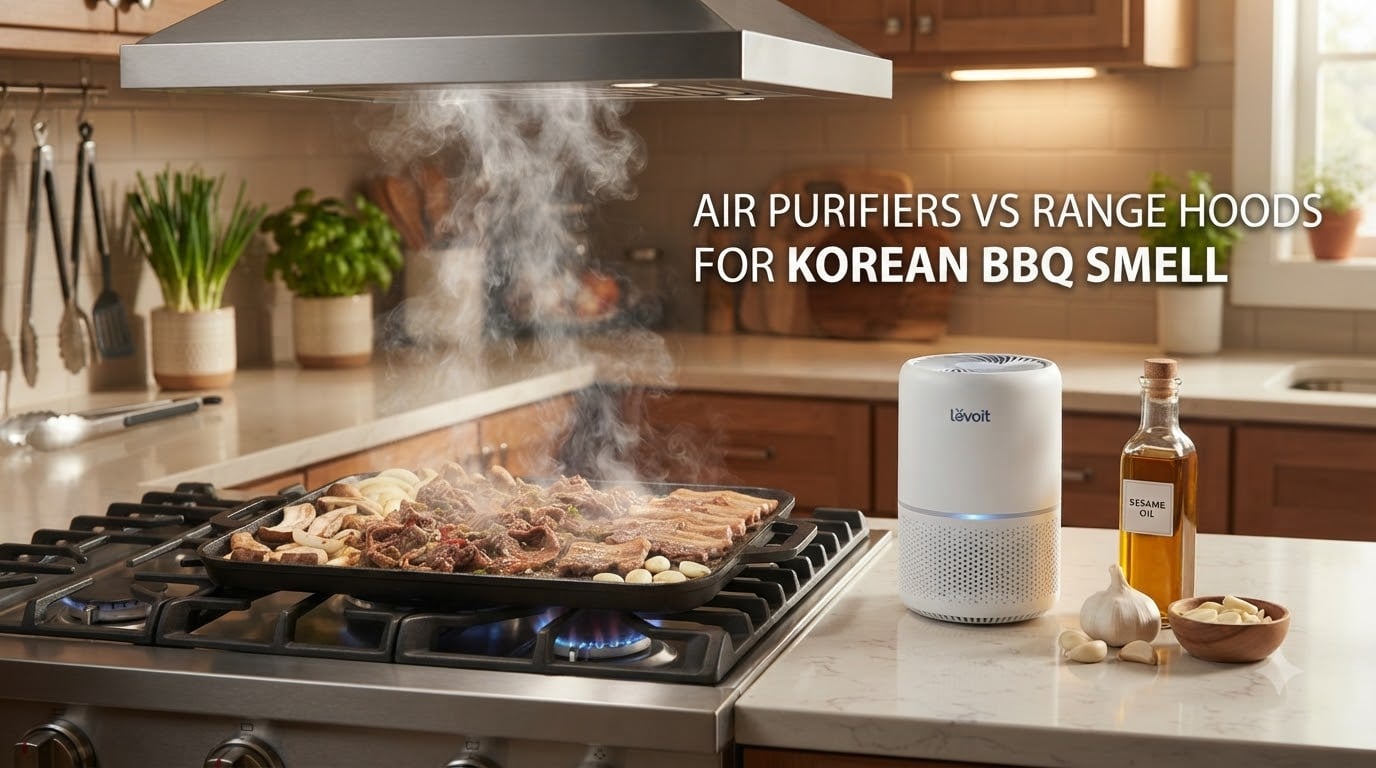
If you have ever grilled bulgogi or galbi indoors, you already know the problem. That incredible marinade of soy sauce, sesame oil, garlic, and gochujang fills your kitchen with mouthwatering aromas while you cook. Then those same aromas stick around for days, settling into your curtains, your couch cushions, and even your hair.
When it comes to choosing between air purifiers vs range hoods for Korean BBQ smell removal, the answer depends on where you cook and what your kitchen allows. In short: a ducted range hood is always the most effective solution because it captures smoke and grease at the source before they spread. Air purifiers are a valuable backup tool, especially in apartments where ducting is not an option, but they clean already-dispersed air rather than stopping contamination at the source.
In this guide, I will walk you through exactly how each solution works, why Korean BBQ is uniquely challenging, and which option makes the most sense for your specific kitchen setup. Whether you are grilling samgyeopsal on a tabletop burner or cooking up a storm on your stovetop, this comparison will help you pick the right ventilation strategy for 2026.
Table of Contents
Why Korean BBQ Smell Is So Hard to Remove
Korean BBQ creates some of the most stubborn cooking odors of any cuisine, and the reason comes down to both ingredients and cooking method. The marinades alone are loaded with volatile compounds. Soy sauce, sesame oil, minced garlic, and gochujang each release strong-smelling molecules that evaporate under heat and cling to surfaces.
When you grill marinated meats at high temperatures, the fat renders and splatters. This produces grease aerosols measuring between 0.1 and 5 microns that float through the air and settle on everything in your kitchen. These particles are small enough to penetrate fabrics and porous materials, which is why the smell lingers long after the meal is over.
Unlike boiling or steaming, Korean BBQ grilling generates both heavy smoke and airborne grease simultaneously. The combination of smoke particles, grease aerosols, and VOCs (volatile organic compounds) from the marinade creates a triple threat that standard ventilation struggles to handle. One Reddit user in the r/KoreanFood community put it perfectly: they wanted to do KBBQ at home but were worried about their entire apartment smelling for a week.
This is also why your smoke detector often goes off during Korean cooking. The fine particulate matter from high-heat grilling fills the air quickly, and without proper source capture, it spreads to every room in your home within minutes.
How Range Hoods Work for Korean BBQ
A range hood uses a fundamentally different approach than an air purifier. It relies on source capture, which means it grabs smoke, grease, and odors right at the cooking surface before they have a chance to disperse into your kitchen. This is the single most important difference between the two solutions.
Range hoods create negative pressure above your cooktop. A powerful fan pulls air upward and away from the cooking surface, directing it either outside through ductwork (ducted) or through a series of filters and back into the room (recirculating or ductless). For Korean BBQ, a ducted range hood is the gold standard because it physically removes contaminated air from your home entirely.
The key metric to look at is CFM, or cubic feet per minute. This measures how much air the hood can move. For Korean cooking, you need a range hood rated between 300 and 600 CFM depending on your stovetop output. High-BTU burners used for wok cooking or tabletop grilling demand the upper end of that range. A range hood that is too weak will not keep up with the volume of smoke that Korean BBQ generates.
Ducted range hoods capture grease using baffle filters or mesh filters. Baffle filters are preferred for Korean cooking because they handle heavy grease loads better and are easier to clean. Mesh filters can clog quickly when you are grilling fatty pork belly or marinated short ribs, requiring more frequent washing.
Recirculating range hoods are less effective for Korean BBQ because they cannot fully remove smoke and VOCs. They rely on charcoal or carbon filters to absorb odors, and those filters saturate quickly when exposed to the heavy grease and strong marinades typical of Korean cooking. If your kitchen has no exterior wall access, a recirculating hood is still better than nothing, but it will not match a ducted system.
How Air Purifiers Work for Korean BBQ Odors
Air purifiers take a completely different approach. Instead of capturing contaminants at the source, they filter air that has already spread throughout the room. This means they are always playing catch-up compared to a range hood that grabs smoke before it escapes the cooking zone.
A typical air purifier uses two main filter stages. A HEPA filter captures particulate matter like smoke particles and fine dust down to 0.3 microns with about 99.97% efficiency. An activated carbon filter handles gases, VOCs, and odor molecules that pass right through the HEPA stage. For Korean BBQ odors, the activated carbon filter is doing the heavy lifting.
Here is the critical detail: the amount of activated carbon matters enormously. Forum users who have tested various air purifiers for Korean cooking consistently report that units with thin carbon sheets or small carbon pads do almost nothing for strong marinade odors. The consensus is that you want an air purifier with at least 100 grams of activated carbon, and ideally more, to handle the VOC load from Korean BBQ.
Timing also makes a big difference. Users on Reddit and other forums who have successfully used air purifiers for Korean cooking recommend running the unit before you start cooking to create clean baseline air, during cooking to continuously filter escaping particles, and for several hours afterward to clear residual odors. Running it only after you finish cooking means you are fighting an uphill battle against particles that have already settled.
The main limitation is that air purifiers cannot capture grease. Grease aerosols from Korean BBQ will still settle on your counters, walls, and the purifier itself. Over time, grease buildup on the pre-filter can reduce the effectiveness of the unit and create a maintenance burden that range hoods handle more gracefully with their dedicated grease filters.
Air Purifiers vs Range Hoods: Head-to-Head Comparison
The fundamental difference comes down to physics. Range hoods use source capture, removing contaminants at the point of origin with directional airflow and negative pressure. Air purifiers clean air that has already dispersed, filtering it as it circulates through the room. For Korean BBQ specifically, source capture wins because the volume of smoke and grease is simply too high to clean effectively after the fact.
Here is how the two solutions compare across the factors that matter most for Korean BBQ cooking:
| Factor | Range Hood | Air Purifier |
|---|---|---|
| Smoke removal | Excellent (captures at source) | Moderate (filters dispersed air) |
| Grease capture | Yes (dedicated grease filters) | No (grease bypasses HEPA) |
| Odor (VOC) removal | Good if ducted; moderate if recirculating | Good with thick activated carbon |
| Speed of clearing | Immediate (before spread) | Gradual (after spread) |
| Apartment-friendly | Difficult without ducting | Excellent (plug and play) |
| Ongoing cost | Low (washable filters) | Moderate (replacement filters) |
| Portability | Fixed installation | Movable between rooms |
For cost-conscious readers, range hoods have a lower long-term expense since their baffle and mesh filters are washable. Air purifiers require ongoing replacement of HEPA and activated carbon filters, which can add up especially when you cook Korean BBQ frequently and saturate the carbon faster than the manufacturer’s suggested replacement interval.
The ideal setup is not an either-or decision. The most effective Korean BBQ ventilation strategy combines both: a range hood to capture smoke and grease at the source, plus an air purifier with a substantial activated carbon filter to handle residual VOCs that escape. This layered approach addresses all three categories of contamination, namely particulate matter, grease, and odor gases.
Apartment-Friendly Korean BBQ Ventilation Solutions
Not everyone can install a ducted range hood. If you live in an apartment or rental where modifying the kitchen is not an option, you still have several practical paths to reduce Korean BBQ smells. The apartment constraint is actually one of the most discussed topics in forums, and for good reason: a huge portion of Korean BBQ at-home cooking happens in apartments.
Portable range hoods are an increasingly popular option. Devices like the AirHood, Breetee, and Zomagas are countertop units designed to sit next to a tabletop grill or portable burner. They use a fan to pull smoke through a filter system, and some models are rechargeable and fully cordless. Forum users report that portable hoods work well for tabletop Korean BBQ setups where you cannot install a permanent hood. They are not as powerful as a full range hood, but they provide meaningful source capture in a compact package.
For apartments with a stovetop but no exterior ducting, a ductless recirculating range hood is worth considering if your landlord permits it. These units mount under a cabinet and pull air through grease filters and charcoal pads before recirculating it. They will not be as effective as a ducted hood for Korean BBQ, but they offer far better source capture than relying on an air purifier alone.
If you are going the air purifier route for apartment Korean cooking, placement is critical. Position the unit as close to the cooking area as possible, ideally within 3 to 5 feet. Choose a model with a thick pellet-based activated carbon filter rather than a thin carbon-impregnated sheet. Running a second smaller purifier in the room adjacent to your kitchen can help catch odors that migrate down the hallway.
One additional apartment tip from forum discussions: create cross-ventilation by opening a window near the cooking area and placing a box fan pointing outward in another window. This creates negative pressure in the kitchen and physically pushes smoky air outside. Combine this with a portable range hood and a carbon-filtered air purifier, and you have a solid three-layer defense even without permanent ducting.
Maintenance: Range Hoods vs Air Purifiers
Maintenance is where range hoods and air purifiers differ significantly, and it affects both performance and cost over time. Korean BBQ cooking puts extra strain on filters due to the heavy grease and strong marinade compounds involved.
Range hood baffle filters can be cleaned in the dishwasher or soaked in hot soapy water. Many users also use baking soda to cut through stubborn grease buildup on range hood filters. Mesh filters require more frequent cleaning since they clog faster with the kind of fatty aerosols that pork belly and marinated short ribs produce. Charcoal range hood filters used in recirculating models cannot be washed and need replacement every 3 to 6 months, or sooner if you cook Korean food regularly.
Air purifier maintenance is simpler but costlier. HEPA filters typically last 6 to 12 months, but activated carbon filters used for Korean cooking odors saturate much faster. If you are cooking Korean BBQ multiple times per week, expect to replace the carbon filter every 2 to 3 months to maintain odor absorption. A saturated carbon filter stops absorbing VOCs and can actually start re-releasing trapped odors back into the room, which defeats the purpose entirely.
Keep an eye on the pre-filter if your air purifier has one. Grease from Korean cooking will coat the pre-filter quickly, restricting airflow and forcing the fan to work harder. Wash or replace the pre-filter every 2 to 4 weeks during periods of heavy Korean cooking to keep the unit performing at its best.
How to Choose the Right Solution for Your Kitchen
Choosing between an air purifier and a range hood for Korean BBQ smell comes down to your kitchen setup, cooking frequency, and budget. Here are five signs you need to upgrade your Korean BBQ ventilation:
First, if your kitchen and living area still smell like sesame oil and garlic the morning after cooking, your current ventilation is insufficient. Second, if you notice a greasy film building up on surfaces near your stove, grease aerosols are escaping capture. Third, if your smoke detector goes off regularly during Korean cooking, you lack adequate source capture. Fourth, if neighbors have mentioned cooking smells in shared hallways, odors are escaping your unit. Fifth, if your clothes and hair retain a cooking smell after a meal, fine particles are spreading beyond your kitchen zone.
For homeowners with ducting access, invest in a ducted range hood rated 400 to 600 CFM. Look for one with baffle filters and a deep hood canopy that extends beyond the edges of your cooking surface. This gives you the best source capture for Korean BBQ smoke and grease.
For apartment dwellers, start with a portable range hood for tabletop grilling or a ductless under-cabinet hood if your stovetop allows it. Supplement with an air purifier that has a pellet-based activated carbon filter containing at least 100 grams of carbon. Position both as close to the cooking area as possible.
Consider CFM and BTU together. If you are using a high-output portable butane burner (common for tabletop Korean BBQ at around 7,500 to 12,000 BTU), a portable range hood or a 300-plus CFM air purifier positioned nearby can keep up. For stovetop cooking on gas burners pushing 15,000-plus BTU per burner, you need at least 350 to 400 CFM of range hood capacity to capture the smoke volume effectively.
Budget-wise, a quality ducted range hood installed costs more upfront but has lower ongoing expenses. A good air purifier with substantial carbon filtration costs less initially but requires regular filter investments. If you cook Korean BBQ more than once a week, factor filter replacement costs into your decision because carbon filters will need frequent changes under heavy use.
FAQs
Does an air purifier get rid of Korean BBQ smell?
Yes, but only partially. An air purifier with a thick activated carbon filter (100 grams or more) can absorb the VOCs and odor molecules from Korean BBQ marinades. However, it cannot capture grease aerosols or remove smoke as effectively as a range hood. For best results, run the purifier before, during, and after cooking.
Can I use an air purifier instead of a range hood for Korean cooking?
You can, but it will be less effective. A range hood captures smoke and grease at the source before they spread, while an air purifier cleans already-dispersed air. If your kitchen has no ducting option, a portable range hood combined with a carbon-filtered air purifier is the best apartment alternative.
Do air purifiers help with burnt food smell from Korean BBQ?
Air purifiers with activated carbon filters help reduce burnt food odors by absorbing VOCs, but they are slower than removing smoke at the source. Burnt particles also coat HEPA and pre-filters quickly, so frequent cleaning is needed when cooking at high heat.
What is the best portable range hood for Korean BBQ at home?
Popular portable range hood options for tabletop Korean BBQ include the AirHood, Breetee, and Zomagas countertop models. These units sit next to your grill and pull smoke through a filter system. They are not as powerful as a permanent range hood but provide meaningful source capture for apartment setups.
Can charcoal range hood filters be washed?
Charcoal range hood filters used in recirculating hoods cannot be washed and must be replaced every 3 to 6 months. However, metal baffle and mesh grease filters can be cleaned in the dishwasher or soaked with baking soda and hot water to remove grease buildup from Korean cooking.
The Verdict: Which Is Better for Korean BBQ Smell?
For the question of air purifiers vs range hoods for Korean BBQ smell, a ducted range hood is the clear winner. Source capture removes smoke, grease, and odors before they spread, which is exactly what Korean cooking demands given the heavy marinades and high-heat grilling involved.
That said, not every kitchen can support a ducted hood. If you are in an apartment without ducting, the best strategy is a layered approach: a portable range hood for source capture near your grill, plus an air purifier with at least 100 grams of activated carbon to handle residual VOCs. Run both before, during, and after cooking for maximum effect.
The bottom line is that you do not have to choose just one if your space allows both. A range hood handles the heavy lifting of smoke and grease, and an air purifier finishes the job on lingering odors. Together, they give you the best possible Korean BBQ experience at home without the smell lasting for days in 2026.