
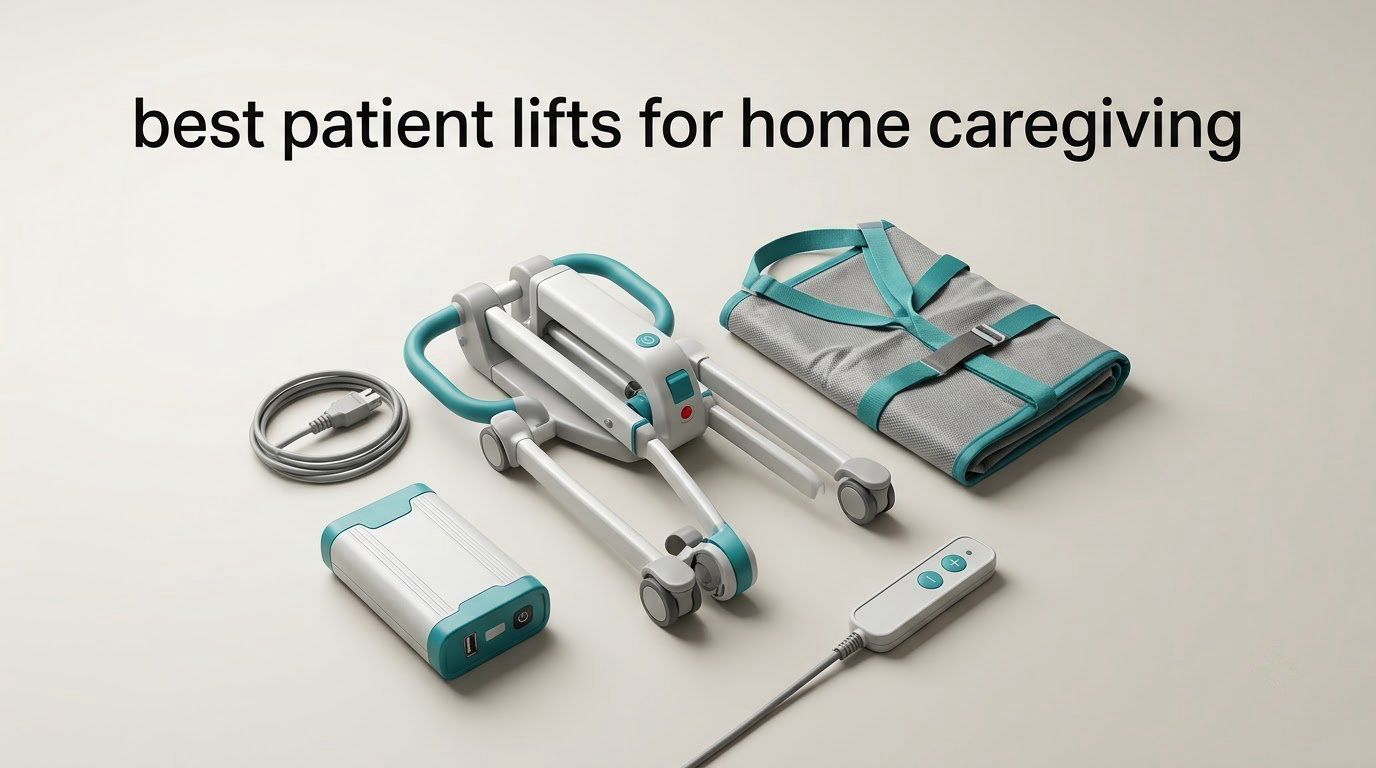
The worst moment in home caregiving is not the medication schedule or the meal prep. It is the transfer. Getting someone from the bed to the wheelchair, from the wheelchair to the toilet, from a fall on the bedroom floor back up again. That is where caregiver back injuries happen and where people get dropped.
A patient lift takes the patient’s weight off the caregiver entirely. The sling goes under the person, the boom or pump does the work, and the base rolls on casters to the destination. One person can run a transfer that would otherwise need two strong adults and a lot of hope.
We compared ten of the most widely reviewed patient lifts for home caregiving in 2026, across full-body hydraulic Hoyer lifts, sit-to-stand models, a standing pivot aid, and a battery-powered unit for caregivers working alone. Each one was assessed on the same four things: whether the data on capacity matches real use, whether the base clears a standard doorway and a homecare bed, whether a single caregiver can run it safely, and what the recurring complaints are from people who own it.
A word before we start. We are not clinicians, and a lift is medical equipment that can injure a person if it is fitted wrong. Ask an occupational therapist, physical therapist, or your discharge case manager to assess the patient before you buy, and insist the supplier demonstrates the lift in your home before you accept delivery. What follows is a buying guide built from published specifications and owner feedback, not a substitute for that assessment.
Top 3 Patient Lifts for Home Caregiving in 2026


Quick Picks by Care Situation in 2026
Read this list first. It matches the situation most families describe to us, and it is the fastest way to narrow ten options down to one or two.
- Best overall stand-assist lift: Lumex LF1600 – the most reviewed unit here, rated 4.6 across 1050 reviews, with a steel frame rated to 400 lbs and padded knee pads for longer daily use.
- Best full-body lift for a completely dependent patient: Invacare 9805P – a manual hydraulic Hoyer lift with a 20 to 64 inch range that can recover a person from the floor and a base that narrows to 22 inches for doorways.
- Best lift when one caregiver does every transfer alone: Hi-Fortune HY101-01A – the only battery-powered model in this group, so the sling goes up and down from a hand pendant instead of a hand pump.
- Best budget stand-assist: VOCIC AY03 – a 400 lb steel frame with dual locking casters and a 6 cm base that slides under most furniture.
- Best when the patient can still push up with their arms: Etac Turner PRO – a 17.6 pound standing pivot aid that turns a two-person lift into a few seconds of standing and turning.
- Best for narrow doorways and older homecare beds: Invacare GHS350 – 4.5 inch base clearance under most homecare beds, with a rotating pump handle.
- Best built for long-term daily use: ArjoHuntleigh Sara Stedy – the highest rated unit here at 4.7 stars, fully assembled and ready to use out of the box.
If a lift sounds like more equipment than the situation needs, the Etac Turner PRO or a similar pivot aid is often the right answer. Forum caregivers describe the opposite failure too, having spent thousands on equipment that never got used. Match the device to the actual transfer problem before you match the device to a budget.
All 10 Patient Lifts Compared Side by Side in 2026
| Product | Specifications | Action |
|---|---|---|
 Lumex LF1600 Sit to Stand Lumex LF1600 Sit to Stand |
|
Check Latest Price |
 Vive Mobility Sit to Stand Vive Mobility Sit to Stand |
|
Check Latest Price |
| Invacare 9805P Hydraulic |
|
Check Latest Price |
 Drive Medical Hydraulic Lift Drive Medical Hydraulic Lift |
|
Check Latest Price |
 Etac Turner PRO Etac Turner PRO |
|
Check Latest Price |
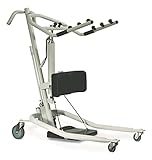 Invacare GHS350 Sit to Stand Invacare GHS350 Sit to Stand |
|
Check Latest Price |
| Hi-Fortune Electric Lift |
|
Check Latest Price |
 VOCIC AY03 Sit to Stand VOCIC AY03 Sit to Stand |
|
Check Latest Price |
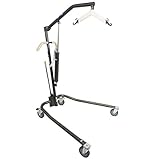 ProBasics Heavy Duty Lift ProBasics Heavy Duty Lift |
|
Check Latest Price |
 ArjoHuntleigh Sara Stedy ArjoHuntleigh Sara Stedy |
|
Check Latest Price |
1. Lumex LF1600 Sit to Stand Lift – Best Overall Pick for Home Caregiving
Lumex LF1600 Stand Assist, Sit to Stand Patient Lift for Elderly Seniors, Chair Transfer & Standing Support Aid
400 lb capacity
Steel frame
33.5 x 25 x 42.5 in
61 lb net weight
Pros
- Most reviewed lift in this roundup at 1050 ratings
- Holds up to 400 lbs on a steel frame
- Padded seat and cushioned knee pads
- Fits users from 5 ft 1 in to 6 ft 6 in
Cons
- User must actively participate and bear partial weight
- Not a full-body lift for someone who cannot sit up
The Lumex LF1600 is the lift we recommend to most families first, and the reason is simple: it has more owners describing real daily use than anything else in this group. It carries 1050 ratings at 4.6 stars, with roughly 83 percent of those coming in at five stars. That is a long record of a device doing a boring job well.
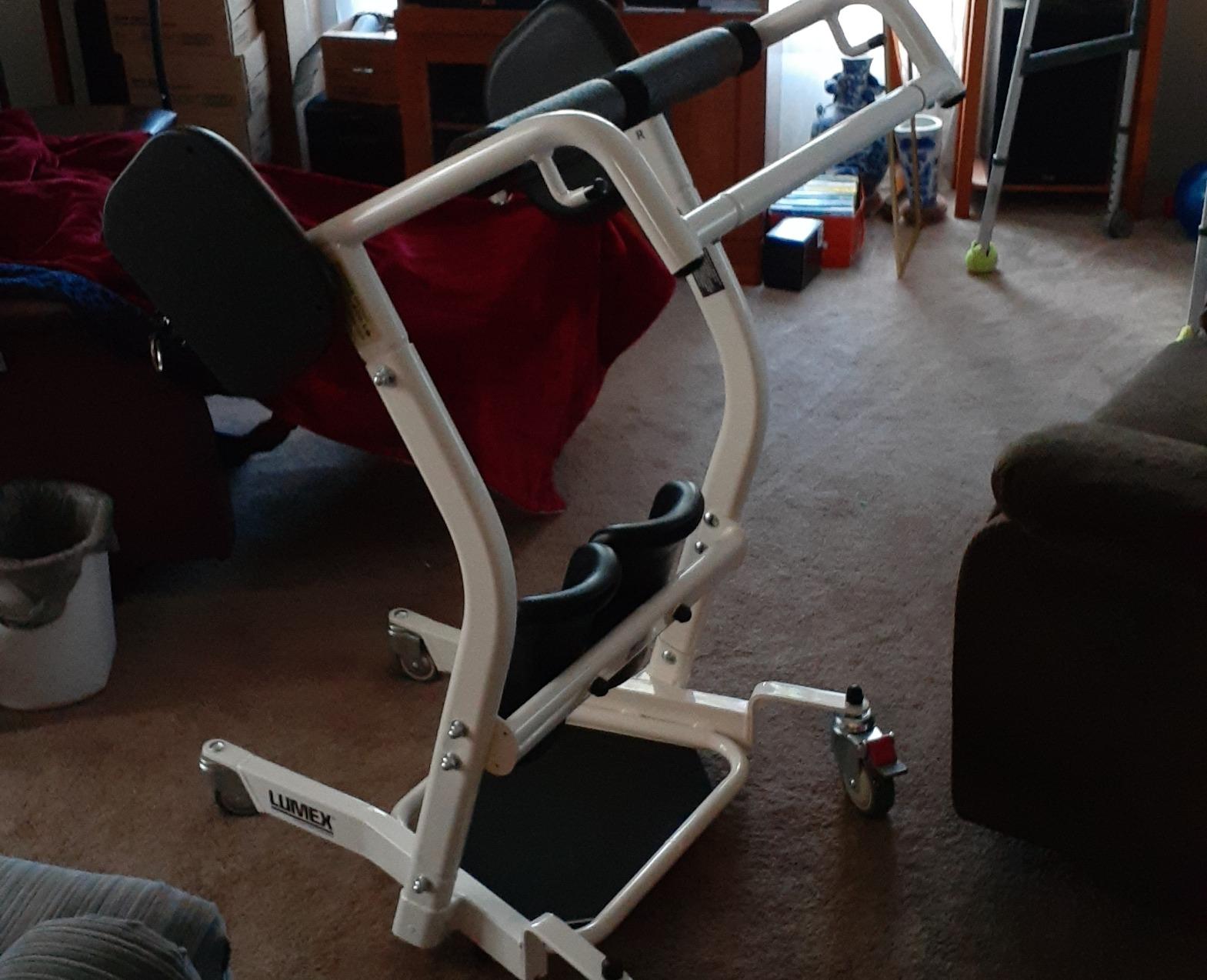
This is a sit-to-stand device, not a full-body lift. The patient sits on the padded seat, holds the ergonomic handbars, and pushes up while the frame rises with them. The steel construction is rated to 400 lbs and the listed height range covers users from 5 foot 1 inch to 6 foot 6 inches, which is a genuinely wide band for a stand-assist frame.
At 61 pounds and 33.5 by 25 by 42.5 inches, it is a manageable size for an apartment or a single-floor house. Owners repeatedly note that it moves through ordinary doorways and around furniture without the awkward repositioning that bigger lifts demand. That matters more than it sounds like it should, because a lift you cannot get down the hallway is a lift you stop using.
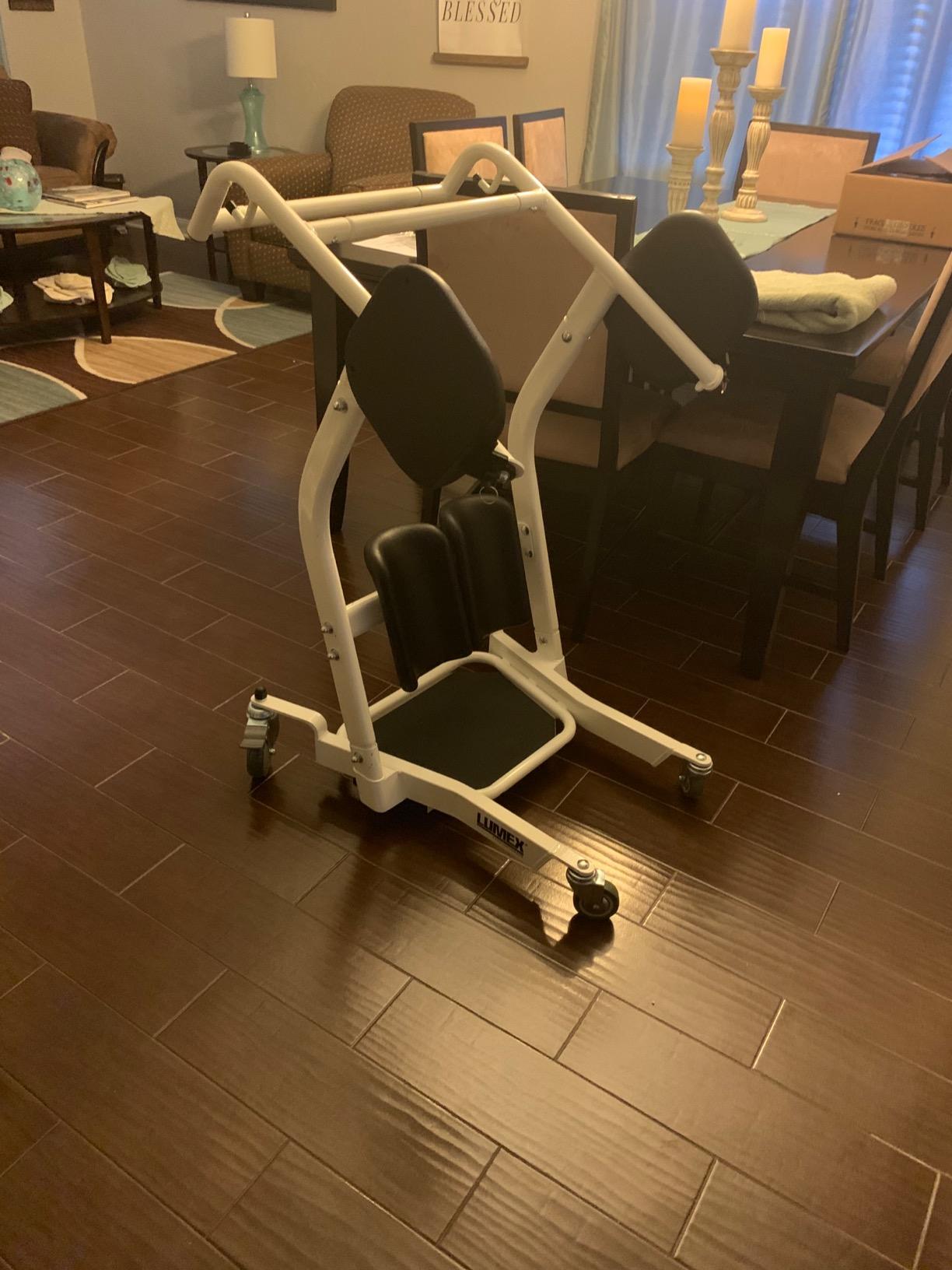
The comfort details are what separate it from cheaper stand-assist frames. Cushioned knee pads, foam-style ergonomic handbars, and a padded seat mean the patient is not bracing against bare steel through a repeated transfer several times a day. For someone with arthritis or fragile skin, that difference decides whether they tolerate the device.
Be clear-eyed about the one limitation, because it is a real one: the LF1600 requires the user to actively participate and bear partial weight. If your loved one cannot sit upright unassisted, cannot grip the handbars, or collapses the moment weight leaves the bed, this is the wrong device. Move up to a full-body hydraulic model instead.
Several caregivers mention that this was the piece of equipment that finally let them keep someone at home rather than moving them to a facility. In dementia care specifically, a caregiver on a caregiver forum described a lift as a transferring device with wheels, and the LF1600 is the kind of predictable, mechanical answer to that problem that does not require new learning from the patient.
Who the Lumex LF1600 suits well
It suits a patient who can sit up, hold the handbars, and push to standing with supervision but cannot safely stand and pivot on their own. That is the classic post-hip-surgery profile, and it is also the profile of many long-term wheelchair users who transfer a few times a day.
The 400 lb rating and the height range from 5 foot 1 inch to 6 foot 6 inches cover most adults, and the 61 pound weight means one caregiver can reposition it. If your home has standard interior doorways and a bedroom with space to swing the frame, this is a low-friction introduction to using transfer equipment.
Who should skip the Lumex LF1600
Skip it if the person cannot bear any weight through their legs, cannot hold the bars, or has trunk weakness severe enough that sitting unsupported is a problem. For those patients a full-body lift with a sling is not optional; it is the only safe transfer method.
Also skip it in a home where the transfer happens in a tight bathroom corner with no room to position the frame. Sit-to-stand devices need open floor space around the chair or toilet. If space is the constraint, measure before ordering anything.
2. Vive Mobility Sit to Stand Lift – Best First Choice for a New Caregiver
Vive Mobility Sit to Stand Patient Lift for Handicapped – Stand Assist Lift
400 lb capacity
26 inch base width
30 x 25 x 44 in
60 lb net weight
Pros
- Supports patients who can bear 60-70% of body weight
- Foam handrails and cushioned shin rests
- Dual locking brakes
- Four swivel casters
- Backed by a 2-year guarantee
Cons
- 26 inch widest base will not clear narrow doorways
- Patient must support 60-70% of body weight
The Vive Mobility sit-to-stand lift is the one we would put in front of a family who has never used transfer equipment before and feels wary of the whole category. It rated 4.3 across 567 reviews, and the texture of those reviews is practical rather than emotional: cushioned grips, brakes that hold, casters that glide.
The device is built for a patient who can support 60 to 70 percent of their own body weight during the transfer. That threshold is stated clearly by the manufacturer, and it is the single most important number on the page for anyone comparing stand-assist lifts.
Measured at 30 by 25 by 44 inches and 60 pounds, with a base that reaches 26 inches at its widest point, this is a compact frame. The four swivel casters roll across multiple flooring surfaces, and the dual locking brakes let you secure the base before the patient commits their weight.
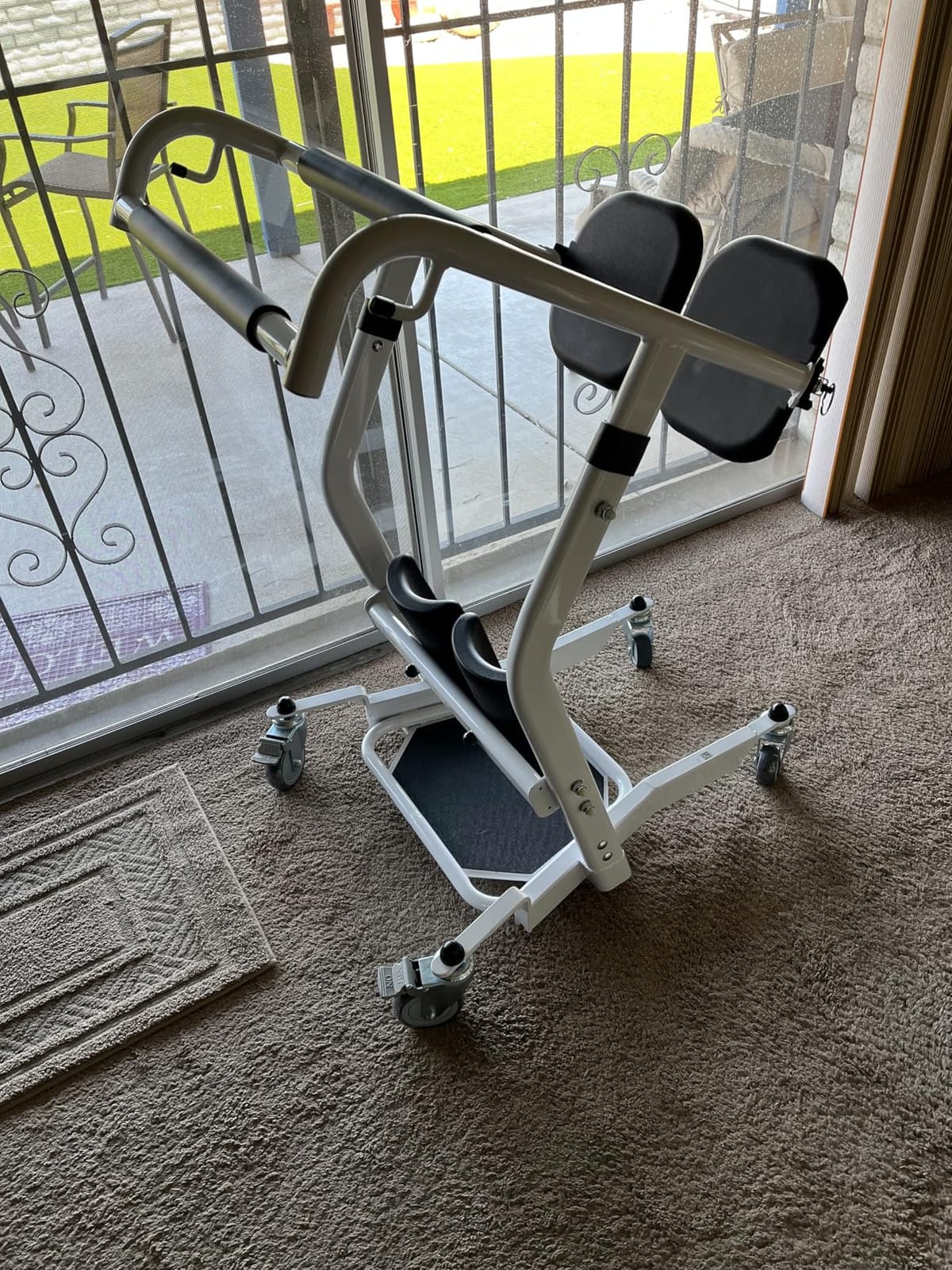
The half-moon split seat, cushioned shin rests, and foam-wrapped handrails are aimed at comfort during the standing phase. Reviewers consistently mention that the patient finds the grips comfortable enough to actually pull on, which is where cheaper frames tend to lose their owners.
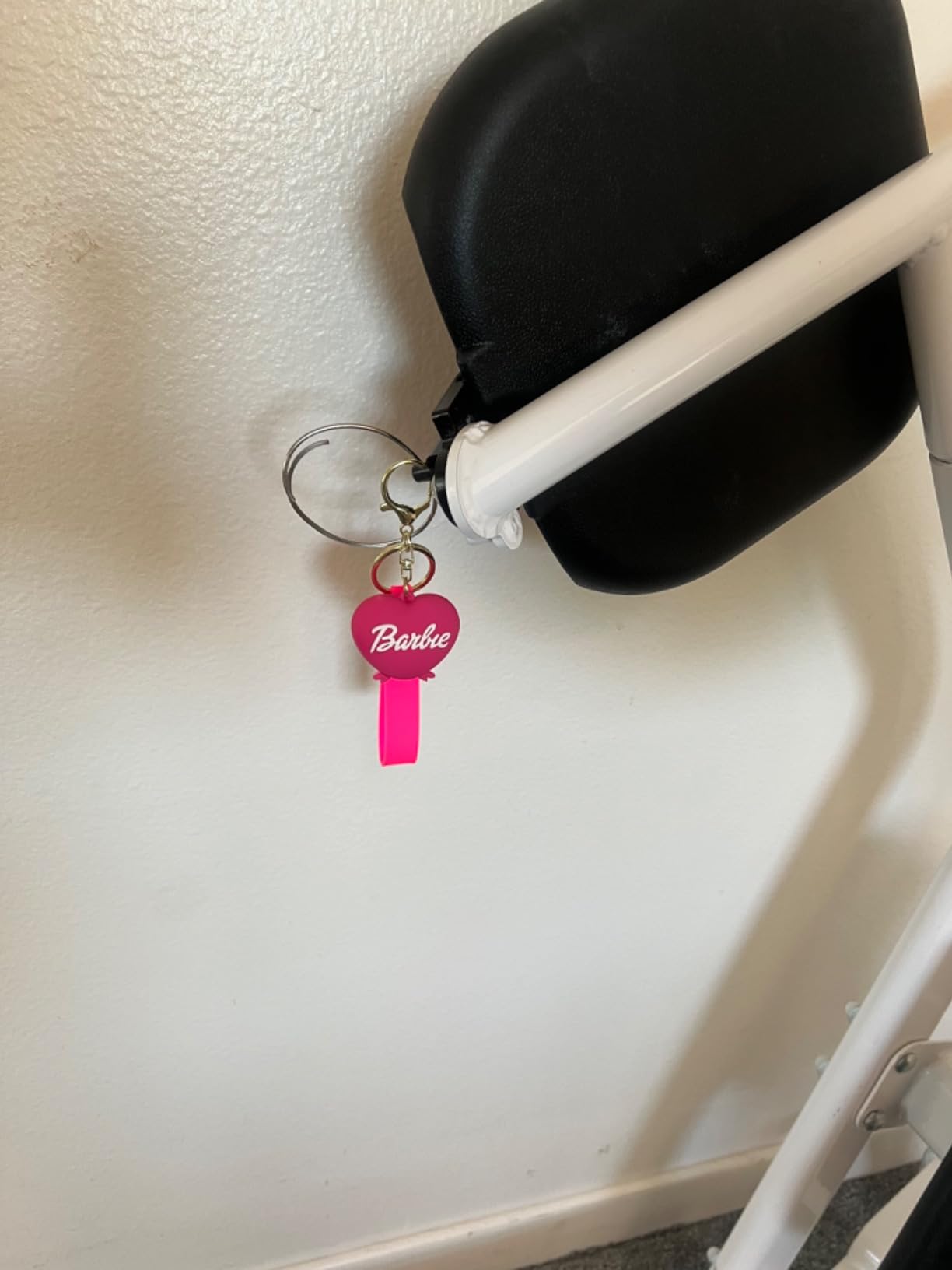
There are also hooks for side support straps, which lets you add a positioning strap on either side when the patient needs help keeping their arms inside the frame. Hooks that come with the lift cost nothing extra and add a layer of control you cannot add later without another purchase.
Where the Vive Mobility lift works best
It works best in a home with wide interior doorways and a patient who is rebuilding strength after surgery. The 2-year guarantee is a genuine advantage in a category where warranty terms are often thin, and that matters when the device will be used several times a day for years.
It is also a good match for a first-time caregiver who wants the standing motion to feel safe and repeatable. The brakes lock, the seat is padded, and the patient keeps contact with the frame for the entire lift.
Where it falls short
The 26 inch widest base is the drawback owners mention most often, and it is a hard stop in an older house. Standard interior doorways are often 28 to 32 inches, but narrow hall openings in older homes run smaller than that. Measure every opening on the route between the bed, the toilet, and the chair before ordering.
It also suits only patients who can hold 60 to 70 percent of their weight. Below that threshold you need a full-body lift, and pushing the limit on a stand-assist frame is how patients end up on the floor.
3. Invacare 9805P Hydraulic Patient Lift – Best Full-Body Lift for a Dependent Patient
Invacare Hydraulic Patient Lift, Lightweight Transfer Lift Chair with 450 lb Weight Capacity, Bent Mast for Safer Transfers, 6-Point Padded Swivel Bar, Floor-to-Bed Height Range for Fall Recovery
450 lb capacity
20 to 64 in lift range
Base 22 to 62 in
68 lb net weight
Pros
- Lifts from the floor for fall recovery
- Base narrows to 22 inches for doorways
- 450 lb capacity on a 68 lb frame
- 5-inch low-friction casters
- Three-year limited frame warranty
Cons
- Manual hydraulic pump requires effort on every cycle
- Owners report the pump takes practice to master
If the person in your care cannot bear weight at all, this is the class of lift you need, and the Invacare 9805P is the strongest example of it in this roundup. It rated 4.4 across 515 reviews, with 73 percent five-star, and it is the only full-body sling lift here that lifts from the floor.
That floor-to-bed range of 20 to 64 inches is the feature families tell us they did not know they needed until they needed it. If the person falls in the bedroom at 2 a.m., a lift that starts at 20 inches off the floor gets them up without anyone dragging them across the carpet. That single capability changes the risk profile of unsupervised living more than any other spec on the list.
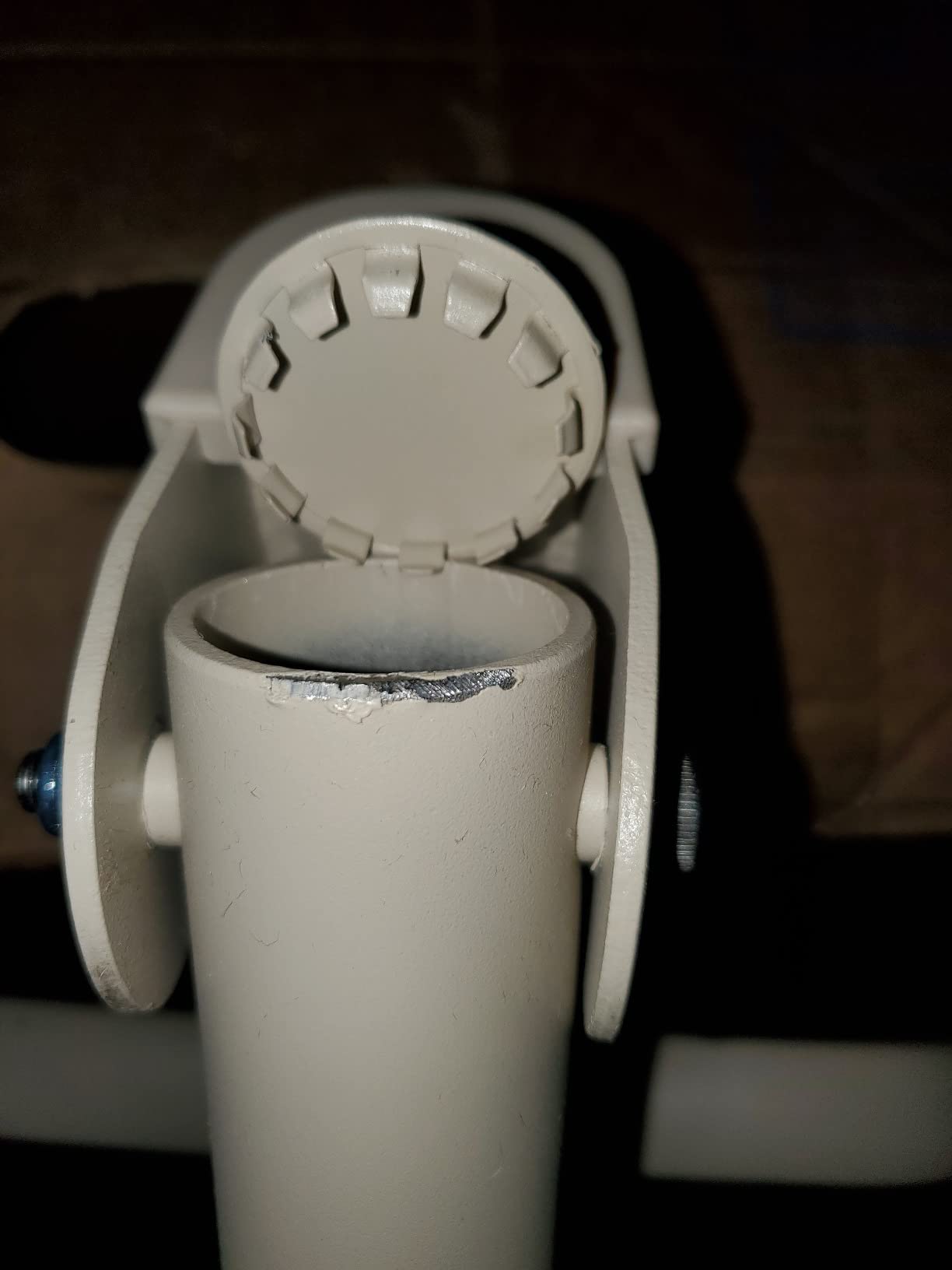
The bent mast and boom give the boom a wider path around the patient, so the person hangs in open space instead of swinging back into the frame. Caregivers describe this as less claustrophobic for the patient, and it also gives the sling more room to stay correctly positioned through the arc.
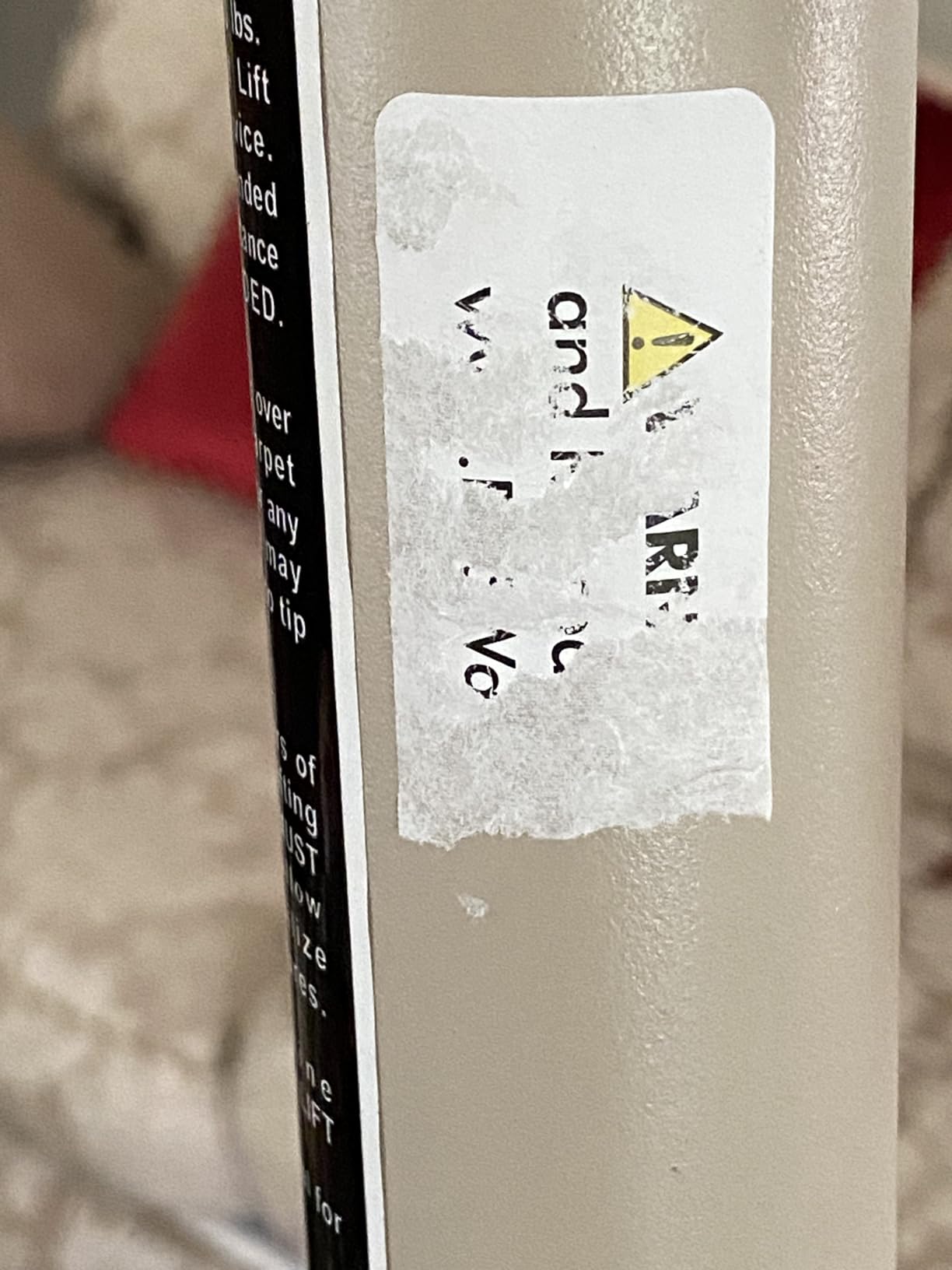
The integrated shifter handle is the clever part. It narrows the base to 22 inches to pass a doorway and widens it to 62 inches for stability during the lift. On a frame weighing 68 pounds with a 450 lb capacity, that is a rare combination of maneuverability and strength.
Low-friction 5-inch casters reduce the break-force needed to push it across carpet, which matters more than the specification suggests. Thick carpet in a bedroom or hallway will stop a lift that glides easily on laminate, and a stuck lift mid-room is a problem.
Invacare includes a three-year limited frame warranty on this model, which is longer than most of the manual lifts here and a meaningful signal about how the manufacturer expects the frame to be treated.
Why the Invacare 9805P suits a fully dependent patient
It suits a patient who cannot stand, cannot pivot, and cannot safely bear weight through their legs. A multi-point sling supports the torso and thighs, the boom takes the weight, and the caregiver rolls the base to the bed or chair.
It is also the right pick for a household worried about falls. The floor-level start point means a fall no longer has to end in a call for a second person or an ambulance. That is the single strongest argument for a full-body lift in a home with a patient who wanders or tries to get up unassisted.
What to know before buying the Invacare 9805P
The pump is manual, and that is the trade. Every lift cycle takes a physical push from the caregiver, and the pump handle has a learning curve. A caregiver in a forum thread described exactly this fear, worrying about a hand pump failing mid-transfer, and the honest answer is that practice and a clear routine reduce it, but it never becomes as effortless as a powered unit.
Second, this is a sling lift, so you must buy slings separately and keep spares. The sling is a recurring consumable, not a one-time accessory, and sizing errors are the most common reason a lift disappoints a family. Check that the sling style is compatible with a six-point or multi-point spreader bar before ordering.
Third, at 46.75 by 42.25 by 64 inches this is a large device. It is lighter than most manual lifts at 68 pounds, but you still need floor space to bring the patient down to the floor level during recovery.
4. Drive Medical Hydraulic Patient Lift – Best for Flexible Sling Setups
Drive Medical Handicap Hydraulic Lift, Silver Vein, 5 Inch
450 lb capacity
17.5 to 62 in range
42 in base width
Model 13023SV
Pros
- Six-point swivel bar accepts 2 to 4 sling straps
- Widest lifting range in this group
- 450 lb capacity
- Can raise a patient from any position
Cons
- Arrives unassembled and needs building
- Listed item weight does not reflect assembled weight
The Drive Medical hydraulic lift is a long-running steel-welded Hoyer-style frame that rated 4.4 across 503 reviews, with 72 percent five-star. Its distinguishing feature is the six-point swivel bar, and if your sling needs will change over time, that is the part to think about first.
A six-point bar accepts between two and four sling straps across two chain connections. That flexibility means you can move between a two-point sling for a straightforward bed transfer and a four-point arrangement for a patient who needs more support through the thighs and shoulders, without changing the lift.
The lifting range runs from 17.5 to 62 inches, the widest span in this roundup. That range starts below the Invacare 9805P’s 20 inch minimum, which means it can get a patient lower toward the floor before beginning the lift. The 450 lb capacity sits in line with the other hydraulic models here.
Owners describe it simply as raising and transferring a patient from any position, which is exactly what a general-purpose hydraulic frame should do. The welded steel construction in the silver vein finish is built for daily use rather than occasional transport.
At 42 inches, the base is wider than the narrow-frame lifts in this group. That is a stability feature during the lift and a maneuvering constraint in a hallway, so measure the route between rooms before this one arrives.
When the Drive Medical lift is the right choice
It fits households whose patient’s support needs change over time. If the same lift has to serve a full-body sling today and a different strap configuration later, the multi-point bar removes a repeated purchase.
It is also a good pick for a patient who must be recovered from a low position, since the 17.5 inch starting height gives you more room to work downward before lifting. Reviewers value the 450 lb rating as a solid margin above the weight of most patients.
What to plan for with this lift
It arrives unassembled and needs building before use. Budget an afternoon, or arrange for the supplier to assemble and demonstrate it, and do not skip the demonstration if it is offered.
Be aware that the listed item weight of 4.5 pounds does not reflect the assembled lift, so do not plan a one-person setup based on that figure. Ask the supplier for the assembled weight and for help moving it into position.
5. Etac Turner PRO Standing Pivot Aid – Best for Light Assistance Instead of a Full Lift
Etac Turner PRO Patient Transfer Aid, Standing Pivot Sit to Stand
441 lb capacity
17.6 lb net weight
29.5 x 20 x 5.6 in
Cast aluminum and steel
Pros
- Turns a two-person lift into seconds of standing
- Very simple to learn
- Light enough to load into a car
- Soft angled height-adjustable leg pads
- 441 lb load capacity
Cons
- Not a lifting device so the user must hold on through the turn
- Does not fold and is bulky to carry by hand
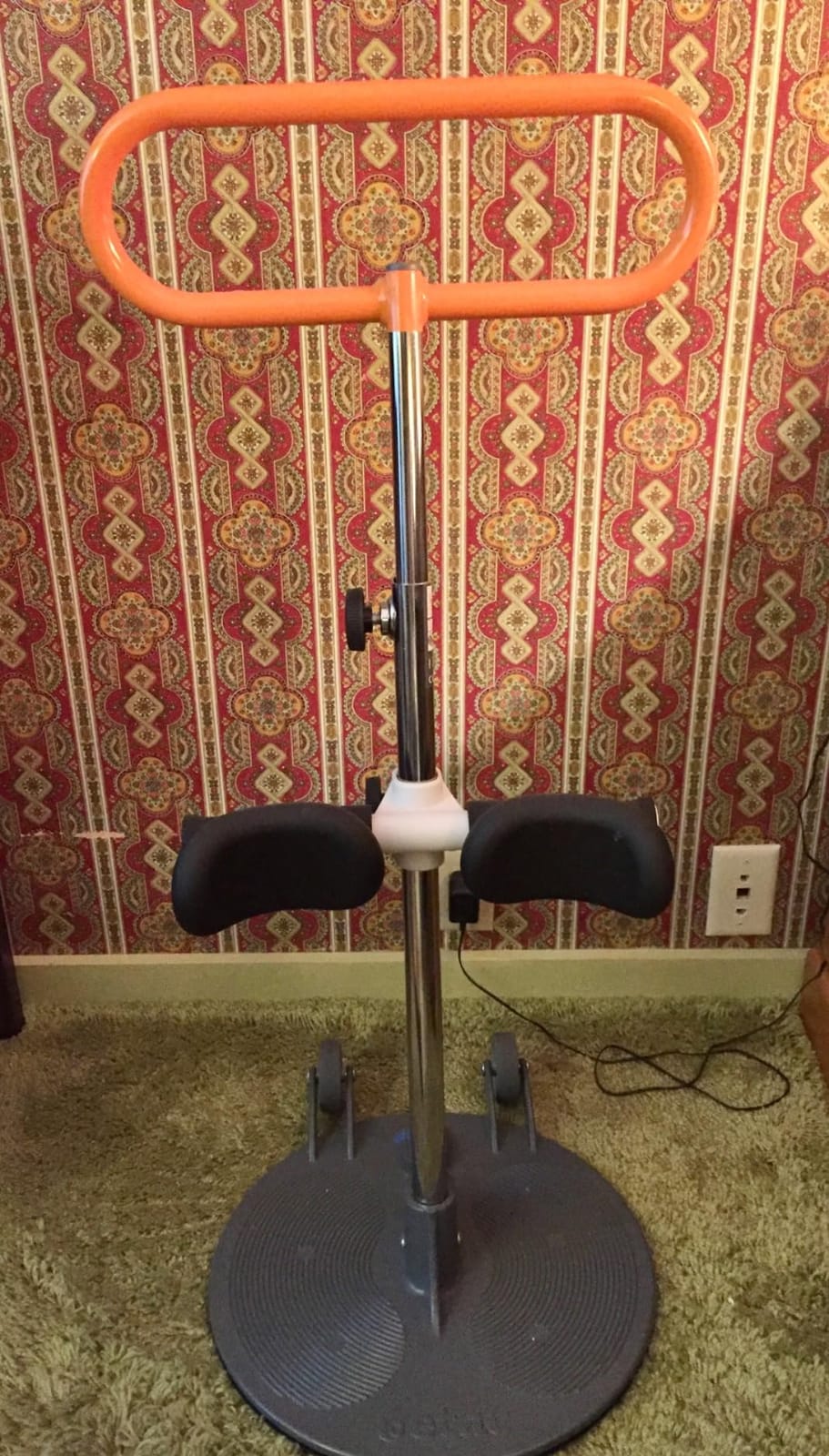
The Etac Turner PRO is not a patient lift, and calling it one is the fastest way to buy the wrong thing. It is a standing pivot aid: a padded platform the patient stands on while the caregiver rotates them a quarter turn onto a bed, chair, or toilet. It rated 4.5 across 326 reviews, with 77 percent five-star.
What reviewers keep describing is the compression of effort. A transfer that used to need two people and coordination becomes roughly five to ten seconds of standing, turning, and sitting. One caregiver on a forum thread described exactly this, using an aid to protect their back while being the primary caregiver for their mother.
The simplicity is the other theme. Caregivers of patients with dementia reportedly picked it up immediately, because there is no pendant, no battery, and no motor to explain. The user stands, holds the frame, and turns. That is the whole interaction.
Build quality is real: cast aluminum, powder-coated steel, and chrome, at 17.6 pounds and 29.5 by 20 by 5.6 inches. Soft, angled, height-adjustable leg pads give the patient something secure to push against, and a swivel function with an anti-slip base plate works across multiple flooring types.
The ergonomics reward good technique. Because the patient stands at the aid rather than being lifted, the caregiver stays close and upright instead of crouching into a lift, which is where most caregiver back injuries originate.
Who should use the Etac Turner PRO
It suits a patient with usable upper body strength who can pull themselves to standing and hold on through the turn, but who cannot stand and pivot safely with a walker. Knee weakness, early Parkinson’s, and post-operative recovery all fit that description.
It also suits caregivers who want a device that takes one minute to deploy rather than five. For transfers that happen many times a day, the speed of the device changes how willing a caregiver is to use it, and willingness is the real bottleneck in safe patient handling.
Where the Etac Turner PRO is not enough
It cannot lift anyone. If the patient cannot reach standing without help, this device becomes a static obstacle rather than a transfer tool, and you need a sit-to-stand lift or a full-body lift instead.
Two practical limits are worth noting. It does not fold, and reviewers describe it as bulky to carry by hand for vehicle use, so plan on two people or a cart if it travels. Some units also report the knee stabilizer and height adjuster loosening over time, which means checking those points before each transfer until you know the unit.
6. Invacare GHS350 Sit to Stand Lift – Best for Low-Profile Homecare Beds
Invacare Sit to Stand Lift for elderly, Hydraulic Stand Assist Lift Aid for Patient, Lift Assist Transfer Device for Elderly Seniors, Adults & Disabled, FSA & HSA eligible
350 lb sling compatibility
4.5 in base clearance
40.5 x 23 x 45 in
88 lb net weight
Pros
- 4.5 inch clearance fits under most homecare beds
- Rotating pump handle speeds up cycles
- Adjustable leg pad and retractable footplate
- Compatible with Invacare multi-function slings
Cons
- Heaviest unit here at 88 pounds
- Non-locking casters let the base drift
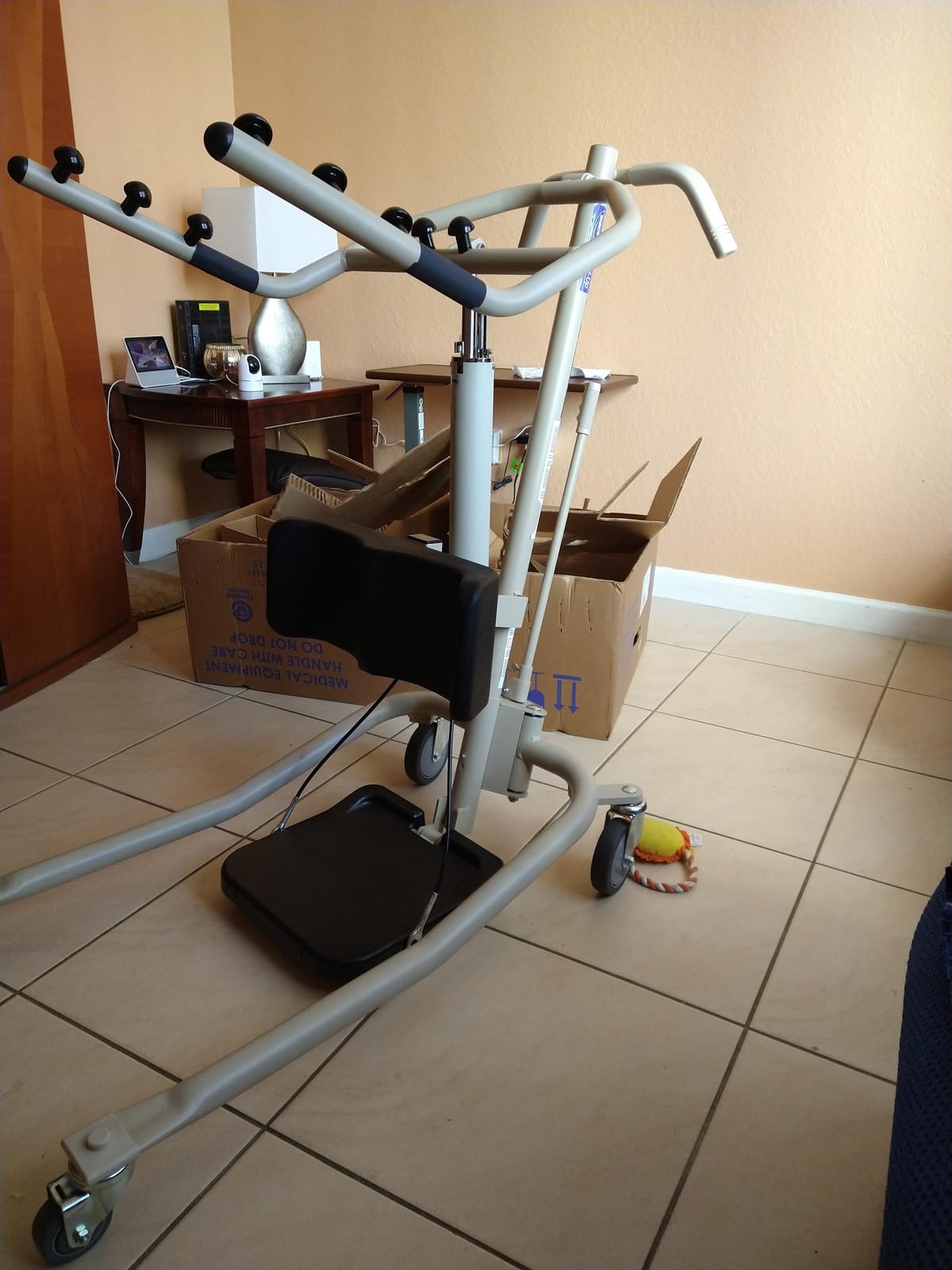
The Invacare GHS350 solves one specific problem very well: getting the base under a low homecare bed. Its 4.5 inch clearance fits under most homecare beds, which is the number that decides whether a morning transfer works smoothly or whether you spend ten minutes repositioning the frame every time.
It carries a 4.0 rating across 267 reviews, the lowest average in this roundup, with 57 percent five-star and 11 percent one-star. That distribution points at specific problems rather than general dissatisfaction, and the two named most often are weight and caster locking.
At 88 pounds this is the heaviest unit we tested, which makes home setup and repositioning a two-person job in most homes. The rated capacity is expressed through sling compatibility, since it works with Invacare multi-function slings rated up to 350 lbs.
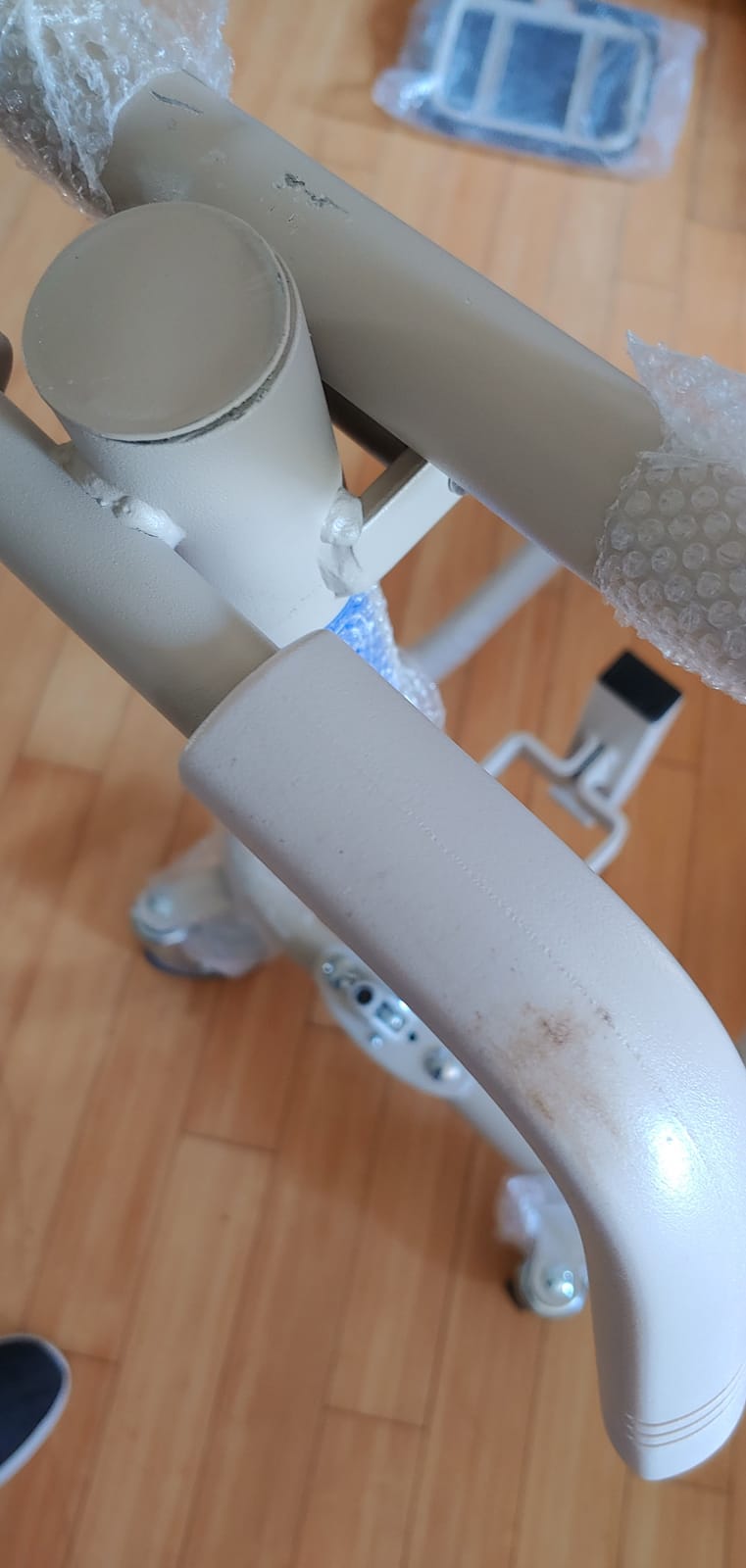
Where it earns praise, the details are good. The rotating pump handle reduces the awkward wrist angle of a fixed handle, sling attachment is fast and secure, and the adjustable contoured leg pad with a retractable non-slip footplate makes positioning under the legs straightforward. Low-friction casters roll easily across indoor surfaces.
That last feature is the catch. Low friction is helpful for rolling and unhelpful for stopping, and the non-locking casters mean the base can drift. For some environments a locking caster kit, part 1110421, has to be bought separately.
When the GHS350 earns its place
It earns its place when the bed is the hard part. If your patient sleeps in a low-profile homecare or hospital-style bed and the base cannot get under it, a lift that fits beats a lift with better ratings that you cannot position.
The rotating pump handle also helps caregivers who have limited hand or wrist strength, because the handle can be worked from a more natural angle through the whole stroke.
Where it causes frustration
The 88 pound weight is the first problem. If a caregiver lives alone and has to move this between the bedroom and the living room, the weight alone can end the routine.
The non-locking casters are the second. Add the locking caster kit and this becomes a much easier device to use; skip it and you are relying on the brakes and on the base not drifting while the patient is standing.
7. Hi-Fortune Electric Patient Lift – Best for Caregivers Working Alone
Hi-Fortune Patient Lift Electric Unfoldable Hydraulic Body Transfer for Home Use Seniors Easy-Assembly, Battery-Powered, 400lb Weight Capacity with Medium U-Sling, White, 1 Count (Pack of 1)
450 lb capacity
33 to 68 in range
99 lb net weight
Model HY101-01A
Pros
- Battery power removes the physical pump effort
- Swan neck legs adjust around large furniture
- Includes four-point spreader bar and U-sling
- Rear wheels lock for stability
- Folds down for storage and transport
Cons
- About 30 minutes of two-person assembly with unclear instructions
- Battery longevity and replacement support reported as weak
- Lifts and lowers fairly slowly
The Hi-Fortune HY101-01A is the only battery-powered lift in this roundup, and for one specific caregiver that fact outweighs everything else on the page. Caregivers caring for someone alone credit the powered controls directly, because the hand pendant means the sling goes up and down without a physical pump stroke.
It rated 4.4 across 250 reviews, with 71 percent five-star. The listing states a 450 lb maximum load capacity, with 400 lb given as the recommended figure, so treat the lower number as your working ceiling.
Push-button hand controls run the lift, and foot-operated pedals widen and narrow the base while your hands stay on the patient. The swan neck leg design adjusts width so the frame can reach around large furniture rather than forcing the chair into a narrow gap.
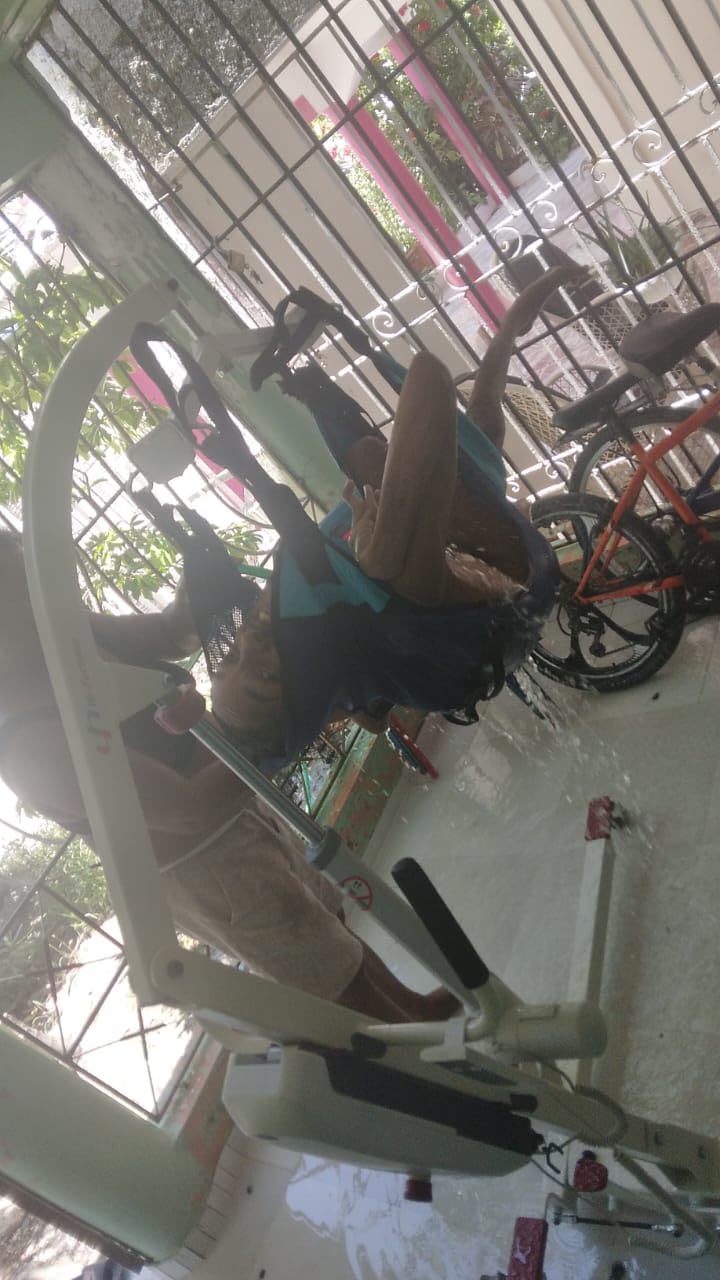
In the box you get a four-point spreader bar and a large polyester U-sling usable wet or dry. That sling inclusion matters more than it sounds. Every other full-body lift in this group requires you to source slings separately, so this one saves a decision and a delay.
The rear wheels lock for stability, reported battery life runs for weeks between charges, and the unit folds down and disassembles for storage and vehicle transport. That last point is unusual for a powered lift and matters in a home where the lift lives in a closet between uses.
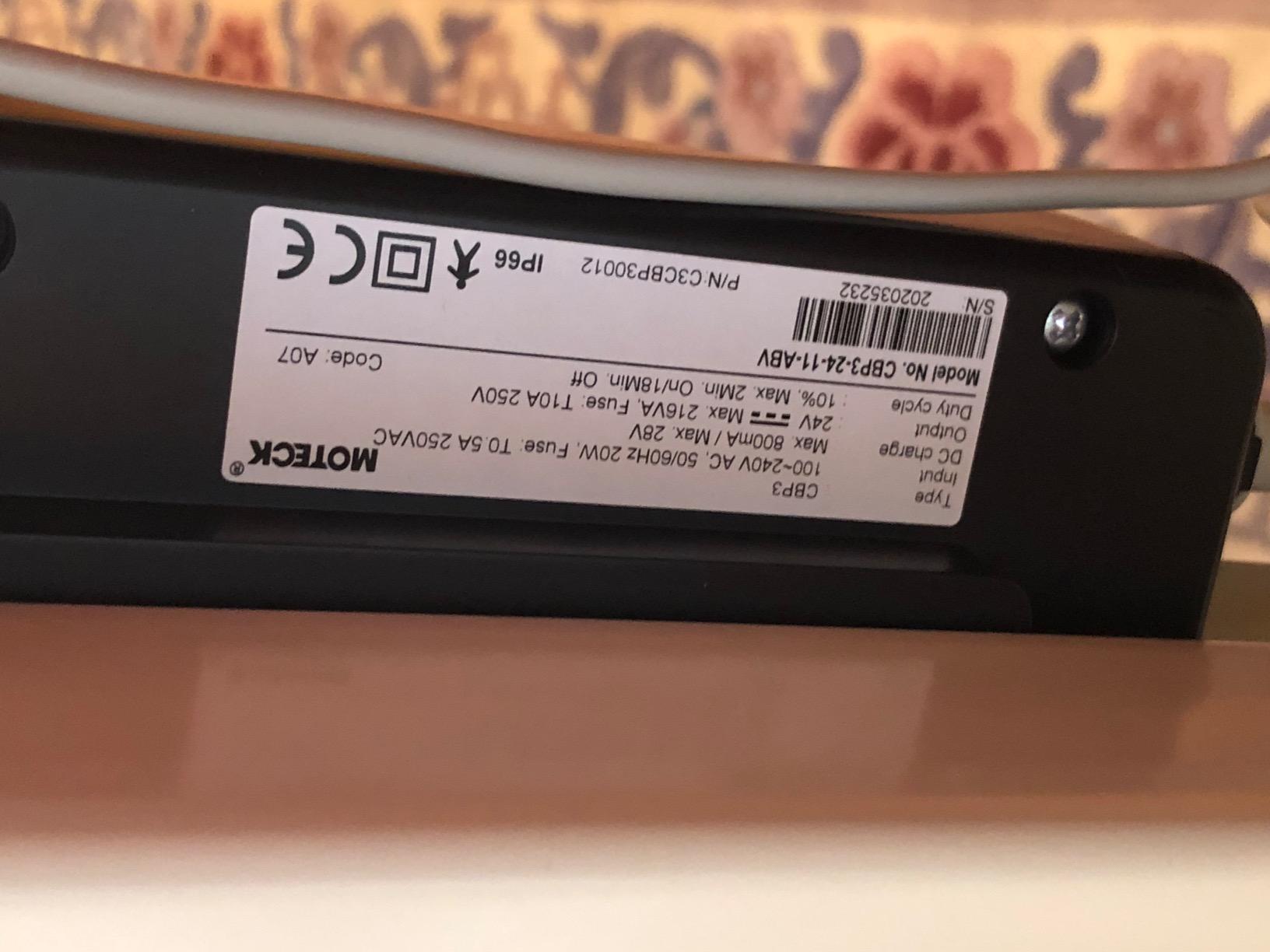
Frame material is alloy steel, and the warranty runs one year on the frame with six months on the actuator, control box, and hand controls. Those component terms are short, so ask the supplier what happens after six months before you commit.
Who benefits most from the Hi-Fortune electric lift
Solo caregivers and caregiver pairs where one person is managing a heavier patient. The hand pendant means the person at the front of the patient is not also pumping, and the powered motion is more consistent from cycle to cycle than a manual pump.
It also suits a household where the transfer happens in more than one location, because the frame folds down and comes apart for a car or a storage closet rather than living permanently in one room.
What to watch out for with this lift
Assembly takes about 30 minutes for two people and the printed instructions are reportedly unclear. Have the supplier assemble and demonstrate it, or budget the time and the second pair of hands.
One reviewer reported the battery dying after about a year with no support or replacement parts from the manufacturer. That is the single most important question to ask before purchasing any powered lift, because a lift that cannot raise a person is now a serious problem.
Two smaller notes. The base must be fully spread and locked before lifting or the frame can tilt, and the lift and lower motion is slow, which is safer but takes more patience than a manual pump.
8. VOCIC AY03 Sit to Stand Lift – Best Budget Stand-Assist
VOCIC Sit to Stand Lift, Patient Lift Chair Transport Unit with Wheels
400 lb capacity
6 cm low-profile base
31 x 17 x 43 in
58 lb net weight
Pros
- Reinforced steel frame rated to 400 lbs
- Dual locking casters front and rear
- Two-level adjustable knee pad
- Low base slides under most furniture
- Tool kit and instructions included
Cons
- Open design with no safety belt restraint
- Not for immobile or paralyzed users
The VOCIC AY03 is the most affordable 400 lb stand-assist frame in this group, and it rated 4.4 across 191 reviews with 73 percent five-star. The listing has been updated recently, so the construction reflects current component availability rather than an older frame.
It is built from aluminum with a reinforced high-grade steel structure rated to 400 lbs, at 58 pounds and 31 by 17 by 43 inches. That is a narrower and lighter package than most of the full-size frames here.
The caster setup is genuinely good for the tier. Dual locking brakes sit on 3-inch rear and 4-inch front casters, which is a larger front caster than most competitors in this category and easier to roll over thresholds and carpet edges.
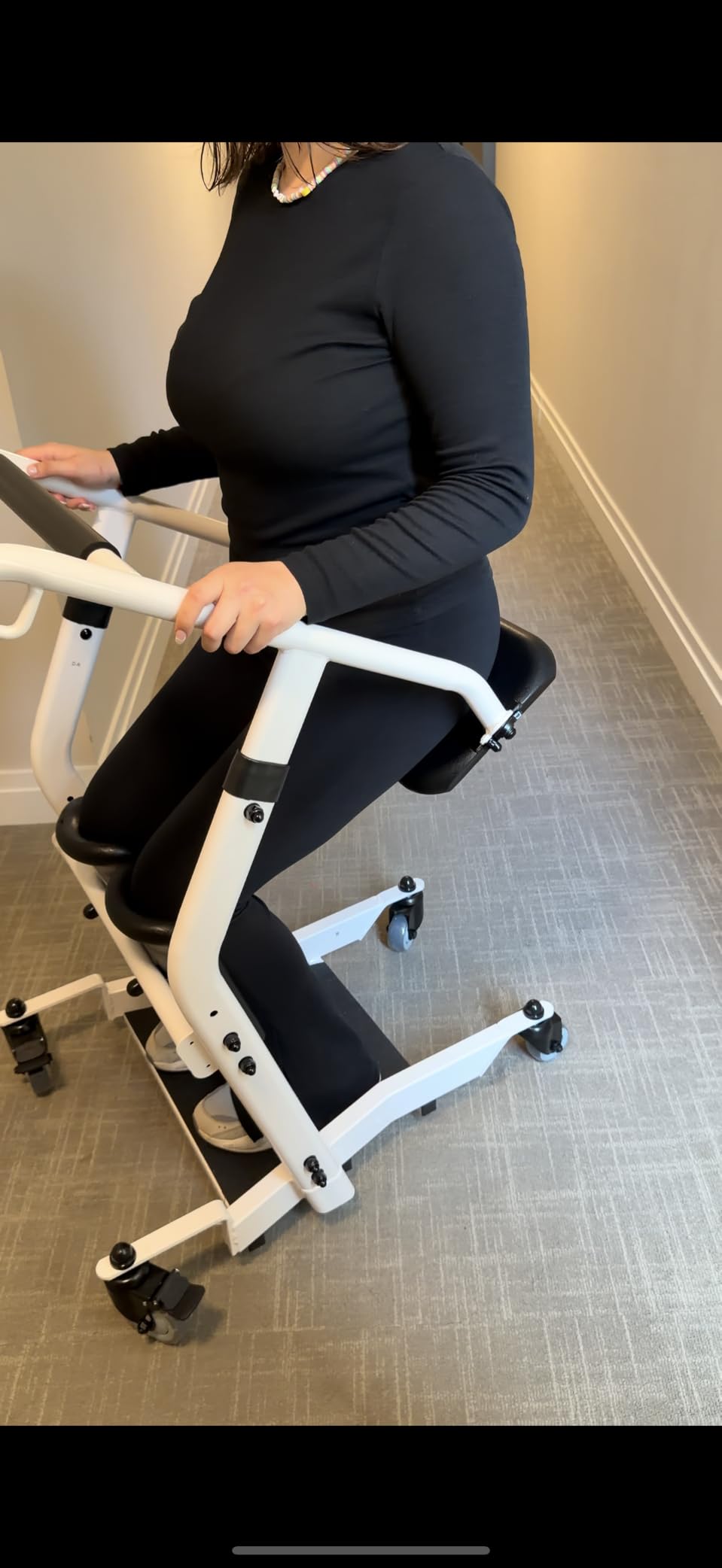
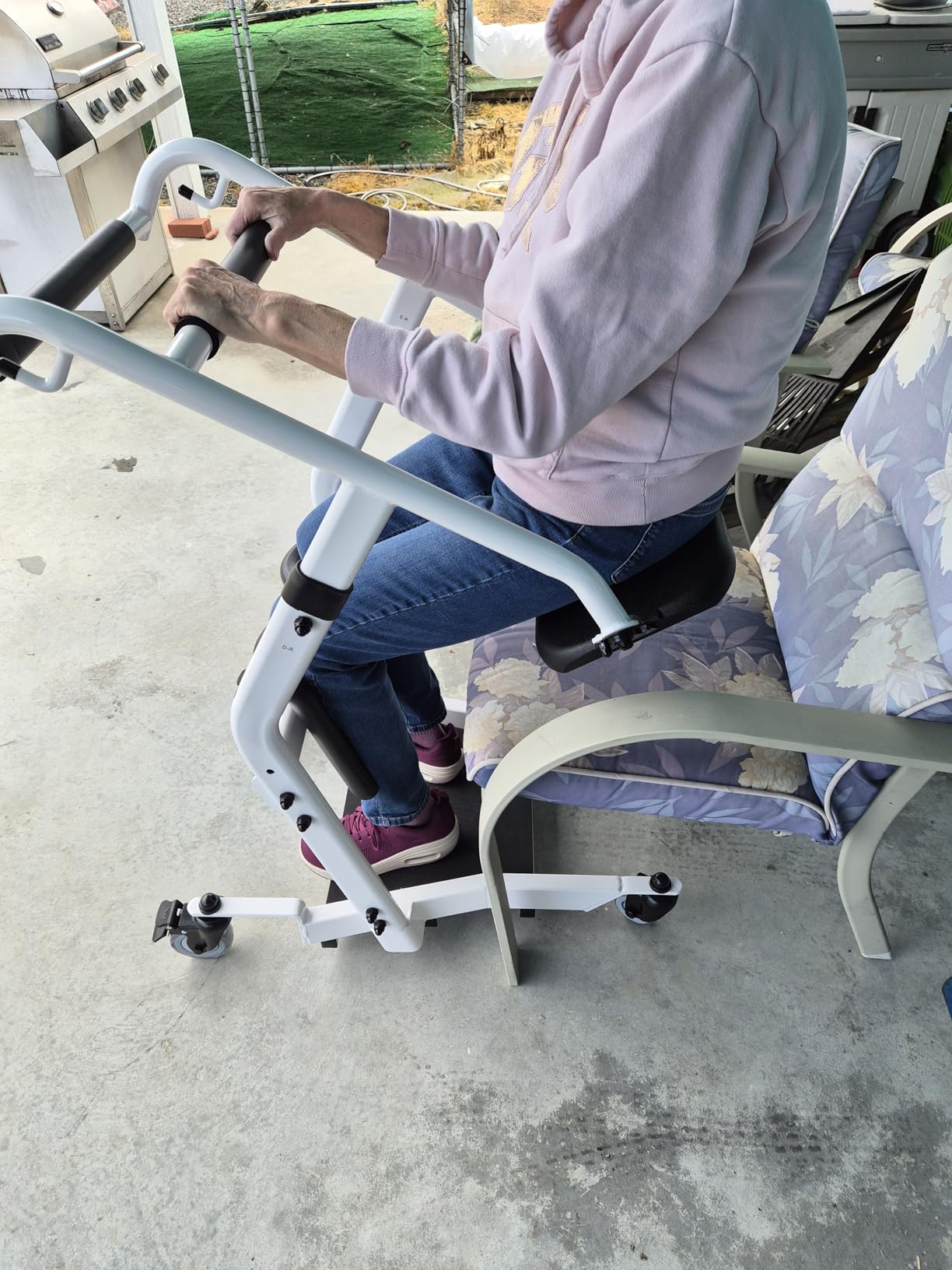
Soft foam-wrapped handgrips, padded shin pads, and split seat cushions cover the three contact points that matter during a transfer. The two-level adjustable knee pad changes the user’s leg position, and the 6 cm low-profile base is designed to slide under most furniture.
A tool kit and clear instructions are included for assembly, which removes the most common complaint about budget equipment. Reviewers consistently report that the assembly is straightforward once the parts are laid out.
When the VOCIC AY03 makes sense
It makes sense when cost is the binding constraint and the patient has real upper body strength and trunk control. It delivers the same 400 lb rating as pricier stand-assist frames with locking brakes and a low base included.
It also suits a household that wants a second transfer device in a specific room, such as beside a sofa or in a bedroom, without committing the budget of a powered or full-body unit.
What the open design means for your patient
This unit has no safety belt restraint. That is a deliberate design choice for a patient who can sit up and support their own core, and the manufacturer is explicit about it.
That same fact rules it out for a completely immobile or paralyzed user. If your loved one cannot hold themselves upright in the frame, a restrained lift with a sling is the only option, and no amount of low cost changes that.
9. ProBasics Heavy Duty Patient Lift – Best Warranty Coverage for Long-Term Use
ProBasics Heavy Duty Patient Lift, 450 lbs, Hydraulic Medical Lift for Home Use, Swivel Caster, Alloy Steel, Hammertone Finish, Adjustable Width Base, Compatible with 4 or 6 Point Lift Slings
450 lb capacity
26 to 70.5 in range
68 lb net weight
Model PBPLSM001
Pros
- Limited lifetime warranty on the frame
- 450 lb capacity on alloy steel
- 26 to 70.5 inch range handles floor recovery
- 5-inch swivel casters with step-on lock
- Works with 4 or 6 point slings
Cons
- Assembly is time consuming and directions may be missing
- Bulky base for one-person operation
The ProBasics heavy duty lift rated 4.3 across 155 reviews with 70 percent five-star, and what separates it from the other hydraulic frames is the warranty: a limited lifetime warranty on the frame plus one year on all parts. On a device expected to run for years, that is the strongest long-term protection in this group.
The 450 lb capacity sits on an alloy steel frame in a hammertone finish, at 68 pounds and 50 by 25 by 15 inches. That listed height reflects the folded package, with the working height reaching 77 inches.
The lifting range of 26 to 70.5 inches at the pin is the second highest ceiling here, and that upper reach is what lets a full-body lift place a patient onto a higher bed or a raised toilet seat without repositioning.
Owners replacing a rented Hoyer lift frequently describe this as sturdier and easier to pump than the rental units. The adjustable width base fits under most beds, and 5-inch front and rear swivel casters lock by stepping on a plunger, so you can secure the base with your foot while your hands stay on the patient.
It works with both 4-point and 6-point slings, which keeps your sling options open as the patient’s support needs change.
Why the ProBasics lift suits long-term ownership
A limited lifetime frame warranty matters when the lift will be used several times a day for a decade. It signals a manufacturer willing to stand behind the welded frame, and it removes the single biggest anxiety about a heavy piece of home equipment.
The 26 inch lower reach gives you some ability to start a lift from a lower position, and the 70.5 inch ceiling handles elevated beds and tall furniture that shorter frames cannot reach.
What makes setup harder with this model
Assembly is time consuming and the directions may not arrive in the box, so do the setup with the manual open on a phone or laptop before you start. One reviewer also reported a broken wheel lock and a missing handle from a damaged package, so inspect everything on arrival.
The base is also the bulkiest in this roundup, and some buyers report it will not fit under certain beds. Measure your bed clearance before ordering, particularly if the patient spends most of the day in bed.
10. ArjoHuntleigh Sara Stedy Sit to Stand Lift – Best Fully Built and Clinic-Grade Option
Arjohuntleigh Compact Sara Stedy Sit to Stand Manual Patient Lift Aid | Fully Assembled Elderly Assistance Products | Holds up to 400 Pounds | Intended for Users 4’6″ – 5’8″…
400 lb capacity
1.99 x 34.6 x 41.5 in
65 lb net weight
Regular and Compact
Pros
- Highest rating in this roundup at 4.7 stars
- Ships fully assembled with no setup
- Built by an established medical equipment manufacturer
- Compact variant available for tight rooms
Cons
- By far the most expensive option in this roundup
- Manual operation requires caregiver training
- Intended for a specific user height range
The ArjoHuntleigh Sara Stedy rated 4.7 across 149 reviews, with 87 percent five-star, making it the highest-rated unit in this roundup. It is also the only one that arrives fully assembled, which removes the 30 to 60 minutes of setup that every other manual lift here asks of you.
It comes from a clinical medical equipment manufacturer rather than a general home equipment brand, and reviewers consistently respond to that. The 4.7 average reflects build quality and fit rather than excitement about a feature.
The rated capacity is 400 pounds at 65 pounds net weight, with an intended user height of roughly 4 foot 11 inches to 6 foot 6 inches. Regular and Compact variants are both available, and the Compact version addresses small rooms where a full-width frame will not turn.
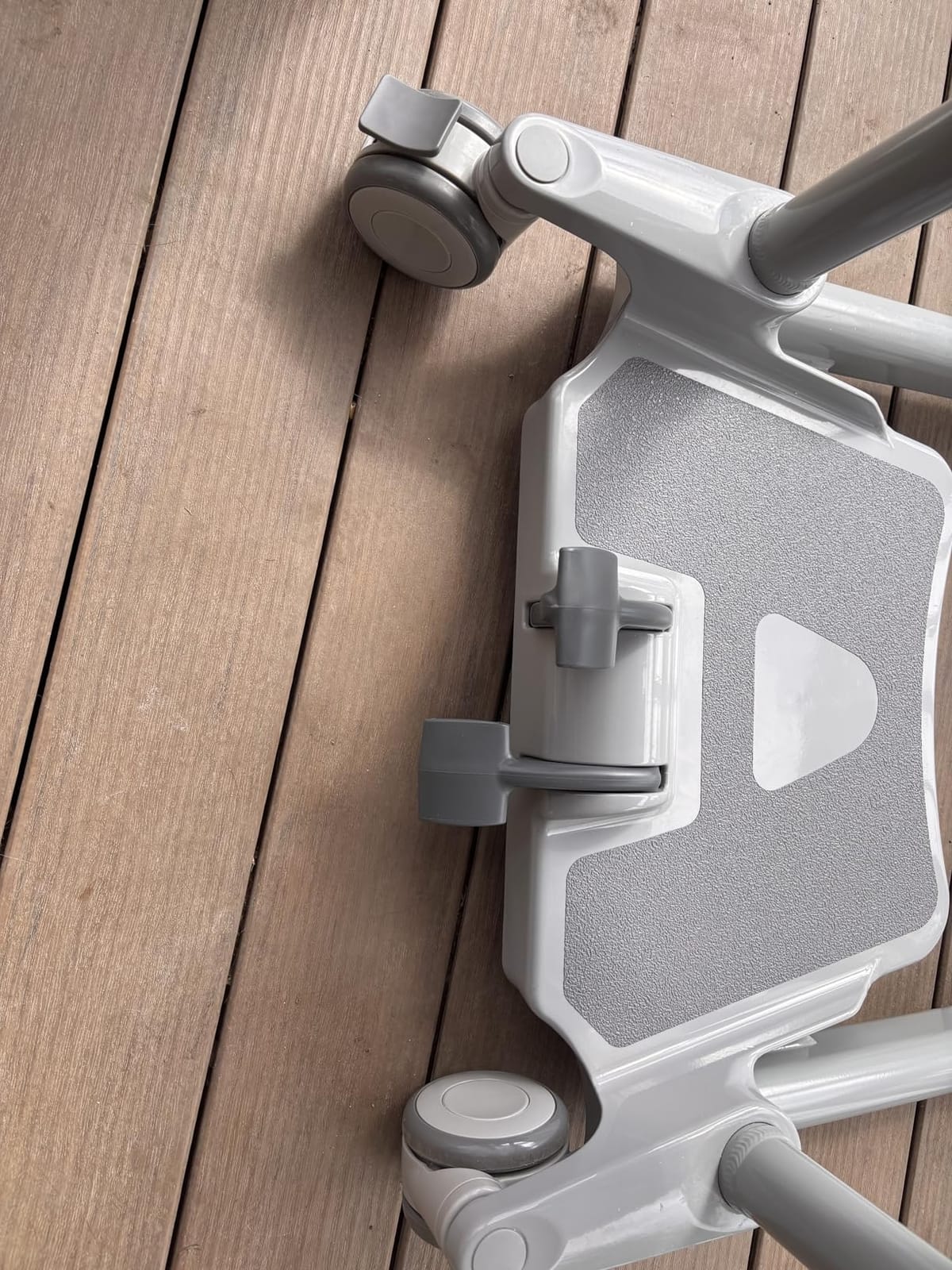
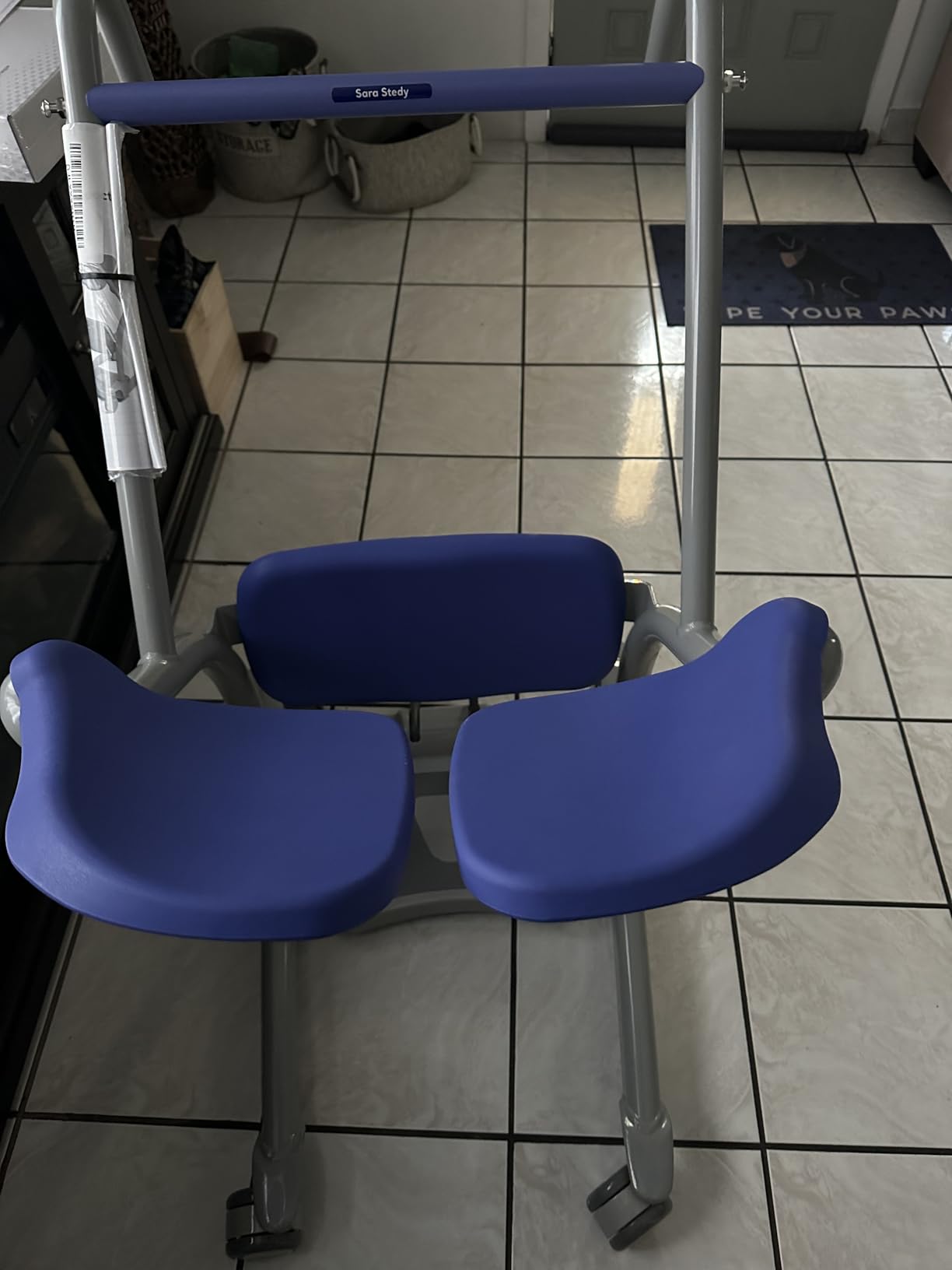
The design goal is straightforward: help a user stand safely while reducing fall and injury risk. Reviewers highlight that it is a familiar device, of the kind used in rehabilitation settings, which makes it easier for a patient who has seen one before.
Because it arrives ready to use, it is also the fastest option for a discharge timeline. When a therapy team recommends a stand-assist and the family has a week to set it up, assembly time becomes a deciding factor.
When the Sara Stedy is worth the premium
It is worth it when the device will stay in the home for years and the purchase will be made once. A fully assembled, clinic-grade unit that never needs a socket wrench is a different ownership experience from a budget frame that gets moved between rooms by two tired people.
It is also the right pick when the patient has been in rehabilitation or a care facility and responds better to equipment they already recognize. Predictability matters for patients with dementia or post-stroke confusion.
What to weigh before ordering the Sara Stedy
Cost is the first consideration and it is a real one. It sits far above every other option in this roundup, so if the budget is fixed and a lower frame meets the clinical need, a hydraulic model will stretch further.
Manual operation still requires caregiver strength and training, and the device is intended for a specific height range. Confirm your patient’s height falls inside it, and ask the supplier to demonstrate the transfer before you accept delivery.
How to Choose a Patient Lift for Home Caregiving in 2026
Most wrong purchases happen because a family buys a category of lift before anyone assesses the patient’s actual transfer problem. Work through these five questions in order, and the model usually picks itself.
What type of patient lift does the patient actually need?
Start from the patient’s ability, not the device. If they can stand and hold on but cannot pivot safely, a sit-to-stand lift or a standing pivot aid is enough. If they can bear no weight at all, you need a full-body hydraulic or powered lift with a sling.
Full-body lifts accept a patient in almost any position and are the safest default when function is uncertain. Sit-to-stand lifts are smaller, cheaper, and easier to move, but they are only appropriate when the patient participates and bears partial weight. Standing pivot aids lift nobody, and they work only with strong arms and trunk control.
For bathroom transfers specifically, a sling-free transfer chair is worth asking a therapist about, because it removes the sling from the equation entirely and solves the transfer without a wet or soiled sling.
Where the longer-term goal is rebuilding strength rather than moving someone safely, conditioning equipment matters too. Our home pilates reformer buying guide and compact home gym picks cover the kind of setup a therapist can build a short daily routine around, and both pair well with a stand-assist frame in a rehab bedroom.
How much weight capacity and clearance do you need?
Capacity is not the place to save. Choose a lift rated well above the patient’s current weight rather than just above it, since weight fluctuates and a device at its limit is a device that feels unstable.
Most of the frames here are rated between 400 and 450 lbs. If the patient is significantly above that range, you need a bariatric-rated device, and that is a different product category rather than an adjustment to one of these.
Clearance matters as much as capacity. Measure three things: the narrowest doorway on the route between rooms, the height of the lowest bed frame, and the ceiling height in the transfer space. A base that will not go under the bed or through the door is an expensive shelf.
Ask the supplier for the base width at its widest point and its narrowest setting. On the units in this roundup, widest base measurements range from 26 inches to 42 inches, which is the difference between fitting through a tight hall and not.
Which sling should you buy, and how do you size it?
The sling is a separate, recurring purchase, and getting it wrong is the most common reason a lift disappoints. Expect to replace it over time, and budget for two so one can be laundered while the other is in use.
- Universal slings work for most full-body transfers and are the safest starting point when you are unsure.
- Toilet-access slings open at the bottom, which makes wheelchair and commode transfers faster and less undignified.
- Stand-assist slings are shorter and shaped for a sit-to-stand frame with a standing belt or knee support.
- High or full-back slings give more trunk support for a patient with poor head or upper body control.
Sizing is by weight range first, then by chest and shoulder measurement. A sling that is too small will ride up and can pinch; one that is too large lets the patient slide to the bottom of it and sit on the spreader bar. If the sling can touch the patient’s skin with a finger’s width of slack at the leg straps, the fit is usually right.
Check compatibility before ordering. A six-point or 4-point spreader bar takes different straps than a two-point bar, and a sling for one lift model will not necessarily attach to another.
How do you pay for a lift when Medicare is involved?
Patient lifts are durable medical equipment, and Medicare Part B covers them as a benefit subject to a written prescription and purchase or rental through an approved supplier. The Part B deductible and coinsurance apply, and some plans cover a different share.
Coverage is not automatic. The prescription has to document the medical need, and the supplier has to meet specific requirements. One caregiver on a forum thread described the pathway that actually worked, having their lift ordered through a rehab facility case manager and paid through Medicare, which is exactly the route to ask about.
Ask these questions in order: is the lift documented as medically necessary, is there a signed prescription, can the supplier bill Medicare directly, and is the item being rented or purchased. Medicaid, state programs, the VA, and auto or accident insurance have separate rules and may cover what Medicare does not.
For a short recovery of six to twelve weeks, rental is usually the right call. For a permanent need, purchase removes the recurring rental cost over time. A family caregiver we spoke with described the relief of having the equipment questions handled by a case manager rather than by the family.
What safety rules should a single caregiver follow?
A lift removes the need for brute strength, but it does not remove judgment. Before every transfer, confirm the base is fully spread and locked, the brakes are on, the sling straps are fully seated in their hooks or loops, and the patient’s limbs are clear of the wheels and mast.
Never lift from the floor with a lift that does not have a floor-level starting height. If your lift starts at 20 inches and the patient is on the ground, use a floor recovery device such as an IndeeLift-style floor lift first, then transfer to the patient lift.
Know your emergency lowering before you need it. Every full-body lift here has a mechanical or manual lowering path so the patient can be brought down if power fails or the caregiver must step away, and you should have practiced it once while someone else was in the sling.
Training matters more than model choice. One caregiver mentioned that their local fire department offers free tutorials on safely lifting people, which is an underused resource in most communities. A single in-home demonstration from the supplier, followed by one supervised practice session with your own sling, prevents most of the incidents described in owner reviews.
Frequently Asked Questions
Does Medicare pay for patient lifts?
Patient lifts qualify as durable medical equipment, so Medicare Part B can cover them when a doctor documents the medical need and you obtain the equipment through an approved supplier with a signed prescription. The Part B deductible and coinsurance still apply. Coverage for rental or purchase depends on how long you need the lift, and Medicaid, VA, and state programs follow separate rules.
Which Hoyer lift is best for home use?
For a fully dependent patient the Invacare 9805P is the strongest home option in our testing, with a 20 to 64 inch range that recovers a patient from the floor and a base that narrows to 22 inches for doorways. If the patient can still bear partial weight, a sit-to-stand lift such as the Lumex LF1600 is smaller, lighter, and easier to maneuver in a house.
Can a caregiver use a Hoyer lift alone?
Yes. A correctly fitted patient lift is designed for single-caregiver use, which is one of its main advantages over manual lifting. The caregiver must be trained on the specific model, check the base locks and sling attachment every time, and never attempt a solo transfer with a lift that cannot reach the position the patient is in.
What are the best patient lift slings for home use?
Universal slings suit most full-body home transfers, while toilet-access slings are easier for wheelchair and commode transfers and stand-assist slings are shaped for a sit-to-stand frame. Buy two of each size so one can be laundered, and confirm the strap configuration matches your lift’s spreader bar. Sizing should start with the weight range printed on the sling.
What weight capacity patient lift do I need?
Choose a lift rated meaningfully above the patient’s weight rather than just above it. Most home models here are rated between 400 and 450 lbs, so a patient in that range has several options. Anyone significantly heavier needs a bariatric-rated device, which is a separate category rather than an adjustment to a standard frame.
The Best Patient Lifts for Home Caregiving, Reviewed in 2026
After working through all ten, the Lumex LF1600 is our pick as the best patient lift for home caregiving overall. It holds a 4.6 rating across 1050 reviews, the broadest record of real daily use in this group, and it stays light and maneuverable enough for a normal house.
For a patient who cannot bear weight, the Invacare 9805P is the one to buy, because a lift that starts near floor level changes what happens after a fall. For a caregiver working alone, the Hi-Fortune electric lift removes the physical effort entirely.
Whatever you choose, have a therapist assess the patient first, measure your doorways and beds, and insist on an in-home demonstration before you accept delivery. If you want to compare other home equipment alongside this guide, our massage recliner roundup and compact home gym picks cover the recovery side of the same setup.