
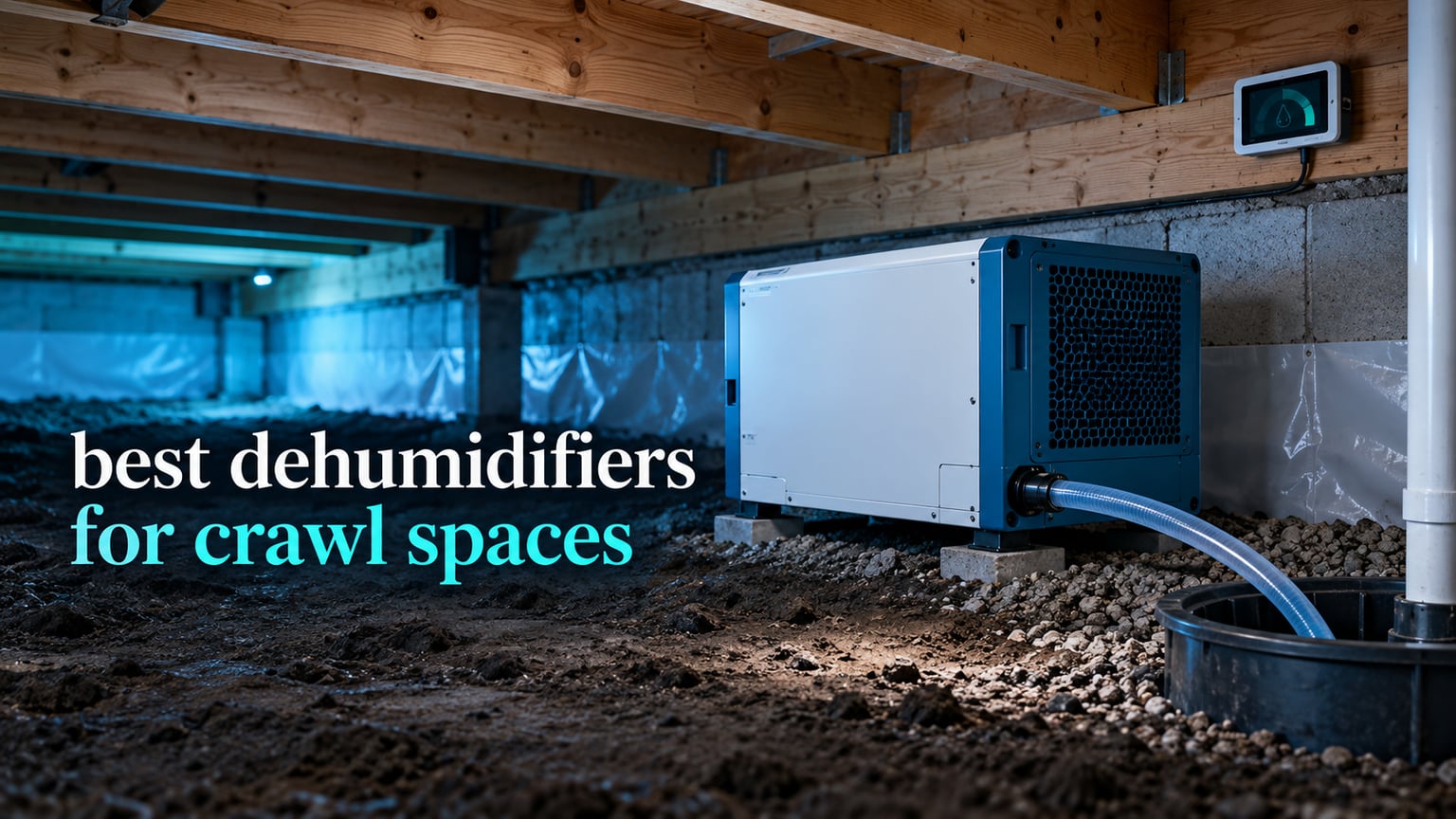
A crawl space is the least forgiving room in a house. It is a few feet tall, it is cold, it sits on damp soil, and nobody is standing down there to empty a bucket or notice when the machine has quit. That combination is why the best dehumidifiers for crawl spaces are commercial machines with low-temperature compressors, continuous drainage, and a body slim enough to fit through a standard access hatch.
We put eight of them through their specs, review histories, and real-world constraints to work out which one fits which crawl space. Every model below is a commercial-format unit rated for unattended operation, and each one documents how it removes water. The short version: if your crawl space has a low point, gravity drainage and high capacity win. If it does not, you need a built-in condensate pump. If it sits in a genuinely cold climate, read the low-temperature and defrost details carefully, because that is where most cheap choices fail.
If your moisture problem is upstairs rather than under the house, our guides to the best dehumidifiers for basements and the best dehumidifiers for bedrooms cover different rooms and different sizing math. For compact apartments and tight living quarters, we also tested the best Korean dehumidifiers side by side.
Top 3 Picks For Best Crawl Space Dehumidifier Picks for 2026

AlorAir Sentinel HD55
- 113 pints saturation
- 53 pints AHAM
- Up to 1200 sq. ft.
- Tankless continuous drain
- Automatic defrost

Moiswell Defender M145
- 155 pints saturation
- 70 pints AHAM
- Covers up to 6000 sq. ft.
- Energy Star certified
- Low-profile joist-friendly body

Best Dehumidifiers for Crawl Spaces in 2026
Here is the short list before the detail. If you only read one section, read this one.
Best overall: AlorAir Sentinel HD55 – 113 pints saturation capacity, 53 pints at the AHAM standard, handles up to 1,200 sq. ft., and a compact body that clears most crawl space hatches without turning sideways.
Best value for large crawls: Moiswell Defender M145 – 155 pints saturation, 70 pints AHAM, up to 6,000 sq. ft., Energy Star certified, and a horizontal body made to sit between floor joists.
Best on a budget: Yaufey 70 Pint – 70 pints per day, 5,000 sq. ft. rated coverage, and the lowest power draw we found at 265W.
Best when there is no gravity drain: AlorAir Sentinel HD35P – 70 pints with a built-in pump that lifts condensate 19.6 feet.
Best for monitoring without entering the space: Waykar 158 Pint – a 32.8 ft wired remote and a 16.4 ft humidity sensor cable.
Then there is the one model with the highest satisfaction score in the lineup. The Moiswell Defender MP145 carries a 4.6 rating and matches the M145’s capacity while adding a 16.5 foot pump lift.
| Product | Specifications | Action |
|---|---|---|
| AlorAir Sentinel HD55 |
|
Check Latest Price |
 Aiusevo AS610 Aiusevo AS610 |
|
Check Latest Price |
| Moiswell Defender M145 |
|
Check Latest Price |
 Waykar 158 Pint Waykar 158 Pint |
|
Check Latest Price |
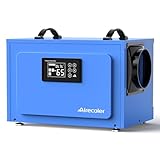 Airecoler GT-X5 Airecoler GT-X5 |
|
Check Latest Price |
| Yaufey 70 Pint |
|
Check Latest Price |
 Moiswell Defender MP145 Moiswell Defender MP145 |
|
Check Latest Price |
 AlorAir Sentinel HD35P AlorAir Sentinel HD35P |
|
Check Latest Price |
1. AlorAir Sentinel HD55 – Best Overall for Tight Crawl Spaces
ALORAIR 113 Pints Crawlspace Dehumidifier for Commercial, Sentinel HD55
53 pints per day AHAM
Up to 1200 sq. ft.
13.3 in tall
41.7 lbs
Tankless auto-drain
Pros
- Compactest body in the group at 19.2 by 12.2 by 13.3 in
- Tankless design with automatic continuous drainage
- Rugged metal casing with carry handle
- MERV-1 filter
- 6-year limited warranty
Cons
- Evaporator coils ice up often and trigger heavy defrost cycling
- Audible during continuous operation
- Replacement MERV-1 filters are pricey
- Some reports of refrigeration failure within roughly two years
The HD55 is the machine we keep coming back to, and the reason is physical rather than marketing. At 19.2 inches deep by 12.2 wide by 13.3 high, it clears almost any crawl space hatch and most joist bays without you having to turn it sideways.
It runs a true tankless design. Water leaves through a continuous drain line and there is no bucket to fill, which matters because nobody empties anything in a space sealed behind a door.
Installers on r/basement describe AlorAir as the model they reach for again and again for crawl spaces, and that reputation lines up with the review base here: 1,211 reviews averaging 4.3 stars is the largest body of feedback in this group.
Owners also report that the HD55 pulled a basement from 65 percent relative humidity to under 50 percent within a day, which is the kind of result that tells you the evaporator is working hard rather than short-cycling.
How it behaves when the crawl space drops below 60 degrees
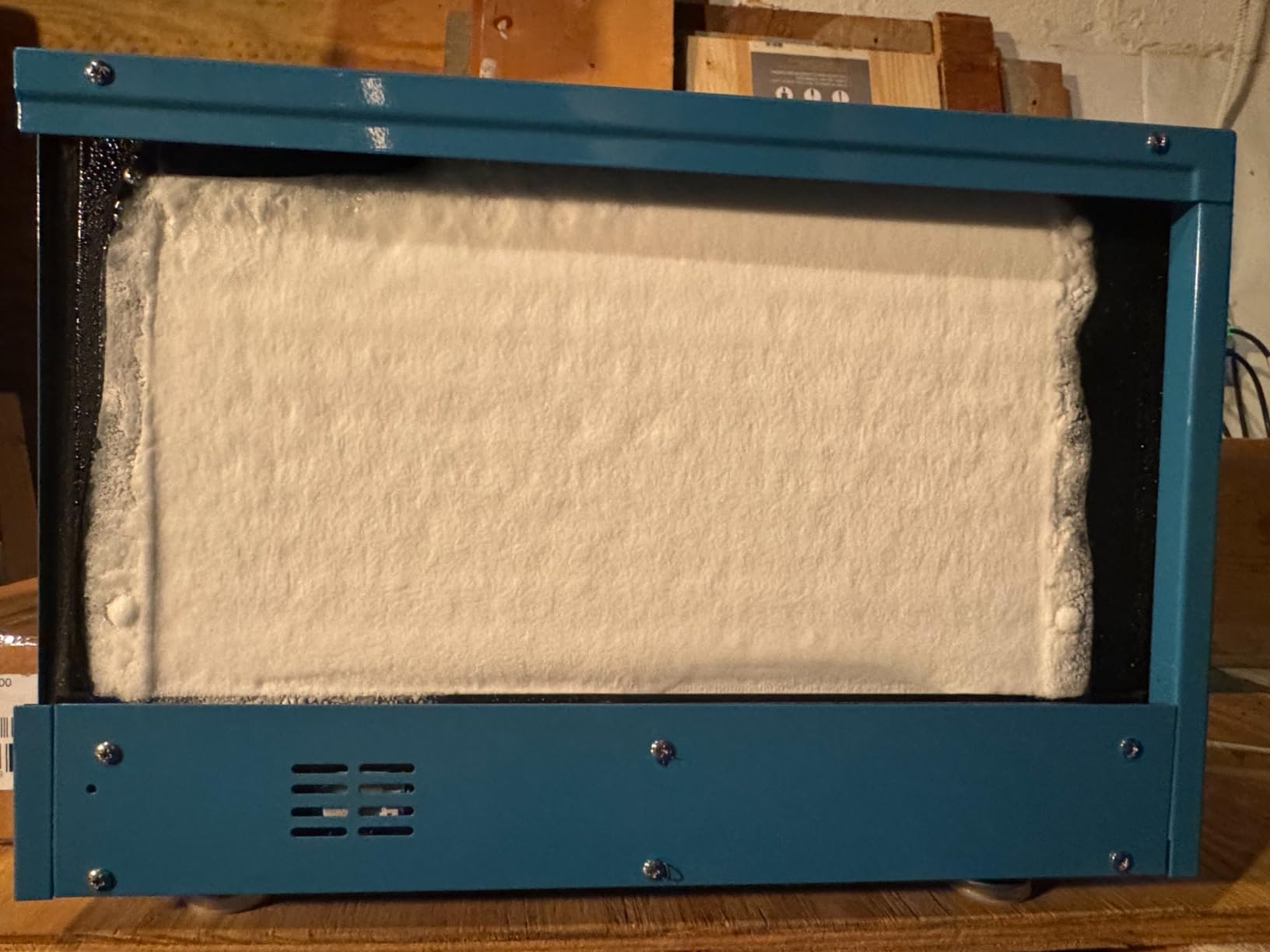
Below roughly 60 degrees the evaporator coil is close to freezing, and frost is the single biggest reason crawl space dehumidifiers quit. The HD55 uses temperature-sensor automatic defrost, which periodically reverses the cycle to clear the coil and resumes normal extraction.
That recovery takes real time, and a recurring minority of reviews report frequent icing and reduced output compared with the headline capacity number. If your crawl space holds under 55 degrees all winter, defrost downtime is a bigger factor than the pints-per-day figure.
What the 113-pint number actually means for your crawl
The 113 pints is a saturation figure measured at 95 degrees and 90 percent relative humidity. The 53 pints is the AHAM standard, measured at a lower, more realistic temperature and humidity. Both numbers are honest; they just describe different test conditions.
For a sealed crawl space at a steady 60 percent, plan on something closer to the AHAM figure than the saturation figure. The stated coverage of 1,200 sq. ft. is a reasonable match for a crawl space in that range.
2. Aiusevo AS610 – Best When You Want Both Drainage Options
130Pints Crawl Space Dehumidifier with Pump and Drain Hose up to 6500 Sq.Ft
130 pints per day
265 CFM airflow
Built-in pump plus gravity hose
51 lbs
Touchscreen panel
Pros
- Pump and gravity drainage in one machine
- 16.4 ft pump hose plus 6.6 ft gravity hose
- Touchscreen panel with timer and temperature readout
- Ductable 6 inch outlet opens up whole-house distribution
- 265 CFM airflow handles large damp areas
Cons
- Some reports of unreliable power-on needing a replug
- Settings may not persist across power cycles
- Only a 2-year warranty
- Modest humidity reduction reported in very large spaces
The AS610 ships with both drainage paths in the box. You get a 16.4 foot pump discharge hose for when there is no low point, and a 6.6 foot gravity hose for when there is.
That flexibility solves the most common install headache. If you have not yet dug a drain line, you can start on the pump and decide later without replacing the machine.
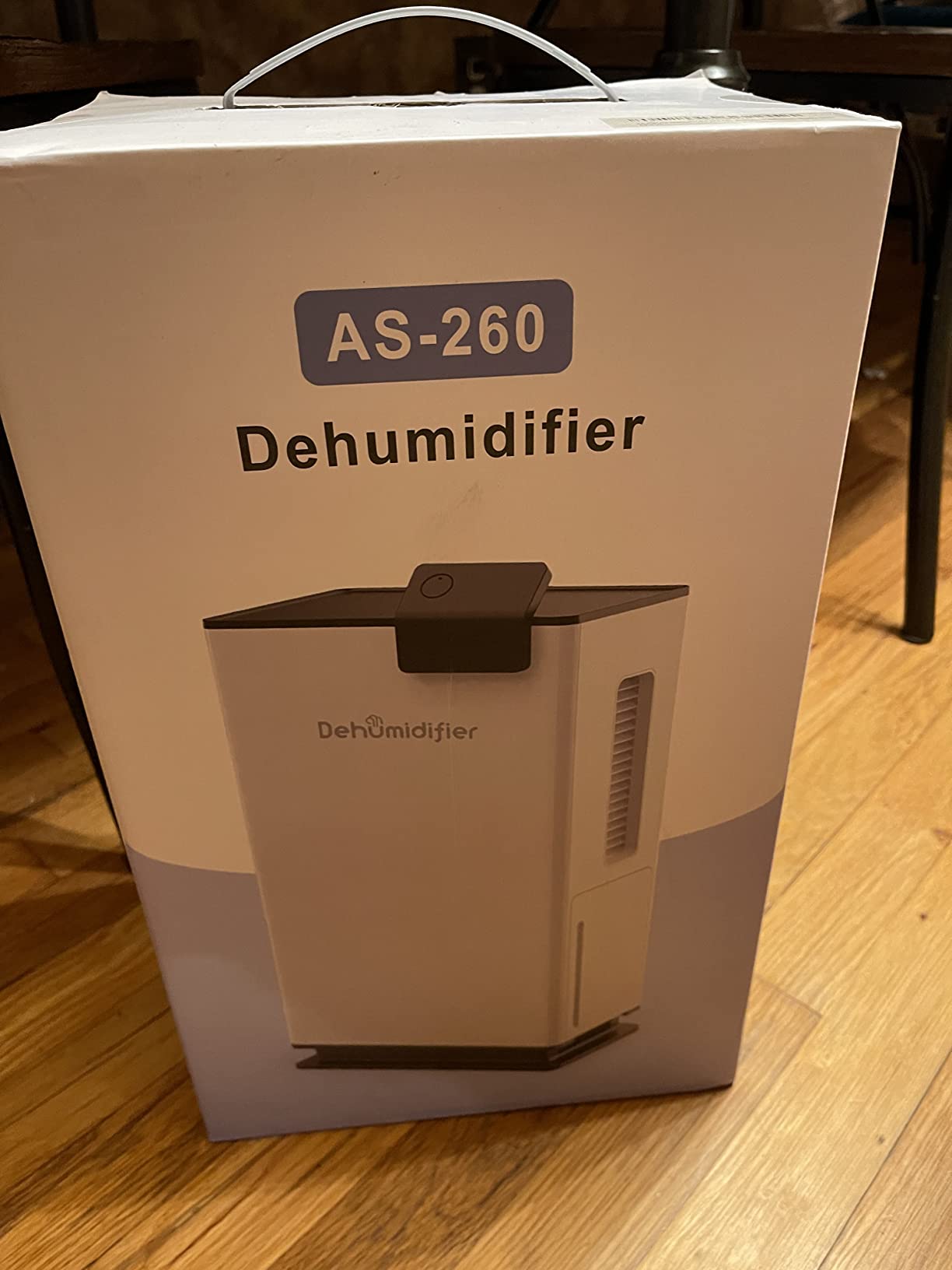
At 265 CFM the airflow moves a lot of air for a crawl space machine, and buyers report fast, visible moisture collection in small and medium spaces. The 6 inch ductable outlet is unusual at this capacity and lets one machine feed a distribution run.
At 51 pounds and 17.5 inches tall, this is one of the deeper machines in the lineup, so check your clearance before committing.
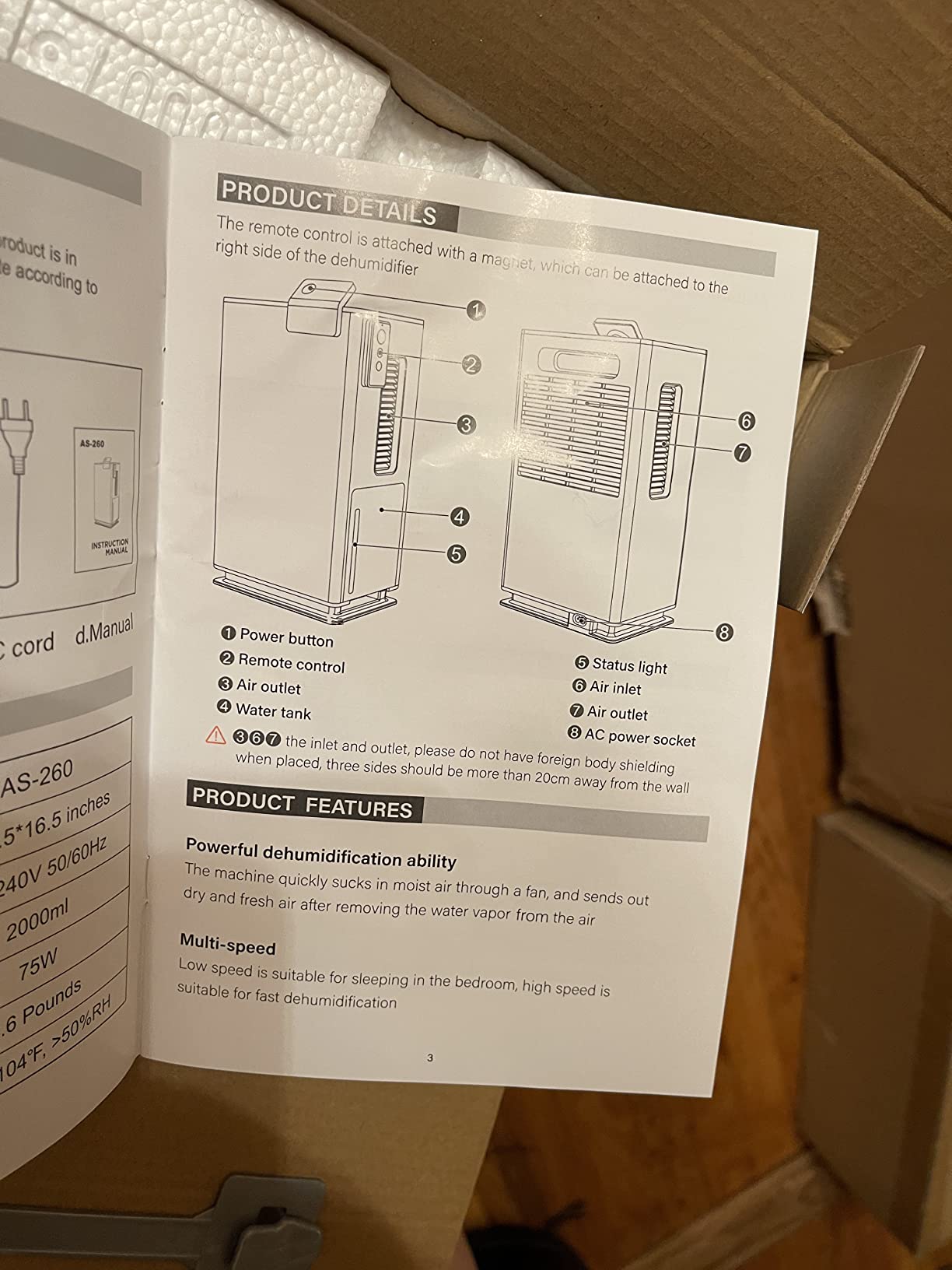
Why the warranty length matters more than usual here
A crawl space dehumidifier runs unattended for months at a stretch in conditions that are damp, dusty, and cold. A 2-year warranty on this model is the shortest in the group, and every other machine in this list runs 5 to 6 years.
That is the trade you make for the dual drainage and the ductable outlet. If you are installing this in a space you cannot easily reach, the shorter coverage is a real cost.
What to check before you order
Reviewers flag two recurring issues: some units need to be replugged to power on reliably, and panel settings sometimes fail to hold after a power cycle. Auto restart is listed, but memory of your setpoint is the part that has gaps.
Both are manageable if you program the humidistat before you seal the hatch and check back after the first storm, rather than trusting the panel months later.
3. Moiswell Defender M145 – Top Rated for Large Crawl Spaces
Moiswell 155 Pint Commercial Dehumidifier with Drain Hose for Crawl Spaces
70 pints per day AHAM
Up to 6000 sq. ft.
265 CFM airflow
63 lbs
Energy Star
Pros
- 4.5 star average across 500 reviews
- High capacity paired with Energy Star efficiency
- Slim horizontal body fits between floor joists
- Auto defrost with gravity auto-drain
- 24-hour timer and auto restart
Cons
- Heavy at 63 lbs and the second-hardest lift in this group
- Gravity drain only so placement height matters
The Defender M145 is the pick for a big crawl space with a real low point. It pulls 155 pints at saturation and 70 pints at the AHAM standard, moves 265 CFM of air, and covers up to 6,000 sq. ft.
It is Energy Star certified, which matters for a machine that will run for most of a day, most days of the humid season. Reviewers put the M145 at a 4.5 average across 500 reviews, and the complaints that show up are almost entirely about handling rather than performance.
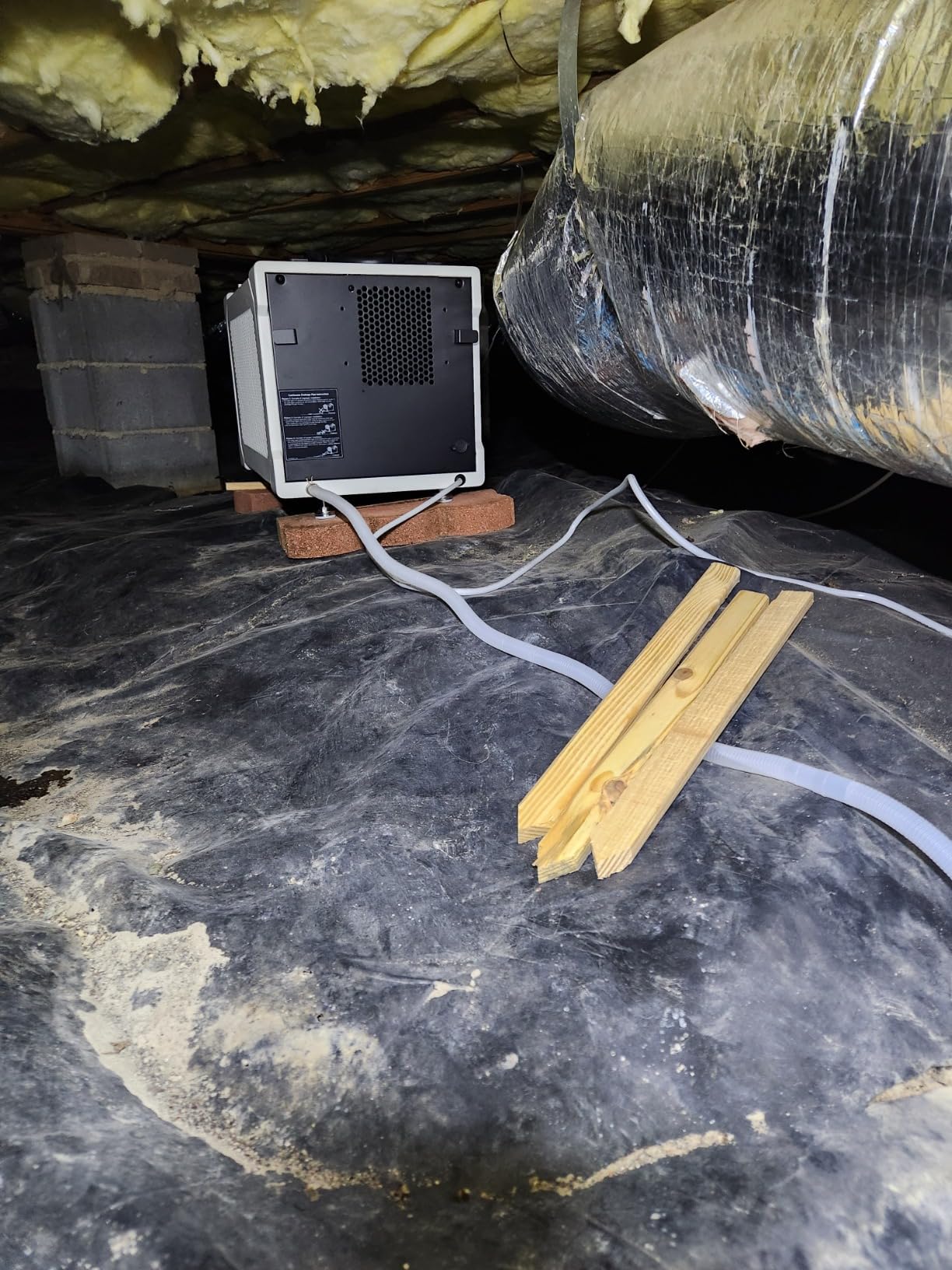
Reviewers also report the M145 taking a crawl space from 66 percent humidity to 53 percent in minutes, which fits a machine of this capacity class working against a saturated air mass.
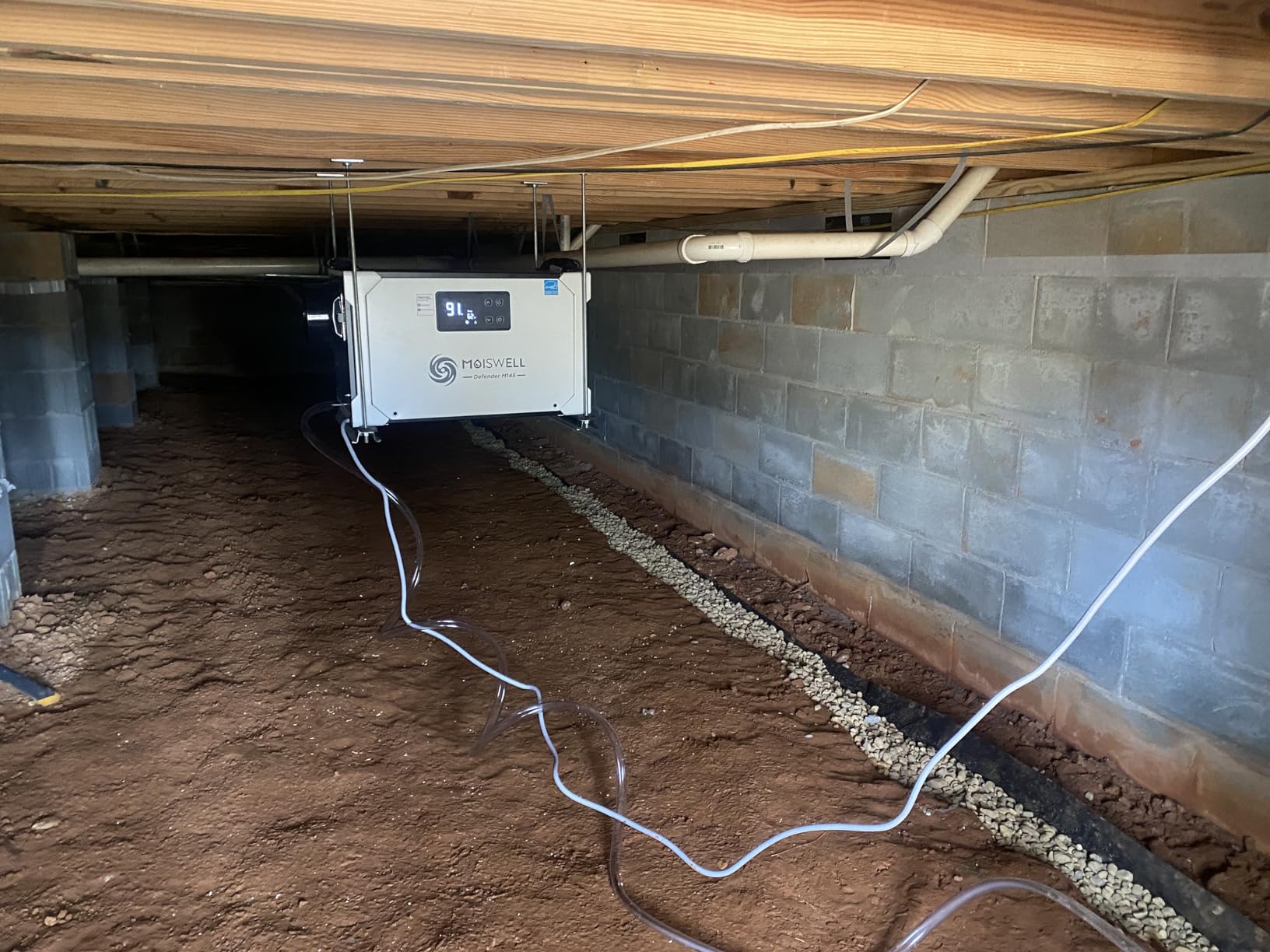
The body is 22.5 inches deep, 14 wide, and 14.7 high, laid out horizontally. That shape is not an accident; it is meant to sit between 2 by 6 floor joists or along a foundation wall without stealing usable height.
Whether the gravity drain rules it out for you
This machine drains by gravity, which means the drain outlet must sit above the destination. If your sump, floor drain, or exterior drywell is higher than the crawl floor, this model will not solve the problem on its own.
Placement also affects output. Sit the unit too low and the drain line runs uphill and backs up. Owners who report trouble with this unit mention needing a proper low point and enough fall in the line.
How it pairs with joist suspension
The horizontal layout means most people suspend or brace the M145 between joists rather than standing it on the soil. Mounting it clear of the ground also protects the casing from splash-back during flooding events.
At 63 pounds it is a two-person lift through a crawl space hatch. Measure your access opening and plan the route before the unit arrives, because maneuvering it around a rim joist is the part that goes wrong.
4. Waykar 158 Pint – Best for Monitoring Without Entering the Space
Waykar 158 Pints Crawl Space Dehumidifier with Remote Control and Pump, Dual Duct HVAC Commercial Whole-House Dehumidifier for Basement, Industry Water Damage Unit – 5-Year Quality Coverage
158 pints per day
Up to 7500 sq. ft.
Pump lift to 16.4 ft
70.9 lbs
Wired remote included
Pros
- Highest stated capacity in the lineup at 158 pints per day
- 32.8 ft remote control keeps you out of the damp space
- 16.4 ft humidity sensor cable for true remote readings
- Built-in pump and gravity hose both included
- Dual duct intake and outlet supports HVAC integration
Cons
- Heaviest unit here at nearly 71 lbs
- Humidity sensor must be mounted for automated functions
- Premium tier relative to comparable capacity
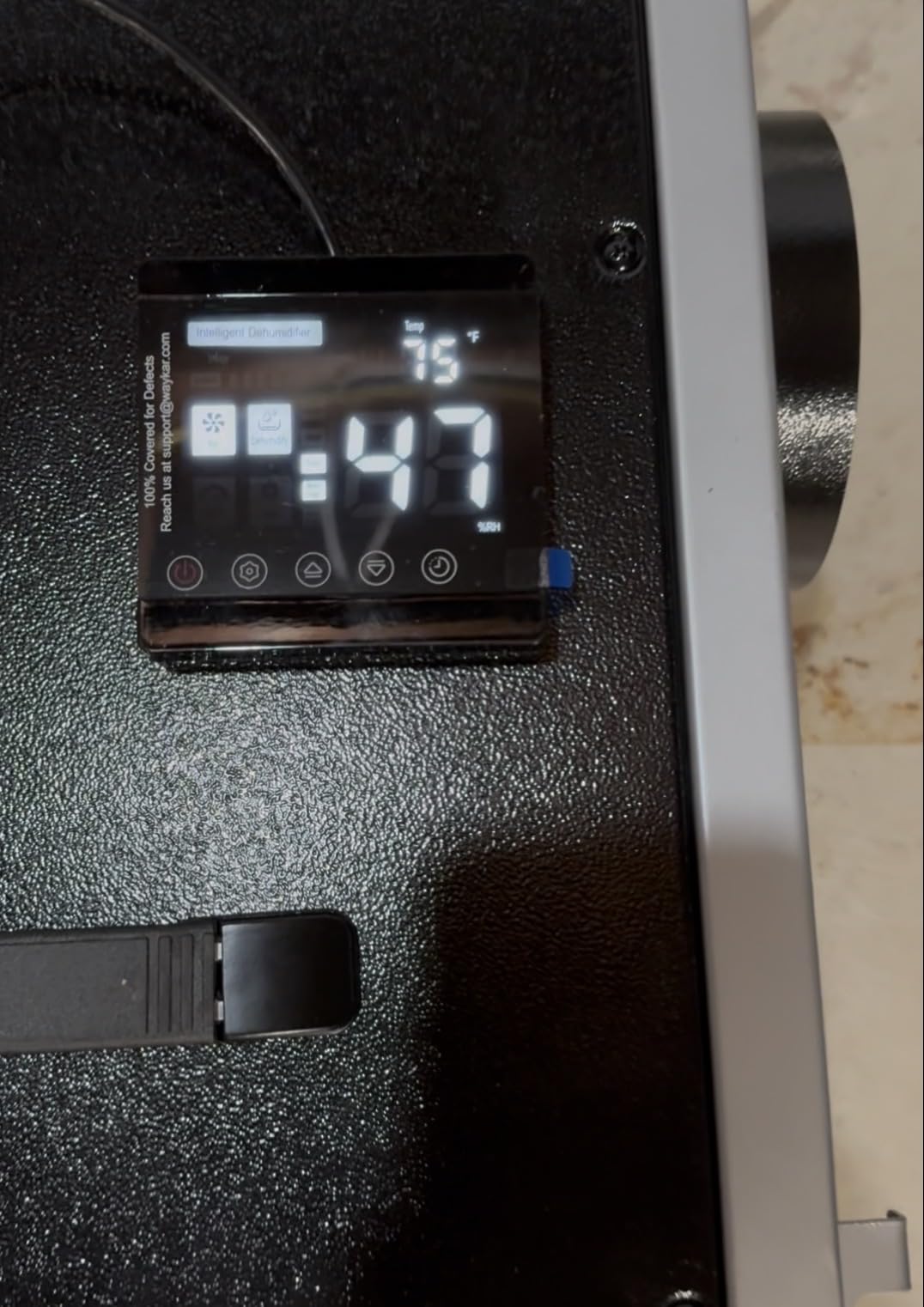
The Waykar is built around a simple idea: you should not have to climb into a crawl space to find out what the humidity is doing. It ships with a 32.8 ft wired remote control and a 16.4 ft humidity sensor cable you can run up to a finished room.
Capacity is the highest stated figure here at 158 pints per day, with coverage up to 7,500 sq. ft. and 206 CFM of airflow from a brushless motor, adjustable from 10 to 90 percent relative humidity.
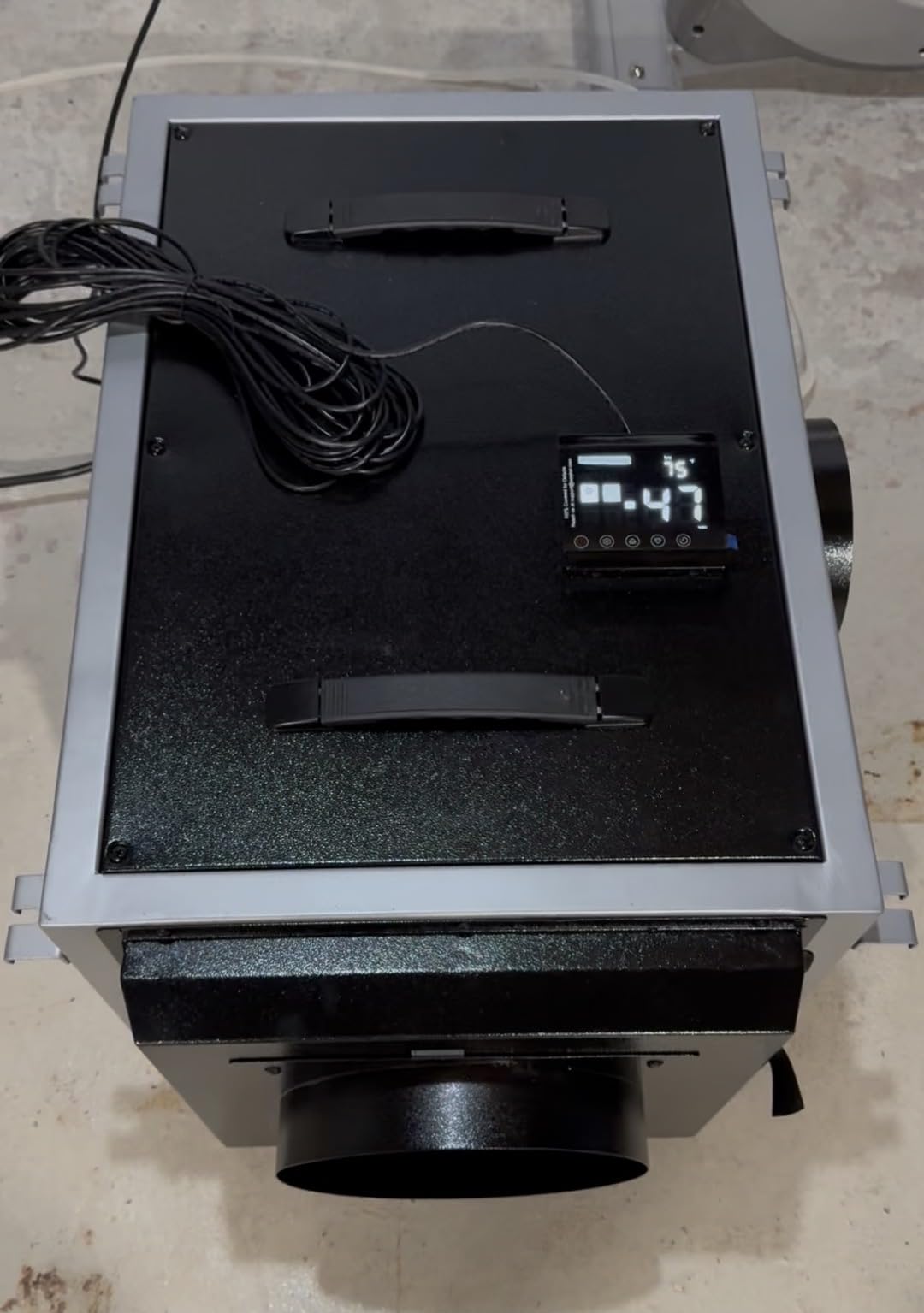
Buyers point to the pump as the practical advantage. It lifts condensate 16.4 feet vertically, which clears a typical rim joist and gives you routing freedom when no gravity low point exists.
The box is unusually complete: pump, both hose lengths, remote, sensor, and a removable washable filter all ship together. Nothing extra to source before the install.
What the dual duct design changes
The separate ducted inlet and outlet mean this unit can pull air from one part of a space and deliver conditioned air to another, or tie into a whole-house distribution system. That is how one machine can cover a crawl space and an unfinished basement with the same ductwork.
If your project is a single sealed crawl with no HVAC plan, you can ignore this and just use the free-air intake and outlet.
Where the installation gets awkward
At nearly 71 pounds this is the heaviest machine in the lineup, and its 24.4 inch width makes it the widest as well. It needs a planned path in through the access hatch, and probably a second person on the other side.
The humidity sensor also has to be mounted in the space for the automated cycling functions to work. Skip that step and the unit is running without the feedback loop that makes it worth buying.
5. Airecoler GT-X5 – Best for Tight Footprints with Big Capacity
Airecoler 125 Pints Commercial Dehumidifier for Crawl Space & Basement
60 pints per day AHAM
Up to 6000 sq. ft.
19.2 in deep
R32 refrigerant
50 lbs
Pros
- Compact 19.2 by 12.2 by 13.4 in body fits low-clearance crawls
- R32 refrigerant system with lower power draw
- 125 pints saturation and 60 pints AHAM
- Auto drain
- auto defrost and 24-hour timer
- 5-year warranty coverage
Cons
- Gravity drain only in this configuration
- 830W draw is among the highest here
- Smaller review base than the leading picks
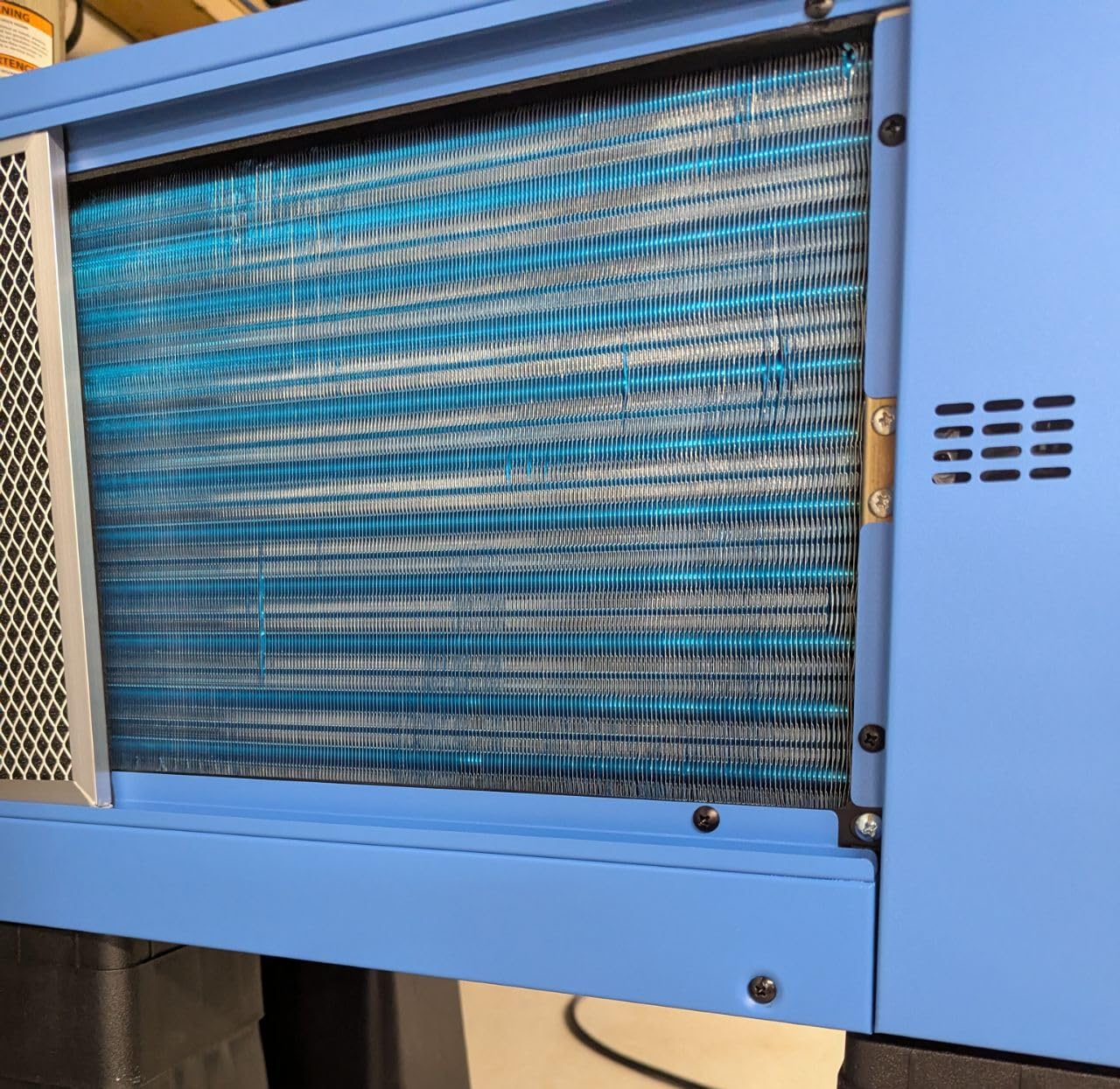
The GT-X5 packs 125 pints of saturation capacity into a body that is 19.2 inches deep and 13.4 inches tall. That is the same general footprint as much smaller machines, which makes it a good answer to a shallow crawl space.
It rates 4.4 stars across 290 reviews, and the R32 refrigerant system is the quiet differentiator. R32 has a lower global warming potential than the older R410 designs and is what a growing number of manufacturers have moved to.
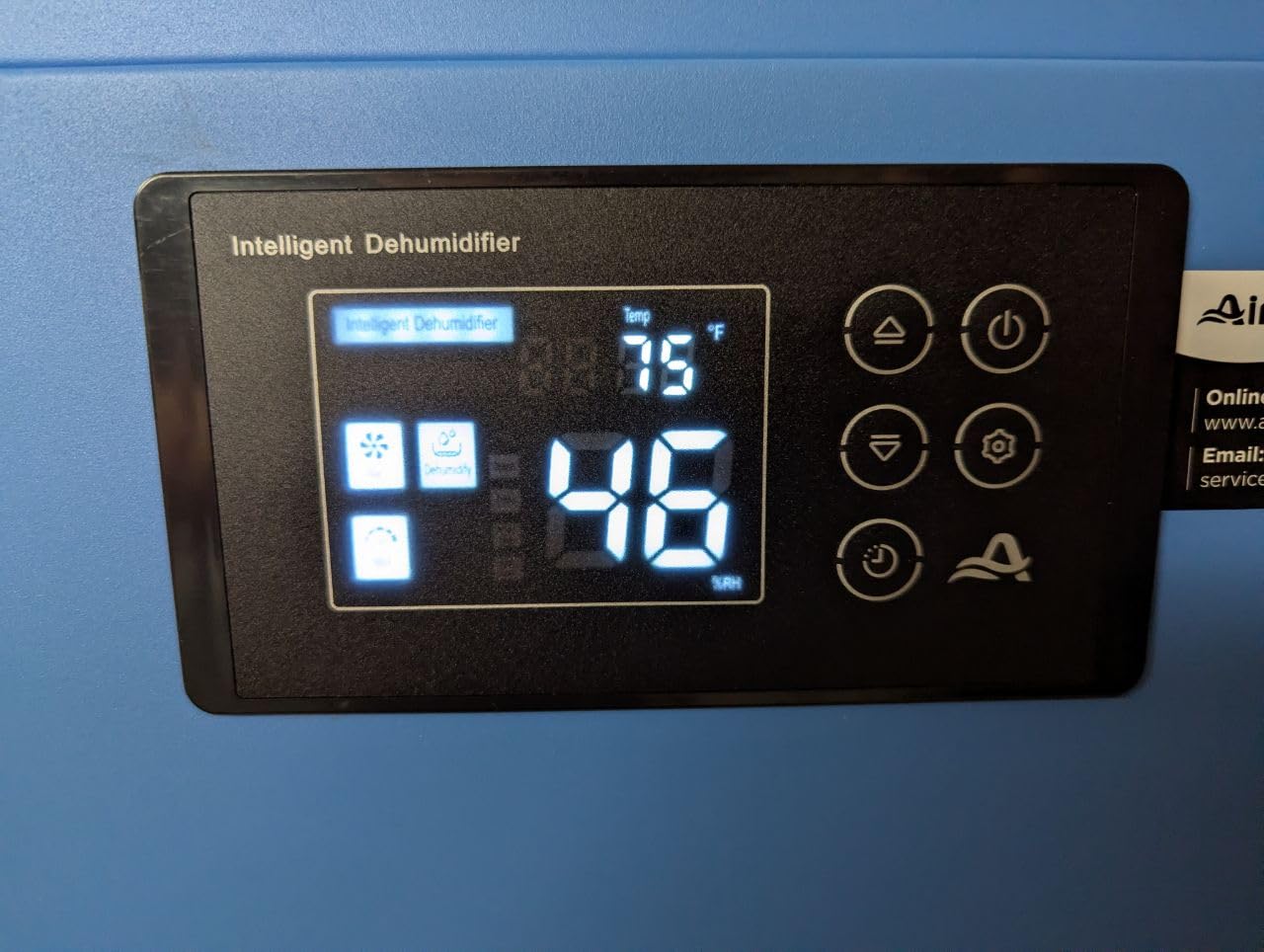
Auto drain, automatic defrost, a 24-hour timer, and auto restart after a power outage all come standard, along with a 6.56 foot drain hose and a memory start function so the unit resumes at your last setting.
Reviewers consistently mention strong drying for the money and a body that fits where larger machines will not.
The energy question with an 830W draw
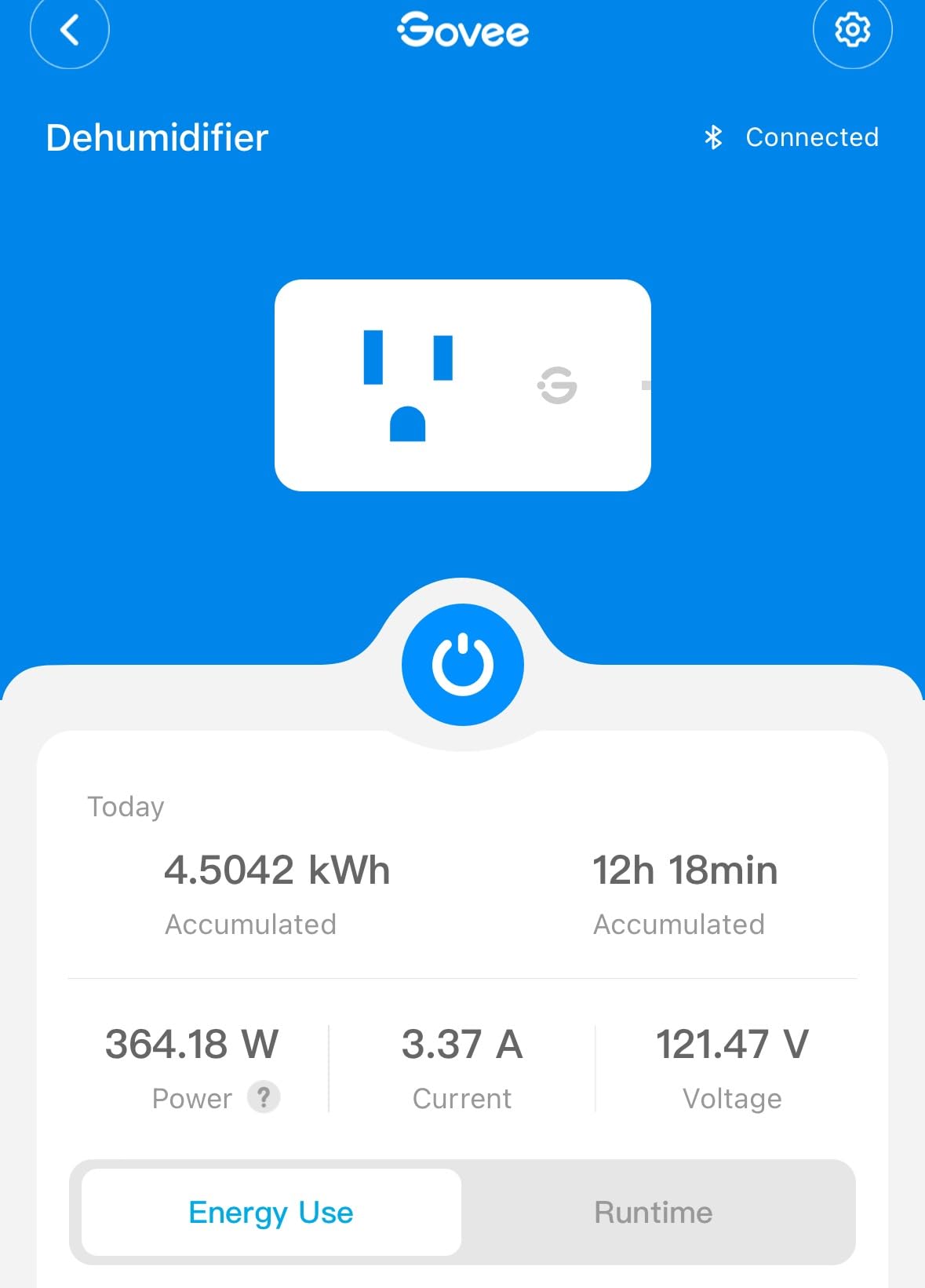
This unit draws 830 watts, near the top of the range in this lineup. At a full 10 hours of run time that is about 8.3 kWh a day, so multiply by your own utility rate to see the monthly figure.
Energy-conscious buyers running a unit in a small crawl should look at the lower-draw picks in this category instead. Larger spaces that need the capacity tend to accept the draw because the machine reaches setpoint faster and cycles off more often.
Checking whether the drain works for you
This configuration is gravity drain only. If your crawl has a low point and you can run a hose with fall to a sump, drywell, or exterior drain, it works fine.
If there is no low point, look for the pump variant of this model rather than trying to raise the machine on a stand. Raising the unit reduces the head pressure and cuts real-world output.
6. Yaufey 70 Pint – Budget Pick for Smaller Crawl Spaces
Yaufey 70 Pints Energy Star Commercial Dehumidifier with Drain Hose for 5000 Sq. Ft. Crawl Space, Basement, Industrial, 10-90% RH Humidity Control, 24/7 Continuous Drainage,TUV Certified,5-Yr Coverage
70 pints per day
Up to 5000 sq. ft.
265W draw
Energy Star
41.3 lbs
Pros
- Lowest power draw in the group at 265W
- Energy Star and TUV certified with R32 refrigerant
- Shallow 12.99 in depth suits tight crawls
- Wide 10 to 90 percent RH control range
- All-metal housing
- 5-year compressor coverage
Cons
- Gravity drain only with no built-in pump
- Modest 70 pints capacity for larger spaces
- 4.2 average with a 13 percent one-star share
- Smallest review base at 211
The Yaufey is the entry point that still gets the two things a crawl space demands: automatic defrost and continuous gravity drainage. It runs 70 pints per day and is rated for up to 5,000 sq. ft.
What makes it interesting is efficiency. At 265 watts it draws roughly a third of what some machines in this list use, and it is both Energy Star and TUV certified.
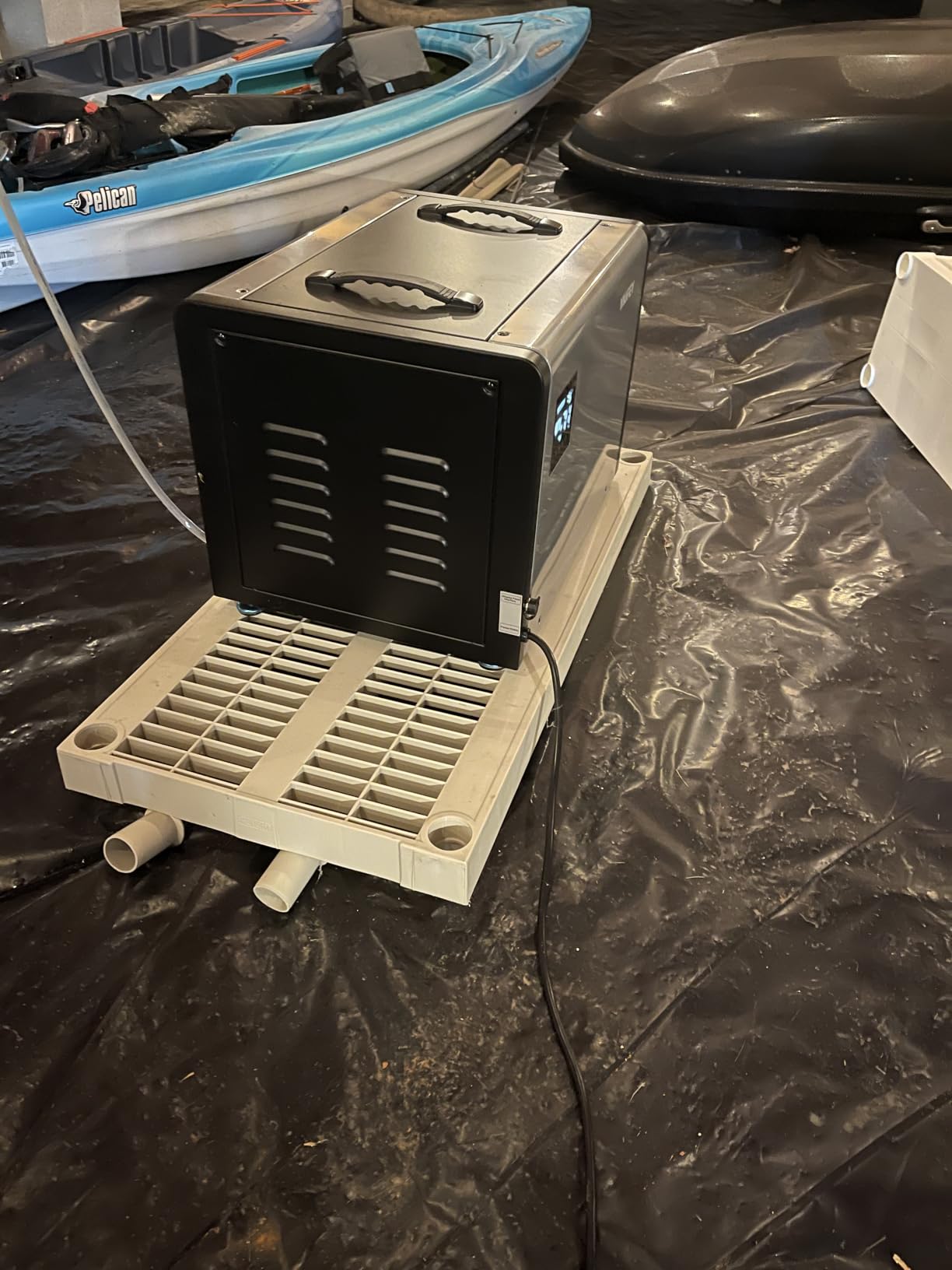
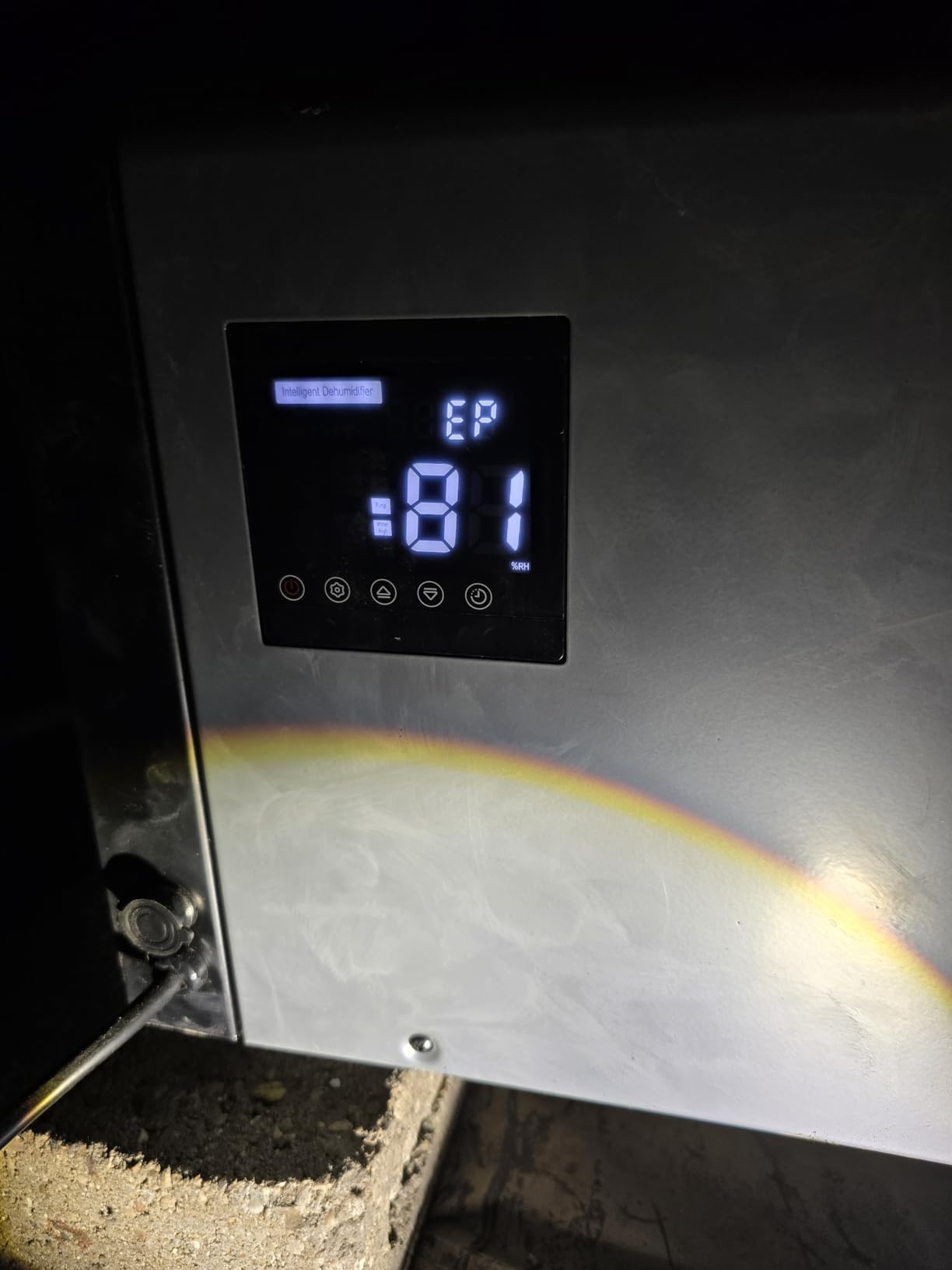
The body is only 11.81 inches tall and 12.99 inches deep, so it handles shallow crawl spaces and can sit freestanding, on a shelf, or mounted near joists depending on your clearances.
Buyers value the low draw and the compact footprint for budget installs. At 4.2 stars across 211 reviews, it sits near the bottom on rating, and 13 percent of its reviews are one-star.
Where 70 pints is enough and where it is not
Against a closed crawl space of roughly 800 to 1,000 sq. ft. sitting near 60 percent humidity, 70 pints of capacity is workable. Most crawl spaces that size are pulling air through a semi-sealed envelope, not open soil.
Once you move past about 1,200 sq. ft., or if the space is vented and pulling humid outside air, 70 pints becomes a machine that runs continuously and never reaches setpoint. Persistent short-cycling is the symptom to watch for.
What the 4.2 rating tells you
Owners point to modest capacity relative to the space and the absence of a pump as the main reasons for one-star reviews here, at 13 percent of the total.
The 10 to 90 percent RH control range is wider than typical home units and there is a 3-minute compressor delay to protect the machine on restart, so the controls are better than the average score suggests.
7. Moiswell Defender MP145 – Best for Uphill Drainage on a Big Crawl
Moiswell 155 Pints Commercial Dehumidifier with Pump for Crawl Space
70 pints per day AHAM
Up to 6000 sq. ft.
16.5 ft pump lift
R32 system
64 lbs
Pros
- Highest average rating here at 4.6 with 83 percent five-star
- Built-in pump lifts condensate 16.5 ft
- Same capacity and airflow as the non-pump Defender
- R32 refrigerant system
- Automatic defrost and auto restart
- 5-year limited warranty
Cons
- Costs more than the comparable gravity-drain Defender
- Review base of 189 is the thinnest here
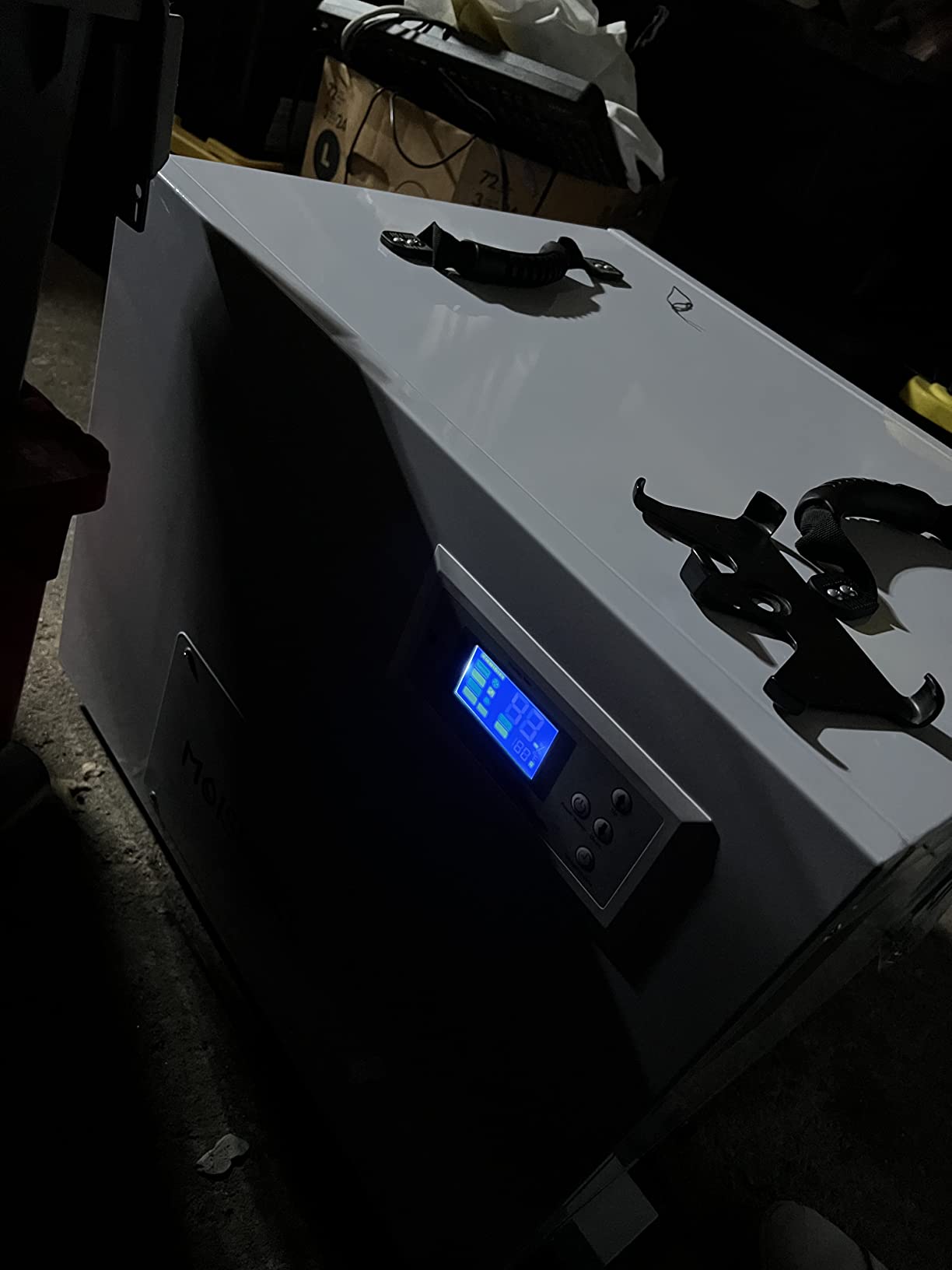
The MP145 is the M145 with a pump added, and it carries the highest satisfaction score in this group: 4.6 stars, with 83 percent of reviews at five stars.
The capacity figures match the gravity version at 155 pints saturation and 70 pints AHAM, with 265 CFM airflow and coverage up to 6,000 sq. ft. The pump lifts condensate 16.5 feet vertically through a 16.5 foot hose.
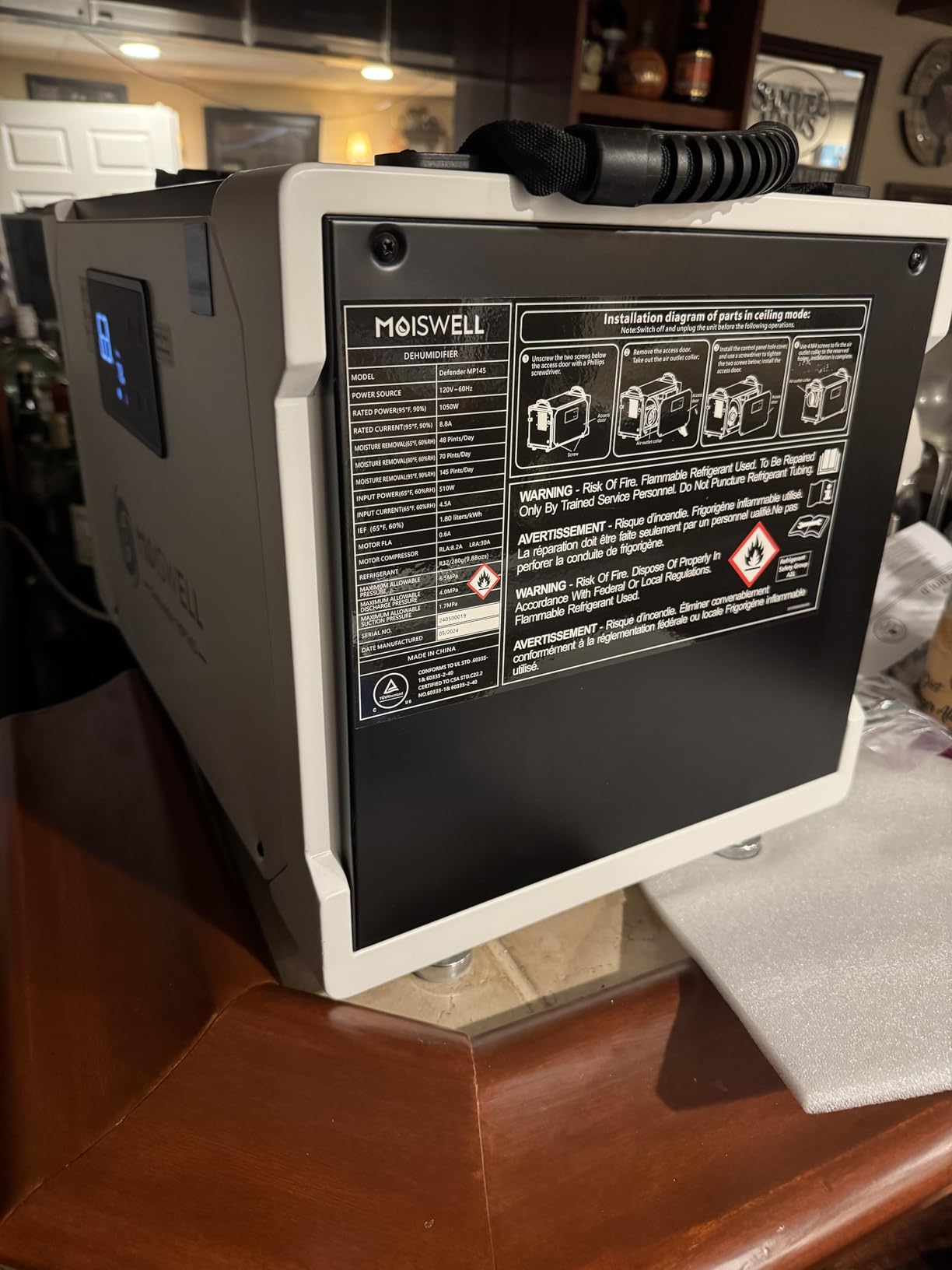
That lift height is the whole reason to choose this model. A crawl space floor is often the lowest accessible surface in the house, so the water still has to go somewhere higher, and a gravity line has nowhere to go.
The R32 dehumidification system improves efficiency over older R410 designs, and automatic humidity cycling plus auto restart handle unattended weeks without intervention.
Whether to pay up over the gravity version
If your crawl has a genuine low point, the M145 does the same job for less and skips the pump entirely. Choose the MP145 only when drainage geometry forces water upward.
The warranty is a 5-year limited term: 2 years on the full unit and 3 additional years on the dehumidification system, matching what Moiswell offers on the non-pump model.
What a smaller review history means for you
At 189 reviews, this is the shortest review history among the eight picks. The 4.6 average is encouraging, but a smaller sample means less long-term failure data than the 1,211-review HD55 has accumulated.
That is a reasonable trade for a pump-equipped machine at this capacity. Just factor in the tank, which is listed at 68 liters, and plan a gravity backup in case the pump ever stops.
8. AlorAir Sentinel HD35P – Best for Crawl Spaces Under 1,000 Sq. Ft.
ALORAIR 70 PPD Dehumidifier with Pump for Crawl Space and Basement
35 pints per day AHAM
Up to 1000 sq. ft.
19.6 ft pump lift
38.2 lbs
Under 50 dB
Pros
- Lightest unit in the group at 38.2 lbs
- Built-in pump with the longest lift in the group at 19.6 ft
- Documented operation under 50 dB
- cETL listed with a 6-year limited warranty
- Auto restart after power interruption
Cons
- 70 pints saturation and 35 pints AHAM covers about 1000 sq. ft.
- 4.0 average with 16 percent one-star reviews
- More durability complaints than the top-rated picks
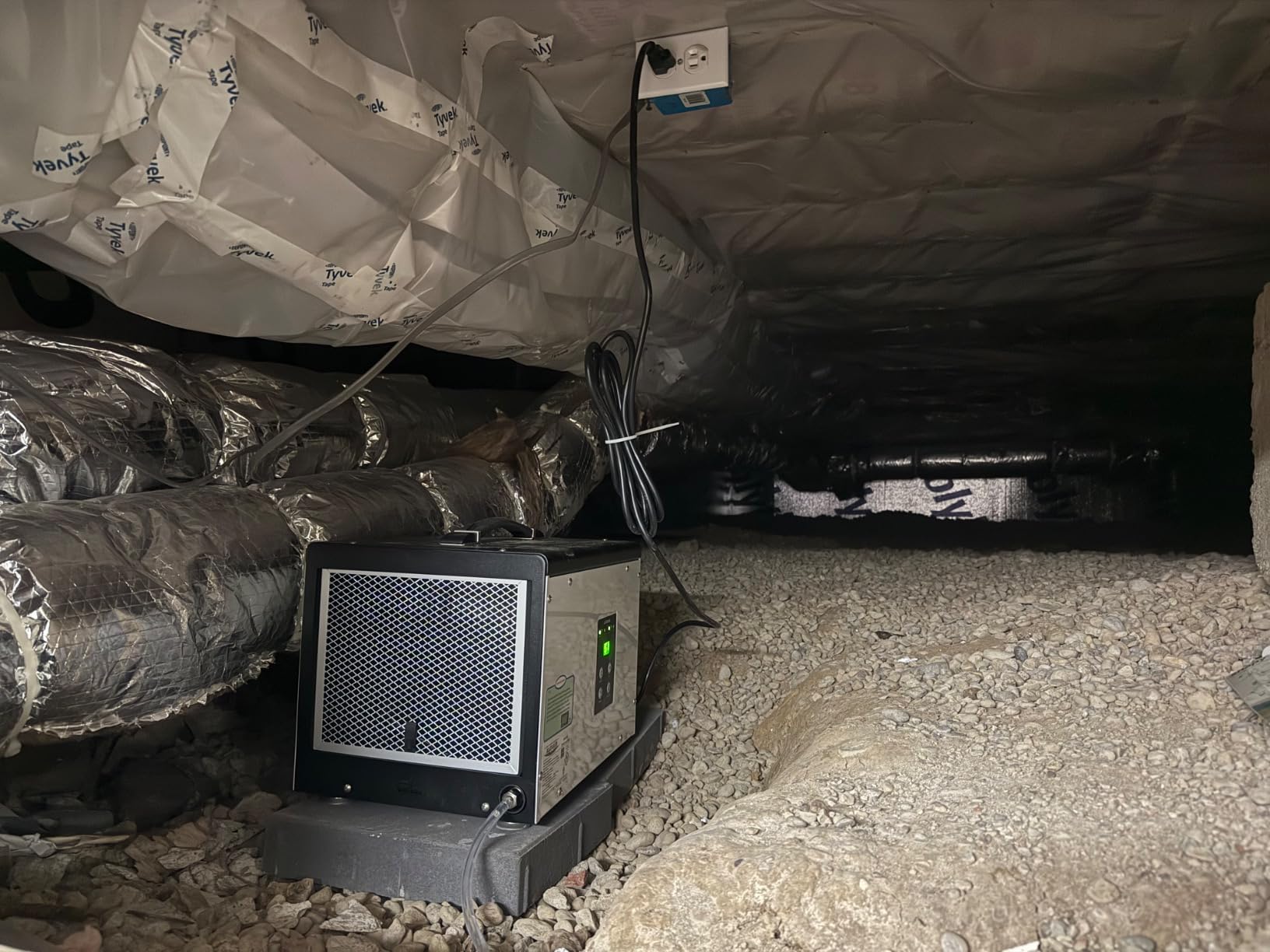
The HD35P is the small-space answer. At 38.2 pounds and 15.2 by 11.2 by 11.4 inches, it is the easiest machine in this list to carry in through a small hatch, and its listed sound level sits under 50 dB.
Despite the 70-pint headline, the pump is the real feature. Its 19.6 foot vertical lift is the longest in this group, paired with a 19.6 foot drain hose, so it handles the uphill drainage case better than anything else listed.
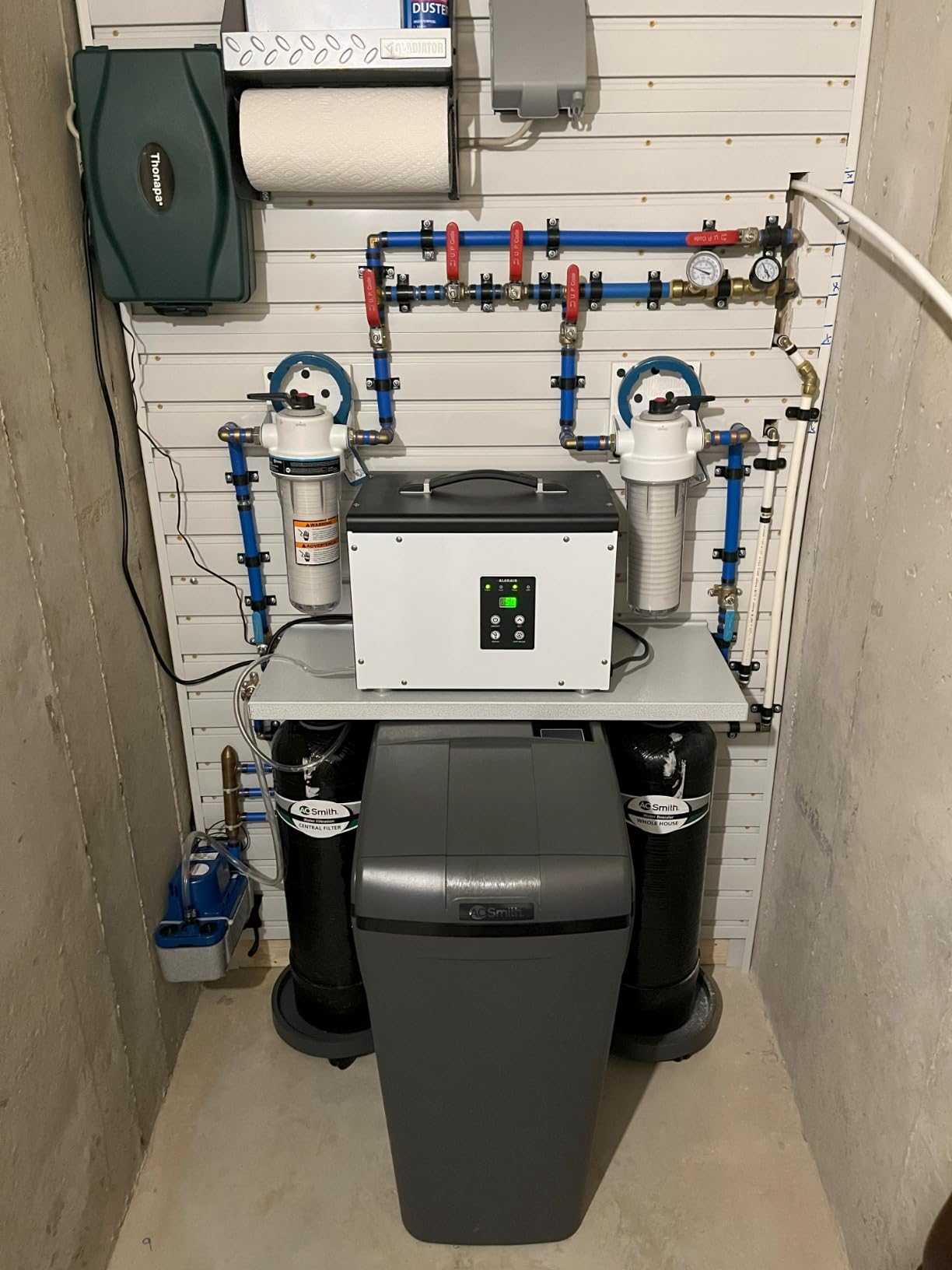
For a crawl space of about 1,000 sq. ft. or less, the 35-pint AHAM rating is adequate. Reviewers like the quiet, compact build and the pump strength.
The 4.0 average across 773 reviews is the lowest here, with 16 percent of reviews at one star. Durability and value concerns relative to its capacity class are the recurring theme.
How long 35 pints per day takes to work
Think of capacity as a rate, not a bucket size. In a sealed crawl space near 1,000 sq. ft. holding steady at 65 percent humidity, the machine needs to run a good share of each day to pull the space under 60 percent.
Once the space is sealed and dry, the load drops sharply and the unit cycles on only for the moisture coming through the soil and the wood. That is the operating pattern you want to reach.
Reading the 4.0 rating honestly
The complaints cluster around long-term durability and around the value question: a machine rated at 70 pints competing against larger units on capability. Both are fair criticisms at this size.
What tips the balance for many buyers is the 6-year limited warranty, the cETL listing, and the MERV-1 filter. That combination of documented service life and clean air handling is not universal at this capacity.
How to Choose a Crawl Space Dehumidifier in 2026
Sizing, drainage, and cold-weather behaviour decide almost everything. Here is how to think through each one before you order.
Size by pints per day, not square footage
Coverage claims in this category are optimistic, because they assume a sealed, well-insulated space. Size on the AHAM pints-per-day rating instead, which is measured under conditions closer to what a crawl space actually sees.
A workable rule: allow roughly 30 to 35 pints per day of AHAM capacity for each 1,000 sq. ft. of crawl space in a moderate climate, and more in a coastal or humid region. Round up when the space is uninsulated or has any open vents.
The failure mode is symmetric and both are bad. Undersized, the machine runs continuously, never reaches setpoint, and wears out. Oversized, it cycles on and off so often that the compressor never gets a proper run cycle, which also shortens its life.
Saturation rating vs AHAM rating: why both numbers are real
Saturation capacity is measured at 95 degrees and 90 percent relative humidity, a deliberately punishing test. AHAM capacity is measured at a lower temperature and humidity that better reflects average indoor conditions.
That is why the AlorAir HD55 can truthfully be a 113-pint machine and a 53-pint machine at the same time. Comparing a saturation number from one brand against an AHAM number from another is the single most common mistake in this category, and it is exactly the confusion dominating buyer discussion on r/basement.
Gravity drain or built-in condensate pump
Gravity drainage is simpler, uses no pump to fail, and costs nothing to run. It requires that the drain outlet sit above a drain that still slopes downhill from there.
A built-in condensate pump solves the case where no low point exists, or where the drain destination is above the crawl floor. Lift height of 16 to 20 feet covers a typical rim joist. The pump is the one component most likely to fail long-term, so keeping a gravity path as a backup is sensible where you can.
If you do not know which case you are in, the Aiusevo AS610 and the AlorAir HD35P both give you the pump option and let you decide after opening the hatch.
Low-temperature operation and auto defrost
Below about 60 degrees, the evaporator coil approaches freezing. Without defrost, the machine accumulates ice and eventually stops extracting anything.
All eight picks here use temperature-sensor automatic defrost. The difference is how often it triggers, which you generally cannot control. In a crawl space that holds 45 to 50 degrees all winter, expect the unit to spend more time in defrost and deliver less than its rated capacity.
Desiccant designs are the alternative for genuinely cold unheated spaces, since they use no cooling coil and do not freeze. None of the eight models here are desiccant machines, and that is a real limitation of this list worth naming.
Target relative humidity and run time
Keep relative humidity below 60 percent at the wood, and aim for 50 to 55 percent for the best protection against mold and rot. Above 60 percent you are in the range where mold colonies and wood-decay fungi become active.
Measure at the wood surface, not at the access hatch. Air at the door can read several points lower than air against the joists and subfloor, which is where moisture damage starts.
After the space is sealed and dry, a properly sized unit should cycle rather than run flat out. If it never shuts off, either the capacity is short or the envelope is still leaking humid air in.
Encapsulation is the other half of the job
A dehumidifier without a sealed envelope is an expensive way to dry the outdoors. If your foundation vents are still open while the machine runs, moist outside air moves in through those vents faster than the machine can remove the water.
Full encapsulation means lining the crawl walls and floor with a heavy vapor barrier, sealing vents and the access door, and adding rim joist insulation. You can do it in stages: a vapor barrier on the soil alone will slow the moisture load significantly, and it is a reasonable weekend project before you commit to the rest.
Professional encapsulation is a multi-thousand-dollar job depending on the foundation. Once you are quoting that, have the sizing done properly rather than guessing, because an oversized unit on a sealed crawl is an expensive mistake.
What it costs to run
Draw figures range from 265 watts on the Yaufey to 860 watts on the two Moiswell Defender models. At a 10-hour run day, that is roughly 2.6 kWh to 8.6 kWh per day, so the spread in running cost between picks is genuinely large.
Multiply your model’s wattage by daily run hours and your utility rate for the monthly figure. The 530W Waykar running 12 hours a day works out to about 6.4 kWh, which is modest on any US residential rate.
Red flags that mean you have water intrusion, not humidity
Standing water, soft or spongy wood, an active drip, or a musty odor that returns within days of drying all point to a leak, groundwater intrusion, or a failed vapor barrier. No dehumidifier fixes those, and buying a bigger machine delays a repair you need anyway.
The order of operations matters here: fix water first, then measure humidity, then size the machine. A hygrometer left in the space for a week gives you the number that should drive your purchase.
Frequently Asked Questions
Is it worth putting a dehumidifier in a crawl space?
Yes, when the space is sealed or sealable and humidity measures above 60 percent. Keeping relative humidity at 50 to 55 percent at the wood prevents mold, rot, and termite activity that would otherwise damage the structure from below. The unit only pays off if the envelope is closed, because a dehumidifier running against open vents is drying outside air.
What is the fastest way to dry out a crawl space?
Remove the moisture source first: repair leaks, add a perimeter drain or sump pump where groundwater collects, and grade the soil away from the foundation. Then line the crawl floor and walls with a heavy vapor barrier and close the vents. Only then add a dehumidifier and set the humidistat between 50 and 55 percent. Skipping the source fix is why crawl spaces re-wet within weeks.
Can I put a dehumidifier in my crawl space without encapsulation?
You can, and it will help, but you are fighting a losing gradient. An open vented crawl continually exchanges moist outside air for drier crawl air. Lining the soil with a vapor barrier is the single highest-value step you can take before spending on a machine, and full encapsulation adds wall lining, vent sealing, and rim joist insulation.
What size dehumidifier do I need for a 2000 sq ft crawl space?
For a 2,000 sq. ft. crawl space, look for a machine rated at 60 to 75 pints per day on the AHAM standard, not the saturation figure. In a coastal or humid region, step up toward 75 pints. Remember that a crawl space near 2,000 sq. ft. needs a drain low enough to run gravity, or a built-in condensate pump with at least 16 feet of lift.
Is 70 humidity too high for a crawl space?
Yes. Above 60 percent relative humidity, mold and wood-decay fungi become active on exposed joists and subfloor, and it is the range where termite activity picks up too. Aim to hold 50 to 55 percent at the wood surface. Reading humidity at the access hatch is unreliable because air near the opening is often drier than air against the framing.
How long should a dehumidifier run in a crawl space?
Run it continuously through the humid season, and year-round in humid climates. A crawl space should never be allowed to sit above 60 percent even in winter, because cold wood holds moisture for weeks. Once the space is sealed and dry, a correctly sized machine cycles on and off rather than running flat out, which is how you confirm the sizing is right.
Our Top Pick for Crawl Spaces in 2026
The AlorAir Sentinel HD55 is the best overall choice among the best dehumidifiers for crawl spaces. It fits through tight access openings, drains continuously without a tank, carries a 6-year limited warranty, and has the deepest review history here at 1,211 ratings.
For a large crawl with a gravity low point, the Moiswell Defender M145 is the efficient pick. For no low point and no desire to dig a drain, the AlorAir Sentinel HD35P gives you a 19.6 foot lift. Whichever you choose, seal the envelope and measure the humidity at the wood before you seal the hatch.