
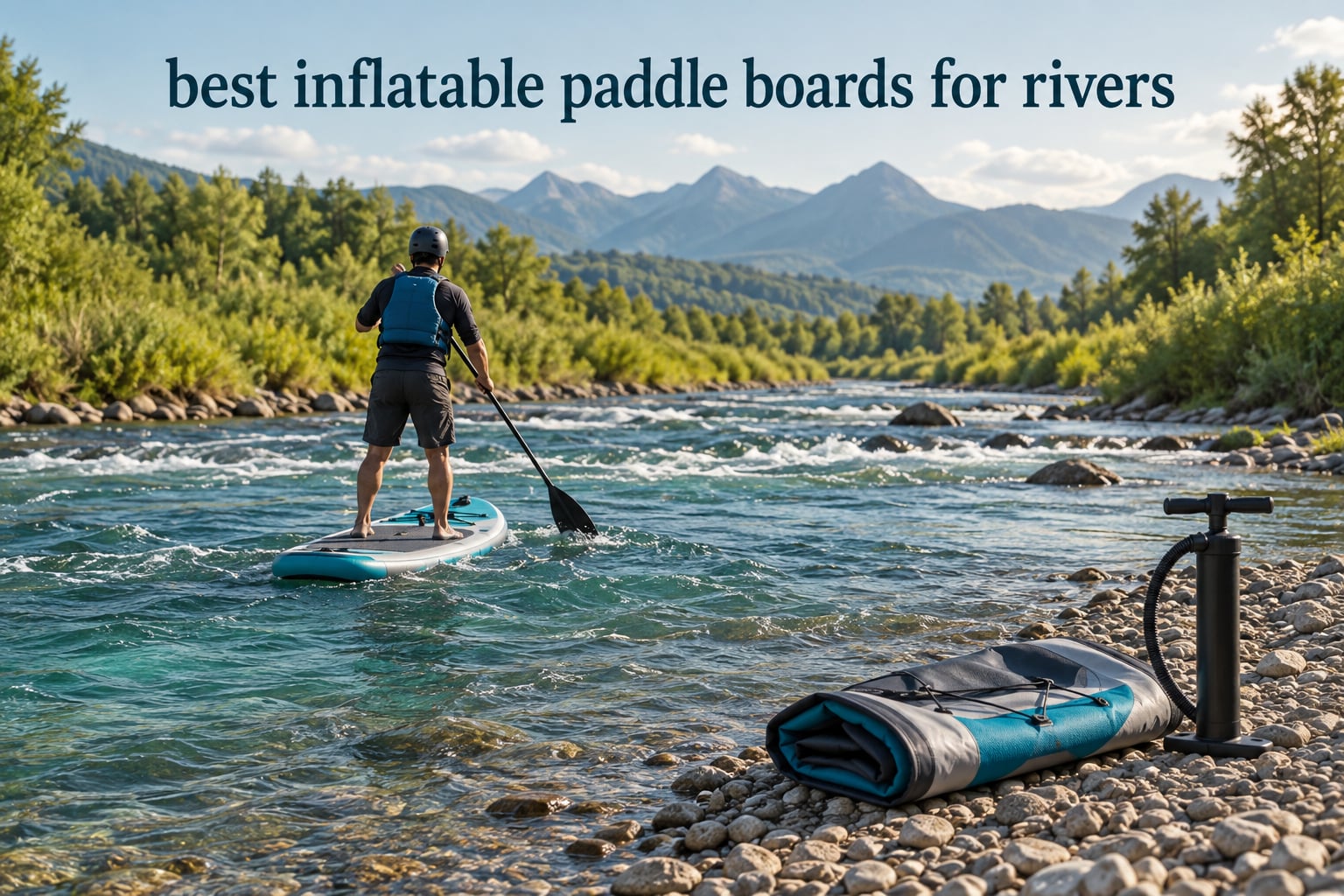
Most paddlers who search for the best inflatable paddle boards for rivers are not looking for a whitewater racing machine. They want to know whether the board already in their garage will float down a section of moving water without hurting them, and if not, what to buy instead. We spent weeks reading thousands of owner reviews, comparing rocker, fin systems, width and weight limits across ten boards, and tagging each one with the water we would actually put it in.
Here is the short answer. On a flat, slow, Class I river, you do not need a specialist river board. Any wide, stable all-around inflatable will do, and the single most important piece of gear is not the board at all. On moving water, never wear a standard ankle leash, wear a personal flotation device every time, and treat a helmet as standard practice from Class II upward.
River safety, before anything else. A conventional SUP ankle leash is the most dangerous accessory on a river. If the board wraps around a rock, log or strainer while the leash is attached to your ankle, the leash holds you downstream, often underwater. Use a quick-release waist leash or paddle with no leash at all. Wear a PFD every single time, add a whitewater helmet for Class II and above, and never paddle moving water alone. Every board in this roundup comes with an ankle leash, so plan to replace or remove it before your first launch.
What follows is our full list of ten inflatable paddle boards for rivers, each with its dimensions, pressure rating, weight capacity, fin system and an honest river-class ceiling based on how it actually handles. We also cover what rocker and fin choice do on moving water, how to match a board to your body weight, and how to maintain a board after a rocky day on the river.
Table of Contents
Can You Paddle Board on a River?
Yes, you can paddle board on a river, and on a calm or slow-moving Class I river you do not need a specialist board. Any stable all-around inflatable will do. You need a purpose-built river board once the water is fast enough to hold you off line, or shallow and rocky enough that a fixed fin will find a rock. Never wear a standard ankle leash on moving water, and wear a PFD every time.
Here is how the water changes the requirement:
- Flat and slow, Class I to easy Class II. Wide all-around boards with a normal length and a removable center fin. Tracking matters more than turning, and any board in this roundup fits the bill.
- Riffles and current, solid Class II. The same shape, but you want a longer board for straight-line tracking, a fin you can remove when the bottom gets shallow, and welded or reinforced seams.
- Class III and above. None of the ten boards below belongs here. Above Class II you want heavy nose rocker so the board rides over wave trains instead of pearling, retractable or short flexible fins that survive rock strikes, and a full whitewater kit. That is specialist territory, and the boards are built completely differently.
That last point is the honest headline of this roundup. Every board we tested is a stable all-around or adventure inflatable, not a whitewater hull. We have labelled each one with the highest class we would trust it on rather than pretending otherwise.
Top 3 River SUP Picks for 2026
Our three standouts cover the widest range of river use. The Roc leads on proven reliability and owner volume, the Skatinger adds width and cargo capacity for heavier days, and the Niphean is the one to buy if you want a complete kit without spending serious money.

Roc 10 ft 6 in Inflatable SUP
- 33 inch wide and 350 lb rated
- Complete kit in the box
- 3-year warranty
- 18k+ owner reviews

Skatinger 11 ft 6 in Wide SUP
- 35 inch width and 450 lb capacity
- 10 inch fin for straight tracking
- 20 psi dual-layer sidewall

Niphean 10 ft 6 in All-Round SUP
- 450 lb capacity and 20 psi build
- River use listed by the maker
- 3-year guarantee
The Best Inflatable Paddle Boards for Rivers in 2026
The Roc 10 ft 6 in is our best overall pick. It has the deepest owner history in the group, a 33 inch platform that tolerates beginners, and a complete kit so there is nothing else to buy. Everything below is ranked for river suitability first, then for how much gear and how many people the board can carry.
- Roc 10 ft 6 in Inflatable SUP: best overall, widest owner base, 350 lb rating
- Skatinger 11 ft 6 in Super Wide SUP: 35 inch platform and 10 inch fin for tracking
- Niphean 10 ft 6 in All-Round SUP: complete entry kit with a 3-year guarantee
- Niphean Extra Large 11 ft SUP: large detachable center fin, holds a line in current
- NACATIN 12 ft Wide Fishing SUP: rod holder, fish ruler and a 300 kg rating
- iTAOSTAR 12 ft Adventure SUP: longest shape here for flat-water multi-day trips
- UPWELL 11 ft Inflatable SUP: clean all-rounder for lake-to-river versatility
- CETANA 11 ft 6 in Extra Wide SUP: stays upright with dogs and full gear loads
- ATPROSS 12 ft Wide SUP with Seat: 500 lb rating and a tool-free seat
- Aqua Plus 10 ft 6 in Inflatable SUP: packs to a 1 ft roll for small cars
Quick Overview: Specs, Fins and River Class
Every board below is rated to carry between 310 and 661 pounds and packs down to the size of a rolled foam mat. The differences that matter on a river are the fin system, the width, the warranty and how well the board tracks when the current is pushing you sideways. The table sets out the headline specs; the individual reviews below give you our honest ceiling for each one.
| Product | Specifications | Action |
|---|---|---|
| Roc 10 ft 6 in Inflatable SUP |
|
Check Latest Price |
| Skatinger 11 ft 6 in Super Wide SUP |
|
Check Latest Price |
| Niphean 10 ft 6 in All-Round SUP |
|
Check Latest Price |
 Niphean Extra Large 11 ft SUP Niphean Extra Large 11 ft SUP |
|
Check Latest Price |
 NACATIN 12 ft Wide Fishing SUP NACATIN 12 ft Wide Fishing SUP |
|
Check Latest Price |
 iTAOSTAR 12 ft Adventure SUP iTAOSTAR 12 ft Adventure SUP |
|
Check Latest Price |
 UPWELL 11 ft Inflatable SUP UPWELL 11 ft Inflatable SUP |
|
Check Latest Price |
 CETANA 11 ft 6 in Extra Wide SUP CETANA 11 ft 6 in Extra Wide SUP |
|
Check Latest Price |
 ATPROSS 12 ft Wide SUP with Seat ATPROSS 12 ft Wide SUP with Seat |
|
Check Latest Price |
 Aqua Plus 10 ft 6 in Inflatable SUP Aqua Plus 10 ft 6 in Inflatable SUP |
|
Check Latest Price |
1. Roc 10 ft 6 in Inflatable SUP: Best Overall for River Days
Roc Inflatable Stand Up Paddle Board 10′ 6″ with Premium SUP Paddle Board Accessories, Wide Stable Design, Non-Slip Comfort Deck for Youth & Adults (Ocean Current)
10 ft 6 in x 33 in x 6 in
350 lb weight limit
3-year warranty
Pros
- Deepest owner history in the group
- 33 inch platform suits first-time paddlers
- Full kit: backpack
- reversible paddle
- seat
- leash and pump
- Bungee deck and multiple anchor points for river day gear
- 3-year manufacturer warranty
Cons
- Front carrying strap failed for one owner after a few uses
- Large fin clip needs a tool to release
- Included hand pump takes 10 to 15 minutes
This is the board we kept reaching for. With 18k+ reviews averaging 4.8 stars and 88 percent of ratings at five stars, it has the most owner history of anything in this roundup, and that history matters on a river because durability questions get answered over seasons rather than weekends.
The 10 ft 6 in by 33 in by 6 in platform is a genuinely forgiving shape. It is wide enough that a beginner can stand up without immediately falling, and long enough to hold a line on a slow-moving reach. The 350 lb weight limit is the lowest rated capacity in our group, which matters if you are a heavier paddler or planning to carry a child, a dog and a day of gear.
The accessory bundle is unusually complete for this money. You get a backpack, a reversible SUP and kayak paddle, a seat, a leash, a pump and bungee storage on deck. Owners report multiple seasons of use without leaks, which is the sort of thing you want to hear from people who have actually hauled a board to a put-in.
The small print is the hardware. One owner reported a front carrying strap that broke after a few uses, and the large fin clip is genuinely awkward to release by hand, so keep a small tool in the bag. The included hand pump is slow, taking roughly ten to fifteen minutes.
How the Roc handles on Class I and easy Class II water
On flat and slow river sections this board does everything you would ask of it. The nose lifts cleanly off wave trains rather than digging in, and the wide platform keeps secondary stability when the current pushes your hips one way and the board the other. One reviewer specifically reports using it on a river with no problems.
Our ceiling is Class I, stretching into gentle Class II on open reaches without shallow rock. The single large fin is the limiting factor. In water that drops off a gravel bar or runs over submerged timber, that fin is a liability, so get comfortable removing it before you need to.
What to check before you buy the Roc
Check your own weight against the 350 lb limit first. It is the tightest rating in the list, and a board that is overloaded feels unstable long before it feels dangerous. If you are over that, look at the Skatinger or the Niphean Extra Large instead.
Then budget for an electric pump. It is the single most common upgrade across owner reviews on almost every board in this roundup, and it turns a fifteen-minute chore into a two-minute one. After that, the only real river modification you need is replacing the ankle leash.
2. Skatinger 11 ft 6 in Super Wide SUP: Best Value for Wide, Loaded Days
Skatinger 11’6×35″ Super Wide Inflatable Paddle Board, Ultra Stable Stand Up Paddleboards for 450lb/3 People/Family/Big Size w/Shoulder Strap, 100L Backpack, Ultra-Light All-Round Sup Board
11 ft 6 in x 35 in x 6 in
450 lb capacity
20 psi
19.8 lb packed
Pros
- 35 inch platform and 450 lb rating for large paddlers or a tandem
- 10 inch fin holds a straight line over distance
- Front and rear bungee systems for river day gear
- 1680D backpack and three carry handles for solo transport
- Dual-layer sidewall rated to 20 psi for abrasion
Cons
- 10 inch fin can catch on submerged objects in shallows
- Kayak seat is not included and sold separately
- 19.8 lb packed weight is heavy on long carries
Ninety-two percent of ratings on this board are five stars, the highest share in the group, and the reason is simple: width. At 35 inches it is several inches broader than a typical all-around board, and that extra few inches is exactly what you want when the water underneath you is moving.
The 10 inch US box fin is the other reason owners are happy. It is a large fin, and reviewers repeatedly single it out for cutting side-to-side drift on longer paddles. The manufacturer markets it directly at lake and river use, and the tracking claim holds up in the review record.
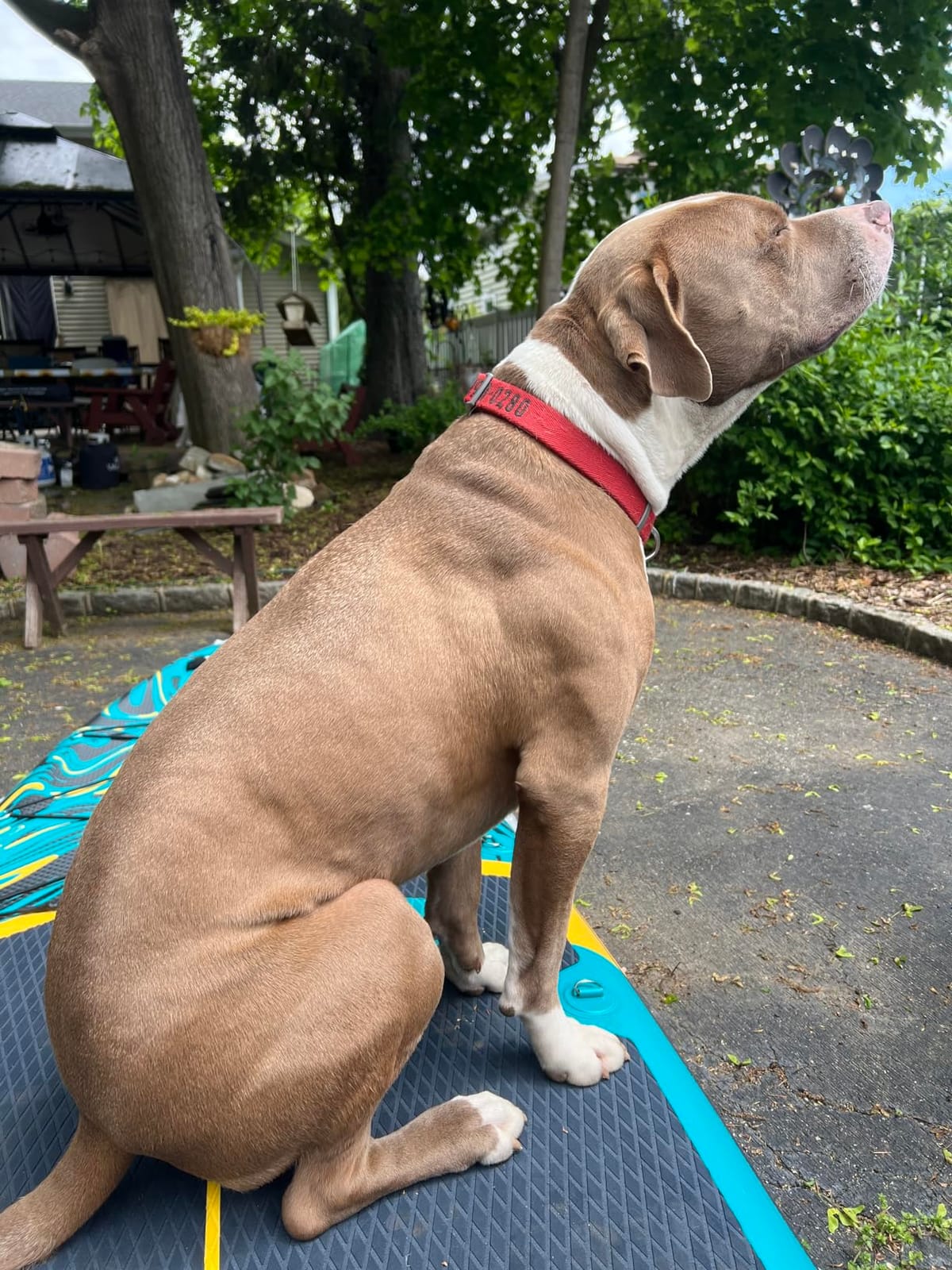
Capacity is the third argument. A 450 lb rating covers a heavier paddler, a tandem setup, or a solo paddler with a heavy gear load, and the front six-point and rear four-point bungee systems give you somewhere sensible to strap a dry bag or a cooler.
Warranty is where it loses ground. Two years from the manufacturer is respectable but sits below the three years on the two Niphean boards, and the kayak seat that some competitors include is sold separately here.
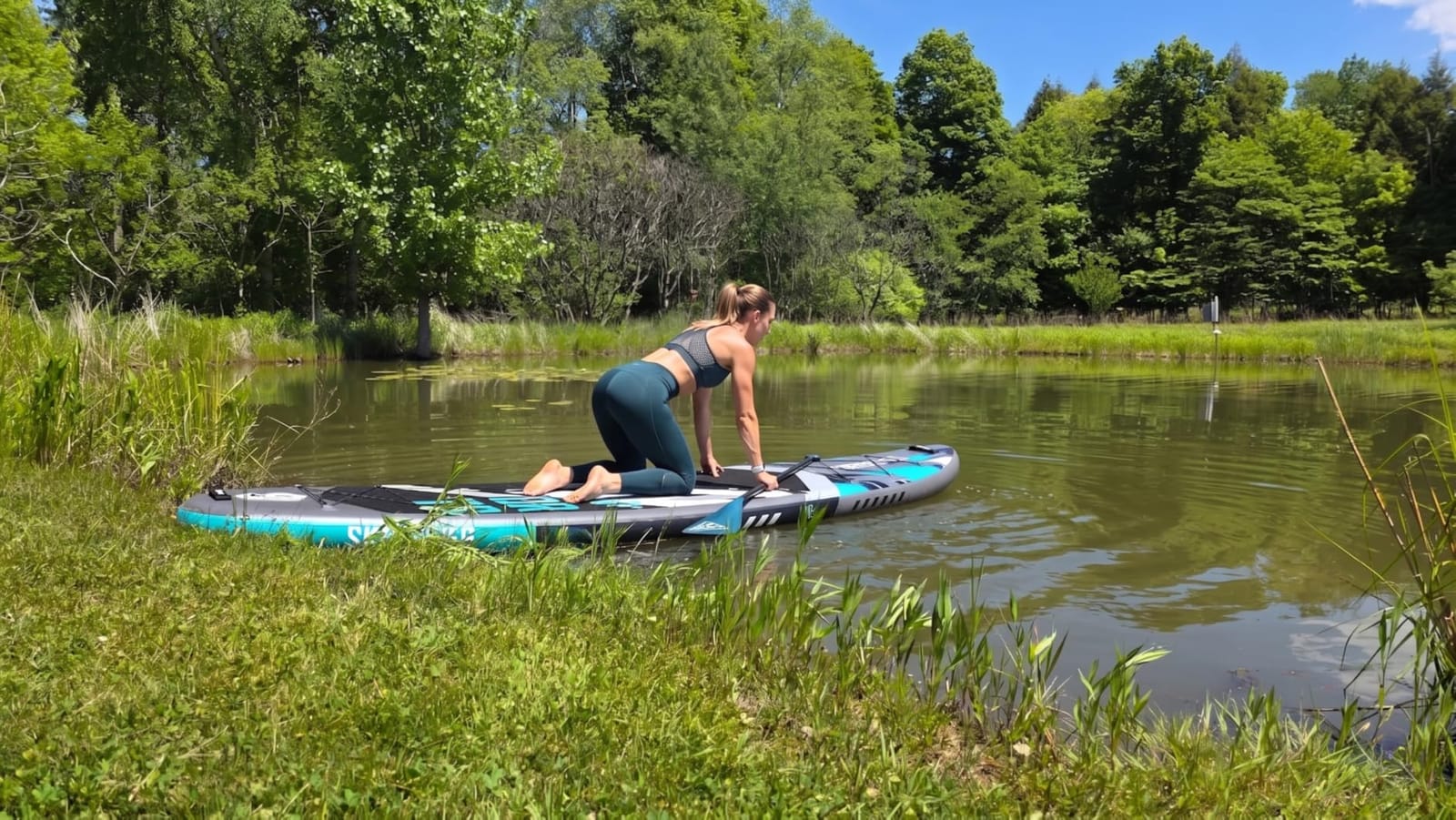
When the 10 inch fin becomes a problem
That big fin is excellent on a deep, slow river and a genuine hazard on a shallow one. Owners on gravel-bottomed sections report catching the fin on submerged obstacles. If your river is shallow and gravelly, the honest advice is to run it without the large fin, which costs you some tracking on open water.
This is the most common compromise in the whole roundup: long fins track well and strike rocks. There is no fin that does both. The two giant fins here, this one and the Niphean Extra Large center fin, are the right answer for wide water and the wrong answer for shallow water.
Who should buy the Skatinger and who should not
Buy it if you are a heavier paddler, if you want to carry a second person or a lot of gear, or if you want maximum primary stability while learning to stand in current. The width does the work that a more expensive narrow river board would do with rocker.
Skip it if your put-in involves a long carry. At 19.8 lb packed, plus pump, PFD and paddle, this is a two-person load on a rough shoreline. If your board has to live in a small car or go up a steep bank, the Aqua Plus later in this list packs smaller and weighs less.
3. Niphean 10 ft 6 in All-Round SUP: Best Budget River Kit
Niphean Inflatable Stand Up Paddle Board with SUP Accessories,Green Wood
10 ft 6 in x 33 in x 6 in
450 lb capacity
20 psi
19 lb packed
Pros
- Grooved EVA deck gives grip in current
- 450 lb capacity at an entry price point
- Manufacturer lists river use alongside lake and open water
- Paddle
- three fins
- leash
- pump and repair kit included
- 3-year guarantee with responsive support
Cons
- Hand pump is slow and tiring above roughly 10 psi
- Three-fin setup adds drag and many owners run a single fin
- Repair kit is unglued vinyl patches
Almost 3800 owners at 4.6 stars, and 80 percent of those ratings are five stars, which is a lot of long-term evidence for an entry board. At full inflation owners describe it as feeling nearly rigid, and the 20 psi rating is the joint highest working pressure in this group.
The manufacturer explicitly lists river use alongside ocean and lake, which matters more than it sounds. It tells you the board is being tested on moving water by people other than us, and reviewers say it holds pressure well in the heat and in transit.
Eleven D-rings mean you can add a kayak seat, a cooler or a tie-down to a second board. The grooved EVA deck gives real grip when you are wet and standing in a current, which is a small thing that makes a large difference in confidence.
Two accessories need replacing on day one. The included hand pump is slow and tiring above roughly 10 psi, and the repair kit contains unglued vinyl patches, so pick up a proper adhesive patch kit before you need it on a remote bank.
Run one fin, not three
The most useful piece of advice anywhere in the review record for this board is also the most counter-intuitive: take fins off. Owners who fitted all three detachable fins report noticeably more drag, and a large share of them ended up running a single rear fin instead.
On a river, that is exactly the right trade. A single smaller fin gives you faster turning in eddy lines and far less chance of catching a submerged rock, at the cost of a little straight-line stability. Keep the other two in the backpack so you can refit for a flat lake day.
Who this board suits
This is the pick for a first river board full stop. It carries 450 lb, which is generous for an entry model, it comes with everything you need, and the three-year guarantee is one of the longer ones in the group. If your budget is fixed and you want a single board that handles flat water and gentle current, this is it.
Where it is not ideal is on a multi-day trip. There is no cargo system to speak of beyond the eleven D-rings and a thin backpack that strains with extra kit. For loading a cooler, a dry bag and a change of clothes for two nights, spend the extra money on a board with real bungee systems.
4. Niphean Extra Large 11 ft SUP: Best for Holding a Line in Current
Niphean (Extra Large) Inflatable Paddle Board, SUP for 2+1 People/Family
11 ft x 33 in x 6 in
500 lb capacity
detachable center fin
19 lb packed
Pros
- Large detachable center fin cuts side-to-side wandering in current
- 500 lb rating carries a heavy paddler plus gear or a passenger
- Included kayak seat adds back support for long sessions
- 15 D-rings plus front and rear bungees for a full day of kit
- Holds 15 psi and feels near-rigid under a 270 lb paddler
Cons
- Big center fin makes tight turns hard and snags in shallows
- Center fin sits where the hip rests on a middle carry
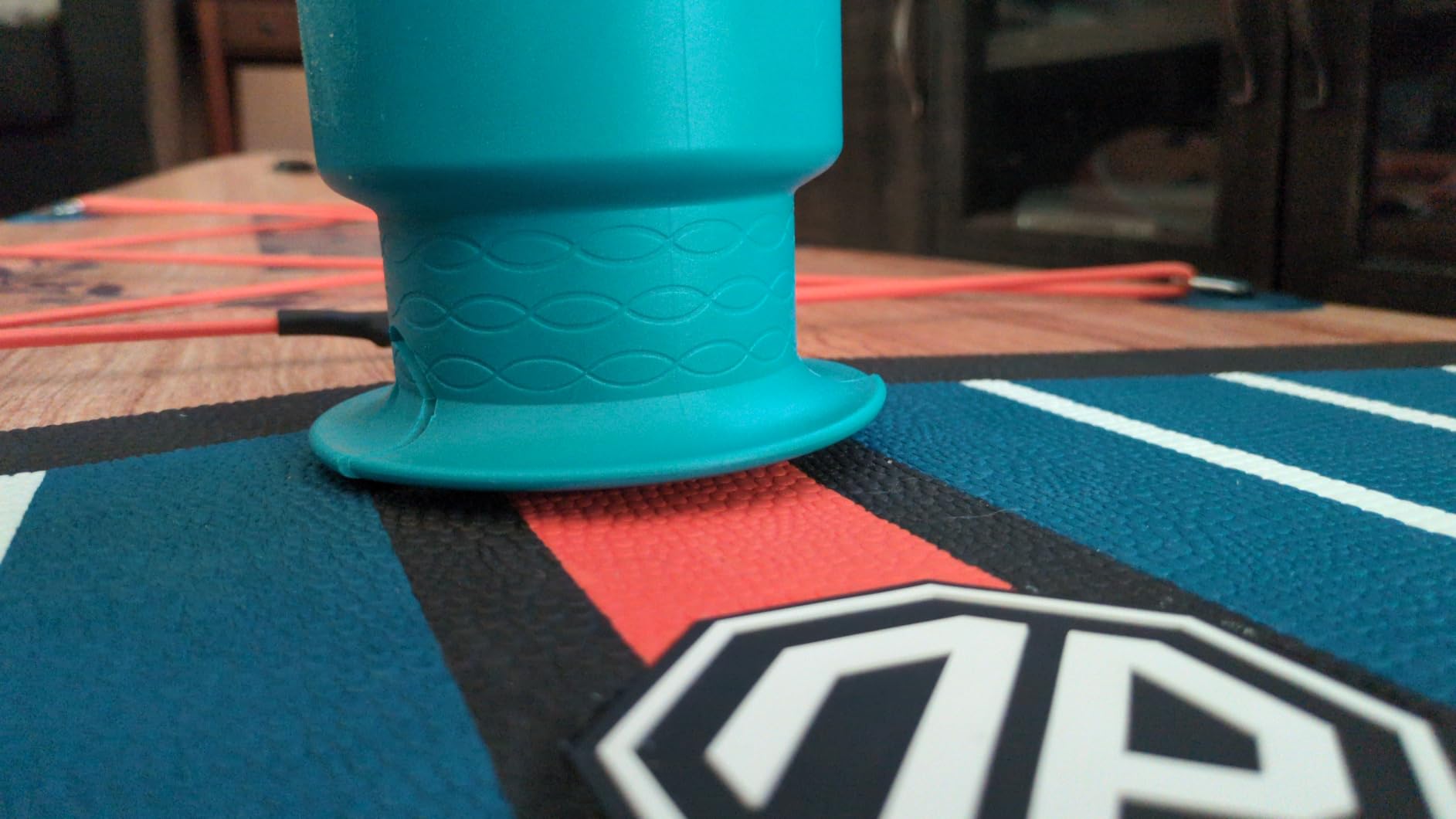
- Cup holder cannot be tightened out of the box
At 500 lb rated capacity this is one of two boards here that comfortably carries a larger paddler, and the large detachable center fin is its defining feature. Owners credit that fin with dramatically reduced side-to-side wandering, and one reviewer specifically reports stable tracking on a river with current.
Unlike the boards with three small fins, this one ships with a balanced center fin that does real work. On a wide, slow reach it keeps the board pointing downstream without constant correction, which is the difference between a relaxing float and constant micro-steering.
The included kayak seat is a genuine river asset. Owners point out that it adds real back support for long or choppy sessions, and it is a sensible confidence builder for anyone hesitant about standing in current. At 15 psi the board is reported to feel nearly rigid under a 270 lb paddler.
Fifteen D-rings and two bungee systems mean you can load a full day of gear without improvising. Spare parts availability is listed at three years, matching the three-year warranty, which is better than most rivals can offer.

Why the big center fin cuts both ways
That same center fin is the reason this board turns badly. Owners describe tight turns as difficult and note that the fin snags in shallow water. On a narrow river with gravel bars, you will spend your day planning the line well ahead of the obstacle rather than reacting to it.
There is a small carry issue too: the center fin sits exactly where your hip rests when you lift the board by the middle handle. Carry it by the front or rear handle on rough ground, or you will be leaning on the fin.
Choosing between the two Niphean boards
Both Niphean boards share the same 3-year warranty and a 450 to 500 lb class of capacity, so the decision is about shape. The 10 ft 6 in model is the general-purpose pick with three interchangeable fins and no seat.
The 11 ft extra-large is the one to choose if your river is wide, you are a heavier paddler, you want the included seat, or you plan to carry a passenger or a dog. If you want a smaller, lighter board that stores in a small car, that is the model in position three.
5. NACATIN 12 ft Wide Fishing SUP: Best for River Fishing
NACATIN 12′ Extra Large Inflatable Stand Up Paddle Board with Seat, Wide 36″ SUP Board for Adults & Family, with Single/Double Paddle, Kayak Seat, Pump, Stable Wide Platform for Beginners, Lake, River
12 ft x 36 in x 6 in
rated to 300 kg
15 psi
seat and double paddle
Pros
- Built-in adjustable rod holder allows casting while paddling
- Onboard fish ruler in cm and inch markings
- Widened tail adds buoyancy through sharp turns
- Converts to a kayak with the included seat and double paddle
- Listings specifically call out lake and river use
Cons
- Shortest warranty in the group at one year
- Listed weight of 17.8 kg makes it the heaviest to carry
- Fishing fittings add deck clutter for pure touring
River angling needs width, cargo space and accessory mounts rather than whitewater features, and this board is built around that. The 12 ft by 36 in platform gives you a wide casting platform, and the widened tail adds buoyancy through sharp turns, which is what you need when you are fighting a fish and pivoting at the same time.
The built-in adjustable rod holder is the feature that separates it. It lets you cast hands-free while paddling, which on a river matters because you rarely have a flat bank to stand on. There is also a fish ruler moulded into the deck in both centimetres and inches, plus a front camera mount.
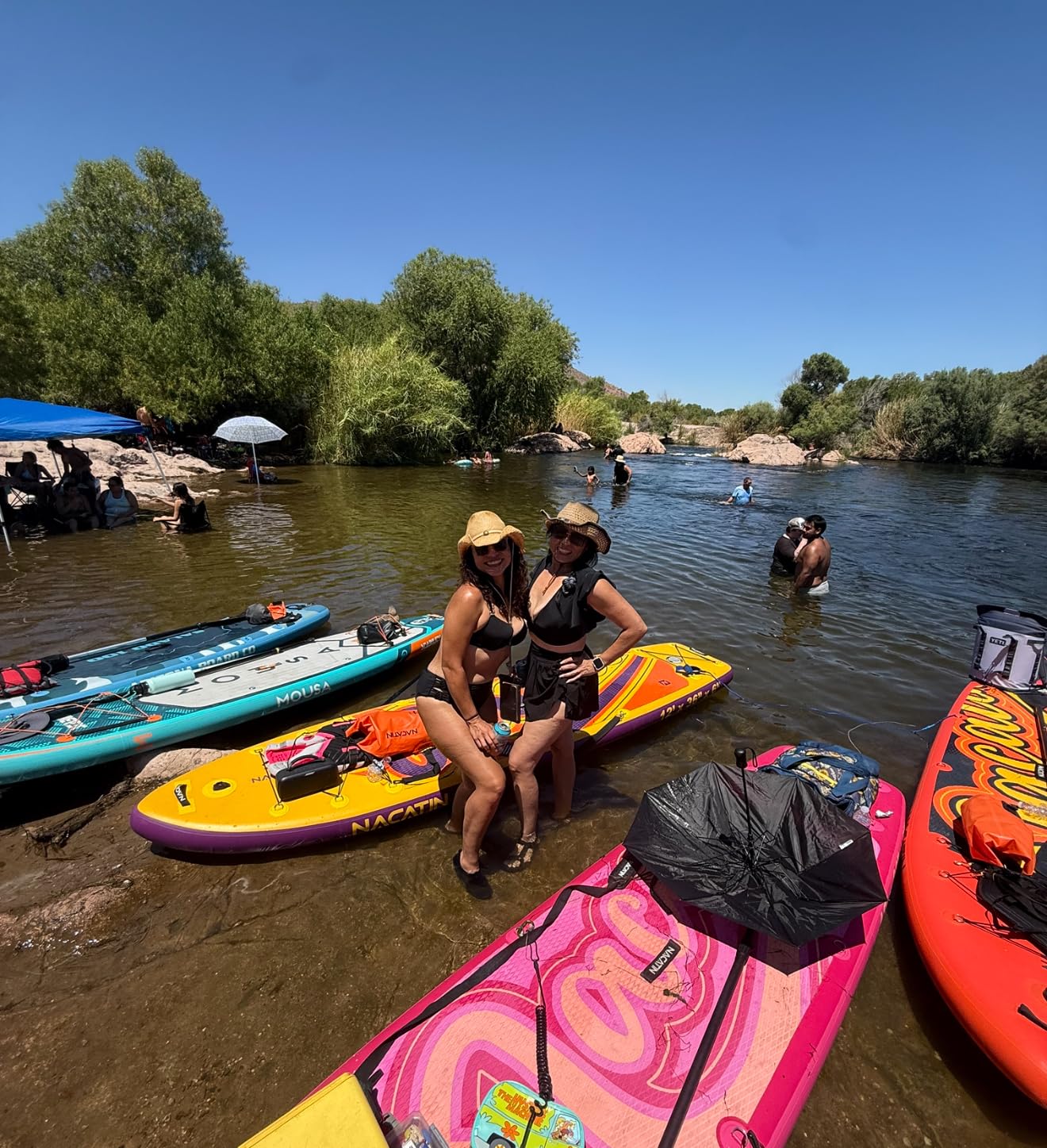
Reinforced D-rings accept fish finders and anchor trolleys, and the whole package converts to a kayak with the included seat and double-sided paddle. That conversion is not a gimmick on moving water; sitting down lowers your centre of gravity, and owners use it for long or choppy sessions.
The rating is unusual. The listing rates it to 300 kg, which is roughly 661 lb with angler and gear, making it the highest stated capacity of any board in this roundup. The 15 psi working pressure is the lowest group with the 12 footers, so expect a slightly softer ride than a 20 psi board.
Angling features that get in the way
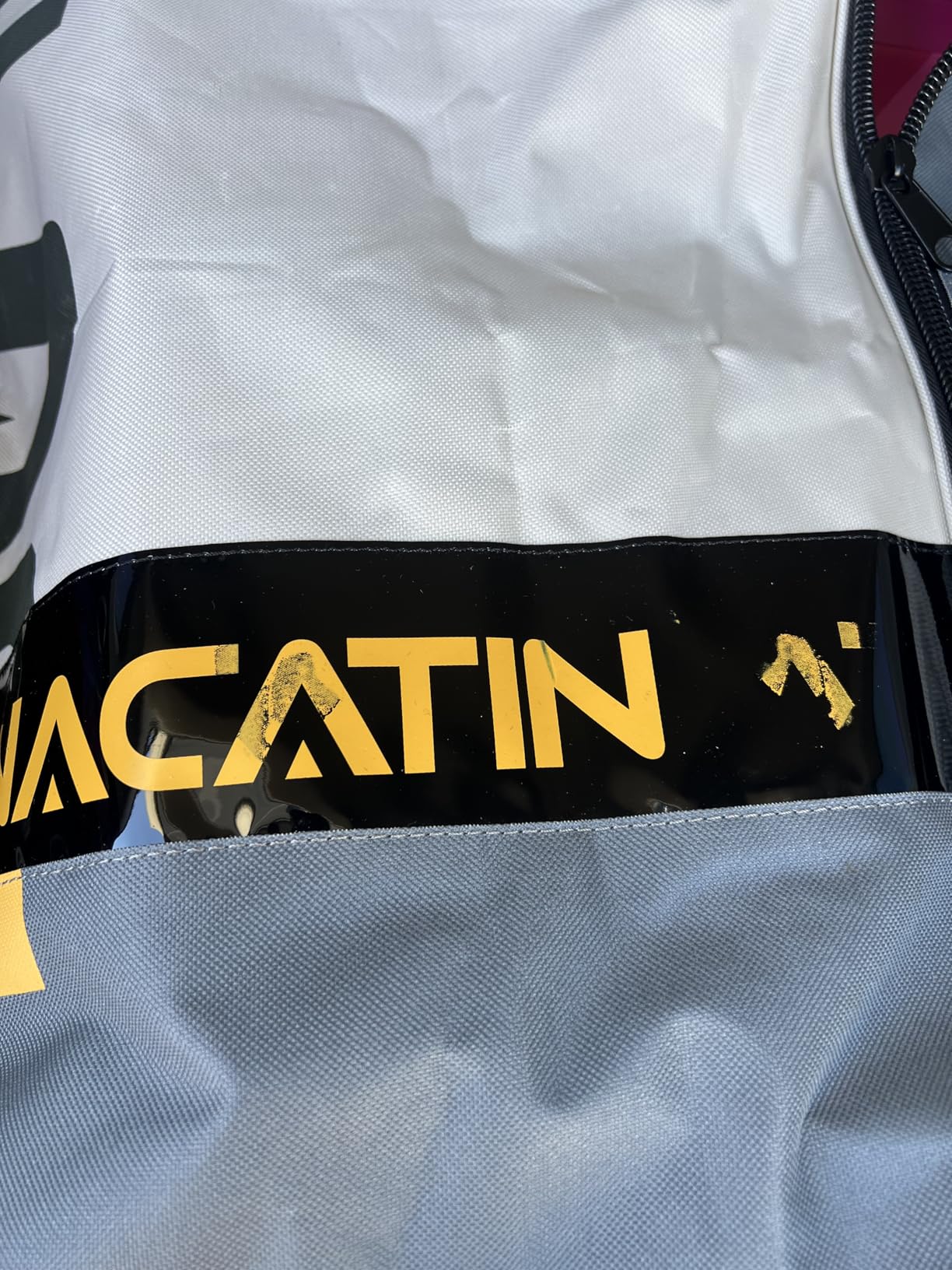
Everything on this board was designed for fishing, and if you are not fishing, some of it is clutter. The rod holder, the fish ruler and the wide tail all add deck space and weight for a reason that touring paddlers do not share.
The more serious reservation is weight. The listed item weight is 17.8 kg, which is the heaviest figure in the group by a wide margin, and the hand pump takes real effort to reach 15 psi. If your put-in is a long walk or you plan to carry this solo, think hard about that number first.
Warranty is the deciding factor here
A one-year manufacturer warranty is the shortest in the roundup. On a fishing board that spends its life contacting submerged timber, rocks and gravel bars, seam and rail integrity is the whole product, and a one-year cover is thin against that reality.
So buy it for the fishing hardware, the 36 inch platform and the capacity, and inspect the seams and rails after every trip. If you want the same width with a longer warranty, the CETANA later in the list has a 35 inch platform and a stronger 22 psi build, though without the rod holder.
6. iTAOSTAR 12 ft Adventure SUP: Best for Flat-Water Multi-Day Trips
iTAOSTAR Adventure 12′ × 35″ Inflatable Stand Up Paddle Board with Seat, Extra Wide SUP Board with 5 Fins Stable Design for Familly, Youth, All Skill Levels, Lakes, Oceans & Fishing
12 ft x 35 in x 6 in
450 lb capacity
15 psi
five detachable fins
Pros
- Long 12 ft platform tracks straight over flat river miles
- Five detachable fins let you tune tracking and speed
- Owners report running it over rocks and branches without damage
- 120L backpack plus 10L dry bag and waist pouch
- Converts to a kayak with seat
- footrest and switchable paddle
Cons
- Slow to turn and more fins add drag
- 21.7 lb is heavy to carry solo
- Deck pad adhesive can peel and one owner reported seam leaks
Multi-day river trips are a tracking problem, not a whitewater problem. When the whole run is flat water, you want length, glide and cargo, and that is exactly what this 12 ft shape is for. It is one of three 12 foot boards here, and the most accessorised of them by some distance.
Five detachable fins, three center and two side, give you real tuning control. You can run a full setup for speed on a flat reach, strip it back to a single fin for a shallow section, and change it in a couple of minutes at the bank.
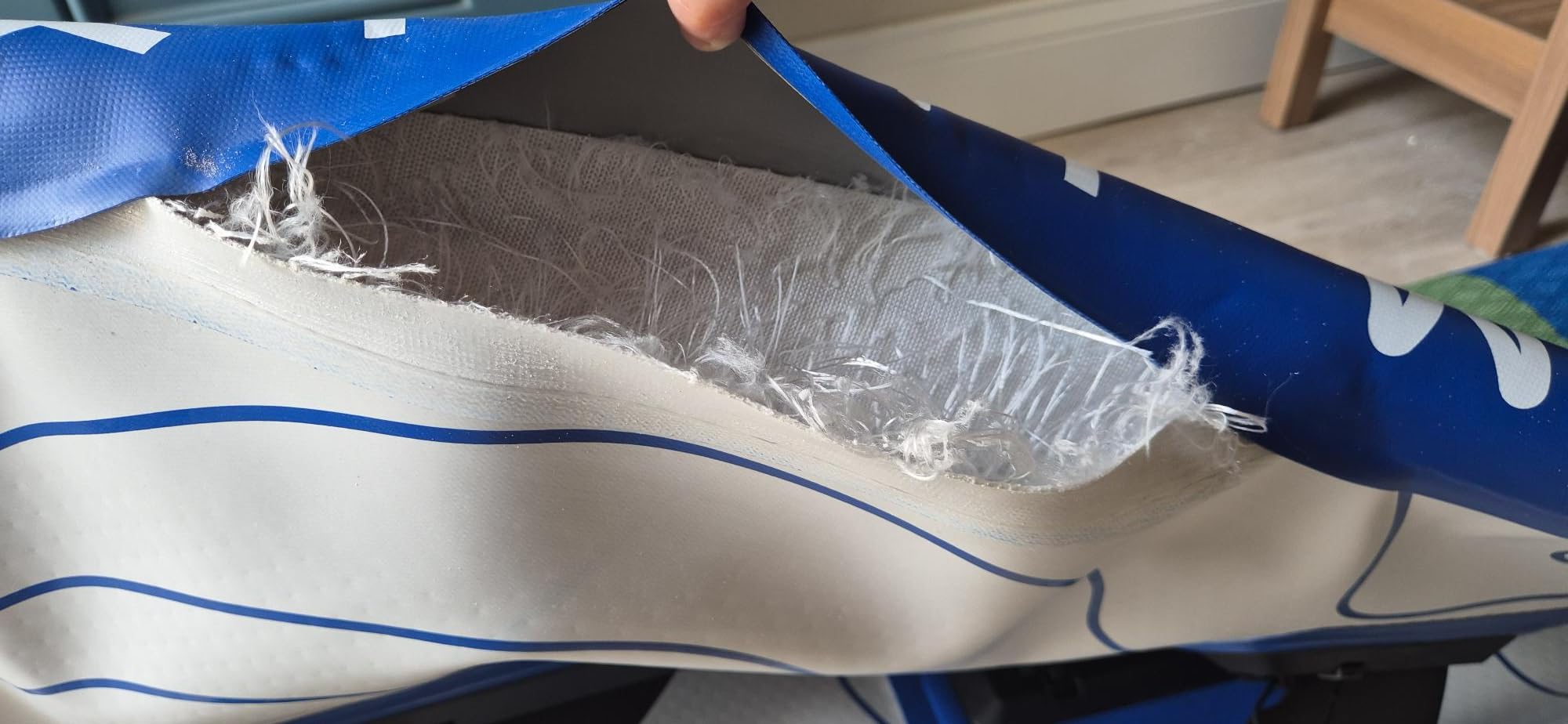
The river feedback is genuinely positive, and unusually specific. One owner reports paddling a rocky, branch-strewn section of the Santa Fe River without damage, and another reports good tracking with mixed fin sizes. For a budget-tier board, that is about as good as river evidence gets.
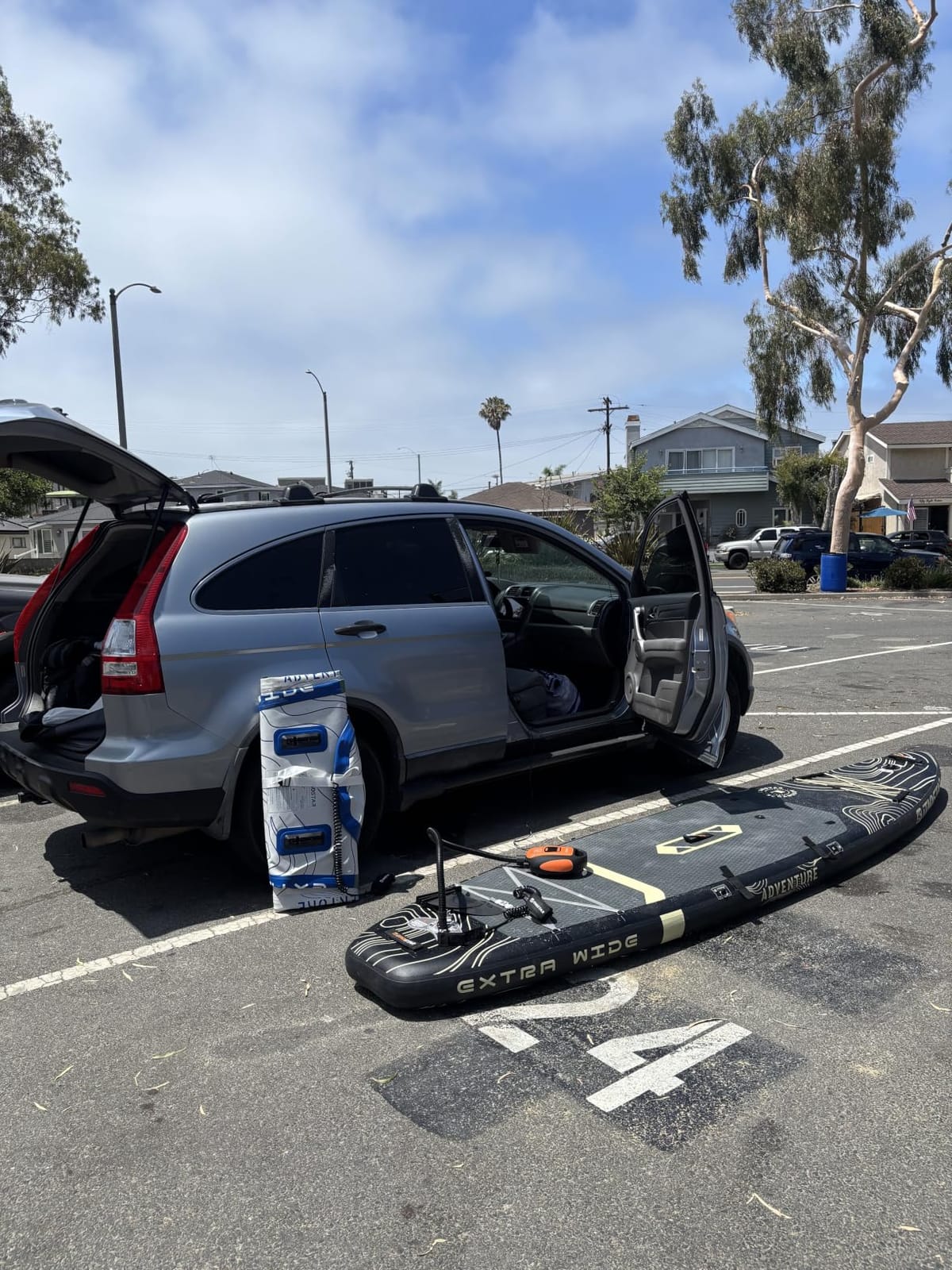
At 15 psi it is reported to feel rigid and stable for a 350 lb paddler. The 120L travel backpack is the biggest in the group and holds the board, all gear and even personal flotation devices, with a 10L dry bag and a waist pouch on top.
Weight and handling are the trade-off
At 21.7 lb packed, this is the heaviest board in the roundup, and it feels that weight on a long approach to the put-in or in a crosswind. Combine it with a pump, paddle and PFD and you are carrying a genuinely awkward load solo.
Handling is the other side of the same coin. A 12 ft board with a large fin is slow to turn, and reviewers describe it as deliberate rather than agile. That is fine on a wide, slow river and frustrating on a narrow one with obstacles. The 39 inch wide version of the same board is worth considering if stability is your priority.
A warranty figure worth checking
There is a discrepancy here that you should be aware of. The listing specification states a one-year manufacturer warranty, while the brand copy elsewhere in the same listing claims three years. Confirm the cover with the seller before you buy, and photograph the board on arrival if it matters to you.
That uncertainty, plus one report of seam leaks that needed pressure topped up mid-trip, is why this board sits sixth rather than higher. The tracking and the accessory set are excellent; the paperwork is not.
7. UPWELL 11 ft Inflatable SUP: Best for Lake-to-River Versatility
UPWELL 11’×34″ Inflatable Paddle Board, Stand Up Paddle Board, Sup Paddle Boards for Adults, Dusk Bloom Violet
11 ft x 34 in x 6 in
450 lb capacity
about 20 lb
double-wall PVC
Pros
- 11 ft by 34 in proportions suit open water and slow rivers
- Double-wall PVC claimed 25 percent lighter than comparable boards
- 2-in-1 paddle converts to a double-sided kayak blade
- Heavy-duty D-rings accept a cooler
- gear bag or seat
- Spacious backpack fits the board and full accessory set
Cons
- Thinnest feedback base in the group at 221 reviews
- No maximum pressure is published in the listing
- 1-year warranty is short next to 3-year rivals
The question we hear most often from paddlers is whether one board can handle both the lake and the river. At 11 ft by 34 in, this is the most balanced all-round shape in the group: enough length to track on a moving river, enough width to feel stable standing up on flat water.
It is a newer listing with 221 reviews, so long-term durability evidence is thinner than anything else here. Eight-two percent of those ratings are five stars, but a 221-review base tells you much less about year-three behaviour than the 18k reviews behind the Roc.
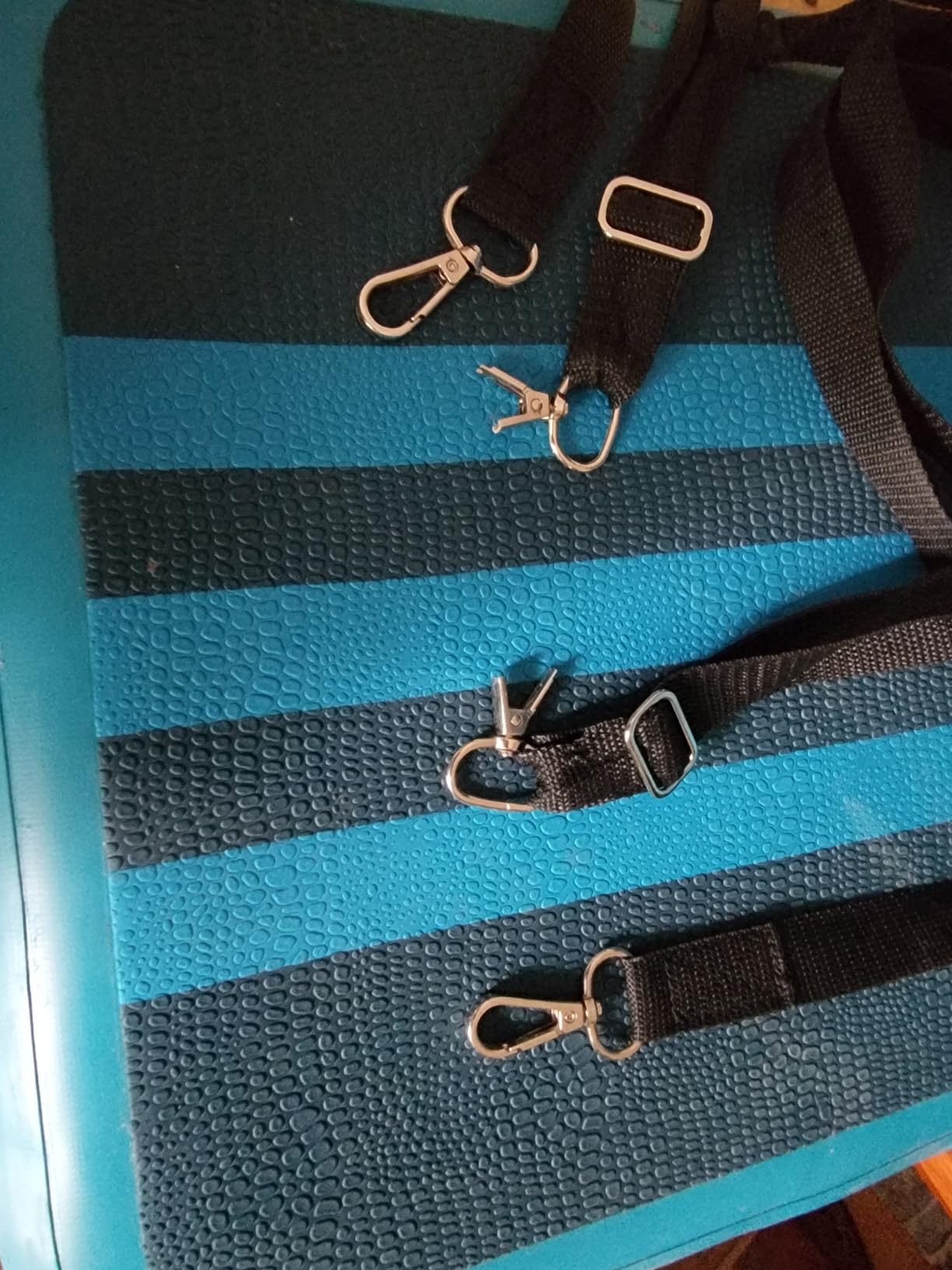
The double-wall PVC construction is claimed to be 25 percent lighter than comparable boards, and at roughly 20 lb the packed weight is competitive. The soft EVA deck pad gives enough grip for standing in current without the aggressive diamond grooves that wear through on rocky boards.
The included 2-in-1 paddle converts to a double-sided kayak blade, which pairs naturally with the heavy-duty D-rings if you want to add a seat for a long day on a slow river.
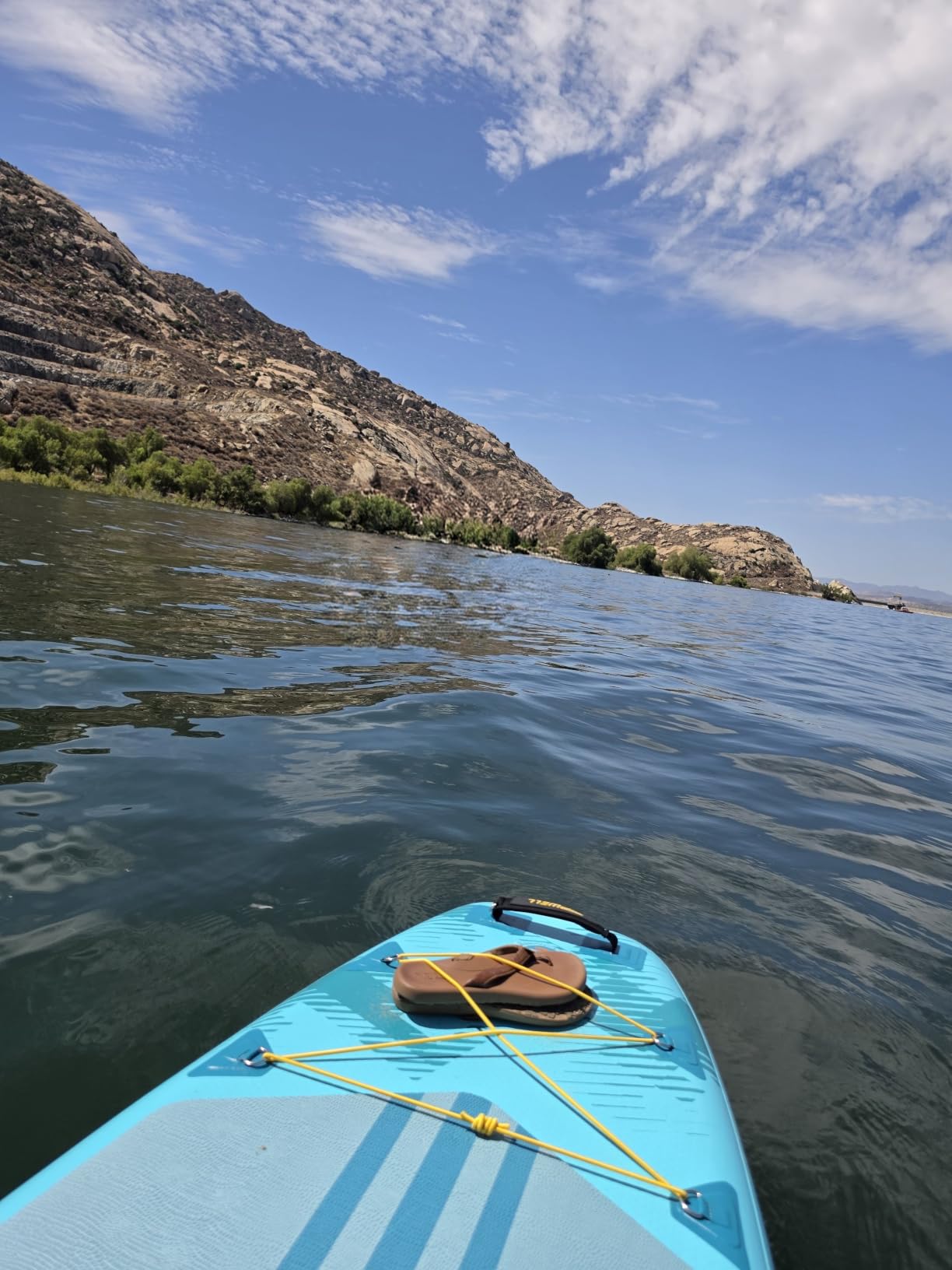
Pressure and warranty are the open questions
The listing does not publish a maximum working pressure, and that is a real gap. Every other board in this roundup except one states a figure, and pressure is what makes an inflatable feel rigid. Without it, assume the 15 to 20 psi range typical of the category and inflate to what the board feels like rather than a number.
A one-year warranty is also the shortest tier. For a board intended to live on a river, the three-year guarantees on the two Niphean boards and the Roc are a meaningful difference in how long you are covered for seam and rail problems.
When this is the right board
Choose it if you own a lake and a slow river and want one board that does both without compromise. The 34 inch width is wide enough for beginners and narrow enough to turn in a modest current, which is a genuinely useful middle ground.
Pass on it if you are a heavy paddler shopping on ratings, or if you need a board you have hard evidence about. In that case the Niphean 10 ft 6 in gives you the same all-round purpose with three times the review history and a three-year guarantee.
8. CETANA 11 ft 6 in Extra Wide SUP: Best for Families, Dogs and Loaded Gear
CETANA Extra Wide Inflatable Paddle Board 11’6 x 35″ x 6″, 450LB High Weight Capacity Wide Stable Stand Up Paddle Board for Beginners, 2–3 Person Large Paddleboard with 3 Fins, Dual Bungee, 15 D Rings
11 ft 6 in x 35 in x 6 in
450 lb capacity
22 psi build
3 fins
Pros
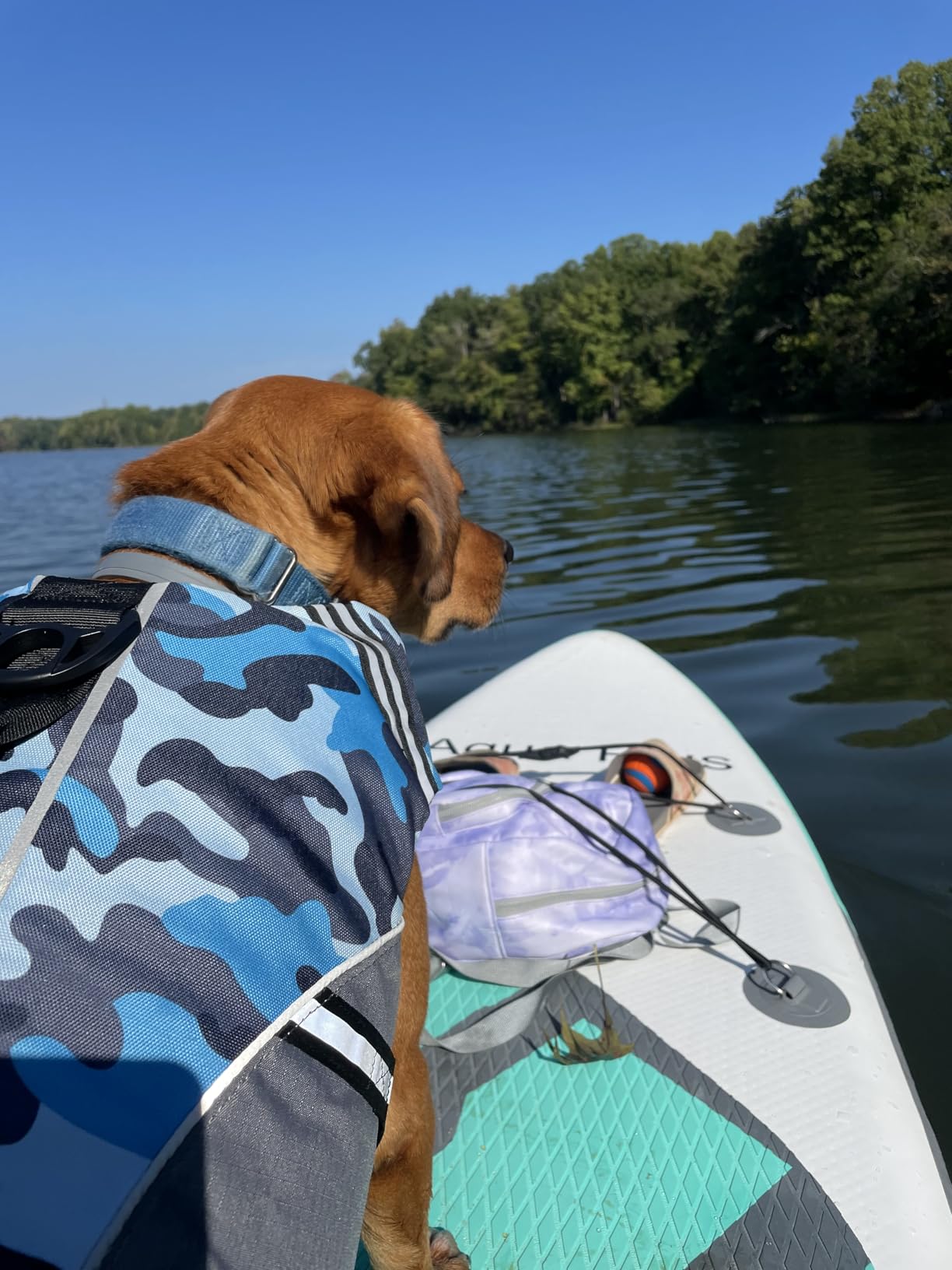
- 35 inch platform stays upright with dogs aboard
- One owner floated a loaded river section and reports straight tracking
- 450 lb rating carries two to three riders
- Front and rear dual bungee plus D-rings for a seat or strap
- 1680D backpack and three reinforced carry handles
Cons
- Factory bungee cords stretched after a single outing
- Stock single-blade paddle is a weak point
- One out-of-box bowed board was reported unusable
Two inches shorter than the 12 foot boards and two inches narrower than the fishing platforms, and for most river days that is the right compromise. The 450 lb rating carries two or three people, and the wide platform resists flipping when a dog shifts position mid-odyssey.
It also has the highest stated build pressure in the group. Owners note reinforced drop-stitch material rated to 22 psi, above the 20 psi ceiling on the Skatinger and Niphean, and higher pressure means a firmer board under your feet in current.
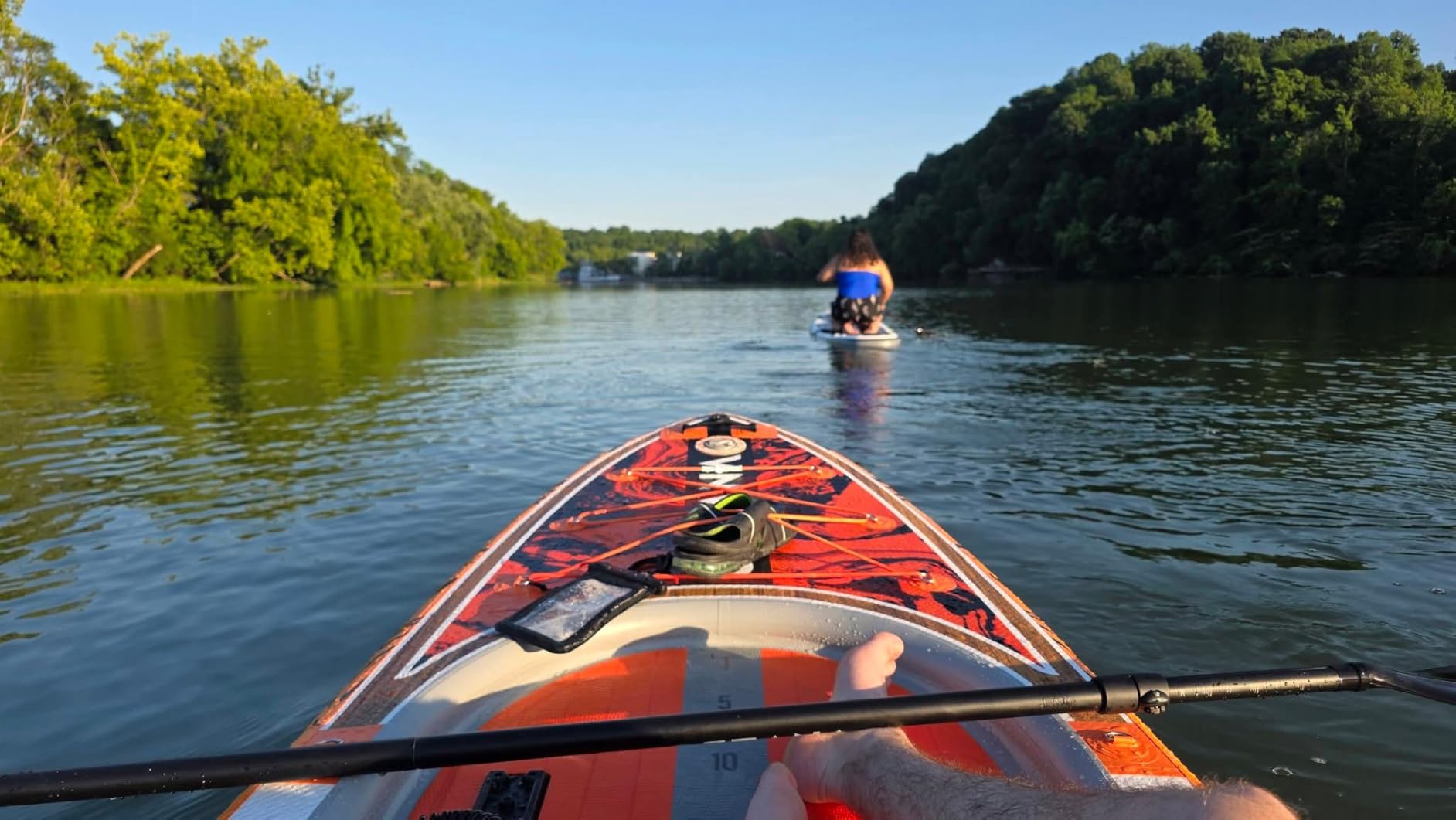
The river report is worth reading twice. One owner floated a section of the San Marcos River with a dog, a cooler, a milk crate and a dry box loaded, and reports that the board tracked well the whole way. That is exactly the use case this shape was built for.
Four D-rings accept a kayak seat or a shoulder strap, and the removable center fin with two side fins gives you a sensible middle ground between tracking and turning. The 1680D backpack is a step up from the 900D bags on cheaper boards.

Two things to replace on day one
The first is the bungee cords. Owners report the factory cords stretching after a single outing, which is a small annoyance at a lake and a real one when your cooler slides aft on a moving river. Replacement cord is cheap and takes five minutes.
The second is the paddle. The stock single-blade paddle is the most-cited weak point, and owners consistently recommend moving to a double-sided kayak paddle, which also lets you use a seat later. Both fixes together cost less than a lesson.
What the bowed-board report means for you
One owner received a board that bowed badly on first inflation and considered it unusable. That is a quality-control issue rather than a design flaw, and it points to a simple precaution: inflate the board fully on the driveway, walk around it, and check that the rails sit straight before you drive to the river.
It also explains the one-year warranty, which is the shortest tier here. A board this size, with this much load capacity, deserves a longer cover, and that is worth weighing against the 22 psi build and the 450 lb rating when you decide.
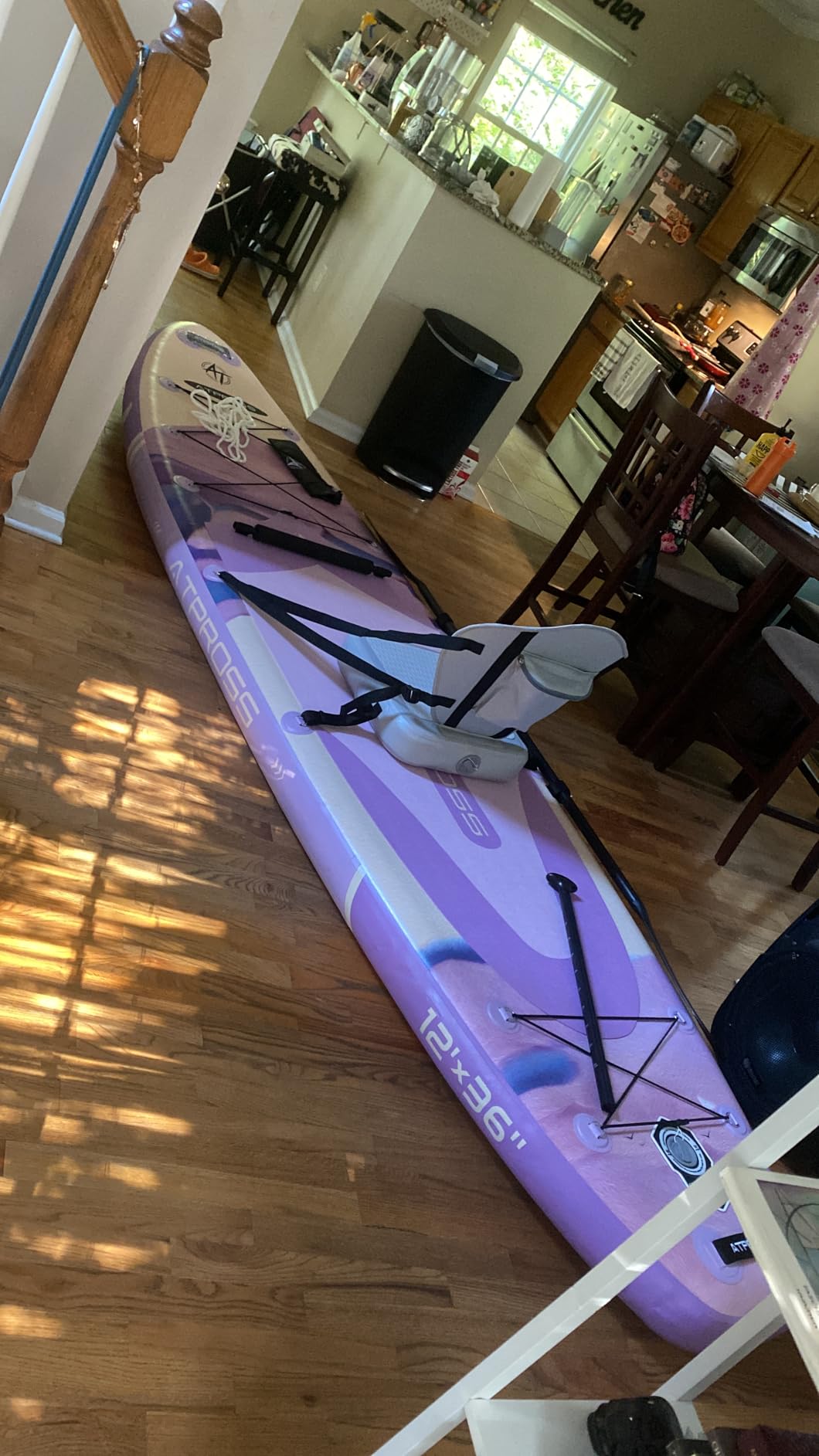
9. ATPROSS 12 ft Wide SUP with Seat: Best for Bigger Paddlers
ATPROSS 12’x36 Inflatable Stand Up Paddle Board with Seat, 500lbs Wide SUP
12 ft x 36 in x 6 in
500 lb capacity
inflatable seat
5 fins
Pros
- 36 inch width gives high primary stability for larger riders
- 500 lb rating while keeping glide reasonable when loaded
- Tool-free QuickLink seat attaches and detaches in seconds
- Double-layer PVC with a reinforced abrasion-resistant sidewall
- Five fins
- footrest
- dry bag and leash included
Cons
- Lowest average rating in the group at 4.3
- 8 percent of buyers gave one star
- Included-components field lists only the board
At 36 inches, this is one of two boards in the group as wide as the fishing platform, and paired with a 500 lb rating it is built for larger paddlers. Width is the single most useful trait for a heavy rider standing in current, because it increases primary stability directly.
The included seat is a real differentiator. It attaches with a tool-free QuickLink system in seconds, and owners say the high-density cushion meaningfully reduces hip and back fatigue on long trips. For a big paddler on a flat multi-day river, sitting is a reasonable choice rather than a compromise.
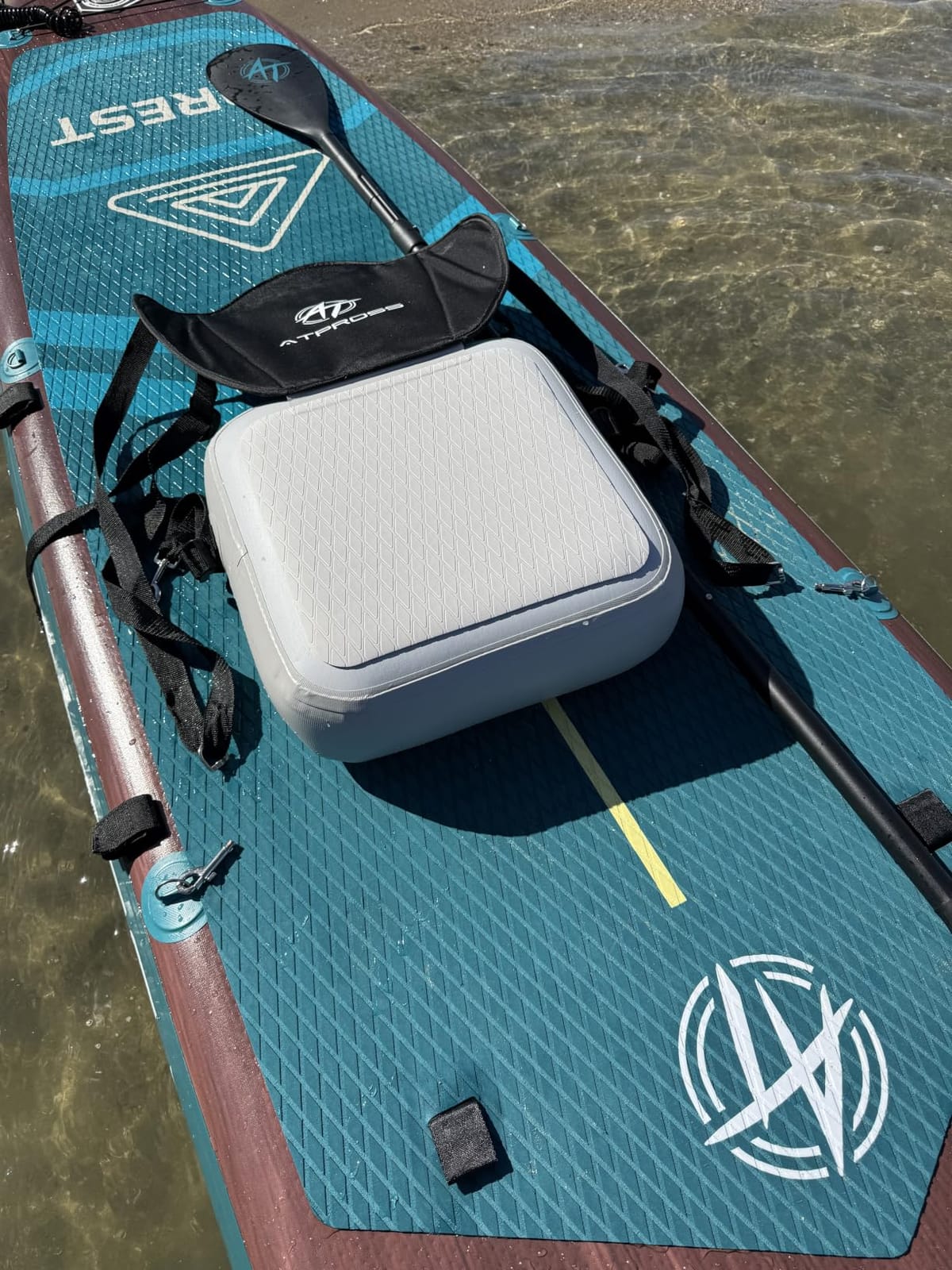
Construction is sound on paper: double-layer PVC with a reinforced sidewall, which is the part that hits rocks, and three large plus two small maneuvering fins so you can trim the board for shallows.
That is the strength. The weakness is the review record. At 4.3 stars this is the lowest average in the group, and 8 percent of buyers gave one star, the highest share of any board here. There is also no stated spare parts availability.
What the rating spread is telling you
With only 127 reviews, the pattern is not necessarily a design problem. Newer listings accumulate their first returns within a few months, so an elevated one- and two-star share usually reflects early quality variance rather than a fundamentally flawed board.
It does mean you are buying with less information than the rest of this list. If you are comfortable with that, the 36 inch platform and included seat are genuinely useful. If you prefer evidence, pick a board with thousands of reviews and the same capacity rating.
Confirm what is actually in the box
The included-components field on this listing names only the paddleboard. The feature list describes five fins, a footrest, a dual-function paddle, a dry bag and a leash, but the specification field does not confirm them.
Check with the seller before you order, because a paddle and a pump are not optional on a river. A 600D Oxford backpack is also lighter-duty than the 1680D bags on the Skatinger and CETANA, which matters if the board lives in your car rather than on your back.
10. Aqua Plus 10 ft 6 in Inflatable SUP: Best for Small Cars and Short Carries
Aqua Plus 6inches Thick Inflatable SUP for All Skill Levels Stand Up Paddle Board,Paddle,Pump,ISUP Travel Backpack, Leash,Shoulder Strap,Youth,Adult Inflatable Paddle Board
10 ft 6 in x 33 in x 6 in
330 lb capacity
20 lb
1 ft by 37 in packed
Pros
- Deflates to a 1 ft diameter roll that fits small cars
- Owner reports of use stretching across six summers
- Reinforced-rail drop-stitch feels close to a hard board
- 11 stainless D-rings plus front deck bungees
- Adjustable aluminium paddle and dual-action pump included
Cons
- Fin is very hard to remove without a tool
- Hand pump is difficult above 12 psi and its gauge reads low
- One owner was spun by current and the fin struck a rock
With over 8000 reviews, this is the second most-proven board in the roundup, and the feedback stretches further back than any other. One owner reports using it monthly for six summers and still finding it in pristine condition, which is the durability evidence most buyers are really looking for.
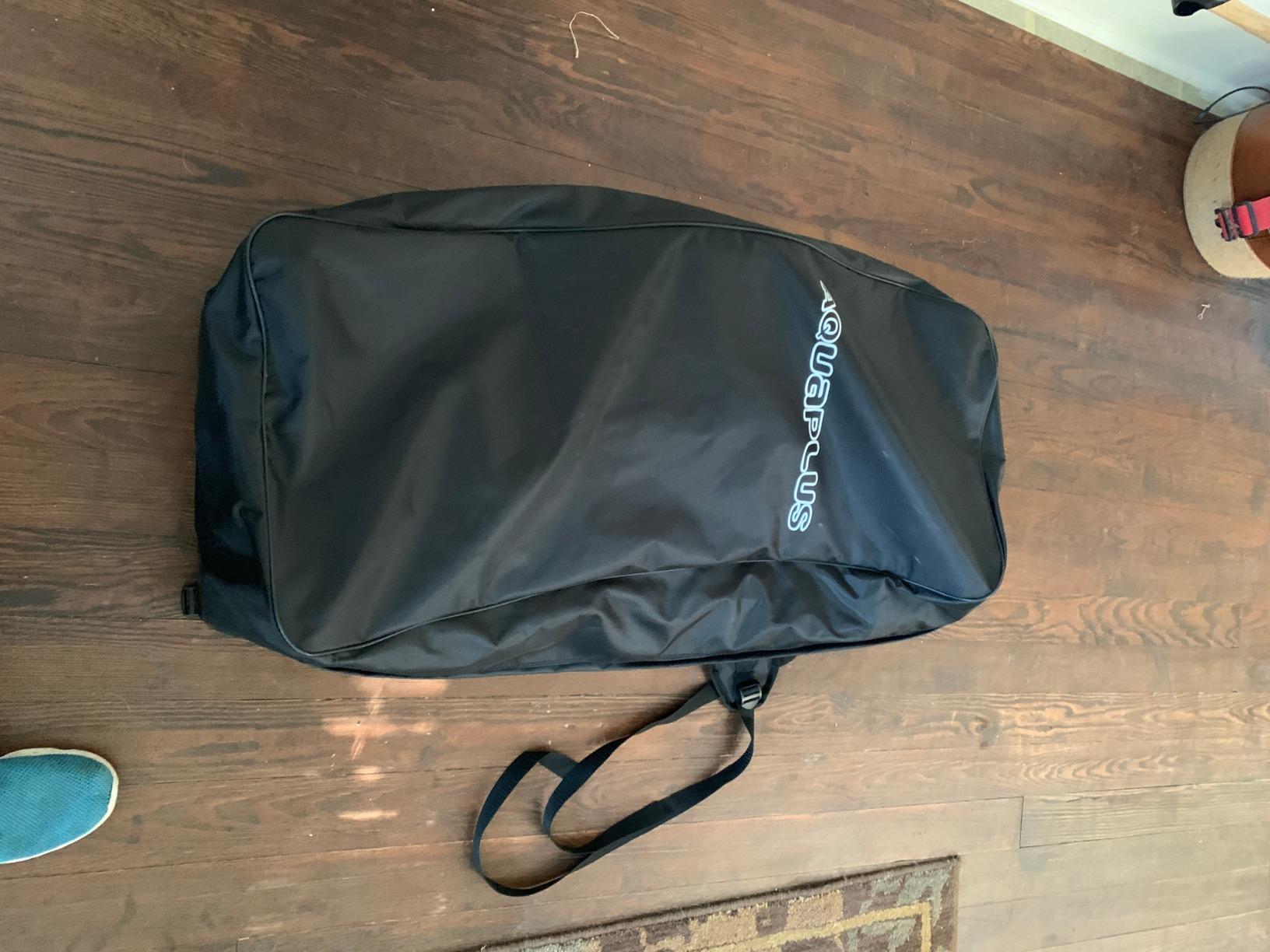
The packed size is the reason it earns a place on a river list. It deflates to a roll one foot in diameter and 37 inches long, so it fits in a small car, and the listed weight of 20 lb is manageable for a solo carry from a roadside put-in.
Construction is the best-specified in the group: military-grade ultralight PVC drop-stitch with reinforced rails, a 5mm diamond-groove traction pad that wears slowly, and 11 stainless steel D-rings with front bungees. Owners describe it as feeling close to a hard board once fully inflated.
It is also the only board here with a documented river failure, and it is worth reading. One owner reports the current spun the board and the fin struck a rock in rapids. Another relies on the removable fin for river travel and finds it easy. Both are using the same board on very different water.
The 330 lb rating is the real limit
This is the second-lowest capacity in the group after the Roc, and the listings describe a 313 to 330 lb range depending on the model. If you are a heavier paddler, or you plan to carry a second person or a large dog, this board is not the right tool and you should move up the list.
Seam longevity is the other factor. Owners report the deck pad and seams can begin separating after eight to twelve months of heavy use, and river work multiplies the flexing and temperature cycling that causes it. Inspect the rails and seams after every rocky day.
Why it is still worth considering
The combination of a small packed size, a long service record and a reinforced-rail build is rare. If your board has to fit in a compact car, live in a locker, or be carried a short distance from a roadside put-in, that convenience is worth more than the extra stability of a 12 foot platform.
Fit an electric pump before the first trip. The included hand pump is genuinely difficult above 12 psi and its gauge reads low, so owners routinely under-inflate and then wonder why the board feels soft. That one upgrade fixes the most common complaint on this board.
River Difficulty Classes Explained
River class is the single most useful number you can attach to a board, because it tells you what the water is doing rather than what the board is shaped like. The International Scale for River Difficulty runs from flat water to impassable, and every board above has been tagged against it.
- Class I: easy. Flat water with small ripples and obvious current. Any stable all-around inflatable in this roundup is fine here, and this is the class where a conventional ankle leash becomes a problem rather than a help.
- Class II: novice. Straightforward rapids with waves, riffles and small obstructions that do not require moving around. Wide boards with removable fins handle this comfortably, provided the bottom is not shallow and rocky.
- Class III: intermediate. Falls with turbulence, waves and obstacles that require deliberate route-finding. None of the boards in this roundup belongs here. You need heavy nose rocker, retractable or short flexible fins, and skills you build on kayaking, not on a stand-up board.
- Class IV: advanced. Powerful, technical whitewater with substantial hazards including strainers and unavoidable obstacles. Specialist equipment and trained paddling only.
- Class V: expert. Large technical rapids with extreme difficulty. Not a stand-up paddle boarding environment under any circumstances.
- Class VI: extreme. The limit of paddling, used mainly for describing unrunnable water and permanent hazards. No board applies.
For context on what sits above this list, community consensus in the whitewater forums, as summarized by the reviewers at paddleroundthepier.com, ranks Hala, Badfish and Hydrus as the three dedicated whitewater brands, and consistently rates retractable fin systems as the most valued feature among experienced paddlers. That is the tier of gear you are buying into if you eventually move above Class II.
River SUP Safety: Leashes, PFDs and Helmets
The leash rule deserves repeating because it is the highest-stakes fact in this article. A conventional SUP ankle leash is designed for flat water, where it keeps a drifting board within reach. On a river it inverts: the board goes downstream, the leash goes taut, and your ankle is the anchor holding you into the rock or the strainer it is pinned against.
Two options are acceptable. The first is a quick-release waist leash, which you can release with one hand if the board catches. The second is no leash at all, which is what many experienced river paddlers choose, accepting that you may lose the board and swimming after it. What is not acceptable is a standard ankle leash.
Every board in this roundup ships with an ankle leash in the box. That is a packing oversight rather than a recommendation, and it is the first thing to change before you get on the water. Also carry a PFD you have actually inflated and tested, and add a proper whitewater helmet from Class II upward. A bicycle helmet is better than nothing and worse than a river helmet.
Paddle with a partner. Every deal-breaker list from the river communities we reviewed converges on the same point, and the reasoning is simple: if you go swimming in current, somebody needs to be on the bank who can see you and reach you.
How to Choose an Inflatable Paddle Board for Rivers
Rocker decides whether the board rides over waves or into them
Rocker is the upward curve of a board from nose to tail, and it is the most important shape variable on moving water. A flat board pushes water out of the way and tracks beautifully on a lake, but on a river it drives the nose into a wave train and stops dead. That failure mode has a name, pearling, and it is how beginners end up swimming.
Two forms matter. Continuous rocker curves the whole length of the board and rides over anything, at the cost of straight-line tracking on flat water. Kick rocker concentrates the curve in the nose and tail, so the middle stays flat and tracks while the ends lift clear. For Class I and easy Class II, a light kick rocker with a slightly lifted nose is enough. Above that, you need continuous rocker and a much shorter board.
Fin systems are where most river damage happens
The single most-cited complaint in every paddling community we reviewed is a snapped or bent fin after a rock strike. On a river bottom, a long rigid fin is a liability, so this is the second decision to get right after the leash.
- Retractable fin box. A spring-loaded fin that folds flat on impact and springs back. The best option for rocks, and the feature experienced river paddlers rate most highly.
- Short removable flex fin. A small fin that flexes and can be taken out entirely in seconds. The best compromise for this roundup, and the reason we rate boards with detachable fins higher.
- Fixed flexible fin. Permanently attached but flexible. Acceptable, and better than nothing.
- Fixed rigid fin. A hard fin that does not move. Avoid on anything with submerged rock, gravel bars or timber. Two of the large-fin boards in this roundup fall into this category on shallow water.
For a shallow, rocky river, run the smallest fin the board takes, or run it with a single center fin. If your board has a large 9 or 10 inch fin, get comfortable pulling it before you reach the water, not during.
Construction and seams decide how many seasons you get
Inflatables fail at the seams before they fail anywhere else, and river work accelerates the process because of abrasion against rock and timber plus repeated flexing and temperature cycling. Glued seams are the weak point on budget boards; heat-welded seams and reinforced rails are the ones worth paying for.
Working pressure matters too. Most boards here sit between 15 and 20 psi, with one claiming 22 psi. Higher pressure means a firmer board under your feet, which is what you want in current, and an under-inflated board feels vague and slow to respond. Buy an electric pump and inflate to the rated figure rather than guessing.
Reinforced rails are the part that actually touches rock, so check them after every rocky session. Look for the flat rail band along the board edge, and inspect it for scuffing that goes through the outer layer.
Length and width: the sizing mistake almost everyone makes
Longer boards track straight and glide fast, and shorter boards turn easily. That is the whole trade-off, and on a river, how much of it you need depends on the water. Wide and slow water rewards length, because you spend your time holding a line. Narrow water with obstacles rewards a shorter board with more rocker, because you spend your time turning.
Width is the stability lever. Boards here run from 33 to 36 inches, and each inch matters more than most buyers expect. Wider is more stable standing up, which matters for beginners, heavier paddlers, anyone standing a fishing cast, and anyone with a dog on board. A wide board will not save you on Class III, but it will make everything below it calmer.
One mistake to avoid is buying a touring shape for whitewater reasons. An 11 to 12 foot touring board glides beautifully and turns like a bus. If your river has obstacles, you want under 11 feet unless the water is genuinely wide and flat.
Match the weight capacity to your actual body weight
Ratings in this roundup run from 330 lb to a listing-rated 661 lb. The number that matters is the paddler plus gear, so a 350 lb-rated board carrying a 180 lb paddler and a 40 lb day of gear is already at 63 percent of its rating, which is where boards start to feel soft and slow.
As a rule, aim to sit under 70 percent of the rated capacity for a solo paddler with normal gear. If you are over 200 lb, the wide boards in the upper half of this list are the correct place to shop, and the two 500 lb-rated models give you real headroom. If you plan to carry a passenger, a child or a large dog, treat that weight as part of your paddler weight.
Do not forget the paddle, the pump and the helmet
Most of these boards include a paddle, but the quality varies a great deal. Several ship with a short single-blade paddle that owners replace with a double-sided kayak paddle, which is a better fit for a river anyway because it works from a seated position too. Budget for a replacement if the one in the box feels marginal.
Then there is the electric pump, which almost every owner in this roundup ends up buying. Two boards include a hand pump that owners describe as exhausting above 10 to 12 psi, and one includes a pump whose gauge reads low, so you under-inflate without realising. An electric pump solves all of that in a couple of minutes.
Finally, add a quick-release waist leash, a PFD and a whitewater helmet to the shopping list before you buy the board rather than after. On a river those three items matter more than the difference between any two boards on this list.
Maintenance After a Rocky River Day
River use is harder on an inflatable than lake use, so a ten-minute routine after every trip is worth it. None of the three competing roundups we studied covers this, and it is the difference between a board that lasts five seasons and one that does not.
- Deflate the board fully at the bank rather than carrying it home inflated, so air pressure and heat do not work at the seams.
- Run your hands along every seam and look for a lifting edge, a bubble or a whitening of the PVC fabric. A hairline split starts small.
- Check the rails for cuts or deep scuffing, since the rail is the part that hits rock.
- Inspect the fins and the fin box for cracks, and check that no fin is bent from a strike.
- Dry the board in shade away from direct sun, and leave the bag unzipped so trapped moisture cannot sit against the PVC.
- Store it rolled rather than folded, loosely, in a bag out of a hot car.
- Carry a proper adhesive patch kit, because the repair kit included with several boards in this roundup contains unglued vinyl patches only.
A useful habit is a monthly pressure check with a gauge. Boards lose a little air through the valve over time, and a board that has dropped two PSI feels noticeably softer underfoot before you notice it visually.
Frequently Asked Questions
Can you do a river float on a paddle board?
Yes, and on a flat or slow-moving Class I river you do not need a specialist board. Any stable all-around inflatable will do. You need a purpose-built river board once the water is fast enough to hold you off line, or shallow and rocky enough that a fixed fin will find a rock. Never wear a standard ankle leash on moving water, and wear a PFD every time.
Do I need a special paddle board for rivers?
Only above Class I. On calm, slow-moving water a wide all-around board works fine, and most general inflatables are marketed for lake and river use. A specialist river board becomes necessary on Class II riffles with shallow rocky bottoms, on multi-day trips where tracking and cargo capacity matter, and above Class II where rocker and fin protection stop being optional.
Should I wear a leash on a river paddle board?
Not a standard ankle leash. If the board wraps around a rock or strainer, a fixed ankle leash holds you downstream and can keep you underwater. Use a quick-release waist leash that you can release with one hand, or paddle with no leash at all. Every board in our roundup ships with an ankle leash in the box, so remove or replace it before your first launch.
What class of river can I paddle board on?
Class I and easy Class II are within reach of a wide all-around inflatable with removable fins. Class II is the practical ceiling for anything in this roundup, and only on open reaches without shallow rock. Class III and above needs a purpose-built whitewater board with heavy rocker and retractable fins, plus skills built in another discipline. Every board here is tagged with its own ceiling in the reviews above.
Are inflatable paddle boards good for whitewater?
The inflatable format handles impact well, and experienced paddlers report that a flexing air deck can feel solid over a rock strike. What determines river capability is not inflation but design: nose rocker so the board rides over wave trains instead of pearling, and retractable or short flexible fins that survive contact with the bottom. A cheap inflatable with a fixed 9 inch fin is not a whitewater board.
What size paddle board do I need for rivers?
For Class I and easy Class II, 10 ft 6 in to 11 ft 6 in with 33 to 35 inches of width is the useful range. Length gives you tracking on a moving river, and width gives you stability standing up. Above Class I, go shorter for maneuverability. Go wider if you are a heavier paddler, carrying a passenger or dog, or standing fishing casts, since every inch of width adds primary stability.
What fin size should I use on a shallow rocky river?
Use the smallest fin the board accepts, or run a single center fin, and be ready to remove it entirely. Large 9 and 10 inch fins track beautifully on deep open water and are a liability on gravel bars, submerged timber and shallow rock, which is the most commonly reported damage on rivers. Carrying a wrench or a small tool matters, since several boards in our roundup have fin clips that are hard to release by hand.
Is it safe to paddle board on a river alone?
No. Every deal-breaker list in the river paddling communities we reviewed ends with the same point: never paddle moving water solo. If you go swimming in current, someone needs to be on the bank who can see you and reach you. Add a helmet for Class II and above, a PFD every time, and scout any rapids from the shore before you commit to a line.
Choosing the Best Inflatable Paddle Board for Your River in 2026
For most people reading this, the Roc 10 ft 6 in is the right answer. It has the deepest owner history in the roundup, a forgiving 33 inch platform, a 350 lb rating and a kit that leaves nothing to buy. If you are a heavier paddler or want more width and cargo capacity, step up to the Skatinger. If you are fishing, the NACATIN’s rod holder and 36 inch tail platform are purpose-built for the job.
The rule that outranks all of it: match the board to the water, not the marketing. Every board here is rated for Class I and gentle Class II, none of them is a whitewater board, and the gear that keeps you safe costs less than any of them. Replace the ankle leash, wear a PFD, add a helmet from Class II upward, and never paddle moving water alone.